Salad Spinner
ProductOverview
A salad spinner is a kitchen appliance that removes water from lettuce and other vegetables using centrifugal force. The user loads wet salad into a Spinning Basket Assembly, closes the Lid Assembly, and pumps a Drive Mechanism Assembly handle, spinning the basket at high speed. Water is flung outward through the Basket Bowl perforations and collects in the Outer Bowl Assembly, which can be drained via the Drain Spout.
The design is ingenious in its simplicity: a gear reduction system converts the hand pump motion into 800–1500 rpm rotation, fast enough to generate 50–100 G of centrifugal acceleration. For a 100 g bunch of lettuce, this translates to 5–10 kg of outward force, which flings water droplets off the leaves in seconds.
The spinner is standard equipment in restaurant kitchens and home kitchens where fresh salads are frequently prepared. It is faster and more effective than patting leaves dry with paper towels, and it aerates the greens, making them stay crisp longer.
How it works
The Drive Mechanism Assembly is the heart of the device. A Pull Cord is attached to a Gear Set, typically a pair of nylon or plastic gears (one small, one large) in a 3:1 or 4:1 reduction ratio. When you pull the cord, the small gear rotates the large gear, which is keyed to the Drum Axle (the central shaft that spins the basket).
The gear ratio means one full pull of the Pull Cord rotates the Spinning Basket Assembly several times. Pulling the cord repeatedly at a steady pace (about 1 pull per second) achieves 800+ rpm, which is sufficient to fling water off.
The Spindle Bearing is a ball bearing or plastic bushing that allows the Drum Axle to spin freely with minimal friction. A poorly designed bearing causes drag, requiring more effort to reach high speed.
The Spinning Basket Assembly is a plastic cylinder with hundreds of small (2–3 mm diameter) perforations drilled or molded into the walls and bottom. As the basket spins, water droplets follow a circular path outward (by inertia) and exit through the perforations. The Basket Handle allows you to lift the basket and remove the dried salad.
Water collects in the Outer Bowl Assembly, the larger container that surrounds the basket. The Drain Spout is a pouring lip or small spout at the base or side of the bowl; after spinning, you can pour the collected water down the sink.
The Brake Button Assembly is a lever on the outside of the salad-spinner-case that, when pressed, engages a Brake Pad against the spinning Drum Axle. This creates friction and stops the basket quickly. Without a brake, the basket would spin for 10–20 seconds after you stop pulling the cord, which is awkward.
The Lid Assembly is a transparent or opaque plastic disc that fits onto the Outer Bowl Assembly. It serves two purposes: it contains splashing water during spinning, and it keeps dust and contaminants off the salad.
Water removal efficiency
The centrifugal acceleration scales with rotational speed: at 800 rpm, the acceleration is roughly 70 G at a 6-inch radius. This is fast enough to remove ~80% of water in 30 seconds. At 1500 rpm, ~95% of water is removed in 10–15 seconds.
A second spin removes additional water; professional kitchens often spin twice. The first spin removes bulk water; the second removes the film of water clinging to the leaves.
The size of the perforations matters: holes that are too large allow lettuce pieces to fall through; holes that are too small clog with vegetable debris and reduce drainage. Standard sizing is 2–3 mm, which balances drainage and leaf retention.
Gear wear and maintenance
The Gear Set is usually nylon-on-nylon or plastic-on-plastic. Nylon gears are self-lubricating and relatively quiet but wear slowly over years of use. After 5+ years of daily use, the gear teeth flatten slightly, reducing the mechanical advantage and requiring more force to spin.
The Spindle Bearing can wear, causing the basket to wobble or stick. If the bearing is a ball bearing, it can be replaced; if it's a molded plastic bushing, the entire salad-spinner-case may need replacement.
The Pull Cord can fray or snap if pulled too aggressively. A replacement cord is inexpensive and can be threaded through the salad-spinner-case-window and re-tied to the Gear Set.
The Brake Pad wears smooth over time and loses friction. Once worn, the brake becomes ineffective and the basket spins for a long time after each use. Replacement pads are available but require partial disassembly.
The Basket Bowl perforations can become clogged with vegetable residue (spinach particles, herb fragments). A quick rinse under running water usually clears them, but over time, mineral deposits from hard water can partially block holes. Soaking in vinegar can dissolve these deposits.
Design variations
Budget spinners use a simple belt-drive or friction-wheel mechanism instead of gears, which is quieter but less efficient. Pulley-based designs require more effort to achieve the same speed.
Some premium spinners have a brake mechanism that automatically engages after you release the pull cord, stopping the basket within 5 seconds. This is convenient but adds cost and complexity.
Designs vary in whether the pull cord is internal (you pull from inside the salad-spinner-case) or external (the cord hangs out). External cords are easier to use but look less clean.
The Lid Assembly can be removable (easier to clean) or hinged (stays attached). Removable lids are prone to getting lost; hinged lids are convenient but may crack at the hinge.
Salad Spinner parts and their functions
6 top-level parts · 23 parts in total · full bill of materials below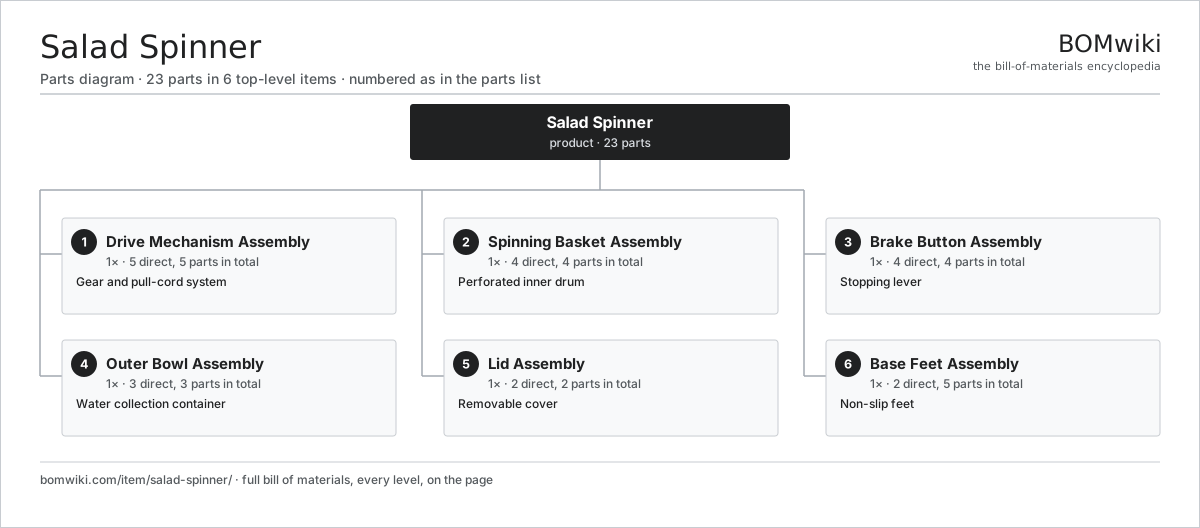
| # | Part | Qty | What it does |
|---|---|---|---|
| 1 | Drive Mechanism Assembly 5 parts | 1× | Gear and pull-cord system |
| 2 | Spinning Basket Assembly 4 parts | 1× | Perforated inner drum |
| 3 | Brake Button Assembly 4 parts | 1× | Stopping lever |
| 4 | Outer Bowl Assembly 3 parts | 1× | Water collection container |
| 5 | Lid Assembly 2 parts | 1× | Removable cover |
| 6 | Base Feet Assembly 2 parts | 1× | Non-slip feet |
3D model
No 3D model yet. Have a CAD file of this? Add a 3D model. STL renders right on this page; STEP, FreeCAD, and OpenSCAD sources are welcome too (openly licensed, like all 3D models on BOMwiki).
Build & assembly graph
expand / collapse · shared sub-assemblies converge · links to related products · est. labourTap an assembly to expand/collapse · tap a part to open it · use “Open page” for any node · drag to pan, scroll to zoom.
Bill of materials for Salad Spinner
6 top-level lines · 26 rows shown · 23 parts total · indented to 3 levels| # | Item / sub-assembly | Part no. | Qty/assy | Ext. qty | Parts | Type |
|---|---|---|---|---|---|---|
| 1 | Drive Mechanism Assembly 5 parts | salad-spinner-drive-mechanism | 1× | 1 | 5 | assembly |
| 1.1 | Gear Set | salad-spinner-gear-set | 1× | 1 | · | part |
| 1.2 | Pull Cord | salad-spinner-pull-cord | 1× | 1 | · | part |
| 1.3 | Drum Axle | salad-spinner-drum-axle | 1× | 1 | · | part |
| 1.4 | Gear Housing | salad-spinner-gear-housing | 1× | 1 | · | part |
| 1.5 | Spindle Bearing | salad-spinner-spindle-bearing | 1× | 1 | · | part |
| 2 | Spinning Basket Assembly 4 parts | salad-spinner-spinning-basket | 1× | 1 | 4 | assembly |
| 2.1 | Basket Bowl | salad-spinner-basket-bowl | 1× | 1 | · | part |
| 2.2 | Basket Bottom | salad-spinner-basket-bottom | 1× | 1 | · | part |
| 2.3 | Basket Handle | salad-spinner-basket-handle | 1× | 1 | · | part |
| 2.4 | Basket Rim | salad-spinner-basket-rim | 1× | 1 | · | part |
| 3 | Brake Button Assembly 4 parts | salad-spinner-brake-button | 1× | 1 | 4 | assembly |
| 3.1 | Brake Lever | salad-spinner-brake-lever | 1× | 1 | · | part |
| 3.2 | Brake Pad | salad-spinner-brake-pad | 1× | 1 | · | part |
| 3.3 | Brake Spring | salad-spinner-brake-spring | 1× | 1 | · | part |
| 3.4 | Brake Cam | salad-spinner-brake-cam | 1× | 1 | · | part |
| 4 | Outer Bowl Assembly 3 parts | salad-spinner-outer-bowl | 1× | 1 | 3 | assembly |
| 4.1 | Bowl Body | salad-spinner-bowl-body | 1× | 1 | · | part |
| 4.2 | Drain Spout | salad-spinner-bowl-drain-spout | 1× | 1 | · | part |
| 4.3 | Measurement Marks | salad-spinner-bowl-measurement-marks | 1× | 1 | · | part |
| 5 | Lid Assembly 2 parts | salad-spinner-lid | 1× | 1 | 2 | assembly |
| 5.1 | Lid Plate | salad-spinner-lid-plate | 1× | 1 | · | part |
| 5.2 | Lid Handle | salad-spinner-lid-handle | 1× | 1 | · | part |
| 6 | Base Feet Assembly 2 parts | salad-spinner-base-feet | 1× | 1 | 5 | assembly |
| 6.1 | Rubber Foot | salad-spinner-foot-rubber | 4× | 4 | · | part |
| 6.2 | Foot Adhesive | salad-spinner-foot-adhesive | 1× | 1 | · | part |
Something wrong in this list? Report a problem with this BOM.
Sourcing: possible vendors
Browse the supplier directory → Prices, MOQ, and lead times are algorithmic estimates, not quotes, and not claims about these companies. Company mappings are curated by keyword; est. price band $20–$600. How estimates work| Vendor | HQ | Specialty | MOQ | Lead time |
|---|---|---|---|---|
|
🇦🇺Breville
breville.com ↗
|
Sydney, AU | Kitchen appliances | 2,000 units | 6–10 wks |
| groupeseb.com ↗ | Écully, FR | Cookware & small appliances | 2,000 units | 6–10 wks |
| hamiltonbeach.com ↗ | Glen Allen, US | Small appliances | 2,000 units | 6–10 wks |
| panasonic.com ↗ | Osaka, JP | Electronics & appliances | 2,000 units | 6–10 wks |
|
🇨🇳Midea
midea.com ↗
|
Foshan, CN | Home appliances | 2,000 units | 6–10 wks |
994-word article