Sample Return Capsule
ProductOverview
A sample return capsule is a specialized reentry vehicle engineered to protect precious samples, lunar regolith, Martian soil, comet material, or atmospheric aerosols, during the violent transition from space to Earth's surface. The fundamental challenge is extreme: incoming velocity of 11 km/s or higher must be dissipated through both aerodynamic drag and thermal ablation while maintaining internal temperatures below 100 °C and structural loads below yield stress.
The capsule design combines two independent safety systems. The ablative heat shield consumes itself, vaporizing Cork-phenolic ablator at roughly 3 mm/second under peak heating, to carry away kinetic and thermal energy. Beneath it, the sample container itself is independently rated for external pressure, impact, and thermal stress, so that even catastrophic heat-shield failure leaves the samples sealed.
The parachute system takes over once the velocity drops below Mach 2, where aerodynamic forces become gentler. A small drogue parachute stabilizes the descent and manages transonic buffeting; a larger main parachute then inflates to land the capsule at ~6 m/s. The recovery beacon activates on impact, broadcasting GPS coordinates and UHF telemetry so recovery teams can locate the capsule in remote terrain.
The flight computer monitors acceleration, temperature, pressure, and attitude throughout the entry sequence. It triggers drogue and main parachute deployment at pre-calculated altitudes and can command jettison of the heat shield if parachute deployment is delayed beyond safe parameters. The entire capsule is designed to be disposable, it flies once, returns once, and is then refurbished or discarded.
Thermal Protection System
The heat shield is a conical shell of fiberglass-reinforced phenolic composite with a 40 mm cork-phenolic ablative layer on the forward face. Cork phenolic is a centuries-old aerospace standard: it ablates predictably, generates minimal slag (loose vaporized debris), and maintains structural integrity until nearly consumed.
The ablation mechanism is simple: as the surface reaches ~600 °C, chemical bonds in the phenolic resin break, releasing volatile gases that carry away heat via mass blowing. The cork particulates, low conductivity, keep interior surfaces much cooler. A 40 mm thickness is empirically chosen for lunar return missions; deeper coatings would increase dry mass; shallower coatings risk burnthrough.
Behind the cork layer is an aluminized polyimide backface barrier that reflects internally radiated heat. Between the barrier and the capsule structure is a multi-layer insulation blanket, Mylar and Kapton foils interspaced with Dacron mesh, that adds another 30 dB of radiant isolation. The combined system holds the avionics compartment below 80 °C even when external stagnation temperature exceeds 3000 K.
Ablative performance is verified in ground tests using arc heaters and oxy-acetylene torches. Test samples are exposed to measured heat flux (typically 200–800 kW/m²) for 30–60 second bursts, and erosion depth is measured post-test. This data feeds trajectory reconstruction codes that predict whether a given heat shield will survive the actual reentry profile.
Sample Container Integrity
The sample container is the heart of the system. A seamless titanium sphere 150 mm in diameter and 10 mm wall thickness, sealed with a bolted closure and nitrile O-ring. The design is rated for:
- External pressure: 10 atm (capsule tumbles in aircraft cabin during descent; parachute containers operate at pressure altitude)
- Impact: 15 g peak deceleration (testing via drop towers and sled deceleration rigs)
- Temperature: -50 °C to +80 °C external (internal stays 0–40 °C under passive control)
- Humidity: Hermetic sealing maintains <5% relative humidity indefinitely
The sphere's geometry is critical: a sphere distributes impact loads evenly and minimizes local stress concentrations. The bolted closure (rather than welded) allows post-flight access without cutting, and the O-ring seal provides redundancy, even with one ring damaged, a backup O-ring prevents sample loss.
Inside the container are sample trays, aluminum holders fitted with Nomex foam pads. The pads deform plastically to absorb impact energy and keep sample specimens from rattling. A typical load is 5–7 kg of loose regolith, cores, or aerosol filters distributed among three to four trays.
Pressure and humidity sensors inside the container feed data back to the flight computer, which logs readings throughout the mission. Post-recovery, engineers confirm the internal environment remained stable, confirming no breach occurred.
Descent Sequence
At 120 km altitude and 11 km/s, the capsule enters the sensible atmosphere and begins heating. The entry interface defines the start of ablation: from this point until parachute deployment, the capsule is ballistic and uncontrolled, attitude is purely a function of blunt-body aerodynamics and center-of-gravity placement.
The flight computer runs a state machine:
- Entry phase (120–20 km): Monitor acceleration and thermal sensors; log data at 100 Hz.
- Drogue deploy (20 km, ~Mach 5): Fire the drogue mortar. A small pilot parachute inflates, stabilizing the capsule and reducing angular rates.
- Main deploy (4 km, ~Mach 1.5): Fire the main parachute mortar. The large disk-gap-band canopy inflates and quickly decelerates the capsule to ~6 m/s.
- Impact detection: Accelerometer threshold crossing signals landing. Relay activates to power the beacon and strobe light.
The drogue parachute is small (1.5 m) and deploys first to prevent the main chute from inflating while the capsule is still transonic and potentially tumbling. Once drogue stabilization is achieved, separation pyrotechs sever the drogue lines, and the main chute deploys seconds later.
The main parachute is a 12 m disk-gap-band design, a compromise between high-load-bearing and low-landing-impact. A 7 m chute would land harder; a 18 m chute would be too slow and drift dangerously far. Each of the 32 suspension lines is rated 150 kg, so the 35 kg capsule lands at a survivable deceleration on soil or shallow water.
Recovery and Post-Flight
At impact, the beacon transmits the capsule's GPS coordinates on 435 MHz UHF every 2 minutes. A 72-hour battery (two primary lithium cells) is sufficient for recovery teams to locate and retrieve the capsule in remote desert, forest, or ocean environments. A xenon strobe light flashing at 1 Hz is visible from 10 km away in daylight, speeding visual location.
Once recovered, the flight computer is downloaded to extract the complete thermal and acceleration history. Engineers reconstruct the entry profile from this data and compare against pre-flight predictions. If the match is good, confidence in the next mission's design is high. If discrepancies exist (e.g., higher-than-predicted deceleration), the cause is investigated and the design is refined.
The sample container is transported to a clean room or laboratory, where it is carefully opened and the sample trays are removed. Samples are inventoried, photographed, and distributed to researchers worldwide.
Design Margins and Reliability
Sample return missions are unrecoverable, if the capsule is lost, years of orbital operations and billions of dollars of mission value evaporate. Thus, the design includes substantial margins:
- Heat shield is sized for 110% of predicted peak heating.
- Parachute structural factors are 4× (ultimate load capacity is 4 times expected load).
- Sample container is tested to 2× external pressure and 2× impact g-load.
- Beacon has dual batteries with cross-wiring so one battery failure does not disable the system.
Redundancy is implemented where possible: two relay switches for parachute deploy, dual thermocouples on the heat shield face, and backup O-rings in the sample container seal.
Testing is extensive: full-scale capsule boilerplates undergo drop tests, thermal-vacuum baking, and thermal shock cycles (rapid heating and cooling to detect adhesive disbonds). Smaller components are individually tested to multiples of their expected operating limits.
Sample Return Capsule parts and their functions
7 top-level parts · 53 parts in total · full bill of materials below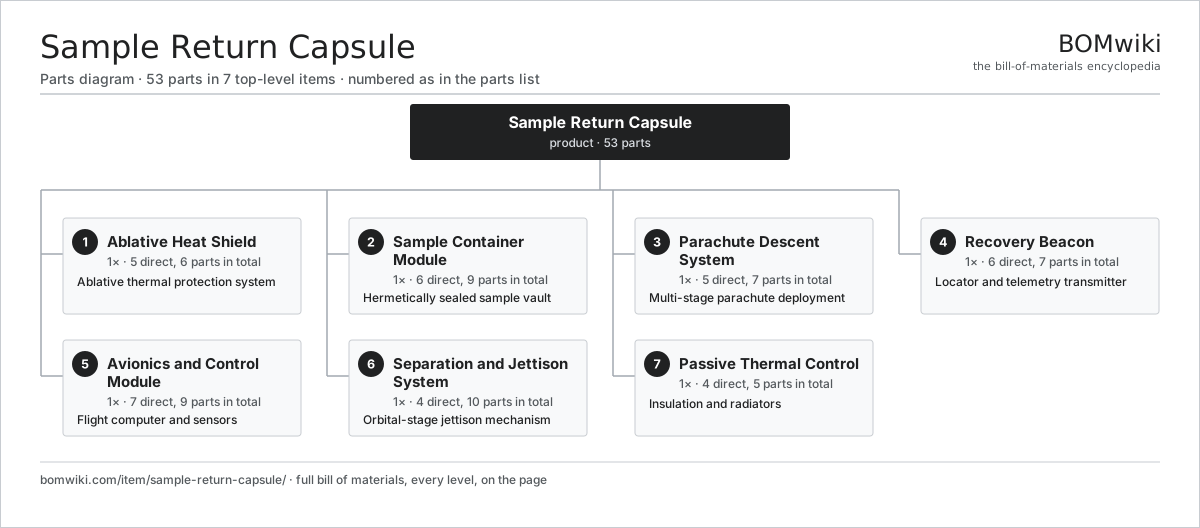
| # | Part | Qty | What it does |
|---|---|---|---|
| 1 | Ablative Heat Shield 5 parts | 1× | Ablative thermal protection system |
| 2 | Sample Container Module 6 parts | 1× | Hermetically sealed sample vault |
| 3 | Parachute Descent System 5 parts | 1× | Multi-stage parachute deployment |
| 4 | Recovery Beacon 6 parts | 1× | Locator and telemetry transmitter |
| 5 | Avionics and Control Module 7 parts | 1× | Flight computer and sensors |
| 6 | Separation and Jettison System 4 parts | 1× | Orbital-stage jettison mechanism |
| 7 | Passive Thermal Control 4 parts | 1× | Insulation and radiators |
3D model
No 3D model yet. Have a CAD file of this? Add a 3D model. STL renders right on this page; STEP, FreeCAD, and OpenSCAD sources are welcome too (openly licensed, like all 3D models on BOMwiki).
Build & assembly graph
expand / collapse · shared sub-assemblies converge · links to related products · est. labourTap an assembly to expand/collapse · tap a part to open it · use “Open page” for any node · drag to pan, scroll to zoom.
Bill of materials for Sample Return Capsule
7 top-level lines · 44 rows shown · 53 parts total · indented to 3 levels| # | Item / sub-assembly | Part no. | Qty/assy | Ext. qty | Parts | Type |
|---|---|---|---|---|---|---|
| 1 | Ablative Heat Shield 5 parts | src-heat-shield | 1× | 1 | 6 | assembly |
| 1.1 | Phenolic Composite Cone | src-phenolic-shell | 1× | 1 | · | part |
| 1.2 | Cork Phenolic Ablator | src-cork-ablator | 1× | 1 | · | part |
| 1.3 | Aluminized Kapton Barrier | src-backface-layer | 1× | 1 | · | part |
| 1.4 | Fastener Set | fastener-set | 2× | 2 | · | part |
| 1.5 | Structural Adhesive | adhesive-bond | 1× | 1 | · | part |
| 2 | Sample Container Module 6 parts | src-sample-container | 1× | 1 | 9 | assembly |
| 2.1 | Titanium Sample Vault | src-vault-shell | 1× | 1 | · | part |
| 2.2 | Vault Closure Plate | src-vault-lid | 1× | 1 | · | part |
| 2.3 | O-Ring Set | oring-set | 2× | 2 | · | part |
| 2.4 | Sample Collection Trays | src-sample-trays | 3× | 3 | · | part |
| 2.5 | Fastener Set | fastener-set | 1× | 1 | · | part |
| 2.6 | Cable Harness | cable-harness | 1× | 1 | · | part |
| 3 | Parachute Descent System 5 parts | src-parachute-system | 1× | 1 | 7 | assembly |
| 3.1 | Drogue Stabilization Parachute | src-drogue-chute | 1× | 1 | · | part |
| 3.2 | Main Landing Parachute | src-main-chute | 1× | 1 | · | part |
| 3.3 | Parachute Riser Bundles | src-riser-assembly | 2× | 2 | · | part |
| 3.4 | Deployment Pack | src-parachute-container | 1× | 1 | · | part |
| 3.5 | Pyrotechnic Separation Cutter | pyro-cutter | 2× | 2 | · | part |
| 4 | Recovery Beacon 6 parts | src-recovery-beacon | 1× | 1 | 7 | assembly |
| 4.1 | UHF Recovery Radio | src-beacon-radio | 1× | 1 | · | part |
| 4.2 | GPS Position Module | src-beacon-gps | 1× | 1 | · | part |
| 4.3 | Beacon UHF Antenna | src-beacon-antenna | 1× | 1 | · | part |
| 4.4 | Xenon Strobe Light | src-strobe-light | 1× | 1 | · | part |
| 4.5 | LiPo Cell | lipo-cell | 2× | 2 | · | part |
| 4.6 | Bare PCB | pcb-bare | 1× | 1 | · | part |
| 5 | Avionics and Control Module 7 parts | src-avionics-module | 1× | 1 | 9 | assembly |
| 5.1 | Flight Control Microcontroller | src-flight-computer | 1× | 1 | · | part |
| 5.2 | 9-DOF Inertial Measurement Unit | src-imu-sensor | 1× | 1 | · | part |
| 5.3 | Type K Thermocouple | src-temp-sensor | 2× | 2 | · | part |
| 5.4 | Barometric Altimeter | src-barometer | 1× | 1 | · | part |
| 5.5 | Relay | relay | 2× | 2 | · | part |
| 5.6 | Bare PCB | pcb-bare | 1× | 1 | · | part |
| 5.7 | Thermal Fuse | thermal-fuse | 1× | 1 | · | part |
| 6 | Separation and Jettison System 4 parts | src-separation-system | 1× | 1 | 10 | assembly |
| 6.1 | Linear Explosive Bolt | src-explosive-bolt | 4× | 4 | · | part |
| 6.2 | Coil Spring | coil-spring | 4× | 4 | · | part |
| 6.3 | Titanium Retaining Clamp | src-clamp-band | 1× | 1 | · | part |
| 6.4 | Fastener Set | fastener-set | 1× | 1 | · | part |
| 7 | Passive Thermal Control 4 parts | src-thermal-control | 1× | 1 | 5 | assembly |
| 7.1 | Multi-Layer Insulation Blanket | src-mlp-blanket | 1× | 1 | · | part |
| 7.2 | Thermal Control Paint | src-white-enamel | 1× | 1 | · | part |
| 7.3 | Radiative Louver Vanes | src-rad-louvers | 2× | 2 | · | part |
| 7.4 | Fastener Set | fastener-set | 1× | 1 | · | part |
Something wrong in this list? Report a problem with this BOM.
Related products
same domain, ranked by shared parts Space Station Treadmill
151 parts · shares 3 with this page
Solar Sail Spacecraft
170 parts · shares 3 with this page
Space Station Treadmill
151 parts · shares 3 with this page
Solar Sail Spacecraft
170 parts · shares 3 with this page
 Rocket Transporter-Erector
167 parts · shares 1 with this page
Rocket Transporter-Erector
167 parts · shares 1 with this page
 Crewed Space Capsule
7,222 parts · shares 3 with this page
Crewed Space Capsule
7,222 parts · shares 3 with this page
 Lunar Lander
1,803 parts · shares 3 with this page
Lunar Lander
1,803 parts · shares 3 with this page
 Space Plant Growth Chamber
82 parts · shares 2 with this page
Space Plant Growth Chamber
82 parts · shares 2 with this page
Sourcing: possible vendors
Browse the supplier directory → Prices, MOQ, and lead times are algorithmic estimates, not quotes, and not claims about these companies. Company mappings are curated by keyword; est. price band $50k–$500M. How estimates work| Vendor | HQ | Specialty | MOQ | Lead time |
|---|---|---|---|---|
|
🇺🇸SpaceX
spacex.com ↗
|
Hawthorne, US | Launch & spacecraft | made to order | 52–104 wks |
| northropgrumman.com ↗ | Falls Church, US | Space & defense | made to order | 52–104 wks |
|
🇫🇷Airbus
airbus.com ↗
|
Toulouse, FR | Aerospace OEM | made to order | 52–104 wks |
| rocketlabusa.com ↗ | Long Beach, US | Launch & spacecraft | made to order | 52–104 wks |
| thalesaleniaspace.com ↗ | Cannes, FR | Satellites | made to order | 52–104 wks |
1,330-word article