Coffee Sample Roaster
ProductOverview
A coffee sample roaster is a small-scale roasting machine used by importers, Q-graders, and roasteries to evaluate small lots of raw (green) coffee before committing to bulk purchases. Green coffee samples are typically 100–500 grams, representing a single farm lot or microlot. Roasting a sample allows a professional cupper to assess the coffee's flavor profile, detect defects, and determine if the lot is worth purchasing in 50–100 kg bags (or containers).
The machine is far simpler than commercial drum roasters. A Roasting Drum, 120–180 mm in diameter, tumbles beans inside an insulated Heating Chamber Assembly. A Heat Source and Burner Assembly (gas or electric) heats the chamber to 400–500 °F. A Air Supply and Control System blower supplies oxygen and carries away chaff and smoke. The Temperature Monitoring System thermocouple monitors bean temperature in real-time, displayed on the Control and Timing Module module's LCD screen. When the roast reaches the desired color (light, medium, or dark), an operator uses the Bean Sampling Trier to extract a sample, inspects it, and either continues roasting or removes the beans to the Cooling Tray Assembly.
The entire roast cycle takes 5–12 minutes, depending on desired roast level and bean density.
How it works
An operator weighs out 200–300 grams of green beans (a typical sample size) and pours them into the Roasting Drum. The drum opening is sealed.
The operator sets the target roast level on the Control and Timing Module microcontroller. Most machines have presets: Light (City), Medium (Full City), Dark (French). The operator presses start.
The Control and Timing Module microcontroller triggers:
- The Blower Motor begins spinning, creating airflow through the Air Inlet Duct.
- The Fuel Control Solenoid opens, energizing the Heat Source and Burner Assembly. If gas, an ignitor sparks; if electric, the heating element energizes.
- The Drum Drive Motor begins rotating the Roasting Drum at 50–100 RPM, tumbling beans.
Heat builds rapidly. The Temperature Monitoring System thermocouple inside the drum measures bean temperature rising: 150 °F, 250 °F, 300 °F. The Control and Timing Module display shows time elapsed and current temperature.
At ~350 °F bean temperature, the beans begin drying out. Moisture evaporates quickly; the beans crackle. This is the first crack, a series of popping sounds as pressure inside the bean releases. The microcontroller can optionally sound an alarm to alert the operator to first crack.
The operator hears the crack and may adjust the Airflow Damper airflow damper slightly to slow the roast if it's proceeding too fast, or leave it as-is to continue. Temperature climbs.
At 370–400 °F bean temperature (typically 8–10 minutes into the roast), the beans have developed into a medium brown. The operator uses the Bean Sampling Trier, a small handheld stainless steel scoop, to extract 5–10 beans from the drum through a sample port. They empty the beans onto the Color Reference Tile (a white ceramic tile) and compare the color to a reference chart: light roast (cinnamon color), medium roast (chestnut), dark roast (chocolate brown).
If the color is correct, the operator opens a discharge gate at the bottom of the drum. The hot beans fall into the Cooling Tray Assembly, a perforated mesh tray beneath the drum.
The Agitator Drive Motor immediately starts, rotating the Cooling Tray Rake rake, stirring the beans. Simultaneously, the Auxiliary Cooling Fan blower pushes cool ambient air upward through the perforated tray from below, rapidly cooling the beans from 400 °F to ambient (80 °F) in 30–60 seconds. As beans cool, their surface hardens, stopping the roasting process.
Once cool, the beans are ready for cupping (professional tasting) or grinding and brewing.
Key engineering features
Drum rotation consistency: The Drum Drive Motor runs at a fixed low RPM (50–100) to tumble beans without excessive turbulence. Uneven rotation creates hot spots and uneven roasting. The Drum Cylinder perforations allow hot air to penetrate the bean bed while drums rotate.
Temperature monitoring: The K-Type Thermocouple is the critical feedback sensor. Placing it inside the drum (not just the chamber air) means the reading reflects actual bean temperature, not chamber air temperature. Bean temperature lags chamber air by 20–50 °F, which matters for timing.
Airflow adjustment: The Airflow Damper lets operators slow or increase roast speed by controlling air velocity. Higher airflow accelerates the roast (faster temperature rise); lower airflow slows it. This is critical for achieving consistent roast levels across different bean densities (light-density high-altitude beans vs. dense sea-level beans).
Rapid cooling: The Cooling Tray Assembly with forced air cools beans in 30–60 seconds, critical because roasting continues for a few seconds even after leaving heat. A slow cool (passive cooling in air) results in over-roasted beans. Forced air stops the roast instantly.
Sample extraction capability: The Bean Sampling Trier handheld tool allows roast assessment without stopping the entire roast. Cupping professionals can taste-test the sample, adjust roast target if needed, and resume.
Roasting science
Coffee roasting is a complex chemical transformation. As beans heat, moisture evaporates (endothermic, cooling the bean). Then, sugars caramelize (exothermic, heating the bean). Chlorogenic acid breaks down into quinic acid (responsible for sourness if roasted light) or completely neutralizes if roasted dark. Proteins fragment into aromatic compounds.
Roast level is defined by the bean's color:
- Light roast (City): 400–410 °F bean temperature, cinnamon color, acidic fruity notes.
- Medium roast (Full City): 420–430 °F, chestnut color, balanced flavor.
- Dark roast (French): 440–450 °F, dark chocolate color, smoky bitter notes.
First crack occurs at ~350 °F; a second crack (quieter) occurs at ~435 °F. Cupping professionals often roast to first crack or just into second crack for optimal flavor development.
Variants
Drum vs. fluid bed: Some sample roasters use a fluid bed design (beans suspended in upward airflow) instead of a rotating drum. Fluid beds heat faster and more evenly but are harder to operate, beans can blow away if airflow is too high. Drum roasters are more forgiving and consistent.
Continuous vs. batch: All sample roasters are batch machines (one roast at a time). Continuous roasters feed green beans in one end and discharge roasted beans from the other; they're used only in high-volume production facilities.
Hybrid roaster: Some machines can roast 100 g samples or scale up to 1–2 kg batches, offering versatility for roasteries that develop new blends frequently.
Maintenance and care
The Drum Cylinder accumulates chaff and old bean residues over time. Weekly cleaning with a brush and compressed air keeps the drum free of debris. The Trier Scoop stainless steel should be cleaned after each use.
The K-Type Thermocouple probe is vulnerable to damage if struck by beans. Visual inspection before each roast confirms it's intact. Replacement is simple (unscrew terminal block, insert new probe).
The Heat Source and Burner Assembly (if gas) requires annual inspection by a gas technician to verify seal integrity and proper combustion. Electric elements are sealed and maintenance-free.
The Drum Bearing Block bearings should be lubricated annually (food-grade grease).
Market role
Sample roasters are essential for specialty coffee. A roastery might evaluate 10–20 new microlots per week, roasting 100–200 g samples of each to decide which 5–10 to purchase in bulk. The roasts also serve as references for production roasting, the roastmaster replicates the sample roast profile in the commercial roaster to achieve consistency.
Coffee Sample Roaster parts and their functions
8 top-level parts · 45 parts in total · full bill of materials below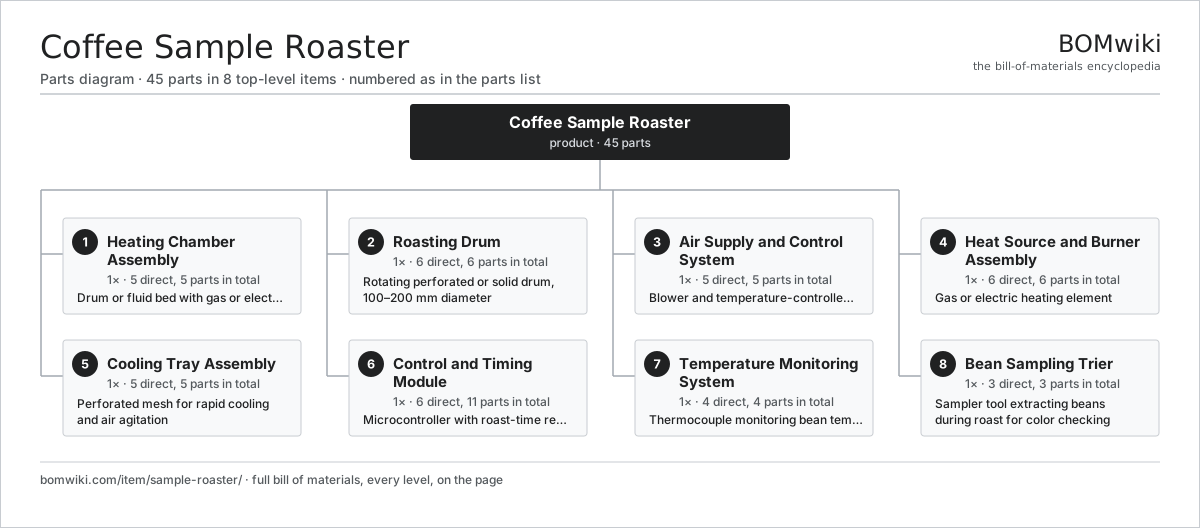
| # | Part | Qty | What it does |
|---|---|---|---|
| 1 | Heating Chamber Assembly 5 parts | 1× | Drum or fluid bed with gas or electric heat |
| 2 | Roasting Drum 6 parts | 1× | Rotating perforated or solid drum, 100–200 mm diameter |
| 3 | Air Supply and Control System 5 parts | 1× | Blower and temperature-controlled airflow |
| 4 | Heat Source and Burner Assembly 6 parts | 1× | Gas or electric heating element |
| 5 | Cooling Tray Assembly 5 parts | 1× | Perforated mesh for rapid cooling and air agitation |
| 6 | Control and Timing Module 6 parts | 1× | Microcontroller with roast-time recording and alarm |
| 7 | Temperature Monitoring System 4 parts | 1× | Thermocouple monitoring bean temperature in real time |
| 8 | Bean Sampling Trier 3 parts | 1× | Sampler tool extracting beans during roast for color checking |
3D model
No 3D model yet. Have a CAD file of this? Add a 3D model. STL renders right on this page; STEP, FreeCAD, and OpenSCAD sources are welcome too (openly licensed, like all 3D models on BOMwiki).
Build & assembly graph
expand / collapse · shared sub-assemblies converge · links to related products · est. labourTap an assembly to expand/collapse · tap a part to open it · use “Open page” for any node · drag to pan, scroll to zoom.
Bill of materials for Coffee Sample Roaster
8 top-level lines · 48 rows shown · 45 parts total · indented to 3 levels| # | Item / sub-assembly | Part no. | Qty/assy | Ext. qty | Parts | Type |
|---|---|---|---|---|---|---|
| 1 | Heating Chamber Assembly 5 parts | sample-roaster-heating-chamber | 1× | 1 | 5 | assembly |
| 1.1 | Chamber Body | sample-roaster-chamber-body | 1× | 1 | · | part |
| 1.2 | Drum Bearing Block | sample-roaster-drum-mounting | 1× | 1 | · | part |
| 1.3 | Air Inlet Duct | sample-roaster-air-inlet | 1× | 1 | · | part |
| 1.4 | Exhaust Port | sample-roaster-exhaust-port | 1× | 1 | · | part |
| 1.5 | Fastener Set | fastener-set | 1× | 1 | · | part |
| 2 | Roasting Drum 6 parts | sample-roaster-roasting-drum | 1× | 1 | 6 | assembly |
| 2.1 | Drum Cylinder | sample-roaster-drum-body | 1× | 1 | · | part |
| 2.2 | Perforation Pattern | sample-roaster-drum-holes | 1× | 1 | · | part |
| 2.3 | Drum Shaft | sample-roaster-drum-axle | 1× | 1 | · | part |
| 2.4 | Drum Drive Motor | sample-roaster-drum-motor | 1× | 1 | · | part |
| 2.5 | Motor Mount Bracket | sample-roaster-motor-mount | 1× | 1 | · | part |
| 2.6 | Fastener Set | fastener-set | 1× | 1 | · | part |
| 3 | Air Supply and Control System 5 parts | sample-roaster-air-system | 1× | 1 | 5 | assembly |
| 3.1 | Blower Motor | blower-motor | 1× | 1 | · | part |
| 3.2 | Blower Motor | sample-roaster-blower-motor-unit | 1× | 1 | · | part |
| 3.3 | Airflow Damper | sample-roaster-damper-valve | 1× | 1 | · | part |
| 3.4 | Air Supply Duct | sample-roaster-air-duct | 1× | 1 | · | part |
| 3.5 | Fastener Set | fastener-set | 1× | 1 | · | part |
| 4 | Heat Source and Burner Assembly 6 parts | sample-roaster-burner-unit | 1× | 1 | 6 | assembly |
| 4.1 | Heating Element or Gas Burner | sample-roaster-burner-element | 1× | 1 | · | part |
| 4.2 | Spark Ignitor | sample-roaster-ignitor | 1× | 1 | · | part |
| 4.3 | Fuel Control Solenoid | sample-roaster-fuel-solenoid | 1× | 1 | · | part |
| 4.4 | Temperature Control Thermostat | sample-roaster-thermostat | 1× | 1 | · | part |
| 4.5 | Heating Element | heating-element | 1× | 1 | · | part |
| 4.6 | Relay | relay | 1× | 1 | · | part |
| 5 | Cooling Tray Assembly 5 parts | sample-roaster-cooling-tray | 1× | 1 | 5 | assembly |
| 5.1 | Cooling Tray | sample-roaster-tray-body | 1× | 1 | · | part |
| 5.2 | Agitator Drive Motor | sample-roaster-agitator-motor | 1× | 1 | · | part |
| 5.3 | Cooling Tray Rake | sample-roaster-agitator-blade | 1× | 1 | · | part |
| 5.4 | Auxiliary Cooling Fan | sample-roaster-cooling-fan | 1× | 1 | · | part |
| 5.5 | Fastener Set | fastener-set | 1× | 1 | · | part |
| 6 | Control and Timing Module 6 parts | sample-roaster-timer-control | 1× | 1 | 11 | assembly |
| 6.1 | Microcontroller | mcu | 1× | 1 | · | part |
| 6.2 | Bare PCB | pcb-bare | 1× | 1 | · | part |
| 6.3 | Relay | relay | 2× | 2 | · | part |
| 6.4 | LCD Panel | lcd-panel | 1× | 1 | · | part |
| 6.5 | Connector | connector | 5× | 5 | · | part |
| 6.6 | Power Supply | power-supply | 1× | 1 | · | part |
| 7 | Temperature Monitoring System 4 parts | sample-roaster-temperature-sensor | 1× | 1 | 4 | assembly |
| 7.1 | K-Type Thermocouple | sample-roaster-thermocouple | 1× | 1 | · | part |
| 7.2 | Thermocouple Terminal Block | sample-roaster-terminal-block | 1× | 1 | · | part |
| 7.3 | Signal Conditioning Amplifier | sample-roaster-signal-amplifier | 1× | 1 | · | part |
| 7.4 | Connector | connector | 1× | 1 | · | part |
| 8 | Bean Sampling Trier 3 parts | sample-roaster-bean-trier | 1× | 1 | 3 | assembly |
| 8.1 | Trier Handle | sample-roaster-trier-handle | 1× | 1 | · | part |
| 8.2 | Trier Scoop | sample-roaster-trier-scoop | 1× | 1 | · | part |
| 8.3 | Color Reference Tile | sample-roaster-trier-cover-tray | 1× | 1 | · | part |
Something wrong in this list? Report a problem with this BOM.
Related products
same domain, ranked by shared parts Industrial Smokehouse
267 parts · shares 7 with this page
Industrial Smokehouse
267 parts · shares 7 with this page
 Chocolate Enrober
470 parts · shares 6 with this page
Chocolate Enrober
470 parts · shares 6 with this page
 Chocolate Tempering Machine
141 parts · shares 6 with this page
Industrial Juice Press
155 parts · shares 6 with this page
Industrial Tunnel Oven
147 parts · shares 6 with this page
Chocolate Tempering Machine
141 parts · shares 6 with this page
Industrial Juice Press
155 parts · shares 6 with this page
Industrial Tunnel Oven
147 parts · shares 6 with this page
Sourcing: possible vendors
Browse the supplier directory → Prices, MOQ, and lead times are algorithmic estimates, not quotes, and not claims about these companies. Company mappings are curated by keyword; est. price band $1k–$500k. How estimates work| Vendor | HQ | Specialty | MOQ | Lead time |
|---|---|---|---|---|
| gea.com ↗ | Düsseldorf, DE | Process technology | 20 units | 12–20 wks |
| buhlergroup.com ↗ | Uzwil, CH | Food & materials processing | 20 units | 12–20 wks |
| tetrapak.com ↗ | Pully, CH | Food packaging & processing | 20 units | 12–20 wks |
| jbtc.com ↗ | Chicago, US | Food processing equipment | 20 units | 12–20 wks |
| alfalaval.com ↗ | Lund, SE | Heat transfer & separation | 20 units | 12–20 wks |
1,277-word article