Sand Molding Machine
ProductOverview
The sand molding machine is the backbone of green-sand foundry production, automating the compaction of cohesive sand onto a pattern plate, then ejecting a finished mold into a pit conveyor. Modern versions integrate proportional hydraulics, electronic sequencing, and real-time density feedback to achieve uniform mold strength and dimensional repeatability, critical for casting porosity control and dimensional stability.
The machine operates in a strict sequence: pattern positioning and clamping, sand metering from the hopper, squeeze-head compression with controlled pressure ramps, jolt-table impact for sand settling, and final mold ejection via stripper plate and push-out cylinders. Each cycle must produce a mold with consistent green strength (typically 200–400 kPa) and minimal sand entrainment, directly affecting the quality of cast parts downstream.
How it works
The pattern plate, usually a two-part assembly called a "molding box," is secured onto the machine table by a pneumatic clamp. An operator or automated loader places the pattern against the fixed side (drag) of the machine, and hydraulic height-adjustment cylinders position the upper squeeze head at the correct distance above the pattern surface.
Sand feed begins when the PLC energizes the auger motor. The Metering Auger rotates at PLC-controlled speed via the VFD, advancing sand from the Sand Hopper into the squeeze chamber, a cavity defined by the pattern and the Squeeze Platen. A Sand Density Probe (capacitive sensor) monitors real-time sand fill level; once the chamber is full and sand density reaches a setpoint, the auger stops.
The squeeze phase begins: the Proportional Squeeze Valve receives a ramped analog signal from the PLC, gradually opening to admit hydraulic flow to both Squeeze Cylinders. Pressure builds linearly, compacting sand against the pattern. The Squeeze Yoke couples both cylinders mechanically, ensuring even pressure distribution across the platen. Peak squeeze pressure (typically 100–160 bar) is held for 2–4 seconds, then released, allowing internal friction and cohesion to bind the sand particles.
While squeeze pressure is still applied or immediately after, the Jolt Mechanism is triggered. The Jolt Impact Cylinder, precharged via the Jolt Accumulator, rapidly cycles at 3 Hz, creating sharp upward impacts to the pattern table. These impacts vibrate settled sand, fill voids, and promote mechanical compaction without adding more squeeze force. Jolt duration is typically 1–2 seconds, providing 3–6 impact cycles per mold.
After squeeze and jolt, the Stripper Plate (a sacrificial aluminum plate mounted above the pattern) is pushed downward by the machine frame, stripping any loose sand from the pattern overhangs. Simultaneously, the Ejection Ram extends, pushing the entire molded assembly up and out of the machine cavity. The finished mold (now inverted, with the pattern still embedded) is conveyed away on a pit table, and the pattern is extracted separately for the next cycle.
Real-world operation and tuning
Foundries configure squeeze pressure, squeeze hold time, jolt frequency, and auger speed individually for each sand composition and mold size. Silica sand (AFS 140–180) may require 120 bar squeeze pressure, while a zircon/olivine blend might demand 160 bar. The PLC stores recipes for each pattern; an operator selects a recipe via the HMI (human–machine interface), and the machine reproduces the sequence automatically.
The Control Hydraulics system manages not only squeeze and jolt but also maintains pilot pressure for the proportional spool valves. The Pressure Relief Valve is set 10 bar above working pressure to prevent damage to cylinders and hoses; the Relief and Reducing Manifold provides additional backup relief and pilot-pressure regulation.
Sand quality deteriorates over time due to mechanical abrasion, oxidation of clay binders, and moisture loss. Foundries typically replace 15–25 % of molded sand per cycle, feeding fresh sand into the hopper and allowing a Sand Reclamation System to recycle the elutriated sand by scrubbing, drying, and reclassifying it. This feedback loop, combined with real-time density sensing on the machine, maintains consistent green strength and dimensional repeatability, the key metric for casting defect prevention.
Material and design
The Main Column and structural components are ductile iron (EN-GJS-600) to withstand repeated impact and vibration without brittle fracture. The Linear Motion Rail system uses precision linear motion (THK SRVS or equivalent) to keep the squeeze platen perpendicular to the pattern, avoiding skew and uneven compaction. Hoses and fittings conform to EN 286 4SP standards for high-pressure reliability.
Electrical integration relies on a robust PLC with redundant input monitoring (pattern-clamp verify, pressure-gauge feedback, density-probe input). Modern machines also log mold density, squeeze pressure curves, and cycle times to a local database, enabling predictive maintenance alerts and foundry-wide production analytics.
Related systems
Upstream, a Sand Reclamation System prepares and regenerates sand from previous molding cycles. Downstream, the mold is transferred to a Cupola Furnace or Continuous Casting Machine for pouring, or to a Wheel Shot Blast Machine for cleaning after casting. For high-volume production of identical molds, some foundries pair a sand-molding machine with an automated pattern-loading carousel or gantry system to achieve fully lights-out operation.
Sand Molding Machine parts and their functions
8 top-level parts · 54 parts in total · full bill of materials below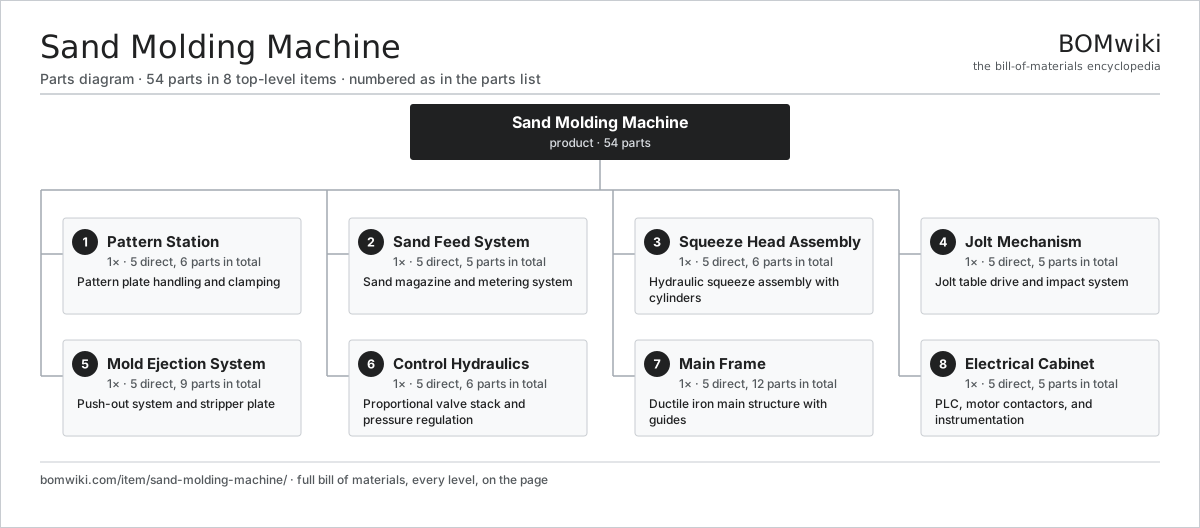
| # | Part | Qty | What it does |
|---|---|---|---|
| 1 | Pattern Station 5 parts | 1× | Pattern plate handling and clamping |
| 2 | Sand Feed System 5 parts | 1× | Sand magazine and metering system |
| 3 | Squeeze Head Assembly 5 parts | 1× | Hydraulic squeeze assembly with cylinders |
| 4 | Jolt Mechanism 5 parts | 1× | Jolt table drive and impact system |
| 5 | Mold Ejection System 5 parts | 1× | Push-out system and stripper plate |
| 6 | Control Hydraulics 5 parts | 1× | Proportional valve stack and pressure regulation |
| 7 | Main Frame 5 parts | 1× | Ductile iron main structure with guides |
| 8 | Electrical Cabinet 5 parts | 1× | PLC, motor contactors, and instrumentation |
3D model
No 3D model yet. Have a CAD file of this? Add a 3D model. STL renders right on this page; STEP, FreeCAD, and OpenSCAD sources are welcome too (openly licensed, like all 3D models on BOMwiki).
Build & assembly graph
expand / collapse · shared sub-assemblies converge · links to related products · est. labourTap an assembly to expand/collapse · tap a part to open it · use “Open page” for any node · drag to pan, scroll to zoom.
Bill of materials for Sand Molding Machine
8 top-level lines · 48 rows shown · 54 parts total · indented to 3 levels| # | Item / sub-assembly | Part no. | Qty/assy | Ext. qty | Parts | Type |
|---|---|---|---|---|---|---|
| 1 | Pattern Station 5 parts | sand-molding-machine-pattern-station | 1× | 1 | 6 | assembly |
| 1.1 | Pattern Plate Clamp Cylinder | sand-molding-machine-pattern-plate-clamp | 1× | 1 | · | part |
| 1.2 | Position Adjustment Cylinder | sand-molding-machine-position-cylinder | 1× | 1 | · | part |
| 1.3 | Clamp Force Distribution Bar | sand-molding-machine-clamp-linkage | 1× | 1 | · | part |
| 1.4 | Connector | connector | 2× | 2 | · | part |
| 1.5 | O-Ring Set | oring-set | 1× | 1 | · | part |
| 2 | Sand Feed System 5 parts | sand-molding-machine-sand-feed | 1× | 1 | 5 | assembly |
| 2.1 | Sand Hopper | sand-molding-machine-sand-hopper | 1× | 1 | · | part |
| 2.2 | Metering Auger | sand-molding-machine-metering-auger | 1× | 1 | · | part |
| 2.3 | Auger Drive Motor | sand-molding-machine-auger-motor | 1× | 1 | · | part |
| 2.4 | Sand Density Probe | sand-molding-machine-density-probe | 1× | 1 | · | part |
| 2.5 | Hopper Abrasion Liner | sand-molding-machine-hopper-liner | 1× | 1 | · | part |
| 3 | Squeeze Head Assembly 5 parts | sand-molding-machine-squeeze-head | 1× | 1 | 6 | assembly |
| 3.1 | Squeeze Cylinders | sand-molding-machine-squeeze-cylinders | 2× | 2 | · | part |
| 3.2 | Squeeze Yoke | sand-molding-machine-squeeze-yoke | 1× | 1 | · | part |
| 3.3 | Squeeze Platen | sand-molding-machine-squeeze-platen | 1× | 1 | · | part |
| 3.4 | Pressure Relief Valve | sand-molding-machine-pressure-relief-valve | 1× | 1 | · | part |
| 3.5 | Fastener Set | fastener-set | 1× | 1 | · | part |
| 4 | Jolt Mechanism 5 parts | sand-molding-machine-jolt-mechanism | 1× | 1 | 5 | assembly |
| 4.1 | Jolt Impact Cylinder | sand-molding-machine-jolt-cylinder | 1× | 1 | · | part |
| 4.2 | Jolt Accumulator | sand-molding-machine-jolt-accumulator | 1× | 1 | · | part |
| 4.3 | Jolt Directional Valve | sand-molding-machine-jolt-valve-block | 1× | 1 | · | part |
| 4.4 | Jolt Base Isolation Plate | sand-molding-machine-jolt-base-plate | 1× | 1 | · | part |
| 4.5 | Relay | relay | 1× | 1 | · | part |
| 5 | Mold Ejection System 5 parts | sand-molding-machine-mold-ejection | 1× | 1 | 9 | assembly |
| 5.1 | Ejection Ram | sand-molding-machine-ejection-ram | 1× | 1 | · | part |
| 5.2 | Stripper Plate | sand-molding-machine-stripper-plate | 1× | 1 | · | part |
| 5.3 | Stripper Spring Set | sand-molding-machine-stripper-spring-set | 3× | 3 | · | part |
| 5.4 | Guide Post | sand-molding-machine-guide-post | 2× | 2 | · | part |
| 5.5 | Oil Seal | oil-seal | 2× | 2 | · | part |
| 6 | Control Hydraulics 5 parts | sand-molding-machine-control-hydraulics | 1× | 1 | 6 | assembly |
| 6.1 | Proportional Squeeze Valve | sand-molding-machine-proportional-valve | 2× | 2 | · | part |
| 6.2 | Relief and Reducing Manifold | sand-molding-machine-relief-manifold | 1× | 1 | · | part |
| 6.3 | Accumulator Isolation Valve | sand-molding-machine-accumulator-isolation-valve | 1× | 1 | · | part |
| 6.4 | Hydraulic Pressure Filter | sand-molding-machine-pressure-filter | 1× | 1 | · | part |
| 6.5 | Hose and Fitting Bundle | sand-molding-machine-hose-bundle | 1× | 1 | · | part |
| 7 | Main Frame 5 parts | sand-molding-machine-frame | 1× | 1 | 12 | assembly |
| 7.1 | Main Column | sand-molding-machine-main-column | 2× | 2 | · | part |
| 7.2 | Side Enclosure Plates | sand-molding-machine-side-plates | 2× | 2 | · | part |
| 7.3 | Linear Motion Rail | sand-molding-machine-guide-rail | 2× | 2 | · | part |
| 7.4 | Rail Carriage Block | sand-molding-machine-bearing-block | 4× | 4 | · | part |
| 7.5 | Fastener Set | fastener-set | 2× | 2 | · | part |
| 8 | Electrical Cabinet 5 parts | sand-molding-machine-electrical-enclosure | 1× | 1 | 5 | assembly |
| 8.1 | Programmable Logic Controller | sand-molding-machine-plc | 1× | 1 | · | part |
| 8.2 | Variable Frequency Drive | sand-molding-machine-vfd | 1× | 1 | · | part |
| 8.3 | Solenoid Driver Module | sand-molding-machine-solenoid-driver-board | 1× | 1 | · | part |
| 8.4 | Pressure Gauge Panel | sand-molding-machine-pressure-gauge-block | 1× | 1 | · | part |
| 8.5 | Fastener Set | fastener-set | 1× | 1 | · | part |
Something wrong in this list? Report a problem with this BOM.
Related products
same domain, ranked by shared parts Decanter Centrifuge
172 parts · shares 3 with this page
Decanter Centrifuge
172 parts · shares 3 with this page
 Foundry Sand Mixer
93 parts · shares 3 with this page
Gravimetric Plastics Blender
139 parts · shares 3 with this page
Hammer Mill
790 parts · shares 3 with this page
High-Speed Disperser
28 parts · shares 3 with this page
Foundry Sand Mixer
93 parts · shares 3 with this page
Gravimetric Plastics Blender
139 parts · shares 3 with this page
Hammer Mill
790 parts · shares 3 with this page
High-Speed Disperser
28 parts · shares 3 with this page
Sourcing: possible vendors
Browse the supplier directory → Prices, MOQ, and lead times are algorithmic estimates, not quotes, and not claims about these companies. Company mappings are curated by keyword; est. price band $5k–$2M. How estimates work| Vendor | HQ | Specialty | MOQ | Lead time |
|---|---|---|---|---|
| atlascopco.com ↗ | Stockholm, SE | Compressors & industrial | 10 units | 12–20 wks |
|
🇦🇹Andritz
andritz.com ↗
|
Graz, AT | Process plants & machinery | 10 units | 12–20 wks |
| buhlergroup.com ↗ | Uzwil, CH | Food & materials processing | 10 units | 12–20 wks |
| gea.com ↗ | Düsseldorf, DE | Process technology | 10 units | 12–20 wks |
| mhi.com ↗ | Tokyo, JP | Heavy machinery | 10 units | 12–20 wks |
885-word article