Sandblasting Cabinet
ProductOverview
A sandblasting cabinet is a specialized enclosure designed for precision abrasive blasting of small to medium parts. Unlike outdoor abrasive blasting (which uses gravity-fed towers or wheel abrasors for large structural components), a sandblasting cabinet contains the process entirely, allowing fine control of abrasive type and particle size, dust collection, and recovery. The operator works through integral gloves, blasting parts against the Viewing Window until they reach the desired cleanliness and surface finish.
The process uses compressed air to accelerate fine abrasive particles (silica sand, aluminum oxide, or synthetic materials) at 80–150 m/s against the part surface. The Blast Gun System siphons sand from the Abrasive Hopper & Recovery and mixes it with air, firing it at the target. The Dust Extractor & Filter captures the exhaust, separates coarse particles for reuse, and filters fine dust. The Abrasive Hopper & Recovery recirculates the recovered sand.
How it works
The operator loads a part through the Access Door and closes it securely, ensuring the sandblasting-seal-collar on the gloves forms an airtight seal around the wrists. The gloves are positioned through the Glove Port Ring in the cabinet wall, allowing full manual control inside the chamber.
The main power switch activates the cabinet. Behind the scenes, the Extraction Fan starts, pulling air from the internal volume at 5–15 m³/min. This creates a slight negative pressure, keeping blast dust from leaking out.
The operator grips the Blast Gun System with both gloved hands. Squeezing the trigger opens the Trigger Valve, which simultaneously:
- Opens the Hopper Valve, allowing sand to flow into the gun's siphon
- Opens the Gun Solenoid Valve, supplying compressed air to the gun at 6–8 bar
The compressed air, drawn from the shop compressor through the Pressure Regulator and Moisture Separator, enters the gun body and creates a venturi effect. This low-pressure zone sucks sand up the Siphon Tube from the hopper. The sand is mixed with the air and accelerates through the Nozzle (typically 3–6 mm diameter) at 80–150 m/s.
The stream impacts the part, shattering and removing rust, scale, old paint, and other surface contaminants. The impact also creates a finely roughened surface texture, which improves paint adhesion and provides a mechanical key for coatings.
The Wear-Resistant Liner on the cabinet walls absorbs the impact energy and wear, protecting the structural shell. The sloped Bottom Floor directs spent sand and dust back toward a collection point. As the operator moves the gun and rotates the part (manually through the Glove Assembly), all surfaces are progressively cleaned.
After blasting, the spent sand, mixed with fine dust, is pulled by the extraction system toward the Cyclone Separator. The cyclone uses centrifugal force to separate coarse particles (sand) from fine particles (dust). The coarse material falls into the hopper below, and the Magnet Screen removes any ferrous contamination (iron filings or steel dust) that might have accumulated.
The recovered sand is returned to the Abrasive Hopper & Recovery via the Recovery Conveyor, either a pneumatic lift or mechanical screw. The Recycled Sand Gate controls the feed back into the supply hopper.
The fine dust continues upward into the Filter Bag, where it is trapped. The Filter Cage holds the bag open and rigid. Clean air exits and is exhausted to the atmosphere (or captured for further processing in a large facility). Over time, dust accumulates on the filter, increasing pressure drop. The Extraction Timer keeps the fan running for 30–60 seconds after blasting stops, allowing residual dust to settle. Periodically, the Dust Collection Hopper is opened and the collected dust is disposed of.
Abrasive consumption depends on the surface condition:
- Light cleaning (removing light rust or scale): 5–10 kg sand per hour
- Medium (heavier corrosion or paint removal): 20–40 kg/h
- Heavy (complete removal of thick coating): 50–100 kg/h
Sand is gradually worn down and fractured by repeated impacts, losing its sharp edges and cutting ability. The Magnet Screen removes some of the dulled material, but eventually (typically after 50–200 hours of blasting), the abrasive must be replaced.
Sandblasting cabinets are essential in precision manufacturing: aerospace companies use them to remove old coatings from engine parts, automotive suppliers clean forgings and castings before machining, and job shops prepare metal for finishing. The enclosed, recirculating design makes them cost-effective and environmentally responsible compared to open-air abrasive blasting.
Sandblasting Cabinet parts and their functions
8 top-level parts · 55 parts in total · full bill of materials below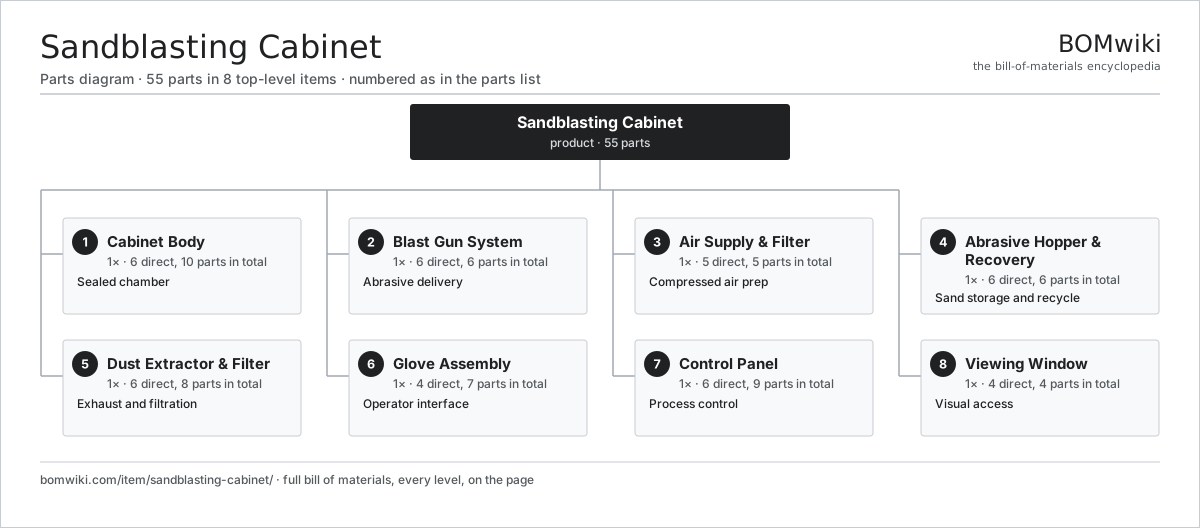
| # | Part | Qty | What it does |
|---|---|---|---|
| 1 | Cabinet Body 6 parts | 1× | Sealed chamber |
| 2 | Blast Gun System 6 parts | 1× | Abrasive delivery |
| 3 | Air Supply & Filter 5 parts | 1× | Compressed air prep |
| 4 | Abrasive Hopper & Recovery 6 parts | 1× | Sand storage and recycle |
| 5 | Dust Extractor & Filter 6 parts | 1× | Exhaust and filtration |
| 6 | Glove Assembly 4 parts | 1× | Operator interface |
| 7 | Control Panel 6 parts | 1× | Process control |
| 8 | Viewing Window 4 parts | 1× | Visual access |
3D model
No 3D model yet. Have a CAD file of this? Add a 3D model. STL renders right on this page; STEP, FreeCAD, and OpenSCAD sources are welcome too (openly licensed, like all 3D models on BOMwiki).
Build & assembly graph
expand / collapse · shared sub-assemblies converge · links to related products · est. labourTap an assembly to expand/collapse · tap a part to open it · use “Open page” for any node · drag to pan, scroll to zoom.
Bill of materials for Sandblasting Cabinet
8 top-level lines · 51 rows shown · 55 parts total · indented to 3 levels| # | Item / sub-assembly | Part no. | Qty/assy | Ext. qty | Parts | Type |
|---|---|---|---|---|---|---|
| 1 | Cabinet Body 6 parts | sandblasting-cabinet-body | 1× | 1 | 10 | assembly |
| 1.1 | Side Wall | sandblasting-side-wall | 2× | 2 | · | part |
| 1.2 | Top Panel | sandblasting-top-panel | 1× | 1 | · | part |
| 1.3 | Bottom Floor | sandblasting-bottom-floor | 1× | 1 | · | part |
| 1.4 | Wear-Resistant Liner | sandblasting-wear-liner | 2× | 2 | · | part |
| 1.5 | Access Door | sandblasting-access-door | 1× | 1 | · | part |
| 1.6 | Fastener Set | fastener-set | 3× | 3 | · | part |
| 2 | Blast Gun System 6 parts | sandblasting-blast-gun-system | 1× | 1 | 6 | assembly |
| 2.1 | Gun Body | sandblasting-blast-gun-body | 1× | 1 | · | part |
| 2.2 | Siphon Tube | sandblasting-abrasive-pickup-tube | 1× | 1 | · | part |
| 2.3 | Nozzle | sandblasting-gun-nozzle | 1× | 1 | · | part |
| 2.4 | Trigger Valve | sandblasting-trigger-valve | 1× | 1 | · | part |
| 2.5 | Hose Assembly | sandblasting-gun-flex-hose | 1× | 1 | · | part |
| 2.6 | Fastener Set | fastener-set | 1× | 1 | · | part |
| 3 | Air Supply & Filter 5 parts | sandblasting-air-supply-filter | 1× | 1 | 5 | assembly |
| 3.1 | Pressure Regulator | sandblasting-pressure-regulator | 1× | 1 | · | part |
| 3.2 | Moisture Separator | sandblasting-moisture-separator | 1× | 1 | · | part |
| 3.3 | Filter Element | sandblasting-filter-element | 1× | 1 | · | part |
| 3.4 | Pressure Gauge | sandblasting-gauge-panel | 1× | 1 | · | part |
| 3.5 | Fastener Set | fastener-set | 1× | 1 | · | part |
| 4 | Abrasive Hopper & Recovery 6 parts | sandblasting-abrasive-hopper | 1× | 1 | 6 | assembly |
| 4.1 | Hopper Tank | sandblasting-hopper-tank | 1× | 1 | · | part |
| 4.2 | Hopper Valve | sandblasting-hopper-valve | 1× | 1 | · | part |
| 4.3 | Recovery Conveyor | sandblasting-recovery-conveyor | 1× | 1 | · | part |
| 4.4 | Magnet Screen | sandblasting-magnet-screen | 1× | 1 | · | part |
| 4.5 | Recycled Sand Gate | sandblasting-recycled-sand-valve | 1× | 1 | · | part |
| 4.6 | Fastener Set | fastener-set | 1× | 1 | · | part |
| 5 | Dust Extractor & Filter 6 parts | sandblasting-dust-extractor | 1× | 1 | 8 | assembly |
| 5.1 | Extraction Fan | sandblasting-extraction-fan | 1× | 1 | · | part |
| 5.2 | Cyclone Separator | sandblasting-cyclone-separator | 1× | 1 | · | part |
| 5.3 | Filter Bag | sandblasting-filter-bag | 2× | 2 | · | part |
| 5.4 | Filter Cage | sandblasting-filter-support-cage | 1× | 1 | · | part |
| 5.5 | Dust Collection Hopper | sandblasting-dust-hopper | 1× | 1 | · | part |
| 5.6 | Fastener Set | fastener-set | 2× | 2 | · | part |
| 6 | Glove Assembly 4 parts | sandblasting-glove-assembly | 1× | 1 | 7 | assembly |
| 6.1 | Glove (left/right) | sandblasting-glove-rubber | 2× | 2 | · | part |
| 6.2 | Glove Port Ring | sandblasting-glove-ring-port | 2× | 2 | · | part |
| 6.3 | Seal Collar | sandblasting-glove-seal-collar | 2× | 2 | · | part |
| 6.4 | Fastener Set | fastener-set | 1× | 1 | · | part |
| 7 | Control Panel 6 parts | sandblasting-control-panel | 1× | 1 | 9 | assembly |
| 7.1 | Power Switch | sandblasting-on-off-switch | 1× | 1 | · | part |
| 7.2 | Extraction Timer | sandblasting-extraction-timer | 1× | 1 | · | part |
| 7.3 | Gun Solenoid Valve | sandblasting-gun-solenoid | 1× | 1 | · | part |
| 7.4 | E-Stop Button | sandblasting-emergency-stop | 1× | 1 | · | part |
| 7.5 | Relay | relay | 3× | 3 | · | part |
| 7.6 | Connector | connector | 2× | 2 | · | part |
| 8 | Viewing Window 4 parts | sandblasting-viewing-window | 1× | 1 | 4 | assembly |
| 8.1 | Tempered Glass Pane | sandblasting-window-glass | 1× | 1 | · | part |
| 8.2 | Window Frame | sandblasting-window-frame | 1× | 1 | · | part |
| 8.3 | Impact Shutter | sandblasting-window-shutter | 1× | 1 | · | part |
| 8.4 | Fastener Set | fastener-set | 1× | 1 | · | part |
Something wrong in this list? Report a problem with this BOM.
Sourcing: possible vendors
Browse the supplier directory → Prices, MOQ, and lead times are algorithmic estimates, not quotes, and not claims about these companies. Company mappings are curated by keyword; est. price band $10k–$1M. How estimates work| Vendor | HQ | Specialty | MOQ | Lead time |
|---|---|---|---|---|
|
🇩🇪DMG MORI
dmgmori.com ↗
|
Bielefeld, DE | Machine tools | 5 units | 12–20 wks |
|
🇯🇵Mazak
mazak.com ↗
|
Oguchi, JP | Machine tools | 5 units | 12–20 wks |
| haascnc.com ↗ | Oxnard, US | CNC machine tools | 5 units | 12–20 wks |
|
🇯🇵Okuma
okuma.com ↗
|
Niwa, JP | Machine tools | 5 units | 12–20 wks |
|
🇩🇪Trumpf
trumpf.com ↗
|
Ditzingen, DE | Laser & sheet-metal machines | 5 units | 12–20 wks |
760-word article