Satellite Dispenser
ProductOverview
A satellite dispenser is the structure between a launch vehicle's upper stage and its payloads: it carries one or many satellites through ascent loads, then releases each at the right time, in the right direction, with a controlled push and no recontact. Single-payload missions use a simple adapter cone; the modern dispenser, driven by rideshare and constellation launches, is a multi-port structure that can manifest a dozen spacecraft of different sizes on one flight and deploy them over hours.
The design splits into a Primary Structure that solves the load problem, Separation Systems that solve the release problem, and Dispenser Avionics that solve the sequencing problem.
Structure
The Central Cylinder, carbon-fiber sandwich or machined aluminum isogrid, is the spine. It must carry the stacked payload mass at quasi-static design loads around 6 g axial and 2 g lateral while keeping the stack's first bending mode above the launch vehicle's control-band limits, typically above 10 Hz lateral. The Lower Interface Ring bolts to the stage on a standard interface (937, 1,194, 1,666, or 2,624 mm circles inherited from decades of adapter standardization), and internal Shear Web stiffen the shell at each payload hardpoint.
Around the circumference, Secondary Rideshare Ports follow the ESPA convention: a machined Port Ring presenting a 15-inch bolt circle rated for a cantilevered spacecraft of roughly 180 kg (more on ESPA Grande's 24-inch ports), reinforced into the skin by a Port Doubler. Smaller customers ride in CubeSat Rail Port canisters that eject 3U–16U CubeSats on a constant-force spring. When the manifest is asymmetric, Ballast Plate trim the stack center of gravity back into the vehicle's control envelope.
Separation
Release devices are chosen by shock budget and heritage. The classic Clamp Band is a Marman band tensioned to 20–40 kN around mating flanges; cutting its bolt frees the joint in one event. Point-restraint designs use several Hold-Down Release Mechanism mechanisms instead, released by Separation Nut, pyrotechnic or, increasingly, non-explosive actuators whose shock stays under ~1,000 g SRS, gentler on payload electronics and reversible during ground test. A Band Catcher retains the sprung-open band so it cannot chase the departing spacecraft.
The push comes from matched Pusher Spring Cartridge: guided compression cartridges calibrated as a set so the resultant force passes through the payload center of mass. Typical separation velocity is 0.3–2 m/s with tip-off rates held under about 2°/s, numbers that matter because a tumbling spacecraft may not be able to point its solar arrays before its battery runs down. The Umbilical Disconnect carry trickle charge and telemetry until the instant of release, then demate at zero force.
Multi-payload missions add a collision-avoidance constraint: consecutive releases must not put two spacecraft on intersecting trajectories. Deployment sequences interleave directions and add coast arcs between events, sometimes with small stage attitude changes so each satellite leaves on a diverging vector.
Sequencing and verification
The Sequencer Unit executes the deployment timeline on redundant timer logic, with per-slot inhibits and acceptance of direct commands from the stage. Firing energy comes from the Pyro Driver Unit capacitor banks, powered by dedicated Dispenser Battery units so a stage power anomaly cannot strand the payloads, and gated by physically installed Arming Plug that keep circuits dead until final pad closeout. Firing lines run as twisted shielded pairs in the Pyro Harness, segregated from signal wiring to meet no-fire isolation rules.
Every release is verified three ways: Separation Switch change state when the foot leaves its seat, the Breakwire Set opens a continuity loop that timestamps the event, and a Deployment Camera streams video to the downlink, the engineering and contractual record that the customer's spacecraft departed cleanly. An onboard Accelerometer Set characterizes the actual shock against the qualification envelope each payload was tested to.
Dispensers are reflown designs more than products: each mission re-analyzes the specific stack for coupled loads with the launch vehicle, re-verifies interface flatness with the Interface Shim Kit, and re-runs the separation analysis for the actual payload masses flown.
Satellite Dispenser parts and their functions
7 top-level parts · 188 parts in total · full bill of materials below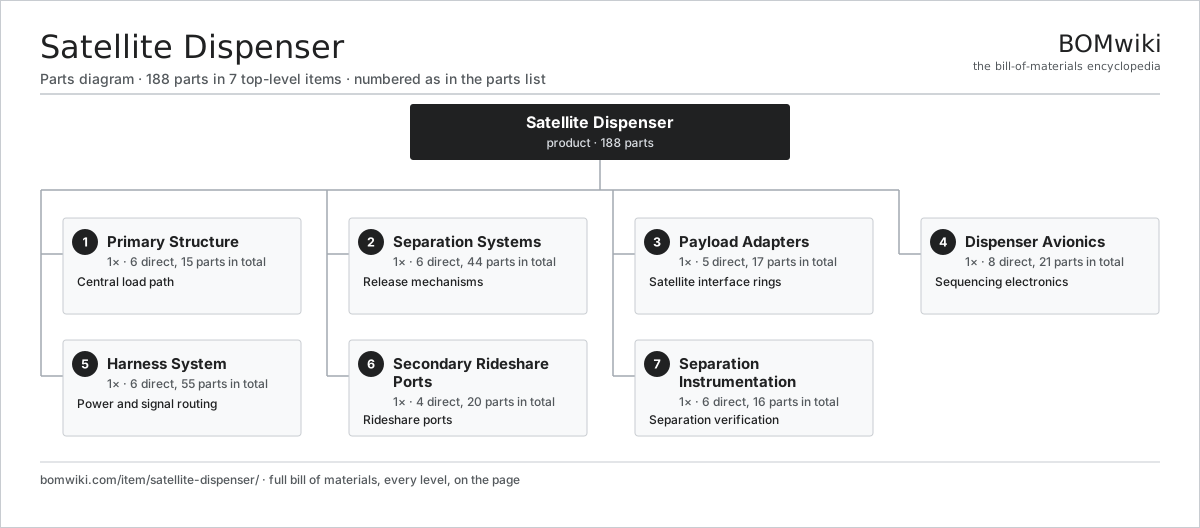
| # | Part | Qty | What it does |
|---|---|---|---|
| 1 | Primary Structure 6 parts | 1× | Central load path |
| 2 | Separation Systems 6 parts | 1× | Release mechanisms |
| 3 | Payload Adapters 5 parts | 1× | Satellite interface rings |
| 4 | Dispenser Avionics 8 parts | 1× | Sequencing electronics |
| 5 | Harness System 6 parts | 1× | Power and signal routing |
| 6 | Secondary Rideshare Ports 4 parts | 1× | Rideshare ports |
| 7 | Separation Instrumentation 6 parts | 1× | Separation verification |
3D model
No 3D model yet. Have a CAD file of this? Add a 3D model. STL renders right on this page; STEP, FreeCAD, and OpenSCAD sources are welcome too (openly licensed, like all 3D models on BOMwiki).
Build & assembly graph
expand / collapse · shared sub-assemblies converge · links to related products · est. labourTap an assembly to expand/collapse · tap a part to open it · use “Open page” for any node · drag to pan, scroll to zoom.
Bill of materials for Satellite Dispenser
7 top-level lines · 48 rows shown · 188 parts total · indented to 3 levels| # | Item / sub-assembly | Part no. | Qty/assy | Ext. qty | Parts | Type |
|---|---|---|---|---|---|---|
| 1 | Primary Structure 6 parts | satellite-dispenser-primary-structure | 1× | 1 | 15 | assembly |
| 1.1 | Central Cylinder | satellite-dispenser-central-cylinder | 1× | 1 | · | part |
| 1.2 | Lower Interface Ring | satellite-dispenser-lower-ring | 1× | 1 | · | part |
| 1.3 | Upper Ring | satellite-dispenser-upper-ring | 1× | 1 | · | part |
| 1.4 | Shear Web | satellite-dispenser-shear-webs | 4× | 4 | · | part |
| 1.5 | Access Panel | satellite-dispenser-access-panels | 4× | 4 | · | part |
| 1.6 | Fastener Set | fastener-set | 4× | 4 | · | part |
| 2 | Separation Systems 6 parts | satellite-dispenser-separation-systems | 1× | 1 | 44 | assembly |
| 2.1 | Clamp Band | satellite-dispenser-clamp-band | 4× | 4 | · | part |
| 2.2 | Hold-Down Release Mechanism | satellite-dispenser-hdrm | 8× | 8 | · | part |
| 2.3 | Pusher Spring Cartridge | satellite-dispenser-pusher-springs | 16× | 16 | · | part |
| 2.4 | Separation Nut | satellite-dispenser-separation-nuts | 8× | 8 | · | part |
| 2.5 | Band Catcher | satellite-dispenser-band-catcher | 4× | 4 | · | part |
| 2.6 | Umbilical Disconnect | satellite-dispenser-umbilical-disconnects | 4× | 4 | · | part |
| 3 | Payload Adapters 5 parts | satellite-dispenser-payload-adapters | 1× | 1 | 17 | assembly |
| 3.1 | Adapter Cone | satellite-dispenser-adapter-cone | 4× | 4 | · | part |
| 3.2 | Lightband Interface Ring | satellite-dispenser-lightband-interface | 4× | 4 | · | part |
| 3.3 | CubeSat Rail Port | satellite-dispenser-cubesat-rails | 2× | 2 | · | part |
| 3.4 | Interface Shim Kit | satellite-dispenser-matchdrill-shims | 1× | 1 | · | part |
| 3.5 | Fastener Set | fastener-set | 6× | 6 | · | part |
| 4 | Dispenser Avionics 8 parts | satellite-dispenser-avionics | 1× | 1 | 21 | assembly |
| 4.1 | Sequencer Unit | satellite-dispenser-sequencer-unit | 1× | 1 | · | part |
| 4.2 | Pyro Driver Unit | satellite-dispenser-pyro-driver-unit | 1× | 1 | · | part |
| 4.3 | Dispenser Battery | satellite-dispenser-battery-pack | 2× | 2 | · | part |
| 4.4 | Arming Plug | satellite-dispenser-arming-plugs | 2× | 2 | · | part |
| 4.5 | Bare PCB | pcb-bare | 4× | 4 | · | part |
| 4.6 | Microcontroller | mcu | 2× | 2 | · | part |
| 4.7 | Relay | relay | 8× | 8 | · | part |
| 4.8 | SMD Passive (R/C/L) | smd-passives | 1× | 1 | · | part |
| 5 | Harness System 6 parts | satellite-dispenser-harness-system | 1× | 1 | 55 | assembly |
| 5.1 | Pyro Harness | satellite-dispenser-pyro-harness | 1× | 1 | · | part |
| 5.2 | Signal Harness | satellite-dispenser-signal-harness | 1× | 1 | · | part |
| 5.3 | Payload Pass-Through Harness | satellite-dispenser-payload-passthrough | 4× | 4 | · | part |
| 5.4 | Wire Bundle | wire-bundle | 8× | 8 | · | part |
| 5.5 | Connector | connector | 40× | 40 | · | part |
| 5.6 | Cable Cleat Set | satellite-dispenser-cable-cleats | 1× | 1 | · | part |
| 6 | Secondary Rideshare Ports 4 parts | satellite-dispenser-secondary-ports | 1× | 1 | 20 | assembly |
| 6.1 | Port Ring | satellite-dispenser-port-ring | 6× | 6 | · | part |
| 6.2 | Port Doubler | satellite-dispenser-port-doubler | 6× | 6 | · | part |
| 6.3 | Ballast Plate | satellite-dispenser-ballast-plates | 2× | 2 | · | part |
| 6.4 | Fastener Set | fastener-set | 6× | 6 | · | part |
| 7 | Separation Instrumentation 6 parts | satellite-dispenser-instrumentation | 1× | 1 | 16 | assembly |
| 7.1 | Separation Switch | satellite-dispenser-separation-switches | 8× | 8 | · | part |
| 7.2 | Breakwire Set | satellite-dispenser-breakwire-set | 1× | 1 | · | part |
| 7.3 | Accelerometer Set | satellite-dispenser-accelerometer-set | 1× | 1 | · | part |
| 7.4 | Deployment Camera | satellite-dispenser-deployment-camera | 2× | 2 | · | part |
| 7.5 | Lens Assembly | camera-lens | 2× | 2 | · | part |
| 7.6 | Pressure Sensor | pressure-sensor | 2× | 2 | · | part |
Something wrong in this list? Report a problem with this BOM.
Related products
same domain, ranked by shared parts Cargo Resupply Spacecraft
574 parts · shares 2 with this page
Cargo Resupply Spacecraft
574 parts · shares 2 with this page
 Crewed Space Capsule
7,222 parts · shares 2 with this page
Crewed Space Capsule
7,222 parts · shares 2 with this page
 GPS Navigation Satellite
2,640 parts · shares 2 with this page
GPS Navigation Satellite
2,640 parts · shares 2 with this page
 Lunar Lander
1,803 parts · shares 2 with this page
Lunar Lander
1,803 parts · shares 2 with this page
 Space Telescope
1,843 parts · shares 2 with this page
Space Telescope
1,843 parts · shares 2 with this page
 CubeSat
158 parts · shares 1 with this page
CubeSat
158 parts · shares 1 with this page
Sourcing: possible vendors
Browse the supplier directory → Prices, MOQ, and lead times are algorithmic estimates, not quotes, and not claims about these companies. Company mappings are curated by keyword; est. price band $50k–$500M. How estimates work| Vendor | HQ | Specialty | MOQ | Lead time |
|---|---|---|---|---|
|
🇺🇸SpaceX
spacex.com ↗
|
Hawthorne, US | Launch & spacecraft | made to order | 52–104 wks |
| northropgrumman.com ↗ | Falls Church, US | Space & defense | made to order | 52–104 wks |
|
🇫🇷Airbus
airbus.com ↗
|
Toulouse, FR | Aerospace OEM | made to order | 52–104 wks |
| rocketlabusa.com ↗ | Long Beach, US | Launch & spacecraft | made to order | 52–104 wks |
| thalesaleniaspace.com ↗ | Cannes, FR | Satellites | made to order | 52–104 wks |
739-word article