Alto Saxophone
ProductOverview
The alto saxophone is a single-reed woodwind built in brass. Adolphe Sax patented the family in 1846 with a specific acoustic intent: a clarinet-style reed driving a wide conical bore, so the instrument overblows at the octave like an oboe but speaks with the power of a brass instrument. The alto, in E-flat, is the most common member; its written range of B♭3 to F♯6 sounds a major sixth lower.
The instrument breaks down into the Body Assembly (the cone itself), the Key Mechanism and Pad Set that valve its 25 tone holes, the Octave Mechanism, the detachable Neck (Crook), and the Mouthpiece Assembly where the sound actually starts.
The tone generator
Everything begins at the Reed, a profiled strip of Arundo donax cane clamped by the Ligature against the flat table of the Mouthpiece. The player's breath pressure bends the reed toward the tip rail, narrowing the gap; pressure waves returning from inside the instrument push it back open. The reed therefore behaves as a pressure-controlled valve, opening and closing at whatever frequency the air column dictates, about 440 times a second for a sounding A4. The mouthpiece tip opening (1.6–2.3 mm on alto) and the reed strength (graded 1.5–5) together set how much effort this valve takes to drive, which is why both are personal choices rather than fixed parts.
The air column
The pitch the reed locks onto belongs to the bore. The Body Tube is a near-perfect cone, around 12 mm where the neck joins and widening continuously through the Bow to the Bell, about a metre of tubing folded so a seated player can hold it. A cone resonates at a full harmonic series, so the saxophone overblows at the octave (a cylindrical clarinet, by contrast, overblows at the twelfth).
Opening a tone hole shortens the effective column. The 25 Tone Hole Chimneys are not soldered-on parts: the chimneys are drawn, pulled up out of the tube wall itself and leveled flat so a pad can seal against the rim. Each hole is covered by a Pad, felt faced with leather, bedded in Pad Shellac inside its brass Key Cup, with a Pad Resonator button so the pad does not soak up treble. A pad that leaks even slightly makes every note below it stuffy, which is why pad seating dominates saxophone repair work.
Keywork
The Key Mechanism is the Boehm-derived logic that maps eight usable fingers and two thumbs onto 25 holes. Keys ride on steel Hinge Rods or pointed Pivot Screws between brass Posts soldered to the body; Needle Springs return them, and the Key Cork Set set silences metal-to-metal contact and fixes each key's open height, which is itself a tuning parameter. Many keys are interlinked, pressing one finger of the lower stack closes several pads together, and small Adjustment Screws regulate these links so paired pads land simultaneously.
The Octave Mechanism is the cleverest linkage on the instrument. To jump to the second register the column needs a small leak near a pressure antinode, but the right vent position changes with the note: notes up to second-register G♯ use the Body Octave Vent, A and above need the Neck Octave Vent. One Octave Key under the left thumb serves both; the Octave Selector Linkage reads whether the G key is closed and routes the motion to the correct vent automatically, through the Octave Ring at the neck joint.
Materials and handling
The body is yellow brass, roughly 70/30 copper-zinc, finished in lacquer or plate; the metal matters less acoustically than the geometry, since the air column, not the wall, is the resonator. The Neck Cork lets the mouthpiece slide to tune; the Neck Screw clamps the Neck Tenon into the body. The player carries the 2.5 kg instrument on a strap through the Strap Ring, steadied by the Thumb Hook, while Key Guards shield the exposed low-note pads on the bell. A well-set-up alto needs pad and cork attention every year or two and a full repad roughly every decade of regular playing.
Alto Saxophone parts and their functions
7 top-level parts · 240 parts in total · full bill of materials below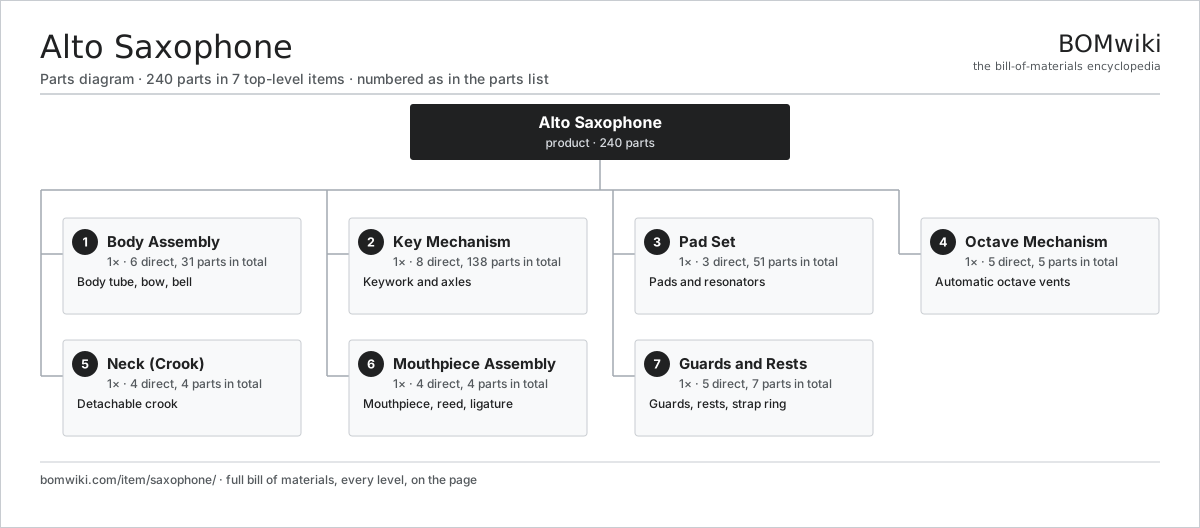
| # | Part | Qty | What it does |
|---|---|---|---|
| 1 | Body Assembly 6 parts | 1× | Body tube, bow, bell |
| 2 | Key Mechanism 8 parts | 1× | Keywork and axles |
| 3 | Pad Set 3 parts | 1× | Pads and resonators |
| 4 | Octave Mechanism 5 parts | 1× | Automatic octave vents |
| 5 | Neck (Crook) 4 parts | 1× | Detachable crook |
| 6 | Mouthpiece Assembly 4 parts | 1× | Mouthpiece, reed, ligature |
| 7 | Guards and Rests 5 parts | 1× | Guards, rests, strap ring |
3D model
No 3D model yet. Have a CAD file of this? Add a 3D model. STL renders right on this page; STEP, FreeCAD, and OpenSCAD sources are welcome too (openly licensed, like all 3D models on BOMwiki).
Build & assembly graph
expand / collapse · shared sub-assemblies converge · links to related products · est. labourTap an assembly to expand/collapse · tap a part to open it · use “Open page” for any node · drag to pan, scroll to zoom.
Bill of materials for Alto Saxophone
7 top-level lines · 42 rows shown · 240 parts total · indented to 3 levels| # | Item / sub-assembly | Part no. | Qty/assy | Ext. qty | Parts | Type |
|---|---|---|---|---|---|---|
| 1 | Body Assembly 6 parts | saxophone-body-assembly | 1× | 1 | 31 | assembly |
| 1.1 | Body Tube | saxophone-body-tube | 1× | 1 | · | part |
| 1.2 | Bow | saxophone-bow | 1× | 1 | · | part |
| 1.3 | Bell | saxophone-bell | 1× | 1 | · | part |
| 1.4 | Tone Hole Chimney | saxophone-tone-hole | 25× | 25 | · | part |
| 1.5 | Bell Brace | saxophone-bell-brace | 1× | 1 | · | part |
| 1.6 | Body Ring | saxophone-body-ring | 2× | 2 | · | part |
| 2 | Key Mechanism 8 parts | saxophone-key-mechanism | 1× | 1 | 138 | assembly |
| 2.1 | Key Cup | saxophone-key-cup | 23× | 23 | · | part |
| 2.2 | Key Arm | saxophone-key-arm | 23× | 23 | · | part |
| 2.3 | Hinge Rod | saxophone-hinge-rod | 12× | 12 | · | part |
| 2.4 | Post | saxophone-post | 30× | 30 | · | part |
| 2.5 | Needle Spring | saxophone-needle-spring | 23× | 23 | · | part |
| 2.6 | Pivot Screw | saxophone-pivot-screw | 18× | 18 | · | part |
| 2.7 | Key Cork Set | saxophone-key-cork | 1× | 1 | · | part |
| 2.8 | Adjustment Screw | saxophone-adjustment-screw | 8× | 8 | · | part |
| 3 | Pad Set 3 parts | saxophone-pad-set | 1× | 1 | 51 | assembly |
| 3.1 | Pad | saxophone-pad | 25× | 25 | · | part |
| 3.2 | Pad Resonator | saxophone-resonator | 25× | 25 | · | part |
| 3.3 | Pad Shellac | saxophone-pad-shellac | 1× | 1 | · | part |
| 4 | Octave Mechanism 5 parts | saxophone-octave-mechanism | 1× | 1 | 5 | assembly |
| 4.1 | Octave Key | saxophone-octave-key | 1× | 1 | · | part |
| 4.2 | Body Octave Vent | saxophone-body-octave-vent | 1× | 1 | · | part |
| 4.3 | Neck Octave Vent | saxophone-neck-octave-vent | 1× | 1 | · | part |
| 4.4 | Octave Ring | saxophone-octave-ring | 1× | 1 | · | part |
| 4.5 | Octave Selector Linkage | saxophone-octave-linkage | 1× | 1 | · | part |
| 5 | Neck (Crook) 4 parts | saxophone-neck | 1× | 1 | 4 | assembly |
| 5.1 | Neck Tube | saxophone-neck-tube | 1× | 1 | · | part |
| 5.2 | Neck Cork | saxophone-neck-cork | 1× | 1 | · | part |
| 5.3 | Neck Tenon | saxophone-neck-tenon | 1× | 1 | · | part |
| 5.4 | Neck Screw | saxophone-neck-screw | 1× | 1 | · | part |
| 6 | Mouthpiece Assembly 4 parts | saxophone-mouthpiece-assembly | 1× | 1 | 4 | assembly |
| 6.1 | Mouthpiece | saxophone-mouthpiece | 1× | 1 | · | part |
| 6.2 | Reed | saxophone-reed | 1× | 1 | · | part |
| 6.3 | Ligature | saxophone-ligature | 1× | 1 | · | part |
| 6.4 | Mouthpiece Cap | saxophone-mouthpiece-cap | 1× | 1 | · | part |
| 7 | Guards and Rests 5 parts | saxophone-trim | 1× | 1 | 7 | assembly |
| 7.1 | Key Guard | saxophone-key-guard | 3× | 3 | · | part |
| 7.2 | Thumb Hook | saxophone-thumb-rest | 1× | 1 | · | part |
| 7.3 | Thumb Button | saxophone-thumb-button | 1× | 1 | · | part |
| 7.4 | Strap Ring | saxophone-strap-ring | 1× | 1 | · | part |
| 7.5 | Fastener Set | fastener-set | 1× | 1 | · | part |
Something wrong in this list? Report a problem with this BOM.
Sourcing: possible vendors
Browse the supplier directory → Prices, MOQ, and lead times are algorithmic estimates, not quotes, and not claims about these companies. Company mappings are curated by keyword; est. price band $50–$5k. How estimates work| Vendor | HQ | Specialty | MOQ | Lead time |
|---|---|---|---|---|
| yamaha.com ↗ | Hamamatsu, JP | Audio & instruments | 200 units | 8–14 wks |
|
🇺🇸Fender
fender.com ↗
|
Los Angeles, US | Guitars & amps | 200 units | 8–14 wks |
|
🇺🇸Gibson
gibson.com ↗
|
Nashville, US | Guitars | 200 units | 8–14 wks |
|
🇯🇵Roland
roland.com ↗
|
Hamamatsu, JP | Electronic instruments | 200 units | 8–14 wks |
| steinway.com ↗ | New York, US | Pianos | 200 units | 8–14 wks |
736-word article