Scent Diffusion System
ProductOverview
A scent-diffusion system disperses fragrance throughout a venue in a controlled, programmable manner. Unlike spray air fresheners (which release a burst of scent), these systems use ultrasonic atomization to create a fine mist that drifts on ambient air currents, providing continuous scent coverage at low intensity. Applications include retail environments (to evoke brand identity or mask odors), hospitality (hotels and spas), museums (to enhance immersion), and office buildings. Professional systems are programmable, allowing scent intensity and timing to vary throughout the day, stronger during peak hours, lighter at night.
The Fragrance Cartridge holds the fragrance concentrate. The Atomizer Pump uses a Piezo Vibrator vibrating at 1.7 MHz to nebulize liquid into an aerosol mist. A Distribution Fan carries mist into the room via Ducting System. A Scheduler Controller programs on/off times and intensity. Optional Sensor Module detects occupancy, triggering adaptive diffusion.
Fragrance cartridges
The Fragrance Cartridge is the consumable element. A typical Cartridge Body holds 150–500 mL of liquid fragrance concentrate. Unlike consumer spray bottles (which are water-based), professional diffusion systems often use oil-based or high-proof alcohol-based fragrances for better aerosol stability and longer hang time in air. The Fragrance Concentrate is a carefully-formulated blend: primary fragrance compounds (esters, aldehydes, etc.) provide the scent character; solvent (usually dipropylene glycol or ethanol) carries the fragrance; and sometimes a trace of water aids nebulization.
Cartridges are sealed with Seals (silicone gaskets) to prevent evaporative loss during storage. The Cartridge Port is a spring-loaded quick-connect fitting with a one-way check valve, when a cartridge is inserted into the machine, the valve opens; when removed, it closes, preventing backflow.
Piezoelectric ultrasonic atomization
The Atomizer Pump uses a Piezo Vibrator, a ceramic disc that vibrates at 1.7 MHz when driven by an AC voltage. The vibration is focused on a small membrane (typically sapphire or stainless steel) at the bottom of the Atomizer Chamber. When liquid touches this vibrating membrane, capillary forces pull a thin film across it. The membrane's ultrasonic vibration exceeds the surface tension threshold, causing the film to shatter into droplets of 4–10 μm diameter, far too small to see individually but visible as a mist to the naked eye.
The Pump Driver IC IC converts 24VDC input to ~100 Vpk AC at 1.7 MHz, supplying the piezo element. The piezo is intermittently switched on and off by the Scheduler Controller microcontroller, allowing 1–10 pulses per minute. Continuous operation (100% intensity) uses ~15 W; pulsed operation at 10% averages <5 W.
An important advantage of ultrasonic atomization over heat-based vaporization is that fragrance compounds are not thermally degraded, no heating means no breakdown of delicate top notes. The mist exits the Nozzle Tip as a cool aerosol, traveling far into the room on air currents.
Air distribution
The Distribution Fan is a quiet brushless EC motor (24VDC, 5–20 CFM) that draws air through the atomizer chamber, carrying mist into the room. The fan speed is adjustable via the Speed Controller, allowing the operator to tune scent diffusion rate independently of atomizer pulse frequency. A Noise Baffle inlet silencer reduces fan noise to <30 dB(A), making the system nearly imperceptible.
Mist exits via Ducting System, flexible tubing routing to a wall outlet or diffuser. In larger installations, ducting may branch to multiple rooms, though a single device typically covers 100–500 m² depending on room size, ventilation, and desired scent intensity.
Scheduling and control
The Scheduler Controller is the intelligence layer. A Control PCB microcontroller with Real-Time Clock (real-time clock) running battery backup can store complex 24-hour profiles: for example, atomizer on at 8:00 AM at 50% intensity, increasing to 100% at 10:00 AM (peak customer hours), dropping to 25% at 5:00 PM, and off at 11:00 PM.
The Display Panel (typically a small LCD or touchscreen) allows manual adjustment without opening the cabinet. A wireless receiver can accept commands from a remote control or a central building automation system, enabling facility managers to adjust scent levels across multiple rooms from a central dashboard.
Occupancy sensing (optional)
A Sensor Module with a PIR Motion Sensor (passive infrared motion detector) triggers diffusion only when people are present. This saves fragrance and reduces scent fatigue (people become desensitized to continuous scent). Some systems add a CO₂ Sensor (non-dispersive infrared CO₂ monitor) to infer occupancy density: rising CO₂ indicates more people, so increase scent intensity.
Power supply and installation
The Power Supply Unit converts 230VAC mains to 24VDC, powering the microcontroller, fan, and piezo driver. Installation is straightforward: mount the Mounting Enclosure on a wall using the Mounting Bracket, connect mains power, insert a fragrance cartridge, and program the schedule. The Cable Entry allows flexible routing of ducting without wall damage.
Fragrance selection and scent profiles
Choosing the right fragrance is critical. Strong fragrances (musk, vanilla) can become cloying at high intensity; subtle fragrances (citrus, green tea) require stronger diffusion to be noticeable. Professional fragrance suppliers provide "scent profiles" tailored to specific environments: luxury retail (premium florals, woods), food service (subtle bakery or coffee notes), healthcare (clean, neutral), etc.
Scent adaptation (olfactory habituation) is a human limitation: the nose becomes insensitive to continuous scent after 15–30 minutes. Professional systems combat this by cycling scent on and off (e.g., 10 minutes on, 5 minutes off) or varying intensity throughout the day, keeping scent perception fresh.
Maintenance
The Atomizer Chamber should be rinsed with distilled water monthly to prevent mineral buildup (which would dampen vibration). The Piezo Vibrator is sensitive to mechanical shock; the device should not be dropped or hit. Cartridge replacement is simple, remove old cartridge, insert new one, confirm connection via LED status light.
For extended installations, a spare scent-diffusion-system-filter-cartridge should be stocked; typical cartridges last 50–100 hours of diffusion before fragrance is exhausted.
Scent Diffusion System parts and their functions
9 top-level parts · 75 parts in total · full bill of materials below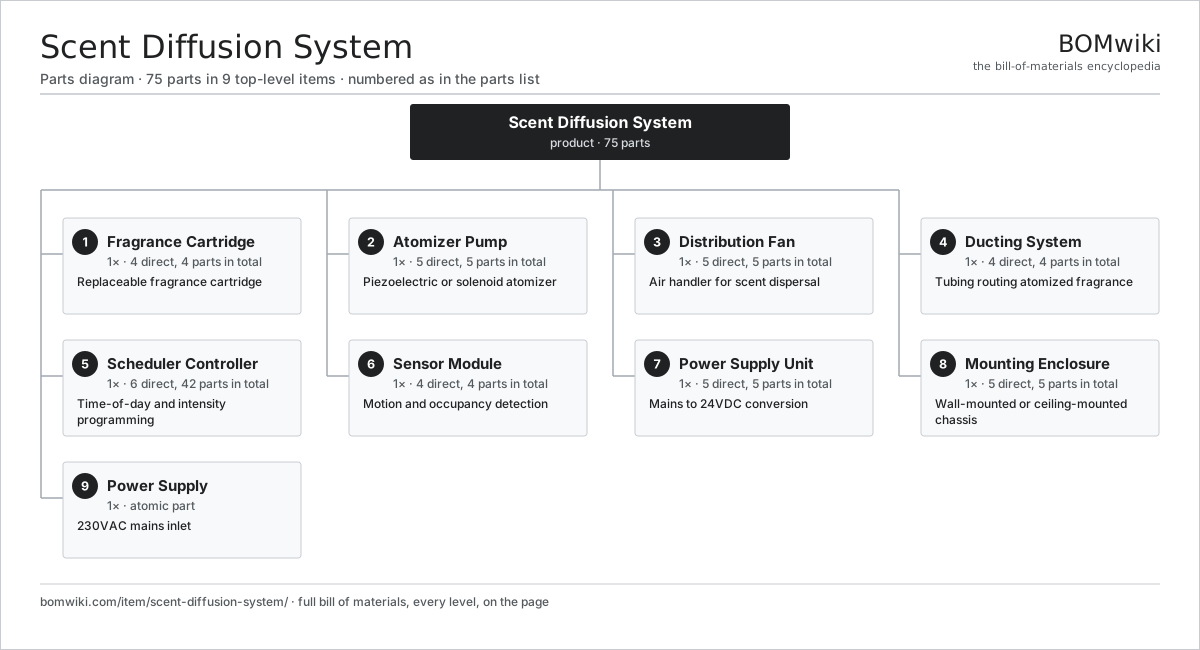
| # | Part | Qty | What it does |
|---|---|---|---|
| 1 | Fragrance Cartridge 4 parts | 1× | Replaceable fragrance cartridge |
| 2 | Atomizer Pump 5 parts | 1× | Piezoelectric or solenoid atomizer |
| 3 | Distribution Fan 5 parts | 1× | Air handler for scent dispersal |
| 4 | Ducting System 4 parts | 1× | Tubing routing atomized fragrance |
| 5 | Scheduler Controller 6 parts | 1× | Time-of-day and intensity programming |
| 6 | Sensor Module 4 parts | 1× | Motion and occupancy detection |
| 7 | Power Supply Unit 5 parts | 1× | Mains to 24VDC conversion |
| 8 | Mounting Enclosure 5 parts | 1× | Wall-mounted or ceiling-mounted chassis |
| 9 | Power Supply | 1× | 230VAC mains inlet |
3D model
No 3D model yet. Have a CAD file of this? Add a 3D model. STL renders right on this page; STEP, FreeCAD, and OpenSCAD sources are welcome too (openly licensed, like all 3D models on BOMwiki).
Build & assembly graph
expand / collapse · shared sub-assemblies converge · links to related products · est. labourTap an assembly to expand/collapse · tap a part to open it · use “Open page” for any node · drag to pan, scroll to zoom.
Bill of materials for Scent Diffusion System
9 top-level lines · 47 rows shown · 75 parts total · indented to 3 levels| # | Item / sub-assembly | Part no. | Qty/assy | Ext. qty | Parts | Type |
|---|---|---|---|---|---|---|
| 1 | Fragrance Cartridge 4 parts | scent-diffusion-system-cartridge-module | 1× | 1 | 4 | assembly |
| 1.1 | Cartridge Body | scent-diffusion-system-cartridge-body | 1× | 1 | · | part |
| 1.2 | Fragrance Concentrate | scent-diffusion-system-fragrance-fluid | 1× | 1 | · | part |
| 1.3 | Seals | scent-diffusion-system-cartridge-seals | 1× | 1 | · | part |
| 1.4 | Cartridge Port | scent-diffusion-system-cartridge-port | 1× | 1 | · | part |
| 2 | Atomizer Pump 5 parts | scent-diffusion-system-atomizer-pump | 1× | 1 | 5 | assembly |
| 2.1 | Piezo Vibrator | scent-diffusion-system-piezo-element | 1× | 1 | · | part |
| 2.2 | Atomizer Chamber | scent-diffusion-system-atomizer-chamber | 1× | 1 | · | part |
| 2.3 | Pump Driver IC | scent-diffusion-system-pump-driver | 1× | 1 | · | part |
| 2.4 | Nozzle Tip | scent-diffusion-system-nozzle-tip | 1× | 1 | · | part |
| 2.5 | Connector | connector | 1× | 1 | · | part |
| 3 | Distribution Fan 5 parts | scent-diffusion-system-distribution-fan | 1× | 1 | 5 | assembly |
| 3.1 | EC Motor | scent-diffusion-system-ec-fan-motor | 1× | 1 | · | part |
| 3.2 | Fan Wheel | scent-diffusion-system-fan-wheel | 1× | 1 | · | part |
| 3.3 | Speed Controller | scent-diffusion-system-fan-speed-control | 1× | 1 | · | part |
| 3.4 | Noise Baffle | scent-diffusion-system-noise-baffle | 1× | 1 | · | part |
| 3.5 | Connector | connector | 1× | 1 | · | part |
| 4 | Ducting System 4 parts | scent-diffusion-system-ducting | 1× | 1 | 4 | assembly |
| 4.1 | Duct Tubing | scent-diffusion-system-duct-tube | 1× | 1 | · | part |
| 4.2 | Duct Connectors | scent-diffusion-system-duct-connectors | 1× | 1 | · | part |
| 4.3 | Diffuser Outlet | scent-diffusion-system-diffuser-outlet | 1× | 1 | · | part |
| 4.4 | Mounting Clips | scent-diffusion-system-duct-clips | 1× | 1 | · | part |
| 5 | Scheduler Controller 6 parts | scent-diffusion-system-scheduler-controller | 1× | 1 | 42 | assembly |
| 5.1 | Control PCB | scent-diffusion-system-control-pcb | 1× | 1 | · | part |
| 5.2 | Real-Time Clock | scent-diffusion-system-rtc-module | 1× | 1 | · | part |
| 5.3 | Display Panel | scent-diffusion-system-display-panel | 1× | 1 | · | part |
| 5.4 | Relay | relay | 2× | 2 | · | part |
| 5.5 | SMD Passive (R/C/L) | smd-passives | 35× | 35 | · | part |
| 5.6 | Connector | connector | 2× | 2 | · | part |
| 6 | Sensor Module 4 parts | scent-diffusion-system-sensor-module | 1× | 1 | 4 | assembly |
| 6.1 | PIR Motion Sensor | scent-diffusion-system-pir-sensor | 1× | 1 | · | part |
| 6.2 | CO₂ Sensor | scent-diffusion-system-co2-sensor | 1× | 1 | · | part |
| 6.3 | Sensor Logic Board | scent-diffusion-system-sensor-logic | 1× | 1 | · | part |
| 6.4 | Connector | connector | 1× | 1 | · | part |
| 7 | Power Supply Unit 5 parts | scent-diffusion-system-power-supply-unit | 1× | 1 | 5 | assembly |
| 7.1 | Transformer | scent-diffusion-system-transformer | 1× | 1 | · | part |
| 7.2 | Rectifier & Filter | scent-diffusion-system-rectifier-filter | 1× | 1 | · | part |
| 7.3 | Voltage Regulator | scent-diffusion-system-voltage-regulator | 1× | 1 | · | part |
| 7.4 | PSU Fuse | scent-diffusion-system-psu-fuse | 1× | 1 | · | part |
| 7.5 | Connector | connector | 1× | 1 | · | part |
| 8 | Mounting Enclosure 5 parts | scent-diffusion-system-mounting-enclosure | 1× | 1 | 5 | assembly |
| 8.1 | Enclosure Body | scent-diffusion-system-enclosure-body | 1× | 1 | · | part |
| 8.2 | Cartridge Bay | scent-diffusion-system-cartridge-bay | 1× | 1 | · | part |
| 8.3 | Cable Entry | scent-diffusion-system-cable-entry | 1× | 1 | · | part |
| 8.4 | Mounting Bracket | scent-diffusion-system-mounting-bracket | 1× | 1 | · | part |
| 8.5 | Fastener Set | fastener-set | 1× | 1 | · | part |
| 9 | Power Supply | power-supply | 1× | 1 | · | part |
Something wrong in this list? Report a problem with this BOM.
Related products
same domain, ranked by shared parts


Sourcing: possible vendors
Browse the supplier directory → Prices, MOQ, and lead times are algorithmic estimates, not quotes, and not claims about these companies. Company mappings are curated by keyword; est. price band $50–$3k. How estimates work| Vendor | HQ | Specialty | MOQ | Lead time |
|---|---|---|---|---|
|
🇯🇵Sony
sony.com ↗
|
Tokyo, JP | Consumer electronics | 1,000 units | 8–12 wks |
| samsung.com ↗ | Suwon, KR | Electronics & displays | 1,000 units | 8–12 wks |
|
🇺🇸Harman
harman.com ↗
|
Stamford, US | Audio (JBL, AKG) | 1,000 units | 8–12 wks |
|
🇺🇸Bose
bose.com ↗
|
Framingham, US | Audio | 1,000 units | 8–12 wks |
| yamaha.com ↗ | Hamamatsu, JP | Audio & instruments | 1,000 units | 8–12 wks |
1,087-word article