Scoliosis Brace (TLSO)
ProductOverview
Scoliosis braces are orthopedic devices designed to slow or halt the progression of adolescent idiopathic scoliosis (AIS), the most common form of spinal curvature disorder affecting 2–3% of adolescents. Unlike adult scoliosis (which results from degenerative disc disease or osteoporosis), AIS occurs during growth and can rapidly worsen if untreated, sometimes progressing 10–15° per year. The Scoliosis Brace (TLSO) (commonly called a TLSO: thoracolumbar spinal orthosis) uses a custom-molded plastic Molded Thermoplastic Shell fitted with corrective pressure pads to apply targeted forces to the spine, either reducing lateral curvature or preventing its progression. When prescribed early and worn consistently (16–23 hours/day), bracing reduces the risk of curve progression requiring surgery by 70–90%.
The principle underlying all scoliosis braces is three-point fixation: applying pressure forces at three strategically chosen locations (e.g., apical pad pushing lateral, superior pad pushing medial) to create a net corrective moment on the scoliotic vertebral column. The success of bracing depends on consistent high compliance (wearing the brace 16+ hours/day throughout the growth period), proper Corrective Pressure Pad Array placement determined by curve type and magnitude, and periodic adjustment as the child grows.
Custom Molding and Shell Fabrication
The Molded Thermoplastic Shell is custom-fabricated for each patient, typically using the Scan-and-Mold (SAM) process:
Patient 3D scanning: The patient stands in a corrected posture (guided by an orthopedic surgeon or technician) while a 3D laser scanner captures the torso shape from iliac crest to axilla. Some clinics use structured-light depth cameras; others use manual anthropometric measurements.
CAD model and pad placement: Software calculates the optimal positions for Corrective Pressure Pad Array based on the patient's curve type, magnitude, and apex location. For a typical right thoracic curve (the most common pattern), pads are positioned to push the apex leftward and downward, and a counter-pad on the left to prevent over-correction.
CNC-milled mold: The CAD model drives a CNC mill or 3D printer to create a negative mold, typically in aluminum or resin.
Thermoplastic forming: A heated Thermoplastic Sheet Blank (polypropylene, copolyester, or polyethylene) is vacuum-formed or pressure-formed onto the mold, then trimmed to the prescribed trimline (just below axilla superiorly, at iliac crest inferiorly).
This custom approach is critical: an off-the-shelf brace cannot account for each patient's unique spinal anatomy, and poor pad placement is one of the leading causes of brace failure. The shell must be comfortable enough for 16+ hours/day wear; excessive pressure or poor fit leads to poor compliance.
Corrective Pressure Pad Design
The Corrective Pressure Pad Array is the functional heart of the brace. Each pad, the Apical Corrective Pad, Lower Thoracic Pressure Pad, and Counter-Pressure Pad, is fabricated from high-density foam (Shore A 40–60) and glued to the interior shell at precise locations. The pad sizes and densities are tailored per curve type:
- Apical pad: Positioned directly over the curve apex (the most rotated vertebra), typically at T7–T8 for right thoracic curves. Size is 3–5 cm diameter; pressure is 10–30 N depending on child age and curve severity.
- Lower thoracic pad: For the lower portion of the curve, providing lateral corrective force, often 4–6 cm wide.
- Lumbar pad: If the curve extends into the lumbar spine, a Lumbar Support Pad applies anterior-lateral force to the lumbar vertebrae.
- Counter-pads: Opposing pads on the contralateral (opposite) side prevent over-correction and distribute force symmetrically, reducing the risk of creating a new curve in the opposite direction.
The pads work by pushing the spine into a less curved posture, believed to slow growth asymmetry between concave and convex sides of the vertebrae. Over months and years, this repeated correction can allow the spine to grow straighter or at least prevent the rapid collapse seen in untreated scoliosis.
Strap System and Wearing Protocol
The Multi-Point Strap System uses three to four fabric or elastic straps anchored to the lateral shell, with hook-and-loop closures allowing the child to adjust tension during the day. The Upper Shoulder Strap prevents the brace from migrating superiorly; the Mid-Torso Circumferential Strap maintains anterior-posterior centering; and the Lower Iliac Strap prevents slippage inferiorly. Proper strap tensioning is critical: over-tightening can cause skin irritation and rib compression; under-tightening allows the brace to shift, reducing corrective force.
Clinical protocols typically prescribe 16–23 hours/day wear, with 1–2 hours for hygiene, bathing, and physical therapy. Some programs use 24-hour wear for severe curves. The brace is worn under clothing and is largely invisible; many adolescents report that peers are unaware of the brace.
Comfort and Compliance Strategy
Long-term compliance is the greatest challenge in scoliosis bracing. Adolescents must wear an uncomfortable, hot, restrictive device during the years of greatest self-consciousness. To maximize compliance:
- Padding and liner: The Inner Liner and Padding uses soft closed-cell polyurethane foam (5–10 mm) and breathable polyester mesh, distributing pressure over the largest possible area and wicking sweat.
- Trimline optimization: The Edge Trim and Finishing is smoothed and rounded, preventing skin chafing at the brace edges.
- Cosmetic finish: Some manufacturers offer colored shells or logos, allowing adolescents to personalize their brace.
- Psychological support: Family counseling and peer support groups improve compliance significantly.
Non-compliance is the leading cause of brace failure. Studies show that braces worn <14 hours/day have minimal effect on curve progression; only children wearing >16 hours/day achieve the 70–90% success rate.
Brace Types and Prescribing
Scoliosis braces are classified by curve severity and treatment goal:
Cobb angle (curve magnitude): Measured on spinal radiographs, it quantifies lateral deviation. Treatment indications vary:
- <20°: Observation only; no brace needed.
- 20–25°: Borderline; brace often prescribed.
- 25–40°: Brace prescribed; typically worn 16–18 hours/day.
- >40°: Surgery typically indicated; bracing unlikely to prevent progression.
Curve pattern: Right thoracic (most common), left thoracic, thoracolumbar, lumbar, or S-shaped double curves. Each pattern requires different pad placement, making custom molding essential.
Skeletal maturity: Risser staging (0–5 based on iliac crest ossification) indicates remaining growth. Bracing is most effective before Risser stage 4; after full skeletal maturity (Risser 5), bracing is ineffective because growth has stopped.
Structural Reinforcement
The Internal Reinforcement Struts are optional but often included for curves >30° or for larger/heavier adolescents. The Aluminum Reinforcement Channel (a 10–15 mm aluminum C-channel or I-beam) is bonded vertically along the lateral thorax using Structural Adhesive (epoxy or polyurethane structural adhesive). This strut stiffens the shell against lateral bending under corrective pad pressure, allowing the pad to transmit force more efficiently to the spine rather than deforming the shell.
Maintenance and Growth Adjustment
As the child grows (typically 1–2 cm per year), the brace shell eventually becomes too short or too tight. Periodic clinic visits (every 3–6 months) assess fit and allow strap re-tensioning and minor padding adjustments. When growth renders the brace unwearable (usually 2–3 years after initial molding), a new Molded Thermoplastic Shell is custom-molded. The old brace is not reusable because the spine has grown and the anatomy has changed.
The Foam Padding Layer and Liner Fabric Cover wear over time and may be replaced in-clinic without re-molding the shell, extending the functional lifespan of the brace.
Outcomes and Long-Term Results
Randomized trials (the BrAIST trial, 2014) demonstrated that dedicated bracing (18.3 hours/day) prevented curve progression >50 Cobb degrees in 72% of patients, compared to 48% in observation-only controls. Most patients who braced successfully had stable curves at skeletal maturity and avoided surgery. Patients who braced but had poor compliance (<8 hours/day) saw progression rates similar to untreated controls, underscoring the importance of sustained wear.
After skeletal maturity (typically age 17–18), the brace is weaned over several months. Most patients remain stable post-brace if treatment was successful during growth, though curves do not spontaneously straighten; the brace goal is to prevent or slow progression, not to correct existing curves.
Scoliosis Brace (TLSO) parts and their functions
5 top-level parts · 18 parts in total · full bill of materials below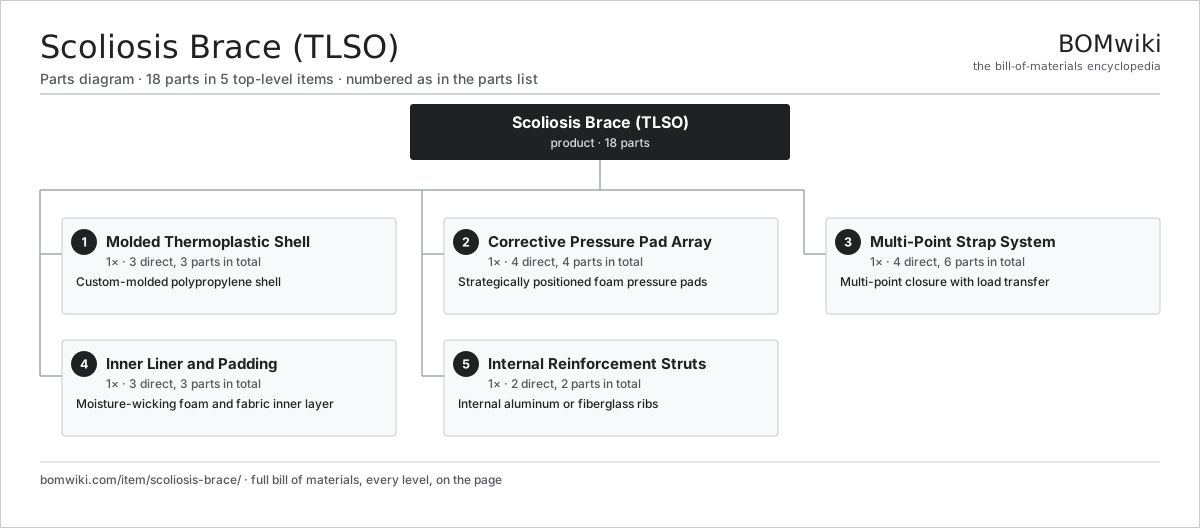
| # | Part | Qty | What it does |
|---|---|---|---|
| 1 | Molded Thermoplastic Shell 3 parts | 1× | Custom-molded polypropylene shell |
| 2 | Corrective Pressure Pad Array 4 parts | 1× | Strategically positioned foam pressure pads |
| 3 | Multi-Point Strap System 4 parts | 1× | Multi-point closure with load transfer |
| 4 | Inner Liner and Padding 3 parts | 1× | Moisture-wicking foam and fabric inner layer |
| 5 | Internal Reinforcement Struts 2 parts | 1× | Internal aluminum or fiberglass ribs |
3D model
No 3D model yet. Have a CAD file of this? Add a 3D model. STL renders right on this page; STEP, FreeCAD, and OpenSCAD sources are welcome too (openly licensed, like all 3D models on BOMwiki).
Build & assembly graph
expand / collapse · shared sub-assemblies converge · links to related products · est. labourTap an assembly to expand/collapse · tap a part to open it · use “Open page” for any node · drag to pan, scroll to zoom.
Bill of materials for Scoliosis Brace (TLSO)
5 top-level lines · 21 rows shown · 18 parts total · indented to 3 levels| # | Item / sub-assembly | Part no. | Qty/assy | Ext. qty | Parts | Type |
|---|---|---|---|---|---|---|
| 1 | Molded Thermoplastic Shell 3 parts | scoliosis-brace-shell-assembly | 1× | 1 | 3 | assembly |
| 1.1 | Thermoplastic Sheet Blank | scoliosis-brace-shell-blank | 1× | 1 | · | part |
| 1.2 | Edge Trim and Finishing | scoliosis-brace-shell-trim-edge | 1× | 1 | · | part |
| 1.3 | Structural Reinforcement Ribs | scoliosis-brace-shell-reinforcement-ribs | 1× | 1 | · | part |
| 2 | Corrective Pressure Pad Array 4 parts | scoliosis-brace-corrective-pad-array | 1× | 1 | 4 | assembly |
| 2.1 | Apical Corrective Pad | scoliosis-brace-apical-pad | 1× | 1 | · | part |
| 2.2 | Lower Thoracic Pressure Pad | scoliosis-brace-lower-thoracic-pad | 1× | 1 | · | part |
| 2.3 | Lumbar Support Pad | scoliosis-brace-lumbar-pad | 1× | 1 | · | part |
| 2.4 | Counter-Pressure Pad | scoliosis-brace-counter-pad | 1× | 1 | · | part |
| 3 | Multi-Point Strap System 4 parts | scoliosis-brace-strap-system | 1× | 1 | 6 | assembly |
| 3.1 | Upper Shoulder Strap | scoliosis-brace-upper-strap | 1× | 1 | · | part |
| 3.2 | Mid-Torso Circumferential Strap | scoliosis-brace-mid-strap | 1× | 1 | · | part |
| 3.3 | Lower Iliac Strap | scoliosis-brace-lower-strap | 1× | 1 | · | part |
| 3.4 | Hook-and-Loop Fastener | scoliosis-brace-velcro-closure | 3× | 3 | · | part |
| 4 | Inner Liner and Padding 3 parts | scoliosis-brace-liner-padding | 1× | 1 | 3 | assembly |
| 4.1 | Foam Padding Layer | scoliosis-brace-foam-liner | 1× | 1 | · | part |
| 4.2 | Liner Fabric Cover | scoliosis-brace-fabric-cover | 1× | 1 | · | part |
| 4.3 | Edge Seam Tape | scoliosis-brace-seam-tape | 1× | 1 | · | part |
| 5 | Internal Reinforcement Struts 2 parts | scoliosis-brace-reinforcement-struts | 1× | 1 | 2 | assembly |
| 5.1 | Aluminum Reinforcement Channel | scoliosis-brace-aluminum-channel | 1× | 1 | · | part |
| 5.2 | Structural Adhesive | scoliosis-brace-strut-adhesive | 1× | 1 | · | part |
Something wrong in this list? Report a problem with this BOM.
Sourcing: possible vendors
Browse the supplier directory → Prices, MOQ, and lead times are algorithmic estimates, not quotes, and not claims about these companies. Company mappings are curated by keyword; est. price band $500–$3M. How estimates work| Vendor | HQ | Specialty | MOQ | Lead time |
|---|---|---|---|---|
| gehealthcare.com ↗ | Chicago, US | Medical imaging & devices | 100 units | 12–20 wks |
| siemens-healthineers.com ↗ | Erlangen, DE | Medical systems | 100 units | 12–20 wks |
|
🇳🇱Philips
philips.com ↗
|
Amsterdam, NL | Health technology | 100 units | 12–20 wks |
| medtronic.com ↗ | Minneapolis, US | Medical devices | 100 units | 12–20 wks |
|
🇨🇳Mindray
mindray.com ↗
|
Shenzhen, CN | Medical devices | 100 units | 12–20 wks |
1,371-word article