Cartridge Filling Machine
ProductOverview
A cartridge filler is an automatic production machine for filling adhesive or sealant cartridges (disposable sealed tubes with plunger-dispensing nozzles). Common applications include silicone sealants, polyurethane adhesives, hot-melt cartridges, and structural adhesives.
The machine operates in four synchronized stages: indexing empty cartridges into the filling station, volumetrically dispensing product, inserting the dispensing nozzle, and capping. Throughput ranges 30–120 cartridges per minute depending on fill volume and nozzle insertion time.
How it works
Empty cartridges are manually loaded into holders on the Indexing Conveyor System carousel. The operator enters the desired fill volume (mL) on the Touchscreen HMI, then presses START. The sealant-cartridge-filler-controls PLC sequences the machine:
Filling: The Stepper Motor with Reducer indexes the carousel, positioning the first cartridge under the Piston/Auger Filler. The Piston Pump (or auger) draws product from the Product Feed Reservoir via Material Pump and Lines. The Fill Volume Adjuster limits pump stroke to dispense the exact pre-set volume. As product flows into the cartridge via Fill Spout, the Fill Level Sensor detects full level and triggers pump shutoff. Typical fill time is 2–5 seconds.
Nozzle insertion: The carousel advances. A nozzle is fed from the Nozzle Magazine magazine via the Nozzle Gripper Head (vacuum or gripper). The Nozzle Press Cylinder double-acting cylinder drives the nozzle down into the cartridge opening at 5–20 ton force. The Insertion Sensor confirms the nozzle is seated at correct depth. If seating pressure is abnormal, the Nozzle Reject Solenoid rejects the nozzle and triggers an alarm.
Capping: The carousel advances again. The Cap Hopper feeds a cap via Cap Gripper. The Cap Press Cylinder (pneumatic or servo) applies 2–10 ton force, seating the cap onto the nozzle. The Cap Position Sensor (vision or proximity) verifies the cap is centered. Any misalignment triggers air ejection via Cap Eject Air Pulse.
Discharge: The finished cartridge exits the carousel and is manually removed into a collection bin or transferred to a labeler downstream.
The PLC and HMI Control Production Counter tallies completed cartridges per shift. The operator can stop the machine mid-cycle without product loss (solenoid pinches discharge line and retracts nozzle).
Key subsystems
Conveyor and indexing: The Stepper Motor with Reducer is a stepper motor with planetary reducer, enabling precise zero-backlash indexing. The Rotating Carousel Table rotates in fixed increments (e.g., 45 degrees if 8 stations exist). Inductive Sensor at each station detect when a cartridge is present and ready for the next operation.
Filling mechanism: The Piston/Auger Filler uses either a piston pump (fast, accurate) or progressive-cavity auger (gentler on viscous products). The Piston Pump draws product, compresses it, and ejects at high pressure. The Fill Volume Adjuster limits the travel distance to set fill volume: a 100 mL stroke on a 2 cc/rev pump requires 50 pump cycles, but modern designs use a fixed-displacement pump and vary stroke, enabling rapid fill times.
The Fill Level Sensor can be a simple proximity switch (cartridge full when nozzle spout is blocked) or a laser sensor (measuring liquid level). Most machines use proximity for cost and reliability.
Nozzle insertion: The Nozzle Installation Unit stage is typically the bottleneck. The Nozzle Press Cylinder double-acting cylinder must insert the nozzle straight and deep enough (typically 10–15 mm into cartridge opening) without over-driving (which can crack plastic cartridges). Insertion force is monitored; if force drops suddenly (nozzle drops), an alarm is triggered.
Capping: The Cap Application Unit applies caps via a press. Screw-on caps require rotation (additional actuator); snap-fit caps are simply pressed. A Cap Position Sensor detects cap centering; if off-center, air pulse ejects and the cycle repeats.
Material handling: The Product Feed Reservoir holds 50–200 liters of product. A Tank Mixer at low speed prevents settling for filled or pigmented products. An optional Tank Heater keeps viscous adhesives warm (30–50°C) for smooth dispensing. The Material Pump and Lines draws via suction line and pressurizes via Metering Pump.
Control automation: The Programmable Logic Controller orchestrates all four stages. Each stage has dwell times and sensor interlocks. If any sensor fails (e.g., fill-height sensor sticks), the PLC halts and displays a fault code on the Touchscreen HMI.
Materials and construction
Carousel: Aluminum or cast iron turntable with precisely machined positioning pins and catch plates. Rotation is via stepper motor with zero-backlash planetary reducer.
Cartridge nests: Stainless steel or aluminum clamps holding cartridges concentrically. Quick-change nests allow rapid switchover between cartridge sizes (10–32 mm diameter).
Nozzle hopper: Gravity-fed chute with dividers preventing nozzle tangling. Vacuum picker uses Venturi suction (pneumatic jet ejector) or electric vacuum pump.
Caps hopper: Similar design to nozzle hopper; vision-based pickers (higher cost) are used if cap orientation is critical.
Fill pump: Gear pump (5–50 cc/rev) with hardened steel gears. Suction line is large-bore (low backpressure); discharge line is smaller diameter and insulated to maintain product viscosity.
Pressure relief: Prevents pump overpressure if discharge is blocked (e.g., clogged nozzle spout).
Operating procedure
- Load cartridges into Cartridge Holder holders on Stepper Motor with Reducer carousel, typically 4–8 cartridges at a time.
- Fill Product Feed Reservoir with product (e.g., 100 liters of silicone sealant).
- Start Tank Mixer to homogenize product (if pigmented).
- Set Tank Heater to 40°C if product is thick (optional).
- On Touchscreen HMI, enter fill volume in mL (e.g., 280 mL for standard 10 oz cartridge).
- Verify Nozzle Magazine is loaded with nozzles and Cap Hopper is loaded with caps.
- Press START; PLC sequences Stepper Motor with Reducer indexing through fill → nozzle → cap → discharge.
- Monitor Production Counter; cartridge count increments after cap is applied.
- Monitor Touchscreen HMI for alarm messages (fill sensor fail, nozzle pressure low, cap misalignment, etc.).
- Every 100 cartridges, sample-inspect one cartridge: visually check fill level, nozzle seating, and cap tightness.
- If fill volume drifts (e.g., after 200 cartridges), adjust Fill Volume Adjuster by ±5 mL and retest.
- At end of shift, stop PLC; drain Product Feed Reservoir and flush pump lines with solvent.
Process control and quality
Fill accuracy: Volumetric fillers are ±2% (e.g., ±5.6 mL on a 280 mL fill). Weight-based filling (using a scale under each nest) is ±1% but adds cycle time. Most cartridge fillers are volumetric for speed.
Viscosity sensitivity: Piston pumps are sensitive to product viscosity. If viscosity changes (temperature drop), fill volume changes. Maintaining constant hopper temperature via Tank Heater is important.
Nozzle seating: Inconsistent insertion depth can cause nozzles to leak or fail to seat. Insertion force monitoring (via Insertion Sensor) detects nozzle damage; deformed nozzles are automatically rejected.
Cap tightness: Screw-on caps must be torqued correctly; under-tightened caps loosen during shipping; over-tightened caps crack. A torque-limiting clutch on the Cap Press Cylinder motor (if servo electric) ensures consistent torque.
Variants and configurations
Semi-automatic machines: Operator manually inserts nozzle and cap; machine only fills. Lower cost, slower (20–40 cartridges/hour).
High-speed fully automatic: 120–180 cartridges per minute using servo electric actuators, vision inspection, and parallel nozzle/cap feeding. Cost >$200k.
Tabletop benchtop machines: Compact 30–50 cartridge/minute fillers for small manufacturers, fitting on a lab bench.
Hot-melt cartridge fillers: Specialized versions with heated pump and spout (180–200°C) for hot-melt adhesives; cooling water circulation prevents product solidification in hose.
Dual-component fillers: Two separate Product Feed Reservoir tanks and pumps dispensing Part A and Part B sequentially into the same cartridge (e.g., two-part epoxy), with internal mixer nozzle.
Cartridge Filling Machine parts and their functions
7 top-level parts · 44 parts in total · full bill of materials below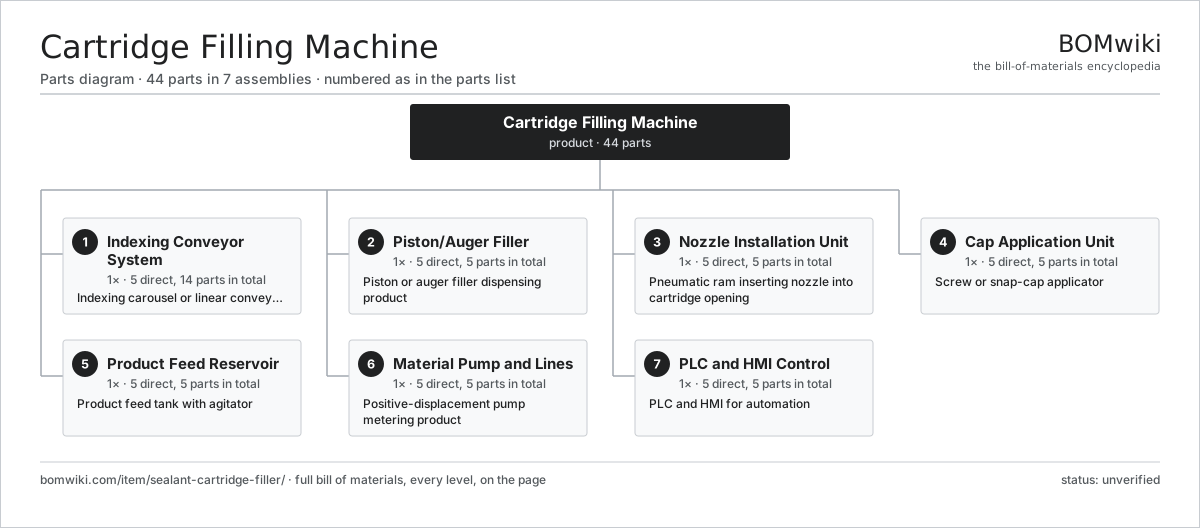
| # | Part | Qty | What it does |
|---|---|---|---|
| 1 | Indexing Conveyor System 5 parts | 1× | Indexing carousel or linear conveyor |
| 2 | Piston/Auger Filler 5 parts | 1× | Piston or auger filler dispensing product |
| 3 | Nozzle Installation Unit 5 parts | 1× | Pneumatic ram inserting nozzle into cartridge opening |
| 4 | Cap Application Unit 5 parts | 1× | Screw or snap-cap applicator |
| 5 | Product Feed Reservoir 5 parts | 1× | Product feed tank with agitator |
| 6 | Material Pump and Lines 5 parts | 1× | Positive-displacement pump metering product |
| 7 | PLC and HMI Control 5 parts | 1× | PLC and HMI for automation |
3D model
No 3D model yet. Have a CAD file of this? Add a 3D model — STL renders right on this page; STEP, FreeCAD, and OpenSCAD sources are welcome too (openly licensed, like all 3D models on BOMwiki).
Build & assembly graph
expand / collapse · shared sub-assemblies converge · links to related products · est. labourTap an assembly to expand/collapse · tap a part to open it · use “Open page” for any node · drag to pan, scroll to zoom.
Bill of materials for Cartridge Filling Machine
7 top-level lines · 42 rows shown · 44 parts total · indented to 3 levels| # | Item / sub-assembly | Part no. | Qty/assy | Ext. qty | Parts | Type |
|---|---|---|---|---|---|---|
| 1 | Indexing Conveyor System 5 parts | sealant-cartridge-filler-conveyor | 1× | 1 | 14 | assembly |
| 1.1 | Stepper Motor with Reducer | sealant-cartridge-filler-carousel-motor | 1× | 1 | · | part |
| 1.2 | Rotating Carousel Table | sealant-cartridge-filler-carousel-table | 1× | 1 | · | part |
| 1.3 | Cartridge Holder | sealant-cartridge-filler-cartridge-nest | 8× | 8 | · | part |
| 1.4 | Inductive Sensor | sealant-cartridge-filler-proximity-sensors | 3× | 3 | · | part |
| 1.5 | Machine Base Frame | sealant-cartridge-filler-frame | 1× | 1 | · | part |
| 2 | Piston/Auger Filler 5 parts | sealant-cartridge-filler-filling-station | 1× | 1 | 5 | assembly |
| 2.1 | Piston Pump | sealant-cartridge-filler-piston-pump | 1× | 1 | · | part |
| 2.2 | Piston Pump Drive | sealant-cartridge-filler-pump-motor | 1× | 1 | · | part |
| 2.3 | Fill Spout | sealant-cartridge-filler-nozzle-spout | 1× | 1 | · | part |
| 2.4 | Fill Level Sensor | sealant-cartridge-filler-fill-height-sensor | 1× | 1 | · | part |
| 2.5 | Fill Volume Adjuster | sealant-cartridge-filler-stroke-adjuster | 1× | 1 | · | part |
| 3 | Nozzle Installation Unit 5 parts | sealant-cartridge-filler-nozzle-inserter | 1× | 1 | 5 | assembly |
| 3.1 | Nozzle Magazine | sealant-cartridge-filler-nozzle-hopper | 1× | 1 | · | part |
| 3.2 | Nozzle Gripper Head | sealant-cartridge-filler-nozzle-picker | 1× | 1 | · | part |
| 3.3 | Nozzle Press Cylinder | sealant-cartridge-filler-insertion-ram | 1× | 1 | · | part |
| 3.4 | Insertion Sensor | sealant-cartridge-filler-nozzle-pressure-sensor | 1× | 1 | · | part |
| 3.5 | Nozzle Reject Solenoid | sealant-cartridge-filler-nozzle-eject-solenoid | 1× | 1 | · | part |
| 4 | Cap Application Unit 5 parts | sealant-cartridge-filler-capping-station | 1× | 1 | 5 | assembly |
| 4.1 | Cap Hopper | sealant-cartridge-filler-cap-hopper | 1× | 1 | · | part |
| 4.2 | Cap Gripper | sealant-cartridge-filler-cap-picker | 1× | 1 | · | part |
| 4.3 | Cap Press Cylinder | sealant-cartridge-filler-cap-press | 1× | 1 | · | part |
| 4.4 | Cap Position Sensor | sealant-cartridge-filler-cap-sensor | 1× | 1 | · | part |
| 4.5 | Cap Eject Air Pulse | sealant-cartridge-filler-cap-ejector | 1× | 1 | · | part |
| 5 | Product Feed Reservoir 5 parts | sealant-cartridge-filler-material-hopper | 1× | 1 | 5 | assembly |
| 5.1 | Material Tank | sealant-cartridge-filler-hopper-vessel | 1× | 1 | · | part |
| 5.2 | Tank Mixer | sealant-cartridge-filler-hopper-agitator | 1× | 1 | · | part |
| 5.3 | Tank Heater | sealant-cartridge-filler-hopper-heater | 1× | 1 | · | part |
| 5.4 | Tank Thermometer | sealant-cartridge-filler-hopper-thermometer | 1× | 1 | · | part |
| 5.5 | Suction Hose | sealant-cartridge-filler-hopper-suction-line | 1× | 1 | · | part |
| 6 | Material Pump and Lines 5 parts | sealant-cartridge-filler-pump-system | 1× | 1 | 5 | assembly |
| 6.1 | Metering Pump | sealant-cartridge-filler-displacement-pump | 1× | 1 | · | part |
| 6.2 | Piston Pump Drive | sealant-cartridge-filler-pump-motor | 1× | 1 | · | part |
| 6.3 | Pump Relief Valve | sealant-cartridge-filler-pressure-relief | 1× | 1 | · | part |
| 6.4 | Discharge Hose | sealant-cartridge-filler-hose-assembly | 1× | 1 | · | part |
| 6.5 | Return Filter | sealant-cartridge-filler-filter | 1× | 1 | · | part |
| 7 | PLC and HMI Control 5 parts | sealant-cartridge-filler-control-system | 1× | 1 | 5 | assembly |
| 7.1 | Programmable Logic Controller | sealant-cartridge-filler-plc | 1× | 1 | · | part |
| 7.2 | Touchscreen HMI | sealant-cartridge-filler-hmi-panel | 1× | 1 | · | part |
| 7.3 | Safety Relay Module | sealant-cartridge-filler-safety-relay | 1× | 1 | · | part |
| 7.4 | Production Counter | sealant-cartridge-filler-counter-display | 1× | 1 | · | part |
| 7.5 | 24 VDC Supply | sealant-cartridge-filler-power-supply | 1× | 1 | · | part |
Sourcing: possible vendors
Prices, MOQ, and lead times are algorithmic estimates, not quotes, and not claims about these companies. Company mappings are curated by keyword; est. price band $5k–$2M. How estimates work| Vendor | HQ | Specialty | MOQ | Lead time |
|---|---|---|---|---|
| atlascopco.com ↗ | Stockholm, SE | Compressors & industrial | 10 units | 12–20 wks |
|
🇦🇹Andritz
andritz.com ↗
|
Graz, AT | Process plants & machinery | 10 units | 12–20 wks |
| buhlergroup.com ↗ | Uzwil, CH | Food & materials processing | 10 units | 12–20 wks |
| gea.com ↗ | Düsseldorf, DE | Process technology | 10 units | 12–20 wks |
| mhi.com ↗ | Tokyo, JP | Heavy machinery | 10 units | 12–20 wks |
1,414-word article