Seedling Grafting Machine
ProductOverview
A seedling grafting machine automates the labor-intensive process of joining rootstock and scion stems, producing thousands of grafted plants per shift. Grafting is essential in horticultural propagation: it unites the vigorous root system of one plant (rootstock) with the desirable flowering or fruiting characteristics of another (scion). Hand-grafting is skilled work requiring 30–60 seconds per plant; machines reduce this to 5–10 seconds while improving consistency and survival rates.
The Main Frame houses two Seedling Clamp units holding rootstock and scion vertically. The Cutting Blade, driven at 50–200 Hz by a Blade Drive Motor, makes a precise angled cut on both stems simultaneously. The Alignment Guides ensure blade contact at the exact height, producing mating surfaces. The Clip Applicator then stretches a pre-formed graft clip and slides it over the joined stems, holding them together until callus tissue (healing tissue) fuses the joint (7–14 days).
Grafting machines are standard in commercial nurseries producing tomato, eggplant, melon, watermelon, and ornamental rootstocks. A single machine can produce 2000–3000 grafted plants per 8-hour shift, replacing 3–5 hand-grafters and improving yield consistency by 5–10% (fewer failed unions, more uniform plant size).
How It Works
Setup and Positioning: Rootstock seedlings (typically 4–6 weeks old, 4–8 mm stem diameter) and scion seedlings (2–4 weeks old, 3–6 mm diameter) are pre-selected and arranged on the Conveyor Feed System. The conveyor advances plants through three distinct zones: loading, cutting, and ejection.
Loading Zone: When a seedling reaches the loading position (detected by the Entrance Position Sensor), the greenhouse-climate-computer-touch-panel signals the operator via beep. The operator manually places the rootstock into the lower Seedling Clamp and the scion into the upper clamp. Pneumatic grippers (24 psi) gently squeeze the stems, enough to hold them rigid, not enough to crush. The Height Adjustment screw ensures both clamps are vertically aligned; the blade will contact both stems at the same height.
Cutting Zone: Once stems are clamped, the operator presses the "start" button. The Main PLC verifies both Position Sensor switches detect clamped seedlings. If both confirm, a solenoid valve energizes the Blade Drive Motor, a 100–500 W servo driving the crankshaft at the programmed frequency (typically 100 Hz = 200 cuts/second, each oscillation <1 mm amplitude).
The Cutting Blade oscillates forward and backward, sawing through the rootstock and scion stems. A single diagonal cut at 45° angle typically takes 0.3–0.5 seconds on 5 mm stems. The blade is kept sharp via automatic Blade Sharpener stropping; dull blades cause crushing rather than clean cuts, compromising graft union quality.
As the blade completes its cuts (confirmed by a torque sensor or timer), pneumatic pressure to the clamps is released, and the stem pieces separate slightly (2–3 mm) for clip insertion.
Clip Application Zone: The Clip Applicator immediately engages. A Clip Gripper (pneumatic or electromagnetic) plucks a pre-formed clip from the Clip Magazine. The clip (typically C-shaped plastic or rubber, 3–5 mm inner diameter) is positioned over an expandable Clip Stretcher mandrel. Pneumatic pressure expands the mandrel, opening the clip to 8–10 mm diameter.
A Clip Pusher (pneumatic ram) then slides the stretched clip down over the graft joint, seating it ~1 cm below the cut surfaces. As air pressure releases, the mandrel contracts and the clip snaps tight around the joined stems, compressing the cut faces together with 20–50 N holding force. The entire clip operation takes <1 second.
Ejection Zone: The Conveyor Feed System advances, pushing the grafted seedling onto a collection tray or directly into a hardening chamber. The operator removes the finished graft and places it in a nursery tray.
Cycle time: typically 8–12 seconds per graft (blade cutting 0.5 s, clip application 1 s, positioning/removal 6–10 s).
Cutting Technique and Graft Types
45° Diagonal Splice Graft (most common): Blade angled at 45°. The rootstock receives a diagonal cut 4–6 mm long; the scion receives a matching cut. When aligned and clipped, the diagonal interface maximizes contact area and provides mechanical strength. Success rate: 85–95% (very reliable).
90° Straight Cut (herbaceous plants): Rootstock and scion cut perpendicular to stem. Less contact area but faster cutting (straight cuts = less friction). Success: 70–85%. Used for soft-stemmed crops (basil, lettuce) where gentle cutting matters.
V-Cut or Saddle Graft: Blade makes two angled cuts forming a V-shaped notch on the scion; rootstock receives a matching wedge cut. Complex geometry; machine must make two passes. Success: 80–90%; slower (double cut time).
Most machines are dedicated to a single graft type; custom blade shapes and programmable blade angles allow switching, but setup takes 15–30 minutes.
Rootstock-Scion Compatibility
Not all plants graft successfully. Successful grafts require:
- Genetic proximity: Tomato (Solanum lycopersicum) scions graft reliably to disease-resistant Solanum rootstocks.
- Stem diameter match: Rootstock and scion should be within 1–2 mm diameter for reliable union.
- Physiological compatibility: Vascular tissues must align; poor alignment prevents nutrient transport and graft failure (2–4 weeks post-grafting).
Nurseries typically graft tomato (90% success), eggplant (85%), melon (80%), cucurbits (75–85%), and ornamentals (60–90% depending on species).
Hardening and Healing
Post-grafting, grafted seedlings are placed in a humid, warm healing chamber (22–26°C, 90% RH) for 7–14 days. During this period, callus tissue (undifferentiated wound-healing tissue) forms at the graft interface, and vascular tissues begin fusing. The clip is removed manually once union is visible (usually 10–14 days). Seedlings are then transplanted to field or container production.
Failure analysis: If >10% of grafts fail (wilt, blackening at union), check for:
- Dull blades causing crushing instead of clean cuts.
- Misaligned cutting heights (blade at different heights on rootstock vs. scion).
- Clip applied too tightly (crushing vascular tissue) or too loosely (no contact).
- Healing conditions too cool (<18°C) or dry (<80% RH), slowing callus formation.
Machine Operation and Labor
A skilled operator can maintain 400–500 grafts/hour sustained (vs. 300–400 by hand). The machine reduces physical labor (no repetitive cutting stress) but requires attention to seedling placement, blade angle verification, and clip magazine refills.
Training: 4–8 hours of supervised operation before achieving consistent quality and speed. Most operators reach peak efficiency after 2–3 weeks.
Maintenance: Blade sharpening every 2–4 operating hours (5–10 minutes per sharpening session); pneumatic filter replacement monthly; clip magazine refilling every 100–200 plants.
Comparison to Hand-Grafting
Hand-grafting (knife or scissor):
- Speed: 20–40 plants/hour
- Cost: $2–3 per graft (labor at $15–20/hour)
- Quality: Variable, depends on operator skill; success 60–85%
- Equipment: Knife, sterilization bleach, clips (~$50 initial)
Machine grafting:
- Speed: 400–600 plants/hour
- Cost: $1–2 per graft (labor + equipment depreciation)
- Quality: Consistent, success 85–95%
- Equipment: Machine $15,000–40,000; compressor $2,000–5,000; clips $50/1000
ROI: 2–3 years for nurseries producing >5,000 grafted plants per season.
Energy and Environmental Impact
Pneumatic systems consume compressed air (5–8 bar, 50–100 L/min), requiring a 3–7 kW reciprocating or screw compressor. This dominates power consumption. Electric servo motors for blade and conveyor add only 0.5–1 kW. Total system power: 4–8 kW (intermittent duty).
Water usage: Minimal; clips and blades require occasional rinsing in deionized water to prevent mineral buildup.
Waste: Discarded clips (plastic C-clips) are typically not recyclable. Some nurseries use biodegradable natural rubber clips to reduce environmental impact.
Integration with Nursery Workflow
A typical grafting nursery:
- Week 1–4: Rootstock seedlings germinated and grown in nursery.
- Week 2–5: Scion seedlings germinated and grown separately.
- Week 5: Peak grafting period; 500–1000 plants/day via machine; 2–3 shifts possible.
- Week 6–7: Healing chamber holds grafted seedlings (callus formation).
- Week 7: Manual removal of clips; hardening in cool, dry conditions.
- Week 8–16: Pot-on (transplant to larger containers) and field/customer shipping.
Without grafting machines, this workflow extends 2–4 weeks due to labor bottleneck at grafting step.
Seedling Grafting Machine parts and their functions
8 top-level parts · 50 parts in total · full bill of materials below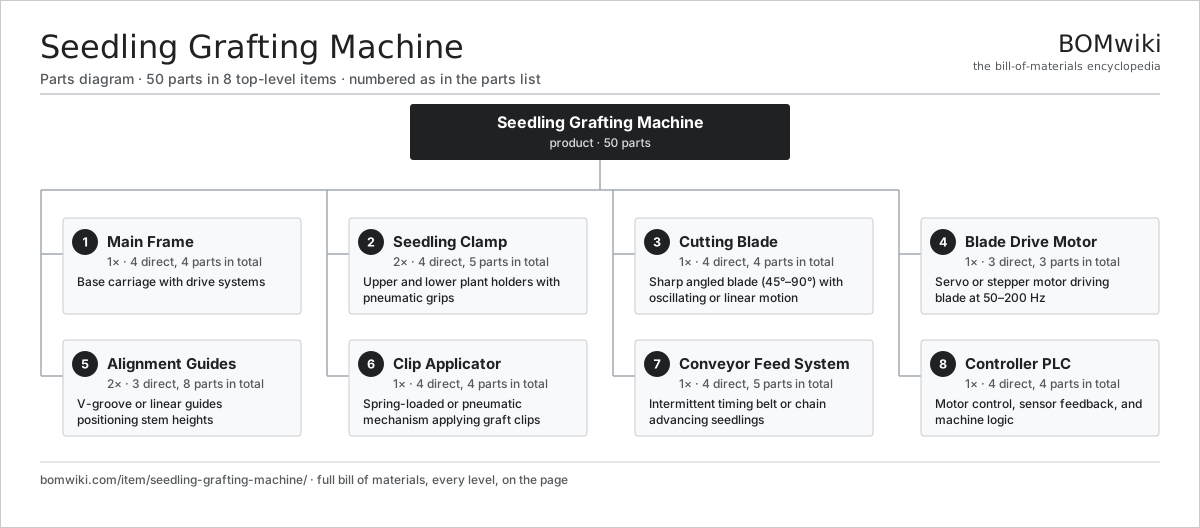
| # | Part | Qty | What it does |
|---|---|---|---|
| 1 | Main Frame 4 parts | 1× | Base carriage with drive systems |
| 2 | Seedling Clamp 4 parts | 2× | Upper and lower plant holders with pneumatic grips |
| 3 | Cutting Blade 4 parts | 1× | Sharp angled blade (45°–90°) with oscillating or linear motion |
| 4 | Blade Drive Motor 3 parts | 1× | Servo or stepper motor driving blade at 50–200 Hz |
| 5 | Alignment Guides 3 parts | 2× | V-groove or linear guides positioning stem heights |
| 6 | Clip Applicator 4 parts | 1× | Spring-loaded or pneumatic mechanism applying graft clips |
| 7 | Conveyor Feed System 4 parts | 1× | Intermittent timing belt or chain advancing seedlings |
| 8 | Controller PLC 4 parts | 1× | Motor control, sensor feedback, and machine logic |
3D model
No 3D model yet. Have a CAD file of this? Add a 3D model. STL renders right on this page; STEP, FreeCAD, and OpenSCAD sources are welcome too (openly licensed, like all 3D models on BOMwiki).
Build & assembly graph
expand / collapse · shared sub-assemblies converge · links to related products · est. labourTap an assembly to expand/collapse · tap a part to open it · use “Open page” for any node · drag to pan, scroll to zoom.
Bill of materials for Seedling Grafting Machine
8 top-level lines · 38 rows shown · 50 parts total · indented to 3 levels| # | Item / sub-assembly | Part no. | Qty/assy | Ext. qty | Parts | Type |
|---|---|---|---|---|---|---|
| 1 | Main Frame 4 parts | seedling-grafting-machine-main-frame | 1× | 1 | 4 | assembly |
| 1.1 | Frame Extrusion | seedling-grafting-machine-frame-extrusion | 1× | 1 | · | part |
| 1.2 | Drive Belt | seedling-grafting-machine-drive-belt | 1× | 1 | · | part |
| 1.3 | Motor Drive | seedling-grafting-machine-motor-drive | 1× | 1 | · | part |
| 1.4 | Fastener Set | fastener-set | 1× | 1 | · | part |
| 2 | Seedling Clamp 4 parts | seedling-grafting-machine-seedling-clamp | 2× | 2 | 5 | assembly |
| 2.1 | Pneumatic Gripper | seedling-grafting-machine-pneumatic-gripper | 1× | 2 | · | part |
| 2.2 | Clamp Jaw | seedling-grafting-machine-clamp-jaw | 2× | 4 | · | part |
| 2.3 | Height Adjustment | seedling-grafting-machine-height-adjustment | 1× | 2 | · | part |
| 2.4 | Clamp Solenoid | seedling-grafting-machine-clamp-solenoid | 1× | 2 | · | part |
| 3 | Cutting Blade 4 parts | seedling-grafting-machine-cutting-blade | 1× | 1 | 4 | assembly |
| 3.1 | Blade Steel | seedling-grafting-machine-blade-steel | 1× | 1 | · | part |
| 3.2 | Blade Holder | seedling-grafting-machine-blade-holder | 1× | 1 | · | part |
| 3.3 | Blade Drive Crank | seedling-grafting-machine-blade-drive-crank | 1× | 1 | · | part |
| 3.4 | Blade Sharpener | seedling-grafting-machine-blade-sharpener | 1× | 1 | · | part |
| 4 | Blade Drive Motor 3 parts | seedling-grafting-machine-blade-motor | 1× | 1 | 3 | assembly |
| 4.1 | Servo Motor | seedling-grafting-machine-servo-motor | 1× | 1 | · | part |
| 4.2 | Motor Controller | seedling-grafting-machine-motor-controller | 1× | 1 | · | part |
| 4.3 | Crankshaft | seedling-grafting-machine-crankshaft | 1× | 1 | · | part |
| 5 | Alignment Guides 3 parts | seedling-grafting-machine-alignment-guides | 2× | 2 | 8 | assembly |
| 5.1 | Linear Rail | seedling-grafting-machine-linear-rail | 2× | 4 | · | part |
| 5.2 | Guide Block | seedling-grafting-machine-guide-block | 4× | 8 | · | part |
| 5.3 | Position Sensor | seedling-grafting-machine-position-sensor | 2× | 4 | · | part |
| 6 | Clip Applicator 4 parts | seedling-grafting-machine-clip-applicator | 1× | 1 | 4 | assembly |
| 6.1 | Clip Magazine | seedling-grafting-machine-clip-magazine | 1× | 1 | · | part |
| 6.2 | Clip Gripper | seedling-grafting-machine-clip-gripper | 1× | 1 | · | part |
| 6.3 | Clip Stretcher | seedling-grafting-machine-clip-stretcher | 1× | 1 | · | part |
| 6.4 | Clip Pusher | seedling-grafting-machine-clip-pusher | 1× | 1 | · | part |
| 7 | Conveyor Feed System 4 parts | seedling-grafting-machine-conveyor-feed | 1× | 1 | 5 | assembly |
| 7.1 | Conveyor Belt | seedling-grafting-machine-conveyor-belt | 1× | 1 | · | part |
| 7.2 | Conveyor Pulley | seedling-grafting-machine-conveyor-pulley | 2× | 2 | · | part |
| 7.3 | Conveyor Motor | seedling-grafting-machine-conveyor-motor | 1× | 1 | · | part |
| 7.4 | Entrance Position Sensor | seedling-grafting-machine-position-sensor-entrance | 1× | 1 | · | part |
| 8 | Controller PLC 4 parts | seedling-grafting-machine-controller-plc | 1× | 1 | 4 | assembly |
| 8.1 | Main PLC | greenhouse-climate-computer-main-plc | 1× | 1 | · | part |
| 8.2 | Pressure Transducer | seedling-grafting-machine-pressure-transducer | 1× | 1 | · | part |
| 8.3 | Touch Panel | seedling-grafting-machine-touch-panel | 1× | 1 | · | part |
| 8.4 | Emergency Stop Button | seedling-grafting-machine-emergency-stop | 1× | 1 | · | part |
Something wrong in this list? Report a problem with this BOM.
Sourcing: possible vendors
Browse the supplier directory → Prices, MOQ, and lead times are algorithmic estimates, not quotes, and not claims about these companies. Company mappings are curated by keyword; est. price band $5k–$800k. How estimates work| Vendor | HQ | Specialty | MOQ | Lead time |
|---|---|---|---|---|
| deere.com ↗ | Moline, US | Agriculture & turf | made to order | 14–24 wks |
| cnh.com ↗ | Basildon, GB | Agriculture (Case IH, New Holland) | made to order | 14–24 wks |
|
🇺🇸AGCO
agcocorp.com ↗
|
Duluth, US | Agriculture (Fendt, Massey Ferguson) | made to order | 14–24 wks |
|
🇩🇪Claas
claas.com ↗
|
Harsewinkel, DE | Harvesters & tractors | made to order | 14–24 wks |
|
🇯🇵Kubota
kubota.com ↗
|
Osaka, JP | Compact tractors & equipment | made to order | 14–24 wks |
1,413-word article