Dental Articulator
ProductOverview
A dental articulator is a mechanical instrument that simulates jaw opening, closing, and lateral movement to test and refine tooth and restoration contact. Unlike a simple hinge (which only opens and closes), an articulator replicates the complex three-dimensional path of the mandible relative to the maxilla, the envelope of motion determined by the temporomandibular joint (TMJ) anatomy and neuromuscular control.
Semi-adjustable articulators represent the practical balance between anatomical realism and ease of use. They allow two key adjustments:
- Sagittal condylar inclination: The forward slope of the TMJ guiding surface (typically 15–70°, varies by patient)
- Bennett angle (transverse condylar guidance): The lateral shift and angle of condylar motion during jaw movement (typically 0–30°, varies by patient)
By setting these angles to match a patient's individual anatomy (measured via jaw records or inferred from standard values), the articulator reproduces that patient's occlusal path and contact patterns. The Incisal Pin and Anterior Reference maintains vertical reference and prevents inadvertent jaw opening beyond the patient's recorded vertical dimension.
Components and Function
Upper and Lower Arms. The Upper Maxillary Frame and Lower Mandibular Frame are rigid aluminum frames. Dental casts or individual dies are mounted parallel on the Die Mounting Plates using quick-set epoxy or polyurethane cement. The lower arm is hinged to the upper arm via the Hinge Pin Assembly, allowing rotation around the horizontal jaw-opening axis.
Condylar Mechanism. Each side of the lower arm has a Adjustable Condylar Mechanism consisting of:
- A Condylar Ball Bearing: a hardened steel sphere resting in a socket on the upper arm, representing the mandibular condyle position
- An adjustable Sagittal Inclination Guide: a guide rail at a calibrated angle, allowing the ball to slide forward and down as the lower jaw protrudes (simulating protrusive movement)
- A Transverse Guidance: a transverse element preventing excessive lateral shifting, limiting Bennett angle
Incisal Pin. The Incisal Pin and Anterior Reference is a vertical post hanging from the lower arm, with a hardened steel ball at the tip. This pin slides on a flat table surface on the upper arm. The vertical distance between the pin and table (set via the Vertical Adjustment Mechanism screw) represents the vertical dimension of occlusion. As the lower jaw opens, the incisal pin ball rolls away from the table, defining the maximum jaw opening and preventing collision between upper and lower teeth.
Adjustment and Calibration
Before use, the articulator must be adjusted to the patient's specific jaw anatomy:
Condylar Inclination. Using a protrusive jaw record (wax bite taken with the mandible pushed forward to edge-to-edge position), the molar and incisor vertical distance changes are measured. The difference is used to calculate the condylar inclination angle:
''' Condylar inclination ≈ arctan((Incisor vertical drop) / (Molar horizontal advance)) '''
The Sagittal Inclination Guide angle is adjusted and locked via the Angle Locking Set set screws.
Bennett Angle. Using a lateral jaw record (wax bite taken with the mandible shifted sideways), the transverse movement of the working and balancing sides is measured. The Transverse Guidance is adjusted to match this angle and locked.
Vertical Dimension. The Vertical Adjustment Mechanism screw is turned until the incisal pin ball just touches the table with the upper and lower teeth in centric contact (the ideal closed-mouth position). This sets the reference height.
Articulation Movements
With adjustments complete, the articulator reproduces jaw movements:
- Centric closure: Lower jaw closes straight up along the incisal guide and condylar path to the position where upper and lower cusps first contact (centric relation).
- Protrusive movement: Lower jaw slides forward; both condylar balls move down their inclines; incisal pin ball rolls away from the table; posterior teeth separate, and anterior teeth edge-to-edge.
- Working movement (lateral): Lower jaw shifts toward the working (chewing) side; the working condyle stays relatively fixed, the balancing condyle moves medially and forward per Bennett angle; cusps trace a lateral path.
- Balanced contacts: Upper and lower restoration contacts are marked with articulating paper, revealing high spots and prematurities.
Articulating Paper and Marking
Articulating paper (thin colored film) is placed between upper and lower teeth in the articulator. As the jaw opens and closes and moves laterally, the paper marks contact points on the restorations. A technician observes these marks and adjusts the restoration shape (grinding or milling) to create proper occlusal contacts. The goal is:
- Balanced contacts in centric relation (ideally 4–6 simultaneous contacts per tooth)
- Smooth gliding contacts during protrusive and lateral movements
- No premature or traumatic high spots
Clinical Integration
Articulators are critical in:
- Crown and bridge delivery: Final restorations are mounted on casts in the articulator, and occlusion is verified before delivery to the dentist
- Denture processing: Complete dentures are mounted on casts and jaw-relation rims, allowing technicians to set centric relation and vertical dimension before processing
- Implant case planning: Implant position is simulated on casts mounted in the articulator to ensure proper emergence profile and occlusal contacts
- Occlusal adjustment: Mounted restorations can be articulated and marked to identify contact issues before chairside adjustment
Semi-Adjustable vs. Fully Adjustable Articulators
Semi-adjustable articulators (this product) are the industry standard in dental labs. They are affordable, durable, and adequate for 95% of restorative cases.
Fully adjustable articulators (Christensen, Denar) include additional degrees of freedom (immediate sideshift, separate sagittal and transverse guides, electronic positional tracking) but are expensive, complex, and rarely justified outside of complex prosthodontic cases.
Accuracy and Limitations
Articulators cannot perfectly replicate individual jaw motion, muscle activity, proprioceptive feedback, and neuromotor control are absent. However, they capture the static envelope of motion (the geometric boundary within which the jaw can move). For practical occlusal adjustment, this is sufficient.
Errors arise if:
- Jaw records are poorly made (unstable or misaligned)
- Articulator adjustment is inaccurate
- Casts are mounted off-axis or non-parallel
- Articulator wear (loose hinges, ball sockets) causes backlash
Professional technicians verify articulator settings monthly and replace worn components.
Integration Points
- Input: Stone casts and individual dies from Dental CAD/CAM Mill milling designs and denture templates
- Output: Verified and marked restorations ready for delivery or further lab processing
- Related: Used in tandem with Dental Model Trimmer for base preparation and Dental Porcelain Furnace staining observation
Articulators serve as the bridge between objective (milling, 3D scanning) and subjective (patient comfort, phonetics) in digital dentistry.
Dental Articulator parts and their functions
6 top-level parts · 26 parts in total · full bill of materials below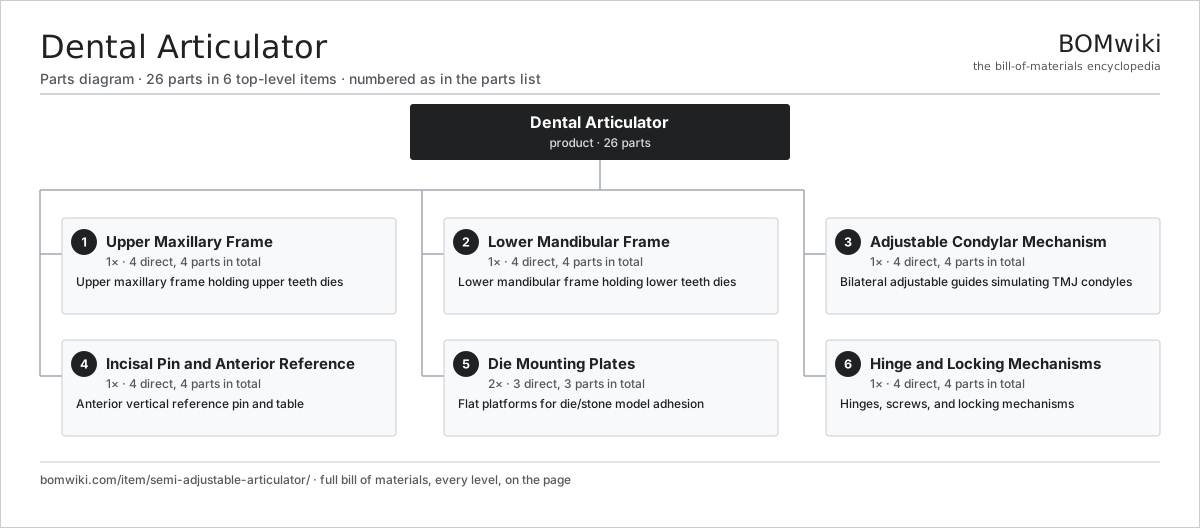
| # | Part | Qty | What it does |
|---|---|---|---|
| 1 | Upper Maxillary Frame 4 parts | 1× | Upper maxillary frame holding upper teeth dies |
| 2 | Lower Mandibular Frame 4 parts | 1× | Lower mandibular frame holding lower teeth dies |
| 3 | Adjustable Condylar Mechanism 4 parts | 1× | Bilateral adjustable guides simulating TMJ condyles |
| 4 | Incisal Pin and Anterior Reference 4 parts | 1× | Anterior vertical reference pin and table |
| 5 | Die Mounting Plates 3 parts | 2× | Flat platforms for die/stone model adhesion |
| 6 | Hinge and Locking Mechanisms 4 parts | 1× | Hinges, screws, and locking mechanisms |
3D model
No 3D model yet. Have a CAD file of this? Add a 3D model. STL renders right on this page; STEP, FreeCAD, and OpenSCAD sources are welcome too (openly licensed, like all 3D models on BOMwiki).
Build & assembly graph
expand / collapse · shared sub-assemblies converge · links to related products · est. labourTap an assembly to expand/collapse · tap a part to open it · use “Open page” for any node · drag to pan, scroll to zoom.
Bill of materials for Dental Articulator
6 top-level lines · 29 rows shown · 26 parts total · indented to 3 levels| # | Item / sub-assembly | Part no. | Qty/assy | Ext. qty | Parts | Type |
|---|---|---|---|---|---|---|
| 1 | Upper Maxillary Frame 4 parts | semi-adjustable-articulator-upper-arm | 1× | 1 | 4 | assembly |
| 1.1 | Upper Frame Body | semi-adjustable-articulator-upper-arm-frame | 1× | 1 | · | part |
| 1.2 | Upper Mounting Platform | semi-adjustable-articulator-upper-arm-platform | 1× | 1 | · | part |
| 1.3 | Condylar Attachment Interface | semi-adjustable-articulator-upper-arm-attachment | 1× | 1 | · | part |
| 1.4 | Fastener Set | fastener-set | 1× | 1 | · | part |
| 2 | Lower Mandibular Frame 4 parts | semi-adjustable-articulator-lower-arm | 1× | 1 | 4 | assembly |
| 2.1 | Lower Frame Body | semi-adjustable-articulator-lower-arm-frame | 1× | 1 | · | part |
| 2.2 | Lower Mounting Platform | semi-adjustable-articulator-lower-arm-platform | 1× | 1 | · | part |
| 2.3 | Horizontal Hinge Axis | semi-adjustable-articulator-lower-arm-hinge | 1× | 1 | · | part |
| 2.4 | Condylar Socket Pair | semi-adjustable-articulator-lower-arm-condylar-socket | 1× | 1 | · | part |
| 3 | Adjustable Condylar Mechanism 4 parts | semi-adjustable-articulator-condylar-mechanism | 1× | 1 | 4 | assembly |
| 3.1 | Condylar Ball Bearing | semi-adjustable-articulator-condylar-ball | 1× | 1 | · | part |
| 3.2 | Sagittal Inclination Guide | semi-adjustable-articulator-condylar-incline | 1× | 1 | · | part |
| 3.3 | Transverse Guidance | semi-adjustable-articulator-condylar-guide | 1× | 1 | · | part |
| 3.4 | Angle Locking Set | semi-adjustable-articulator-condylar-locking | 1× | 1 | · | part |
| 4 | Incisal Pin and Anterior Reference 4 parts | semi-adjustable-articulator-incisal-pin | 1× | 1 | 4 | assembly |
| 4.1 | Incisal Pin Shaft | semi-adjustable-articulator-incisal-pin-shaft | 1× | 1 | · | part |
| 4.2 | Incisal Reference Table | semi-adjustable-articulator-incisal-pin-table | 1× | 1 | · | part |
| 4.3 | Vertical Adjustment Mechanism | semi-adjustable-articulator-incisal-pin-adjust | 1× | 1 | · | part |
| 4.4 | Incisal Pin Ball Tip | semi-adjustable-articulator-incisal-pin-ball | 1× | 1 | · | part |
| 5 | Die Mounting Plates 3 parts | semi-adjustable-articulator-mounting-plates | 2× | 2 | 3 | assembly |
| 5.1 | Upper Mounting Plate | semi-adjustable-articulator-mounting-plates-upper | 1× | 2 | · | part |
| 5.2 | Lower Mounting Plate | semi-adjustable-articulator-mounting-plates-lower | 1× | 2 | · | part |
| 5.3 | Mounting Cement | semi-adjustable-articulator-mounting-plates-adhesive | 1× | 2 | · | part |
| 6 | Hinge and Locking Mechanisms 4 parts | semi-adjustable-articulator-mechanical-assembly | 1× | 1 | 4 | assembly |
| 6.1 | Fastener Set | fastener-set | 1× | 1 | · | part |
| 6.2 | Hinge Pin Assembly | semi-adjustable-articulator-mechanical-assembly-hinge-pin | 1× | 1 | · | part |
| 6.3 | Position Lock Screws | semi-adjustable-articulator-mechanical-assembly-lock-screws | 1× | 1 | · | part |
| 6.4 | Smooth Motion Guides | semi-adjustable-articulator-mechanical-assembly-guides | 1× | 1 | · | part |
Something wrong in this list? Report a problem with this BOM.
Sourcing: possible vendors
Browse the supplier directory → Prices, MOQ, and lead times are algorithmic estimates, not quotes, and not claims about these companies. Company mappings are curated by keyword; est. price band $200–$200k. How estimates work| Vendor | HQ | Specialty | MOQ | Lead time |
|---|---|---|---|---|
| dentsplysirona.com ↗ | Charlotte, US | Dental equipment | 100 units | 10–16 wks |
|
🇺🇸Envista
envistaco.com ↗
|
Brea, US | Dental (KaVo, Nobel) | 100 units | 10–16 wks |
|
🇫🇮Planmeca
planmeca.com ↗
|
Helsinki, FI | Dental units & imaging | 100 units | 10–16 wks |
|
🇺🇸A-dec
a-dec.com ↗
|
Newberg, US | Dental chairs & delivery | 100 units | 10–16 wks |
|
🇺🇸Midmark
midmark.com ↗
|
Versailles, US | Medical & veterinary equipment | 100 units | 10–16 wks |
1,078-word article