Shaft-Mounted Reducer
ProductOverview
Shaft-mounted reducers are compact, economical gearboxes designed to mount directly on driven equipment without separate pedestals or support frames. The key feature is a precision-bored hollow output shaft that slips over the driven machinery shaft (conveyor roller, fan hub, pump impeller), secured by a single key. This eliminates the need for flexible couplings and pedestal bases, reducing installation cost and footprint by 30–50%.
These units are ubiquitous in conveyor belt drives, fan motors, pump speed reduction, and material handling. A chain-driven conveyor line might use a dozen shaft-mounted reducers, each mounting directly on a roller axis. They are also called "in-shaft reducers" or "hollow-bore reducers."
Design and function
The gear train (typically single helical stage for 5:1–15:1, dual stage for 25:1–50:1) provides the speed reduction. Motor torque enters through the input flange, driving the first pinion at motor speed. The pinion drives a helical wheel, reducing speed and increasing torque.
The output element is unique: a hollow shaft (15–50 mm ID bore, h7 precision) slips over the driven equipment shaft and is keyed for torque transmission. This eliminates rigid couplings entirely. The hollow design also enables access: you can insert a rod through the bore for cleaning or maintenance.
Mounting procedure
Installation is straightforward:
- Insert the driven shaft through the reducer bore (slide fit or light interference).
- Align the key in the reducer keyway with the equipment shaft key slot.
- Tap the reducer onto the shaft using a soft-face mallet (or use a hydraulic puller for larger units).
- Bolt the torque arm to the frame to restrain housing rotation.
- Connect input motor flange and add oil.
Typical installation time is 1–2 hours per unit. No separate pedestal, feet, or additional coupling is required, saving time and cost.
Torque arm and reaction restraint
The torque arm bracket extends from the housing and bolts to the machine frame. This restrains the housing against output torque reaction, without it, the housing would rotate backward while the output shaft drives the load forward. The arm is typically sized for 2–3× rated output torque, accommodating shock loads and temporary jamming.
A well-designed frame mount is critical: insufficient restraint or loose bolts allow housing wobble, accelerating bearing wear and causing noise. Typical arm connection is 2–4 bolts (M12–M16) torqued to 50–100 N·m.
Lubrication and cooling
The oil sump beneath the gear mesh holds ISO 46–68 mineral oil, typically 2–10 liters depending on size. Oil circulation is by splash lubrication: the rotating gears dip into the sump and carry oil upward to coat the mesh. Cooling is passive (natural convection through the housing) for light duty.
Continuous-duty or high-power units (>10 kW) can overheat; fan-cooled radiators are optional in tropical climates or when ambient exceeds 40 °C. Oil change intervals are 2000–3000 operating hours; annual oil analysis is recommended.
Hollow bore design benefits and limitations
Benefits:
- Eliminates coupling cost (saving $500–2000 per reducer).
- Reduces installation footprint by 40–50%.
- Enables direct load connection with no intermediary hardware.
- Simplifies alignment: bore tolerance (h7) is tighter than coupling tolerances.
Limitations:
- Bore must be matched to driven shaft diameter within ±0.2 mm; oversizing requires a custom bore.
- Hollow shaft reduces bending stiffness; not suitable for long overhanging loads.
- Maximum bore size ~50 mm due to housing wall thickness constraints.
Shaft-mounted reducers are ideal for relatively stiff load shafts (conveyor rollers, fan hubs) in the 15–50 mm diameter range.
Load distribution and bearing life
The hollow output shaft carries both radial and axial loads. Radial load (from gear mesh reaction) is supported by output bearings; axial load (from helical gear thrust) is resisted by a preloaded bearing pair.
Bearing life is typically 5000–10,000 operating hours under nominal duty; heavily loaded or misaligned units experience accelerated wear. The hollow bore design concentrates bearing loads over a shorter span compared to pedestal-mounted reducers, potentially reducing life by 20–30% if not carefully sized.
Installation errors and troubleshooting
Noise or vibration:
- Check torque arm bolts for looseness (retorque to specification).
- Confirm bore alignment with driven shaft (runout <0.05 mm).
- Verify oil level (low oil causes gear scuffing and noise).
Overheating:
- Verify duty cycle matches nameplate (overloading causes slip and heat).
- Check oil condition (contamination raises friction).
- Inspect breather for blockage (restricted venting prevents cooling).
Leakage:
- Replace shaft seals if weeping occurs.
- Retighten gasket bolts if housing gasket leaks.
- Confirm drain plug is tight (magnetic plug prone to loosening under vibration).
Maintenance and diagnostics
Annual maintenance routine:
- Drain oil sample into clean bottle; send for ASTM D4378 analysis (particle count, TAN, water).
- Inspect breather element for moisture accumulation; replace if wet or discolored.
- Check torque arm bolts for tightness; retorque if loose.
- Rotate reducer by hand (after draining oil); listen for grinding or clicking (sign of bearing wear).
- Refill with fresh oil to correct level.
Sealed, maintenance-free designs (with lifetime grease cartridges instead of oil baths) are emerging but less common due to cost premium.
Variants and specialty designs
Right-angle shaft-mounted reducers use a bevel or helical cross-shaft design to deliver output perpendicular to input. These are useful where load equipment is arranged perpendicular to motor mounting.
Compact mini-versions (1–3 kW, bore 15–25 mm) are common in food and packaging machinery. Heavy-duty variants (>20 kW, bore 40–50 mm) serve cement mills and conveyor transfer points.
Double-reduction units (two-stage gear trains) achieve 25:1–50:1 ratios in a compact footprint, fitting where single-stage 5:1 units would be undersized. Trade-off: additional complexity and slightly lower efficiency (92–94% vs. 94–95% single-stage).
Shaft-Mounted Reducer parts and their functions
8 top-level parts · 29 parts in total · full bill of materials below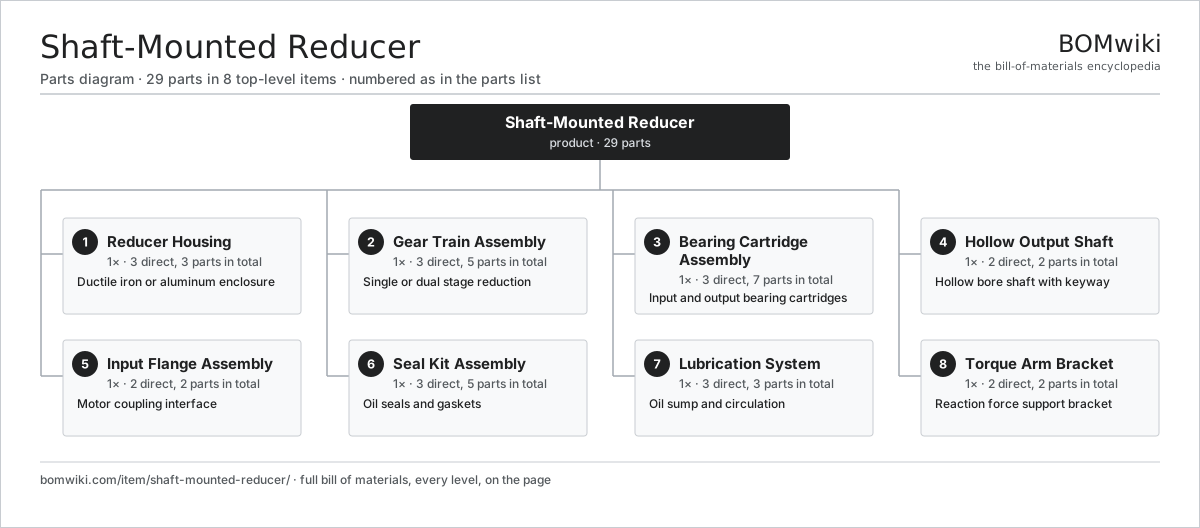
| # | Part | Qty | What it does |
|---|---|---|---|
| 1 | Reducer Housing 3 parts | 1× | Ductile iron or aluminum enclosure |
| 2 | Gear Train Assembly 3 parts | 1× | Single or dual stage reduction |
| 3 | Bearing Cartridge Assembly 3 parts | 1× | Input and output bearing cartridges |
| 4 | Hollow Output Shaft 2 parts | 1× | Hollow bore shaft with keyway |
| 5 | Input Flange Assembly 2 parts | 1× | Motor coupling interface |
| 6 | Seal Kit Assembly 3 parts | 1× | Oil seals and gaskets |
| 7 | Lubrication System 3 parts | 1× | Oil sump and circulation |
| 8 | Torque Arm Bracket 2 parts | 1× | Reaction force support bracket |
3D model
No 3D model yet. Have a CAD file of this? Add a 3D model. STL renders right on this page; STEP, FreeCAD, and OpenSCAD sources are welcome too (openly licensed, like all 3D models on BOMwiki).
Build & assembly graph
expand / collapse · shared sub-assemblies converge · links to related products · est. labourTap an assembly to expand/collapse · tap a part to open it · use “Open page” for any node · drag to pan, scroll to zoom.
Bill of materials for Shaft-Mounted Reducer
8 top-level lines · 29 rows shown · 29 parts total · indented to 3 levels| # | Item / sub-assembly | Part no. | Qty/assy | Ext. qty | Parts | Type |
|---|---|---|---|---|---|---|
| 1 | Reducer Housing 3 parts | shaft-mounted-reducer-housing | 1× | 1 | 3 | assembly |
| 1.1 | Base Casting | shaft-mounted-reducer-base-casting | 1× | 1 | · | part |
| 1.2 | End Cover Plate | shaft-mounted-reducer-end-cover | 1× | 1 | · | part |
| 1.3 | Fastener Set | fastener-set | 1× | 1 | · | part |
| 2 | Gear Train Assembly 3 parts | shaft-mounted-reducer-gear-train | 1× | 1 | 5 | assembly |
| 2.1 | Helical Pinion | shaft-mounted-reducer-pinion | 2× | 2 | · | part |
| 2.2 | Helical Wheel | shaft-mounted-reducer-wheel | 2× | 2 | · | part |
| 2.3 | Intermediate Shaft | shaft-mounted-reducer-gear-shaft | 1× | 1 | · | part |
| 3 | Bearing Cartridge Assembly 3 parts | shaft-mounted-reducer-bearing-support | 1× | 1 | 7 | assembly |
| 3.1 | Ball Bearing | ball-bearing | 4× | 4 | · | part |
| 3.2 | Bearing Collar | shaft-mounted-reducer-bearing-collar | 2× | 2 | · | part |
| 3.3 | Bearing Preload Spring | shaft-mounted-reducer-preload-spring | 1× | 1 | · | part |
| 4 | Hollow Output Shaft 2 parts | shaft-mounted-reducer-hollow-output | 1× | 1 | 2 | assembly |
| 4.1 | Output Bore | shaft-mounted-reducer-output-bore | 1× | 1 | · | part |
| 4.2 | Output Keyway | shaft-mounted-reducer-output-key | 1× | 1 | · | part |
| 5 | Input Flange Assembly 2 parts | shaft-mounted-reducer-input-flange | 1× | 1 | 2 | assembly |
| 5.1 | Input Flange Disc | shaft-mounted-reducer-flange-disc | 1× | 1 | · | part |
| 5.2 | Fastener Set | fastener-set | 1× | 1 | · | part |
| 6 | Seal Kit Assembly 3 parts | shaft-mounted-reducer-seal-kit | 1× | 1 | 5 | assembly |
| 6.1 | Oil Seal | oil-seal | 2× | 2 | · | part |
| 6.2 | Housing Gasket | shaft-mounted-reducer-gasket | 2× | 2 | · | part |
| 6.3 | O-Ring Set | oring-set | 1× | 1 | · | part |
| 7 | Lubrication System 3 parts | shaft-mounted-reducer-lube-system | 1× | 1 | 3 | assembly |
| 7.1 | Sump Cavity | shaft-mounted-reducer-sump-cavity | 1× | 1 | · | part |
| 7.2 | Drain Plug | shaft-mounted-reducer-drain-plug | 1× | 1 | · | part |
| 7.3 | Fill and Breather Plug | shaft-mounted-reducer-fill-breather | 1× | 1 | · | part |
| 8 | Torque Arm Bracket 2 parts | shaft-mounted-reducer-torque-arm | 1× | 1 | 2 | assembly |
| 8.1 | Torque Arm | shaft-mounted-reducer-arm-bracket | 1× | 1 | · | part |
| 8.2 | Fastener Set | fastener-set | 1× | 1 | · | part |
Something wrong in this list? Report a problem with this BOM.
Related products
same domain, ranked by shared parts Continuous Galvanizing Line
1,296 parts · shares 3 with this page
Continuous Galvanizing Line
1,296 parts · shares 3 with this page
 Decanter Centrifuge
172 parts · shares 3 with this page
Decanter Centrifuge
172 parts · shares 3 with this page
Sourcing: possible vendors
Browse the supplier directory → Prices, MOQ, and lead times are algorithmic estimates, not quotes, and not claims about these companies. Company mappings are curated by keyword; est. price band $5k–$2M. How estimates work| Vendor | HQ | Specialty | MOQ | Lead time |
|---|---|---|---|---|
| atlascopco.com ↗ | Stockholm, SE | Compressors & industrial | 10 units | 12–20 wks |
|
🇦🇹Andritz
andritz.com ↗
|
Graz, AT | Process plants & machinery | 10 units | 12–20 wks |
| buhlergroup.com ↗ | Uzwil, CH | Food & materials processing | 10 units | 12–20 wks |
| gea.com ↗ | Düsseldorf, DE | Process technology | 10 units | 12–20 wks |
| mhi.com ↗ | Tokyo, JP | Heavy machinery | 10 units | 12–20 wks |
1,029-word article