Shrimp Peeler Deveiner
ProductOverview
The shrimp peeler-deveiner is the gateway machine in premium shrimp processing, combining mechanical shell removal with pneumatic vein extraction in a single compact unit. Unlike premium-grade headless shell-on shrimp sold fresh, most processed shrimp (for restaurants, prepared foods, and foodservice) must be peeled and deveined. Manual peeling is labor-intensive and inconsistent; industrial peeler-deiners replace knife work with rubber roller friction and vacuum suction, processing 300–800 kg per hour with 95% complete shell removal and 85–95% vein extraction success. The machine accepts whole or tail-on shrimp from upstream (bleach or steam-treated if needed), feeds them belly-up on a conveyor into twin rubber rollers that peel the exoskeleton through friction, and extracts the dark digestive vein via a pneumatic probe with vacuum suction. Output is clean peeled-and-deveined shrimp ready for further processing, icing, or packaging.
Shrimp shell has a complex chitinous structure composed of overlapping segments glued by protein-lipid matrix. Rubber rollers with appropriate durometer (60 Shore A) and microgroove surface texture strip the shell through a combination of compression, friction, and mechanical abrasion. The process is gentler than metal blades, preserving meat quality and color. Deveining, extraction of the dark digestive tract running along the dorsal side, is traditionally done by hand with a sharp pick. Pneumatic extraction probes automate this: a hollow needle pierces the vein, and vacuum sucks it out in a single motion. Success depends on probe diameter (typically 1.5–2.0 mm inner), vacuum strength (0.8 bar), and timing synchronization with roller engagement.
How it works
Whole shrimp are fed into the hopper and orient themselves belly-up on the modular plastic conveyor belt. The belt moves at 30–80 mm/s, controlled independently from the peeling roller speed to allow operator tuning. As each shrimp advances toward the peeling head, it enters the contact zone between the two rotating rubber rollers (200–400 rpm). The rollers are separated by a spring-tensioned guide that applies constant pressure; as shrimp shells are crushed between the rollers, the chitinous exoskeleton flakes and fragments. The microgroove texture on the roller surface provides grip and additional shearing action, enhancing peel quality. A continuous gentle spray of 4°C chilled water washes away loose shell fragments and cools the rollers, preventing rubber hardening from friction heat.
Once the shell is largely removed (after 2–3 seconds of roller contact), the partially peeled shrimp continues forward on the conveyor. An optical sensor or mechanical trigger detects the shrimp position, and the PLC activates the extraction probe. A pneumatic cylinder (double-acting, 30 mm bore) rapidly extends the hollow probe toward the shrimp dorsal surface. The beveled probe tip penetrates the vein; simultaneously, a solenoid-controlled vacuum ejector (venturi type) creates 0.8 bar suction at the probe tip. The vein (a thin cord of tissue 1.5–2 mm diameter) is sucked into and through the hollow probe. At the same moment, a 6 bar air pulse can be used to blow the vein out into a waste collection chamber. The probe retracts, and the now-clean shrimp continues to the discharge chute.
The peeling process is robust and forgiving; even if the probe misses the vein or extraction is incomplete (15–20% of cases), the shrimp is still usable. Some processors install two extraction probes (one dorsal, one ventral) to ensure complete vein removal, improving success to 98%.
Key assemblies
Peeling head: The rubber rollers are the critical wear component. Natural rubber at 60 Shore A is soft enough to grip and peel shell without damaging meat, but hard enough to resist excessive wear. Roller life depends on shrimp size and throughput; small shrimp (16–20 count per pound, ~2 g each) extend roller life to 500–800 hours, while large jumbo shrimp (10–15 count, ~3 g) reduce life to 300–500 hours. Periodic honing with a fine stone (every 100 hours) removes glaze and extends life by 20–30%. When rollers are worn, diameter shrinks from 60 mm to 55 mm, reducing peeling force; replacement is necessary at 55 mm. The roller bearing (tapered roller bearing, size SKF 32309 or equivalent) supports radial loads of 500–1000 kg and requires annual inspection and regreasing.
Vein extraction system: The hollow extraction probe is 1.5–2.0 mm inner diameter stainless steel, beveled at 45° for ease of vein penetration. The vacuum generator is a compact venturi ejector: 6 bar compressed air expands through a nozzle, creating a low-pressure zone that sucks ambient air and products. Modern venturi ejectors achieve 0.8 bar vacuum at 0.5 L/s flow, sufficient to extract a 2 mm vein in 0.2 seconds. Probe life is typically 1000–2000 hours; wear at the beveled tip gradually reduces cutting sharpness, necessitating replacement.
Drive system: The main motor (2–4 kW VFD) powers a helical gearbox (10:1 ratio) driving the peeling rollers at 200–400 rpm. The conveyor belt is separately driven by a smaller motor (0.5–1 kW), allowing independent speed tuning. This decoupling is important: if shrimp are fed too slowly, the rollers over-process and damage meat; if too fast, peeling is incomplete. Typical ratios are 2:1 to 3:1 (roller speed to conveyor speed); at 300 rpm rollers and 100 mm/s conveyor, a shrimp spends 2–3 seconds in the peeling zone.
Pneumatic system: The air compressor (5–10 kW rotary screw) supplies 30–50 cfm at 6 bar to the pilot-operated pressure regulator. The manifold block integrates a 5/3 directional spool solenoid, two pressure switches (low-pressure alarm, high-pressure relief), and the venturi ejector. Total pneumatic duty cycle is typically 10–20% (solenoid activations), so the compressor runs efficiently without constant unloading.
Controls: The PLC sequences the probe extension/retraction in sync with conveyor motion. Typical timing: shrimp detection → 100 ms delay for positioning → probe extend (50 ms) → vacuum on (150 ms) → probe retract (100 ms) → vacuum off. This 400 ms cycle aligns with shrimp spacing on a 100 mm/s conveyor (40 mm spacing = 400 ms headway). The HMI allows operators to adjust probe trigger delay and vacuum dwell time without stopping the machine.
Performance and yield
Small shrimp (16–20 count per pound, 100–150 shrimp/kg) can be processed at 600–800 kg/hour; larger shrimp (10–15 count, 50–70 shrimp/kg) drop to 300–400 kg/hour due to longer roller residence time. Shell recovery is typically 8–10% by weight; the rejected shell can be further processed into shrimp meal or discarded.
Peeling and deveining together result in a 5–10% yield loss (water removal + shell + vein). An operator peeling 100 kg of whole shrimp yields approximately 65–70 kg of peeled product. The machine achieves similar yields but at 5–8 times the speed.
Maintenance and consumables
The rubber rollers are the primary wear item, lasting 300–800 operating hours depending on shrimp size. Replacement cost is $200–400 per pair. Roller reconditioning (honing and diameter restoration via lathe) is economical for the first 2–3 replacements before investing in new rollers.
The vein extraction probe should be inspected weekly for burrs or corrosion at the bevel; a worn probe loses vacuum grip and extraction success drops. Replacement every 1000–2000 hours is typical at $50–100 per probe.
Compressed air system maintenance is routine: air receiver tank pressure test annually, filter element replacement quarterly (or when differential pressure gauge shows red), and desiccant dryer cartridge replacement annually. Oil-lubricated compressor should have oil changed every 500 hours or per manufacturer schedule.
The belt conveyor requires tensioning inspection every 100 hours; worn drive belts (V-belts or synchronous belts) should be replaced as a set to avoid slippage.
Variants and integration
Small facilities (100–200 kg/hour) use manual-feed single-probe machines with fixed roller speed and no feed conveyor, requiring operators to position and activate the machine per shrimp. Mid-range machines (300–500 kg/hour) have auto-feed belt and single probe. High-volume processors (800+ kg/hour) run dual-lane peelers (two complete units side-by-side on a single frame) or multi-probe designs with staggered extraction points.
Integration with upstream chilling (ice-water soak) improves peeling quality by softening the shell-to-meat interface. Downstream icing and packaging are standard.
Premium facilities add a secondary "re-clean" inspection station where a second operator visually checks for residual shell or vein; machines achieving 95% first-pass quality can often skip secondary inspection, improving throughput by 5–10%.
Shrimp Peeler Deveiner parts and their functions
8 top-level parts · 63 parts in total · full bill of materials below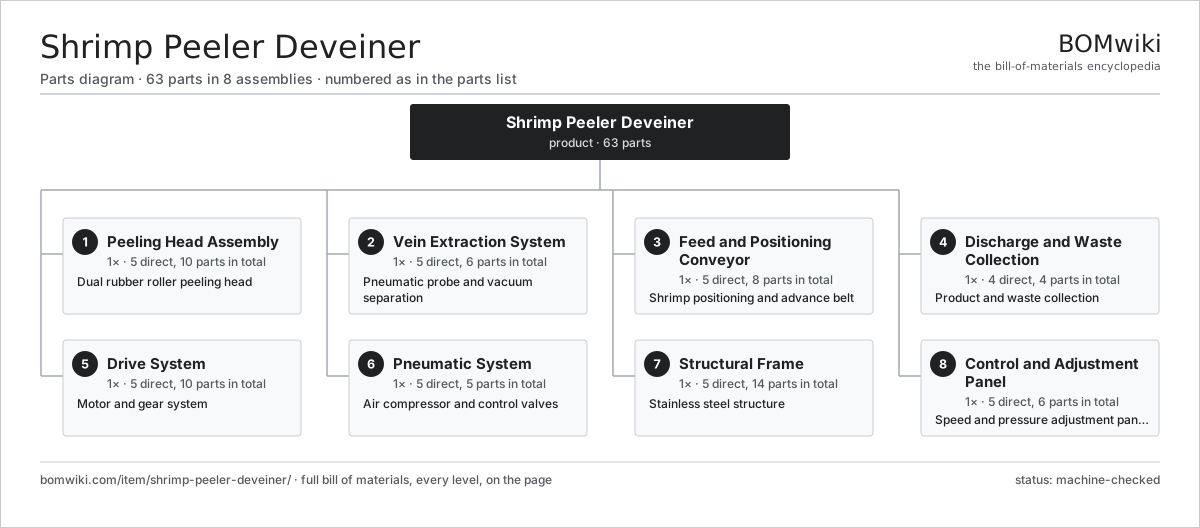
| # | Part | Qty | What it does |
|---|---|---|---|
| 1 | Peeling Head Assembly 5 parts | 1× | Dual rubber roller peeling head |
| 2 | Vein Extraction System 5 parts | 1× | Pneumatic probe and vacuum separation |
| 3 | Feed and Positioning Conveyor 5 parts | 1× | Shrimp positioning and advance belt |
| 4 | Discharge and Waste Collection 4 parts | 1× | Product and waste collection |
| 5 | Drive System 5 parts | 1× | Motor and gear system |
| 6 | Pneumatic System 5 parts | 1× | Air compressor and control valves |
| 7 | Structural Frame 5 parts | 1× | Stainless steel structure |
| 8 | Control and Adjustment Panel 5 parts | 1× | Speed and pressure adjustment panel |
3D model
No 3D model yet. Have a CAD file of this? Add a 3D model — STL renders right on this page; STEP, FreeCAD, and OpenSCAD sources are welcome too (openly licensed, like all 3D models on BOMwiki).
Build & assembly graph
expand / collapse · shared sub-assemblies converge · links to related products · est. labourTap an assembly to expand/collapse · tap a part to open it · use “Open page” for any node · drag to pan, scroll to zoom.
Bill of materials for Shrimp Peeler Deveiner
8 top-level lines · 47 rows shown · 63 parts total · indented to 3 levels| # | Item / sub-assembly | Part no. | Qty/assy | Ext. qty | Parts | Type |
|---|---|---|---|---|---|---|
| 1 | Peeling Head Assembly 5 parts | shrimp-peeler-deveiner-peeling-unit | 1× | 1 | 10 | assembly |
| 1.1 | Peeling Roller | shrimp-peeler-deveiner-rubber-roller | 2× | 2 | · | part |
| 1.2 | Tapered Roller Bearing | shrimp-peeler-deveiner-roller-bearing | 4× | 4 | · | part |
| 1.3 | Peeling Guide Rail | shrimp-peeler-deveiner-peeling-guide | 1× | 1 | · | part |
| 1.4 | Spring Pressure Adjuster | shrimp-peeler-deveiner-spring-tensioner | 1× | 1 | · | part |
| 1.5 | Fastener Set | fastener-set | 2× | 2 | · | part |
| 2 | Vein Extraction System 5 parts | shrimp-peeler-deveiner-vein-extraction | 1× | 1 | 6 | assembly |
| 2.1 | Vein Extraction Needle | shrimp-peeler-deveiner-extraction-probe | 1× | 1 | · | part |
| 2.2 | Vacuum Generator | shrimp-peeler-deveiner-vacuum-ejector | 1× | 1 | · | part |
| 2.3 | Pneumatic Actuator | shrimp-peeler-deveiner-actuator-cylinder | 1× | 1 | · | part |
| 2.4 | Solenoid Control Valve | shrimp-peeler-deveiner-solenoid-valve | 1× | 1 | · | part |
| 2.5 | Connector | connector | 2× | 2 | · | part |
| 3 | Feed and Positioning Conveyor 5 parts | shrimp-peeler-deveiner-feed-conveyor | 1× | 1 | 8 | assembly |
| 3.1 | Conveyor Belt | shrimp-peeler-deveiner-conveyor-belt | 1× | 1 | · | part |
| 3.2 | Loading Hopper | shrimp-peeler-deveiner-feed-hopper | 1× | 1 | · | part |
| 3.3 | Conveyor Motor | shrimp-peeler-deveiner-belt-motor | 1× | 1 | · | part |
| 3.4 | Ball Bearing | ball-bearing | 4× | 4 | · | part |
| 3.5 | Fastener Set | fastener-set | 1× | 1 | · | part |
| 4 | Discharge and Waste Collection 4 parts | shrimp-peeler-deveiner-discharge | 1× | 1 | 4 | assembly |
| 4.1 | Product Discharge Chute | shrimp-peeler-deveiner-product-chute | 1× | 1 | · | part |
| 4.2 | Shell/Waste Collection Basket | shrimp-peeler-deveiner-waste-collection | 1× | 1 | · | part |
| 4.3 | Washdown Spray Header | shrimp-peeler-deveiner-spray-header | 1× | 1 | · | part |
| 4.4 | Fastener Set | fastener-set | 1× | 1 | · | part |
| 5 | Drive System 5 parts | shrimp-peeler-deveiner-drive | 1× | 1 | 10 | assembly |
| 5.1 | Main Drive Motor | shrimp-peeler-deveiner-main-motor | 1× | 1 | · | part |
| 5.2 | Roller Gearbox Reducer | shrimp-peeler-deveiner-roller-gearbox | 1× | 1 | · | part |
| 5.3 | Belt or Synchronous Drive | shrimp-peeler-deveiner-belt-drive | 1× | 1 | · | part |
| 5.4 | Ball Bearing | ball-bearing | 6× | 6 | · | part |
| 5.5 | Fastener Set | fastener-set | 1× | 1 | · | part |
| 6 | Pneumatic System 5 parts | shrimp-peeler-deveiner-pneumatics | 1× | 1 | 5 | assembly |
| 6.1 | Air Compressor | shrimp-peeler-deveiner-air-compressor | 1× | 1 | · | part |
| 6.2 | Air Receiver Tank | shrimp-peeler-deveiner-air-receiver | 1× | 1 | · | part |
| 6.3 | Pressure Regulator | shrimp-peeler-deveiner-regulator | 1× | 1 | · | part |
| 6.4 | Air Filter and Dryer | shrimp-peeler-deveiner-filter-dryer | 1× | 1 | · | part |
| 6.5 | Valve Manifold Block | shrimp-peeler-deveiner-distribution-manifold | 1× | 1 | · | part |
| 7 | Structural Frame 5 parts | shrimp-peeler-deveiner-frame | 1× | 1 | 14 | assembly |
| 7.1 | Base Plate | shrimp-peeler-deveiner-base-frame | 1× | 1 | · | part |
| 7.2 | Vertical Support Column | shrimp-peeler-deveiner-uprights | 4× | 4 | · | part |
| 7.3 | Cross-Brace Beam | shrimp-peeler-deveiner-crossmembers | 6× | 6 | · | part |
| 7.4 | Integral Drip Sump | shrimp-peeler-deveiner-drip-pan | 1× | 1 | · | part |
| 7.5 | Fastener Set | fastener-set | 2× | 2 | · | part |
| 8 | Control and Adjustment Panel 5 parts | shrimp-peeler-deveiner-controls | 1× | 1 | 6 | assembly |
| 8.1 | PLC Controller | shrimp-peeler-deveiner-plc-controller | 1× | 1 | · | part |
| 8.2 | HMI Panel | shrimp-peeler-deveiner-hmi-panel | 1× | 1 | · | part |
| 8.3 | Emergency Stop Button | shrimp-peeler-deveiner-emergency-stop | 1× | 1 | · | part |
| 8.4 | Relay | relay | 2× | 2 | · | part |
| 8.5 | Bare PCB | pcb-bare | 1× | 1 | · | part |
Related products
same domain, ranked by shared parts Automatic Espresso Tamper
45 parts · shares 2 with this page
Automatic Filleting Machine
73 parts · shares 2 with this page
Automatic Espresso Tamper
45 parts · shares 2 with this page
Automatic Filleting Machine
73 parts · shares 2 with this page
 Bakery Deck Oven
44 parts · shares 2 with this page
Beverage Carbonator
95 parts · shares 2 with this page
Bottle Rinser
36 parts · shares 2 with this page
Bakery Deck Oven
44 parts · shares 2 with this page
Beverage Carbonator
95 parts · shares 2 with this page
Bottle Rinser
36 parts · shares 2 with this page
 Bottle Washing Machine
2,388 parts · shares 2 with this page
Bottle Washing Machine
2,388 parts · shares 2 with this page
Sourcing: possible vendors
Prices, MOQ, and lead times are algorithmic estimates, not quotes, and not claims about these companies. Company mappings are curated by keyword; est. price band $1k–$500k. How estimates work| Vendor | HQ | Specialty | MOQ | Lead time |
|---|---|---|---|---|
| gea.com ↗ | Düsseldorf, DE | Process technology | 20 units | 12–20 wks |
| buhlergroup.com ↗ | Uzwil, CH | Food & materials processing | 20 units | 12–20 wks |
| tetrapak.com ↗ | Pully, CH | Food packaging & processing | 20 units | 12–20 wks |
| jbtc.com ↗ | Chicago, US | Food processing equipment | 20 units | 12–20 wks |
| alfalaval.com ↗ | Lund, SE | Heat transfer & separation | 20 units | 12–20 wks |
1,434-word article