Shuffleboard Table
ProductOverview
Shuffleboard is a recreational table game played on a long, low-friction playing surface where players push weighted pucks (also called discs) down the table using a cue stick, attempting to land them in high-point scoring zones while blocking opponents. The Shuffleboard Table combines a carefully engineered bead-covered playing surface that minimizes friction, precise leveling to ensure puck consistency, and climate control to maintain friction coefficients constant across seasons. Shuffleboard is popular in bars, cruise ships, senior centers, and recreational clubs worldwide.
Playing Surface and Friction
The critical component is the deck, a laminated wood base topped with a bonded layer of silicone micro-beads (2–3mm diameter, embedded 1.2mm deep). These beads reduce friction dramatically compared to bare wood, allowing pucks to glide 10–20 meters after a single push. The friction coefficient is intentionally kept low and consistent: 0.15–0.20, compared to 0.5–0.7 for hardwood floors.
Friction varies with humidity and temperature: dry air shrinks wood and stiffens beads, increasing friction. Humid air swells wood and softens beads, decreasing friction. This is why professional shuffleboard facilities employ climate control systems, humidifiers and dehumidifiers maintaining 45–55% relative humidity and 18–22°C temperature. Without this control, summer/winter seasonal changes would make the same push produce wildly different puck speeds, breaking game fairness and player consistency.
Leveling and Installation
The Table Frame must be absolutely horizontal (within ±1mm over 4m length) to prevent pucks from drifting left or right during play. The adjustable screw feet allow precise tuning: installers place pucks at the center and sides of the table, then iteratively adjust feet until pucks stop naturally in the center. This requires patience and precision, many venues hire specialists.
The table also sits on a hardwood or composite base beam that must not sag or twist over time. Venues often place shuffleboard tables in climate-controlled rooms to minimize wood movement from seasonal swelling/shrinking.
Gameplay and Scoring
Two players (or teams of two) face each other from opposite ends. Each player has four pucks, typically red for one player, black for the other. The player pushes a puck down the table using a wooden or fiberglass cue with a V-notch block, imparting controlled momentum. The puck glides down the Playing Deck, potentially bouncing off the wooden bumper rails before settling in a scoring zone.
Scoring zones are typically marked as "+10" (center), "-10" (off to the sides), and outer neutral zones (0 points). The first player to 15 points wins the match. Skill involves precise velocity control, too light and the puck stops short, too hard and it overshoots or bounces off the end rail and returns. Players also use blocking strategy: intentionally positioning their puck to obstruct opponents' pucks from entering high-scoring zones.
Professional and Competitive Play
Professional shuffleboard has standardized rules (National Shuffleboard Association). Tables at tournaments are measured to exact specifications, climate-controlled to guarantee puck behavior, and puck surfaces are inspected for wear and flatness. Tournament-grade tables can cost $3,000–$8,000, while home and bar models cost $500–$2,000.
Competitive players spend hours practicing, learning how to "read" a table's friction and tilt, adjusting push force and trajectory to land pucks within millimeters of target lines.
Maintenance and Surface Degradation
The silicone bead layer gradually compresses and polishes over years of play. A well-maintained table retains consistent friction for 5–10 years. High-traffic venues (cruise ships, active senior centers) may require surface refinishing every 3–5 years. Refinishing involves lightly sanding the bead layer to restore micro-roughness, or replacing the entire top sheet ($1,000–$2,000).
The pucks also wear: their bottoms flatten and scuff with play. Worn pucks glide differently (more friction) and should be rotated out regularly. A set of eight pucks cost $50–$100 total.
Climate Control Implementation
Many high-end tables integrate humidifiers and dehumidifiers into the base structure. These maintain humidity by spraying fine mist (humidifier) or removing moisture via desiccant or Peltier cooling (dehumidifier). A thermostat monitors surface temperature and activates heating or cooling as needed. This closed-loop system ensures that winter cold or summer humidity doesn't degrade play quality.
Recreational tables often skip climate control, relying on venue HVAC systems to maintain reasonable conditions. However, in dry climates or uncontrolled spaces (patios, basements), friction can vary by 30%+ between seasons, frustrating players.
Venue Economics
A shuffleboard table requires ~4m × 1m of floor space. Bars and clubs view them as profitable entertainment: they encourage longer stays, increase drink sales, and occupy space inexpensively compared to billiards or arcade games. Venues typically charge $1–$5 per game (15–40 minutes). A single table generating 8–10 games per evening can yield $100–$200 weekly revenue, making the $1,000–$3,000 initial investment recoup in 5–15 weeks.
Senior centers and cruise ships view shuffleboard as low-impact recreation, appreciated by aging players who enjoy the skill element without the athleticism required for tennis or badminton.
Shuffleboard Table parts and their functions
7 top-level parts · 46 parts in total · full bill of materials below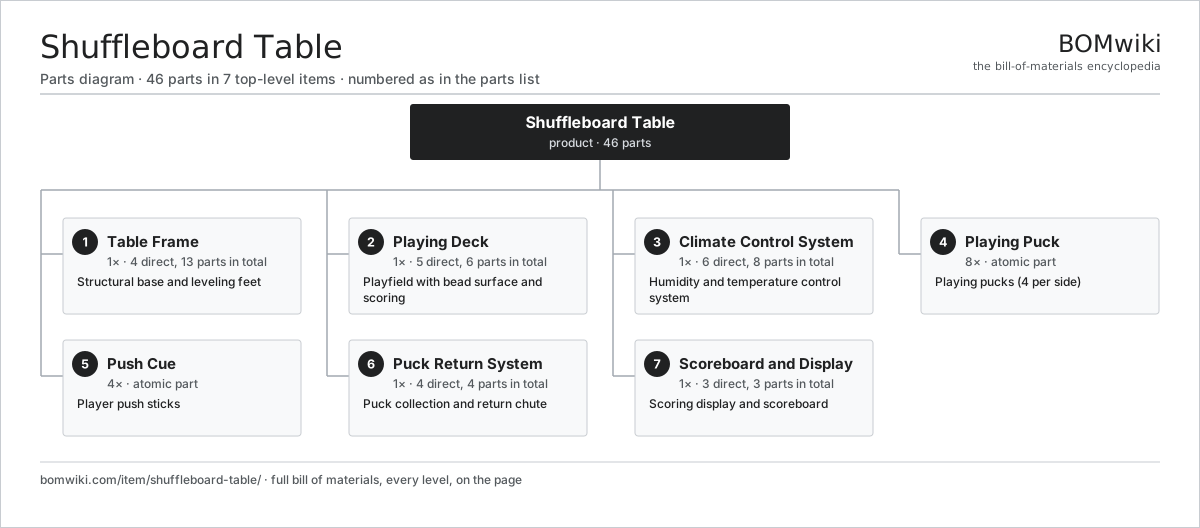
| # | Part | Qty | What it does |
|---|---|---|---|
| 1 | Table Frame 4 parts | 1× | Structural base and leveling feet |
| 2 | Playing Deck 5 parts | 1× | Playfield with bead surface and scoring |
| 3 | Climate Control System 6 parts | 1× | Humidity and temperature control system |
| 4 | Playing Puck | 8× | Playing pucks (4 per side) |
| 5 | Push Cue | 4× | Player push sticks |
| 6 | Puck Return System 4 parts | 1× | Puck collection and return chute |
| 7 | Scoreboard and Display 3 parts | 1× | Scoring display and scoreboard |
3D model
No 3D model yet. Have a CAD file of this? Add a 3D model. STL renders right on this page; STEP, FreeCAD, and OpenSCAD sources are welcome too (openly licensed, like all 3D models on BOMwiki).
Build & assembly graph
expand / collapse · shared sub-assemblies converge · links to related products · est. labourTap an assembly to expand/collapse · tap a part to open it · use “Open page” for any node · drag to pan, scroll to zoom.
Bill of materials for Shuffleboard Table
7 top-level lines · 29 rows shown · 46 parts total · indented to 3 levels| # | Item / sub-assembly | Part no. | Qty/assy | Ext. qty | Parts | Type |
|---|---|---|---|---|---|---|
| 1 | Table Frame 4 parts | shuffleboard-table-frame | 1× | 1 | 13 | assembly |
| 1.1 | Base Beam | shuffleboard-table-base-beam | 2× | 2 | · | part |
| 1.2 | Cross Brace | shuffleboard-table-cross-brace | 4× | 4 | · | part |
| 1.3 | Leveling Foot | shuffleboard-table-leveling-foot | 4× | 4 | · | part |
| 1.4 | Fastener Set | fastener-set | 3× | 3 | · | part |
| 2 | Playing Deck 5 parts | shuffleboard-table-deck | 1× | 1 | 6 | assembly |
| 2.1 | Deck Core | shuffleboard-table-deck-core | 1× | 1 | · | part |
| 2.2 | Bead Playing Surface | shuffleboard-table-bead-layer | 1× | 1 | · | part |
| 2.3 | Scoring Markings | shuffleboard-table-marking-overlay | 1× | 1 | · | part |
| 2.4 | End Bumper Rail | shuffleboard-table-end-rail | 2× | 2 | · | part |
| 2.5 | Fastener Set | fastener-set | 1× | 1 | · | part |
| 3 | Climate Control System 6 parts | shuffleboard-table-climater | 1× | 1 | 8 | assembly |
| 3.1 | Humidifier Module | shuffleboard-table-humidifier | 1× | 1 | · | part |
| 3.2 | Dehumidifier Module | shuffleboard-table-dehumidifier | 1× | 1 | · | part |
| 3.3 | Temperature Control | shuffleboard-table-temperature-sensor | 1× | 1 | · | part |
| 3.4 | Air Circulator | shuffleboard-table-air-circulator | 1× | 1 | · | part |
| 3.5 | Bare PCB | pcb-bare | 1× | 1 | · | part |
| 3.6 | Connector | connector | 3× | 3 | · | part |
| 4 | Playing Puck | shuffleboard-table-puck | 8× | 8 | · | part |
| 5 | Push Cue | shuffleboard-table-cue | 4× | 4 | · | part |
| 6 | Puck Return System 4 parts | shuffleboard-table-return-system | 1× | 1 | 4 | assembly |
| 6.1 | Return Chute | shuffleboard-table-return-chute | 1× | 1 | · | part |
| 6.2 | Puck Hopper | shuffleboard-table-return-hopper | 1× | 1 | · | part |
| 6.3 | Blower Motor | blower-motor | 1× | 1 | · | part |
| 6.4 | Fastener Set | fastener-set | 1× | 1 | · | part |
| 7 | Scoreboard and Display 3 parts | shuffleboard-table-scoring | 1× | 1 | 3 | assembly |
| 7.1 | Electronic Scoreboard | shuffleboard-table-electronic-board | 1× | 1 | · | part |
| 7.2 | Bare PCB | pcb-bare | 1× | 1 | · | part |
| 7.3 | Connector | connector | 1× | 1 | · | part |
Something wrong in this list? Report a problem with this BOM.
Related products
same domain, ranked by shared parts Air Hockey Table
50 parts · shares 1 with this page
Air Hockey Table
50 parts · shares 1 with this page
 Alpine Coaster
1,850 parts · shares 1 with this page
Alpine Coaster
1,850 parts · shares 1 with this page
 Automatic Card Shuffler
87 parts · shares 1 with this page
Bingo Blower
158 parts · shares 1 with this page
Bubble Machine
53 parts · shares 1 with this page
Automatic Card Shuffler
87 parts · shares 1 with this page
Bingo Blower
158 parts · shares 1 with this page
Bubble Machine
53 parts · shares 1 with this page
 Bumper Boats
268 parts · shares 1 with this page
Bumper Boats
268 parts · shares 1 with this page
Sourcing: possible vendors
Browse the supplier directory → Prices, MOQ, and lead times are algorithmic estimates, not quotes, and not claims about these companies. Company mappings are curated by keyword; est. price band $20–$3k. How estimates work| Vendor | HQ | Specialty | MOQ | Lead time |
|---|---|---|---|---|
|
🇩🇰LEGO
lego.com ↗
|
Billund, DK | Construction toys | 2,000 units | 6–10 wks |
|
🇺🇸Mattel
mattel.com ↗
|
El Segundo, US | Toys | 2,000 units | 6–10 wks |
|
🇺🇸Hasbro
hasbro.com ↗
|
Pawtucket, US | Toys & games | 2,000 units | 6–10 wks |
| bandainamco.co.jp ↗ | Tokyo, JP | Toys & amusement | 2,000 units | 6–10 wks |
| spinmaster.com ↗ | Toronto, CA | Toys | 2,000 units | 6–10 wks |
888-word article