Silo Unloader
ProductOverview
A Silo Unloader is a tractor-mounted machine that extracts fermented silage from a vertical silo and loads it into forage wagons for distribution to cattle. Silage storage is the foundation of modern dairy nutrition, fermentation preserves fresh forage over months, smoothing milk production through winter when pasture is unavailable. But silage is inert once stored; it must be extracted, mechanically unloaded, and fed daily. Early unloaders were man-powered (large fork or hand auger), then came explosive powder charges (inefficient and dangerous), and finally mechanical unloaders in the 1960s. Today's rotary cutter design is proven and dominant: a rotating cutting disc suspended by cable into the silo slices off a 15-20 cm layer from the top, an auger conveys it to a blower, and the blower ejects it into a waiting wagon.
The Silo Unloader is operated by tractor hydraulics and PTO, making it a mechanical-only system, no electricity needed. This is critical in barns and silos far from power, and it also means the machine is repairable by any farm mechanic.
Suspension and carousel
The Frame Assembly bolts to the tractor's drawbar (rear hitch) or sometimes to a fixed footing next to the silo. A Carousel Ring bearing (slew ring) allows the entire unloader head to rotate 360° around the silo, so the operator can extract silage at any azimuth without moving the tractor. The rotating platform carries the Cutter Arm, Winch System, and motor manifold.
Cutting mechanism
The Cutter Arm is a hollow steel tube (3-6 m long) extending horizontally from the carousel center, through the silo wall into the silo interior. At the tip is a Cutting Disc, a circular steel blade, 0.3-0.5 m diameter, with replaceable tooth inserts. The disc rotates at 300-500 RPM, powered by a Disc Drive Motor (a hydraulic motor fed by tractor auxiliary hydraulics). As the disc spins and the arm rotates, it sweeps the silage surface, slicing off a 15-20 cm deep layer with each pass.
The cutting mechanism is powerful because silage, when compacted, is nearly concrete-hard. A 300-500 RPM disc tip speed of 5-10 m/s at the cutting edge requires 15-30 cc/rev hydraulic motors consuming 35-60 HP from the tractor.
Winch and lift
The Winch System is the slow-motion element: as the tractor operator unloads material from the top of the silo, the silage surface drops. The cutter arm must be raised continuously to stay at the surface. A Winch Motor (40-75 cc/rev) winds a Steel Cable (100-200 m length, 1/2 - 5/8" diameter wire rope) around a Winch Drum, pulling the arm upward. The cable passes through Pulley blocks that redirect and multiply the force (4:1 or 6:1 mechanical advantage is common).
Winch speed is slow: typically 0.2-0.5 m/min, allowing the operator to fine-tune the arm height. The winch is controlled via a proportional or manual hydraulic spool valve, giving the operator independent control of cable speed while the disc cuts.
Auger conveyor
Cut silage at the arm tip is loose and needs to reach the blower inlet (often 4-6 m away, at the top of the silo). The Discharge Auger moves it there. The auger is a spiral screw: a Screw Flight (a helical steel ribbon) wound around a central shaft, enclosed in a Auger Tube. As the flight rotates (driven by a Auger Motor, a hydraulic motor), it conveys material at 10-20 m/min upward and toward the blower inlet.
The auger is typically oriented at 45-60° from horizontal, so gravity assists the material movement slightly. Auger slip (material sliding back down) is a design consideration; augers for wet, sticky silage are slower and steeper to maintain steady flow.
Blower and discharge
At the blower inlet, the Discharge Blower accelerates the silage and ejects it through a Discharge Chute. The Impeller is a centrifugal rotor (not a fan) spinning at 1000+ RPM, launching silage at 20-30 m/s into the chute. The chute is adjustable (tilting 45-90°) to direct material into a forage wagon or spreader box positioned alongside the silo.
Discharge rate is typically 15-50 tons per hour depending on machine size, silage moisture (wet silage flows faster than dry), and operator speed control. A large silo with dense silage can feed 100+ cows; the unloader running 1-2 hours per day is sufficient for two milkings' feed.
Operator control and coordination
The Control System require careful coordination. The operator must:
- Engage the PTO clutch to start the hydraulic pump.
- Open the main spool valve to pressurize the system.
- Adjust the winch valve to raise the arm at a steady rate (matching the silage discharge rate).
- Adjust the disc valve to control cutting power.
- Monitor silage flow and adjust the chute angle.
- Stop the disc and lower the arm when unloading is complete.
Modern machines add:
- Hydraulic proportional valves allowing smooth, operator-free arm raising (a mechanical linkage or load-sense system).
- Indicators (digital or analog) showing cable position and remaining silage height.
- Safety interlocks preventing the arm from falling if hydraulic pressure is lost.
Maintenance and wear
Cutting disc teeth wear and break; replacement inserts cost USD 500-1500 per set and last 50-100 silo unloads. Cable inspection and replacement every 10-15 years is critical (failure during unloading can drop the arm and damage the machine). Hydraulic hoses and fittings are subject to pressure pulses and vibration; annual hose inspection is recommended.
The carousel bearing (slew ring) is a wear item; if it becomes rough or stiff, rotating the unloader becomes difficult or impossible. Replacement can be USD 5000+, a major repair.
Why unloaders matter
Before mechanical unloaders, silage was dug out by hand, a 6-8 hour daily task requiring 1-2 workers. A single operator with a modern unloader (often a secondary task during morning chores) completes the same job in 1-2 hours. The labor savings alone justified the cost historically; today, with rural labor scarce, an unloader is essential for any herd larger than 30-40 cows.
Unloader quality also affects silage quality. A good cutter disc creates a clean cut with minimal heating or reheating; a dull disc mashes and heats the silage, promoting yeast and mold growth. This is why disc maintenance is a priority.
Models and variations
- Bottom unloader: Rare, removes silage from the base of the silo via a horizontal screw. Complex and prone to ice bridging in winter.
- Top unloader (most common): The suspended-arm rotary design described here.
- Roto-cut: A drum-fed auger replacing the disc; gentler on delicate silage but slower.
- Leveler only: A blade that does not cut but only pushes silage forward (cheaper, used in bunker or bag silos).
For tower silos with vertical unloading access, the top rotary cutter is the industry standard.
Silo Unloader parts and their functions
6 top-level parts · 32 parts in total · full bill of materials below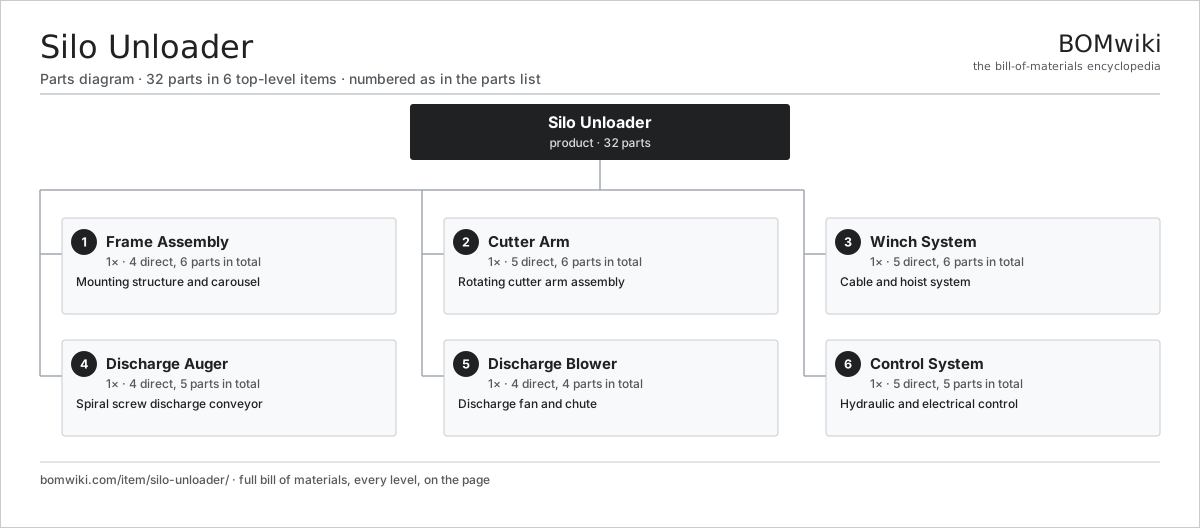
| # | Part | Qty | What it does |
|---|---|---|---|
| 1 | Frame Assembly 4 parts | 1× | Mounting structure and carousel |
| 2 | Cutter Arm 5 parts | 1× | Rotating cutter arm assembly |
| 3 | Winch System 5 parts | 1× | Cable and hoist system |
| 4 | Discharge Auger 4 parts | 1× | Spiral screw discharge conveyor |
| 5 | Discharge Blower 4 parts | 1× | Discharge fan and chute |
| 6 | Control System 5 parts | 1× | Hydraulic and electrical control |
3D model
No 3D model yet. Have a CAD file of this? Add a 3D model. STL renders right on this page; STEP, FreeCAD, and OpenSCAD sources are welcome too (openly licensed, like all 3D models on BOMwiki).
Build & assembly graph
expand / collapse · shared sub-assemblies converge · links to related products · est. labourTap an assembly to expand/collapse · tap a part to open it · use “Open page” for any node · drag to pan, scroll to zoom.
Bill of materials for Silo Unloader
6 top-level lines · 33 rows shown · 32 parts total · indented to 3 levels| # | Item / sub-assembly | Part no. | Qty/assy | Ext. qty | Parts | Type |
|---|---|---|---|---|---|---|
| 1 | Frame Assembly 4 parts | silo-unloader-frame | 1× | 1 | 6 | assembly |
| 1.1 | Drawbar Frame | silo-unloader-drawbar-frame | 1× | 1 | · | part |
| 1.2 | Carousel Ring | silo-unloader-carousel-ring | 1× | 1 | · | part |
| 1.3 | Pivot Bearing | silo-unloader-pivot-bearing | 2× | 2 | · | part |
| 1.4 | Fastener Set | fastener-set | 2× | 2 | · | part |
| 2 | Cutter Arm 5 parts | silo-unloader-cutter-arm | 1× | 1 | 6 | assembly |
| 2.1 | Arm Tube | silo-unloader-arm-tube | 1× | 1 | · | part |
| 2.2 | Cutting Disc | silo-unloader-cutting-disc | 1× | 1 | · | part |
| 2.3 | Disc Drive Motor | silo-unloader-disc-motor | 1× | 1 | · | part |
| 2.4 | Arm Bearing | silo-unloader-arm-bearing | 2× | 2 | · | part |
| 2.5 | Fastener Set | fastener-set | 1× | 1 | · | part |
| 3 | Winch System 5 parts | silo-unloader-winch | 1× | 1 | 6 | assembly |
| 3.1 | Steel Cable | silo-unloader-cable | 1× | 1 | · | part |
| 3.2 | Winch Drum | silo-unloader-winch-drum | 1× | 1 | · | part |
| 3.3 | Winch Motor | silo-unloader-winch-motor | 1× | 1 | · | part |
| 3.4 | Pulley | silo-unloader-pulley | 2× | 2 | · | part |
| 3.5 | Fastener Set | fastener-set | 1× | 1 | · | part |
| 4 | Discharge Auger 4 parts | silo-unloader-auger | 1× | 1 | 5 | assembly |
| 4.1 | Auger Tube | silo-unloader-auger-tube | 1× | 1 | · | part |
| 4.2 | Screw Flight | silo-unloader-auger-flight | 1× | 1 | · | part |
| 4.3 | Auger Motor | silo-unloader-auger-motor | 1× | 1 | · | part |
| 4.4 | Auger Bearing | silo-unloader-auger-bearing | 2× | 2 | · | part |
| 5 | Discharge Blower 4 parts | silo-unloader-blower | 1× | 1 | 4 | assembly |
| 5.1 | Blower Motor | silo-unloader-blower-motor | 1× | 1 | · | part |
| 5.2 | Impeller | silo-unloader-blower-impeller | 1× | 1 | · | part |
| 5.3 | Discharge Chute | silo-unloader-discharge-chute | 1× | 1 | · | part |
| 5.4 | Connector | connector | 1× | 1 | · | part |
| 6 | Control System 5 parts | silo-unloader-controls | 1× | 1 | 5 | assembly |
| 6.1 | Main Spool Valve | silo-unloader-main-valve | 1× | 1 | · | part |
| 6.2 | Winch Control Valve | silo-unloader-winch-valve | 1× | 1 | · | part |
| 6.3 | Disc Control Valve | silo-unloader-disc-valve | 1× | 1 | · | part |
| 6.4 | PTO Clutch | silo-unloader-pto-clutch | 1× | 1 | · | part |
| 6.5 | Relay | relay | 1× | 1 | · | part |
Something wrong in this list? Report a problem with this BOM.
Related products
same domain, ranked by shared parts Agricultural Tractor
306 parts · shares 1 with this page
Agricultural Tractor
306 parts · shares 1 with this page
 Articulated Tractor
1,229 parts · shares 1 with this page
Articulated Tractor
1,229 parts · shares 1 with this page
 Beet Cleaner Loader
228 parts · shares 1 with this page
Beet Cleaner Loader
228 parts · shares 1 with this page
 Boom Sprayer
356 parts · shares 1 with this page
Boom Sprayer
356 parts · shares 1 with this page
 Cane Harvester
287 parts · shares 1 with this page
Cane Harvester
287 parts · shares 1 with this page
 Center-Pivot Irrigator
945 parts · shares 1 with this page
Center-Pivot Irrigator
945 parts · shares 1 with this page
Sourcing: possible vendors
Browse the supplier directory → Prices, MOQ, and lead times are algorithmic estimates, not quotes, and not claims about these companies. Company mappings are curated by keyword; est. price band $5k–$800k. How estimates work| Vendor | HQ | Specialty | MOQ | Lead time |
|---|---|---|---|---|
| deere.com ↗ | Moline, US | Agriculture & turf | made to order | 14–24 wks |
| cnh.com ↗ | Basildon, GB | Agriculture (Case IH, New Holland) | made to order | 14–24 wks |
|
🇺🇸AGCO
agcocorp.com ↗
|
Duluth, US | Agriculture (Fendt, Massey Ferguson) | made to order | 14–24 wks |
|
🇩🇪Claas
claas.com ↗
|
Harsewinkel, DE | Harvesters & tractors | made to order | 14–24 wks |
|
🇯🇵Kubota
kubota.com ↗
|
Osaka, JP | Compact tractors & equipment | made to order | 14–24 wks |
1,192-word article