Sit-to-Stand Lift
ProductOverview
A sit-to-stand lift (also called a stand-assist lift or standing aid) is a mobile device that assists elderly or disabled patients in transitioning from a seated position (bed, chair, toilet) to standing without requiring full-body lifting by caregivers. The device uses forward-reaching motorized arms to support the patient's upper body while forward-tilting the torso, leveraging the patient's remaining leg strength and core stability to facilitate the standing motion.
Unlike full-body patient hoists, sit-to-stand lifts assume the patient retains some lower-limb strength (ability to bear 30–60% of body weight) and some cognitive ability to cooperate. They are ideal for assisted-living facilities, nursing homes, and home care settings where patients have mild to moderate mobility restrictions, as they preserve patient dignity and functional participation while reducing caregiver injury risk during frequent transfers.
How it works
The device is positioned in front of a seated patient, with the stable wheeled base anchoring the unit. The patient grasps the padded lift arms (positioned at ~45–60 degrees forward from vertical) and leans forward slightly, bringing chest toward knees. The patient or caregiver presses the raise button on the Control Pendant, activating the Motor.
The pump motor drives two synchronized hydraulic cylinders (or electric linear actuators) that extend simultaneously, pushing the lift arms upward and slightly forward. As the patient's arms rise, the Knee Pad prevents backward leg sliding, anchoring the lower body. The patient simultaneously activates leg muscles to push downward through feet, and the combined motion, patient pushing through legs plus device lifting through arms, smoothly transfers the patient to standing in 20–40 seconds.
The device supports 40–100% of patient weight depending on the assistance level selected; this is not mechanically controlled but rather electrically modulated, the Onboard Electronics can reduce motor force if the patient is strong enough to benefit from a "train" level of support that maintains muscle activation.
Clinical advantages
Preserves patient function: Unlike full-body hoists that support all weight, sit-to-stand lifts require the patient to activate leg and core muscles, maintaining strength and proprioceptive engagement. Prolonged disuse of lower-limb muscles accelerates deconditioning and fall risk; sit-to-stand devices combat this.
Reduces caregiver strain: A single caregiver can manage the transfer using the device, preventing back injury. Manual assists by caregivers (one holding each arm) cause ~600,000 back injuries annually in healthcare workers; mechanical assistance dramatically reduces this burden.
Portable and flexible: Unlike ceiling hoists, sit-to-stand lifts are wheeled and can be moved between rooms, facilities, or patient homes. The Battery Pack enables cordless operation, eliminating need for fixed electrical supply.
Improves patient confidence: Elderly patients often develop psychological fear of falling during transitions; having a mechanical assist restores confidence to attempt sit-to-stand independently, reducing immobility-related deconditioning.
Limitations and patient selection
Sit-to-stand lifts require minimum functional thresholds:
- Ability to understand and follow commands.
- Sufficient cognitive reserve to cooperate during the assist.
- Minimum 30–40% lower-limb strength to generate some push-off force.
- Tolerance of forward trunk bending without orthostatic hypotension or dizziness.
Patients with severe spasticity, severe dementia, or profound weakness are better served by full-body hoists. Patients recovering from hip surgery may have weight-bearing precautions (toe-touch weight bearing, partial weight bearing, etc.) that contraindicate sit-to-stand devices; they require custom-selected devices or full hoists with graduated load management.
Arm angle and chair height accommodation
The Arm Angle Adjuster allows the lift arms to be positioned at angles between 30 and 60 degrees from vertical. A more vertical angle (30–40 degrees) suits tall chairs or high beds; a more horizontal angle (50–60 degrees) suits low-height seats or patients with limited hip flexibility. Quick adjustment (typically a lever-lock or pin) allows customization per patient and per environment.
Hydraulic vs. electric systems
Traditional sit-to-stand lifts use hydraulic systems (gear pump driven by DC motor) for smooth, variable-speed control and high reliability. Newer designs use direct electric linear actuators (lead-screw or belt-drive), eliminating hydraulic fluid and reducing maintenance. Both approaches support smooth proportional control via the Control Pendant.
Battery operation and portability
The Battery Pack typically stores 2–4 Ah at 48 V (96–192 Wh total energy). At 0.5 kW motor power, this yields 12–24 minutes of continuous motor runtime; however, a typical rise takes 30 seconds, so ~1.4 kWh per transfer. With facility-based use at 20–30 transfers daily, batteries charge nightly via the Battery Charger (2–5 A fast charger) for 8–12 hours continuous operation the next day.
Cordless operation enables use in patient homes, temporary care settings, or transport between facility locations without need for fixed electrical infrastructure.
Safety and load monitoring
The Relief Valve caps system pressure at 100–150 bar, preventing over-pressurization during asymmetric loading (e.g., patient leaning to one side). The Pressure Sensor monitors load; if load drops suddenly (patient falling), the Onboard Electronics halts motor motion instantly. The Emergency Stop (either a deadman grip or separate E-stop button) allows patient or caregiver to halt motion at any point.
The rear brakes lock the wheels during use, preventing device rollaway. Some models include sensors detecting when the patient is in proper contact with the arms, disabling motor if contact is lost.
Sit-to-Stand Lift parts and their functions
7 top-level parts · 60 parts in total · full bill of materials below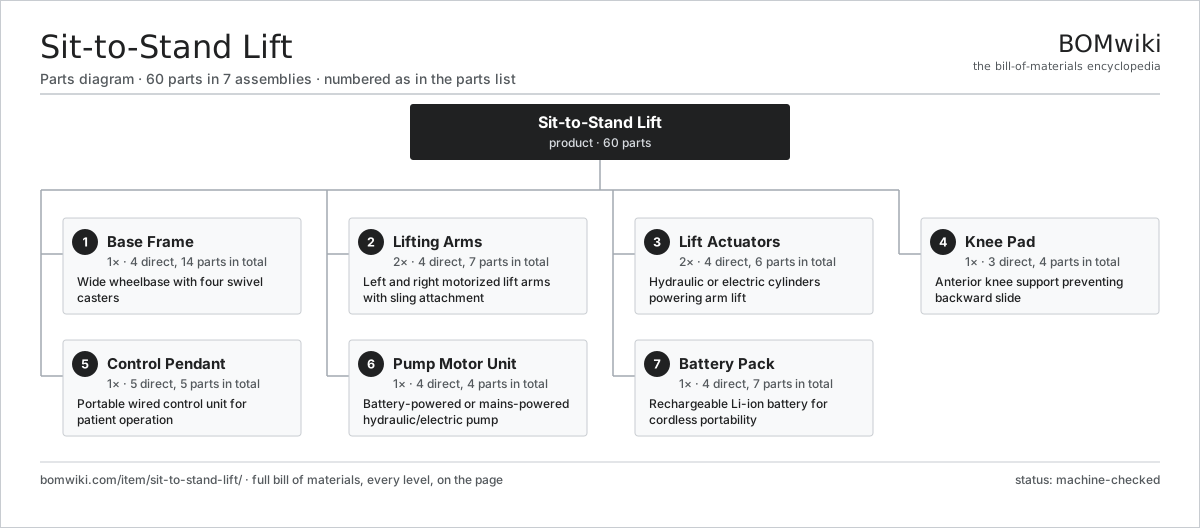
| # | Part | Qty | What it does |
|---|---|---|---|
| 1 | Base Frame 4 parts | 1× | Wide wheelbase with four swivel casters |
| 2 | Lifting Arms 4 parts | 2× | Left and right motorized lift arms with sling attachment |
| 3 | Lift Actuators 4 parts | 2× | Hydraulic or electric cylinders powering arm lift |
| 4 | Knee Pad 3 parts | 1× | Anterior knee support preventing backward slide |
| 5 | Control Pendant 5 parts | 1× | Portable wired control unit for patient operation |
| 6 | Pump Motor Unit 4 parts | 1× | Battery-powered or mains-powered hydraulic/electric pump |
| 7 | Battery Pack 4 parts | 1× | Rechargeable Li-ion battery for cordless portability |
3D model
No 3D model yet. Have a CAD file of this? Add a 3D model — STL renders right on this page; STEP, FreeCAD, and OpenSCAD sources are welcome too (openly licensed, like all 3D models on BOMwiki).
Build & assembly graph
expand / collapse · shared sub-assemblies converge · links to related products · est. labourTap an assembly to expand/collapse · tap a part to open it · use “Open page” for any node · drag to pan, scroll to zoom.
Bill of materials for Sit-to-Stand Lift
7 top-level lines · 35 rows shown · 60 parts total · indented to 3 levels| # | Item / sub-assembly | Part no. | Qty/assy | Ext. qty | Parts | Type |
|---|---|---|---|---|---|---|
| 1 | Base Frame 4 parts | sit-to-stand-lift-base-frame | 1× | 1 | 14 | assembly |
| 1.1 | Base Plate | sit-to-stand-lift-base-plate | 1× | 1 | · | part |
| 1.2 | Caster Set | sit-to-stand-lift-caster-set | 4× | 4 | · | part |
| 1.3 | Upright Post | sit-to-stand-lift-upright-post | 1× | 1 | · | part |
| 1.4 | Fastener Set | fastener-set | 8× | 8 | · | part |
| 2 | Lifting Arms 4 parts | sit-to-stand-lift-lifting-arms | 2× | 2 | 7 | assembly |
| 2.1 | Arm Link | sit-to-stand-lift-arm-link | 2× | 4 | · | part |
| 2.2 | Arm Pad | sit-to-stand-lift-arm-pad | 2× | 4 | · | part |
| 2.3 | Arm Angle Adjuster | sit-to-stand-lift-arm-angle-adjuster | 1× | 2 | · | part |
| 2.4 | Connector | connector | 2× | 4 | · | part |
| 3 | Lift Actuators 4 parts | sit-to-stand-lift-actuator-pair | 2× | 2 | 6 | assembly |
| 3.1 | Actuator Cylinder | sit-to-stand-lift-actuator-cylinder | 2× | 4 | · | part |
| 3.2 | Linkage Bar | sit-to-stand-lift-linkage-bar | 2× | 4 | · | part |
| 3.3 | Position Feedback | sit-to-stand-lift-position-feedback | 1× | 2 | · | part |
| 3.4 | Pressure Sensor | pressure-sensor | 1× | 2 | · | part |
| 4 | Knee Pad 3 parts | sit-to-stand-lift-knee-pad | 1× | 1 | 4 | assembly |
| 4.1 | Knee Foam | sit-to-stand-lift-knee-foam | 1× | 1 | · | part |
| 4.2 | Knee Mount | sit-to-stand-lift-knee-mount | 1× | 1 | · | part |
| 4.3 | Fastener Set | fastener-set | 2× | 2 | · | part |
| 5 | Control Pendant 5 parts | sit-to-stand-lift-control-pendant | 1× | 1 | 5 | assembly |
| 5.1 | Pendant Housing | sit-to-stand-lift-pendant-housing | 1× | 1 | · | part |
| 5.2 | Raise Button | sit-to-stand-lift-raise-button | 1× | 1 | · | part |
| 5.3 | Lower Button | sit-to-stand-lift-lower-button | 1× | 1 | · | part |
| 5.4 | Emergency Stop | sit-to-stand-lift-emergency-stop | 1× | 1 | · | part |
| 5.5 | Wire Bundle | wire-bundle | 1× | 1 | · | part |
| 6 | Pump Motor Unit 4 parts | sit-to-stand-lift-pump-motor | 1× | 1 | 4 | assembly |
| 6.1 | Motor | sit-to-stand-lift-motor | 1× | 1 | · | part |
| 6.2 | Pump | sit-to-stand-lift-pump | 1× | 1 | · | part |
| 6.3 | Relief Valve | sit-to-stand-lift-relief-valve | 1× | 1 | · | part |
| 6.4 | Onboard Electronics | sit-to-stand-lift-onboard-electronics | 1× | 1 | · | part |
| 7 | Battery Pack 4 parts | sit-to-stand-lift-battery-pack | 1× | 1 | 7 | assembly |
| 7.1 | LiPo Cell | lipo-cell | 4× | 4 | · | part |
| 7.2 | Battery Management System | sit-to-stand-lift-bms-module | 1× | 1 | · | part |
| 7.3 | Power Connector | sit-to-stand-lift-connector-power | 1× | 1 | · | part |
| 7.4 | Battery Charger | sit-to-stand-lift-charger | 1× | 1 | · | part |
Related products
same domain, ranked by shared parts Fetal Monitor
312 parts · shares 3 with this page
Fetal Monitor
312 parts · shares 3 with this page
 Syringe Pump
252 parts · shares 3 with this page
Syringe Pump
252 parts · shares 3 with this page
 Vital Signs Monitor
499 parts · shares 3 with this page
Vital Signs Monitor
499 parts · shares 3 with this page
 Robotic Prosthetic Arm
84 parts · shares 2 with this page
Robotic Prosthetic Arm
84 parts · shares 2 with this page
 Anesthesia Machine
562 parts · shares 2 with this page
ECG Machine
719 parts · shares 2 with this page
Anesthesia Machine
562 parts · shares 2 with this page
ECG Machine
719 parts · shares 2 with this page
Sourcing: possible vendors
Prices, MOQ, and lead times are algorithmic estimates, not quotes, and not claims about these companies. Company mappings are curated by keyword; est. price band $500–$3M. How estimates work| Vendor | HQ | Specialty | MOQ | Lead time |
|---|---|---|---|---|
| gehealthcare.com ↗ | Chicago, US | Medical imaging & devices | 100 units | 12–20 wks |
| siemens-healthineers.com ↗ | Erlangen, DE | Medical systems | 100 units | 12–20 wks |
|
🇳🇱Philips
philips.com ↗
|
Amsterdam, NL | Health technology | 100 units | 12–20 wks |
| medtronic.com ↗ | Minneapolis, US | Medical devices | 100 units | 12–20 wks |
|
🇨🇳Mindray
mindray.com ↗
|
Shenzhen, CN | Medical devices | 100 units | 12–20 wks |
976-word article