Sitar
ProductOverview
The sitar is a long-necked lute of North Indian classical tradition. Its defining feature is the Resonator, a gourd that provides both acoustic amplification and a distinctive buzzing timbre characteristic of Indian classical music. Unlike a guitar or lute with a flat, rigid soundboard, the sitar's hollow gourd resonates freely, and its many strings (main, bass, and sympathetic) create a halo of harmonic colour that extends each note far beyond its initial strike.
The instrument carries typically four main strings played with a plectrum, one melody string and three bass strings that establish rhythm and drone, plus thirteen unfingered sympathetic strings tuned to scale degrees. When the player strikes a melody note on the main string, the corresponding sympathetic string vibrates in sympathy, creating the sitar's characteristic shimmering sustain.
Resonator
The Resonator is a dried gourd (Lagenaria siceraria, a species of bottle squash), typically 20–30 cm in diameter, hollowed out and left to season. The gourd's shape and thickness vary by maker and region; thinner gourds are more resonant but more fragile, thicker ones are more durable but duller. The Gourd Body is acoustically massive, a single struck note will sustain for 10–20 seconds as the gourd slowly releases stored vibrational energy. This is the sitar's signature behaviour: rapid decay of the strike sound, then a slow tail of sympathetic resonance.
A smaller secondary Second Gourd (optional) mounted halfway up the neck (called a jhala) is optional but common in concert instruments. It further extends sustain and raises the overall tonal brightness.
The Air Holes (usually two or three circular openings on the gourd side) tune the resonance peak. Their size and position are adjusted by the maker to match the sitar's string set and intended tuning.
Neck and frets
The long Neck Assembly is a solid hardwood beam (teak, walnut, or sheesham), typically 90–110 cm long. Unlike a Western guitar, the sitar neck has no solid fretboard or nut at the base. Instead, a shallow Neck Groove runs along the top where the sympathetic strings sit, and the main strings lie atop a curved bridge.
The Fret System is the most distinctive feature. Rather than fixed frets pressed into a fingerboard, a sitar has movable brass Brass Frets held in place by Fret Rope, traditionally gut, now often nylon, woven under the frets. Each fret is roughly semi-circular in cross-section, high enough that the player's finger never touches the neck wood, only the fret itself. This allows the player to slide the finger along a fret before moving to the next, executing smooth portamento (gliding between pitches) and the microtonal intervals essential to raag (raga) performance. A few frets (usually 5–7) are fixed; the remainder are movable for tuning and retuning within a session.
Strings and playback
The sitar has four Main Strings: typically one Melody String of ~0.8 mm steel, which carries the main melodic voice, and three heavier Bass Strings (khoj) of ~1.2 mm that establish a rhythmic and harmonic foundation. All four lie across a high Main Jawari bridge (jawari) that sits on the gourd but is not glued, allowing it to move slightly and produce the characteristic buzzing timbre.
The player wears a plectrum (mizrab) on the index finger of the right hand, a triangular brass or bone pick. The left hand frets the melody string, while the right hand maintains the rhythm on the bass strings and occasionally crosses to the melody.
Underneath the main strings, passing through a bridge position, lie thirteen Sympathetic Strings, unfingered, unplucked, and tuned to scale degrees. When a main string vibrates, the Sympathetic Bridge (jawari-style) couples that vibration to the sympathetic strings, which then resonate in tune with the played note. This creates the sitar's wash of harmonic colour: strike a single note and the whole instrument seems to sing in response.
Bridges and jawari tone
The Bridges are the critical tone control. The main Main Jawari is a curved piece of bone or hardwood with a sharp, narrow high point where the strings sit. This narrow contact point causes the strings to buzz slightly against the bridge, creating that characteristic ''tsing'' attack. If the jawari is too high, the strings buzz excessively and the attack becomes harsh; if too low, the buzz disappears and the tone is dull. Makers and players spend considerable effort carving and tuning the jawari curve. The Bridge Height Adjuster allows fine adjustment by moving shims or the bridge base.
The Sympathetic Jawari serves the sympathetic strings, tuned to sustain their resonance without the buzz of the main strings.
Tuning
A sitar typically has 20 wooden or plastic conical pegs at the head, one per main/bass string (4) and one per sympathetic string (13), plus a few extras. Each peg is wound with string and turned to tension the strings. Friction Rings (brass or horn washers) underneath each peg provide friction to hold the tuning once set.
Typical tuning varies by raag and player preference. Common starting points are Sa-Pa or Sa-Sa on the main strings (separating the melody string from the bass drones), with the sympathetic strings tuned to the ascending scale of the raag being performed. Before a performance, a player may spend 15–30 minutes tuning and retuning, adjusting for temperature and humidity, which cause the gourd and strings to swell and shrink.
Playing technique
The player holds the sitar upright, resting it on the left thigh. The right hand plucks and strikes with the mizrab (plectrum), establishing rhythm on the bass strings while the left hand plays melody on the fretted main string. The left-hand technique is entirely finger-based: no pick, no nails, just the pads of the fingers sliding along the smooth brass frets. This allows exquisite control over pitch bending, vibrato (meend), and fast runs. A skilled player can execute microtonal slides smaller than a semitone, essential to the intonation of Indian classical music, which divides the octave into 22 ''shrutis'' (tuning references) rather than 12 equal temperament steps.
The typical sound is: strike a melody note, the main string decays within 2–3 seconds, but the sympathetic string corresponding to that note continues to ring, joined by nearby harmonics. The result is a single note that unfolds over time, with a complex harmonic evolution that makes the sitar instantly recognizable.
Sitar parts and their functions
7 top-level parts · 94 parts in total · full bill of materials below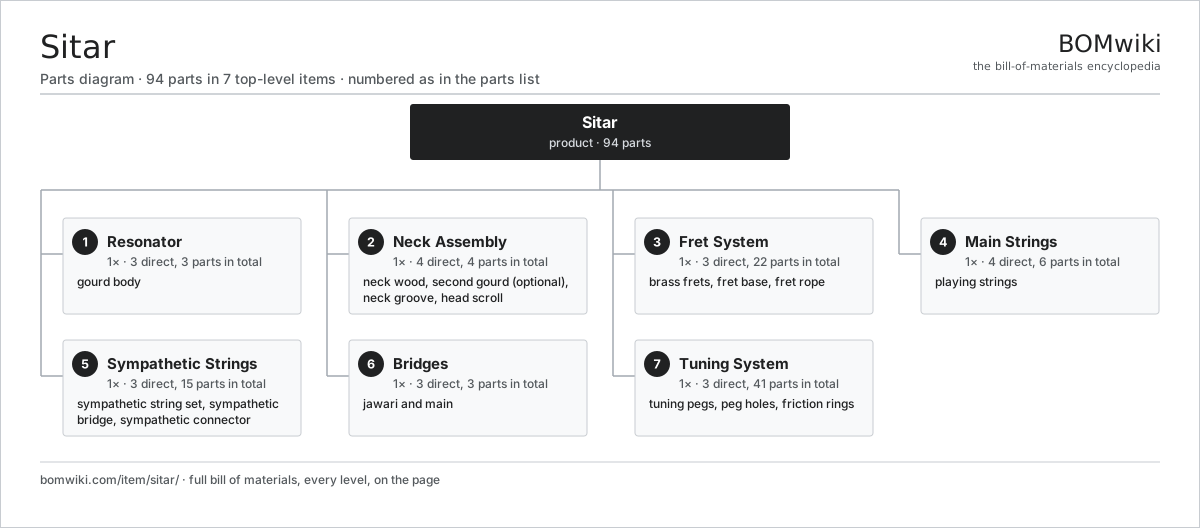
| # | Part | Qty | What it does |
|---|---|---|---|
| 1 | Resonator 3 parts | 1× | gourd body |
| 2 | Neck Assembly 4 parts | 1× | Long wooden neck carrying the frets and string attachment points. |
| 3 | Fret System 3 parts | 1× | Curved brass frets allowing finger position slides and microtonal bending. |
| 4 | Main Strings 4 parts | 1× | playing strings |
| 5 | Sympathetic Strings 3 parts | 1× | Set of unfingered strings tuned to harmonic pitches, vibrating in resonance with the played notes. |
| 6 | Bridges 3 parts | 1× | jawari and main |
| 7 | Tuning System 3 parts | 1× | Pegs and friction mechanisms at the head controlling all string tensions. |
3D model
No 3D model yet. Have a CAD file of this? Add a 3D model. STL renders right on this page; STEP, FreeCAD, and OpenSCAD sources are welcome too (openly licensed, like all 3D models on BOMwiki).
Build & assembly graph
expand / collapse · shared sub-assemblies converge · links to related products · est. labourTap an assembly to expand/collapse · tap a part to open it · use “Open page” for any node · drag to pan, scroll to zoom.
Bill of materials for Sitar
7 top-level lines · 30 rows shown · 94 parts total · indented to 3 levels| # | Item / sub-assembly | Part no. | Qty/assy | Ext. qty | Parts | Type |
|---|---|---|---|---|---|---|
| 1 | Resonator 3 parts | sitar-resonator | 1× | 1 | 3 | assembly |
| 1.1 | Gourd Body | sitar-gourd-body | 1× | 1 | · | part |
| 1.2 | Resonator Neck Joint | sitar-resonator-neck-joint | 1× | 1 | · | part |
| 1.3 | Air Holes | sitar-air-holes | 1× | 1 | · | part |
| 2 | Neck Assembly 4 parts | sitar-neck-assembly | 1× | 1 | 4 | assembly |
| 2.1 | Neck Wood | sitar-neck-wood | 1× | 1 | · | part |
| 2.2 | Second Gourd (optional) | sitar-second-gourd | 1× | 1 | · | part |
| 2.3 | Neck Groove | sitar-neck-groove | 1× | 1 | · | part |
| 2.4 | Head Scroll | sitar-head-scroll | 1× | 1 | · | part |
| 3 | Fret System 3 parts | sitar-fret-system | 1× | 1 | 22 | assembly |
| 3.1 | Brass Frets | sitar-brass-frets | 20× | 20 | · | part |
| 3.2 | Fret Base | sitar-fret-base | 1× | 1 | · | part |
| 3.3 | Fret Rope | sitar-fret-rope | 1× | 1 | · | part |
| 4 | Main Strings 4 parts | sitar-main-strings | 1× | 1 | 6 | assembly |
| 4.1 | Melody String | sitar-melody-string | 1× | 1 | · | part |
| 4.2 | Bass Strings | sitar-bass-strings | 3× | 3 | · | part |
| 4.3 | String Bridge | sitar-string-bridge | 1× | 1 | · | part |
| 4.4 | String Connector | sitar-string-connector | 1× | 1 | · | part |
| 5 | Sympathetic Strings 3 parts | sitar-sympathetic-strings | 1× | 1 | 15 | assembly |
| 5.1 | Sympathetic String Set | sitar-sympathetic-string-set | 13× | 13 | · | part |
| 5.2 | Sympathetic Bridge | sitar-sympathetic-bridge | 1× | 1 | · | part |
| 5.3 | Sympathetic Connector | sitar-sympathetic-connector | 1× | 1 | · | part |
| 6 | Bridges 3 parts | sitar-bridges | 1× | 1 | 3 | assembly |
| 6.1 | Main Jawari | sitar-jawari-main | 1× | 1 | · | part |
| 6.2 | Sympathetic Jawari | sitar-jawari-sympathetic | 1× | 1 | · | part |
| 6.3 | Bridge Height Adjuster | sitar-bridge-height-adjuster | 1× | 1 | · | part |
| 7 | Tuning System 3 parts | sitar-tuning-system | 1× | 1 | 41 | assembly |
| 7.1 | Tuning Pegs | sitar-tuning-pegs | 20× | 20 | · | part |
| 7.2 | Peg Holes | sitar-peg-holes | 1× | 1 | · | part |
| 7.3 | Friction Rings | sitar-friction-rings | 20× | 20 | · | part |
Something wrong in this list? Report a problem with this BOM.
Sourcing: possible vendors
Browse the supplier directory → Prices, MOQ, and lead times are algorithmic estimates, not quotes, and not claims about these companies. Company mappings are curated by keyword; est. price band $50–$5k. How estimates work| Vendor | HQ | Specialty | MOQ | Lead time |
|---|---|---|---|---|
| yamaha.com ↗ | Hamamatsu, JP | Audio & instruments | 200 units | 8–14 wks |
|
🇺🇸Fender
fender.com ↗
|
Los Angeles, US | Guitars & amps | 200 units | 8–14 wks |
|
🇺🇸Gibson
gibson.com ↗
|
Nashville, US | Guitars | 200 units | 8–14 wks |
|
🇯🇵Roland
roland.com ↗
|
Hamamatsu, JP | Electronic instruments | 200 units | 8–14 wks |
| steinway.com ↗ | New York, US | Pianos | 200 units | 8–14 wks |
1,093-word article