Ski Ergometer
ProductOverview
A ski ergometer (ski erg) is a stationary trainer for the double-poling motion of cross-country skiing. The user stands facing a vertical Frame Column, grips two Handle grips hanging from overhead cords, and drives them down from above head height to past the hips using the lats, triceps, and a forceful trunk crunch, the same kinetic chain as poling on snow. Each pull spins an air-braked Fan Flywheel, and a Performance Monitor converts flywheel behaviour into watts, pace per 500 m, and stroke rate. The machine shares its flywheel, damper, and monitor design with the rowing ergometer; the difference is the vertical orientation and the two independent arm drives.
Air resistance
The Flywheel Unit is a fan in a louvred Fan Cage. Air drag on the fan vanes rises with the cube of flywheel speed, which makes the resistance self-regulating: pull twice as hard and the wheel simply spins faster, absorbing the extra power without any adjustment. The Damper lever (numbered 1-10) changes how much air enters the cage per revolution. A high damper setting lets the wheel move more air, so it decelerates faster between strokes and each pull feels heavier and slower, analogous to a slow, grinding uphill pole. A low setting feels light and fast. Critically, the damper does not set workout intensity; intensity is whatever power the athlete produces. What the damper sets is the drag factor, which the monitor measures continuously.
Two-arm drive
Unlike a rower's single chain, the Drive System has two fully independent sides. Each Drive Cord runs from its handle, over a Cord Guide Pulley pulley in the Top Housing, down to a Clutch Sprocket on the Flywheel Shaft. The one-way clutch engages the shaft during the pull and freewheels during the return, while a clock-type Return Spring rewinds the cord. Because each side has its own clutch, the machine supports both classic double-poling (both arms together) and alternating single-arm strokes used for skate-ski training and rehabilitation, either arm can load the flywheel at any time, and the faster pull simply engages while the slower side freewheels.
Power measurement
The Speed Pickup times every flywheel revolution. During the recovery phase, when the clutches freewheel, the Monitor Board watches how quickly the wheel decelerates; since the only torque acting is air drag, the deceleration rate yields the drag factor directly. Knowing the drag factor and the flywheel's moment of inertia, the Microcontroller computes the energy the athlete added during each pull from the wheel's speed change, giving true mechanical watts accurate to about ±2%, the reason erg scores are comparable between machines and accepted for competition. The monitor shows pace, watts, calories, and stroke rate on its LCD Panel, logs intervals, and streams data over ANT+ and Bluetooth LE via its Compute SoC Module radio to heart-rate straps and training apps. Two D cells in the Battery Holder run it for roughly a year; the flywheel needs no external power at all.
Frame and stand
The Column Extrusion places the cord exits about 2.1 m up, spaced shoulder width apart in the Top Housing so the cords track naturally past the ears during the stroke. The column either bolts to a wall with the Wall Bracket or stands on the Floor Stand. The stand solves a real load problem: a hard double-pole stroke pulls the column toward the athlete with transient loads approaching 1.5 kN. The Stand Foot Platform platform puts the user's own body weight on the base of the stand, while Stand Strut diagonals triangulate the column and the Stand Crossbar widens the footprint; Leveling Foot adjusters handle uneven floors.
Use
Because the legs only flex and extend rather than carry the load cycle, the ski erg is one of the few high-power aerobic machines usable from a seated position, which has made it standard in adaptive sport and Paralympic Nordic training. For able-bodied athletes a 1,000 m time trial is the benchmark test; elite male skiers sustain over 400 W for the roughly three-minute effort, with peak strokes during sprints exceeding 1,000 W.
Ski Ergometer parts and their functions
7 top-level parts · 43 parts in total · full bill of materials below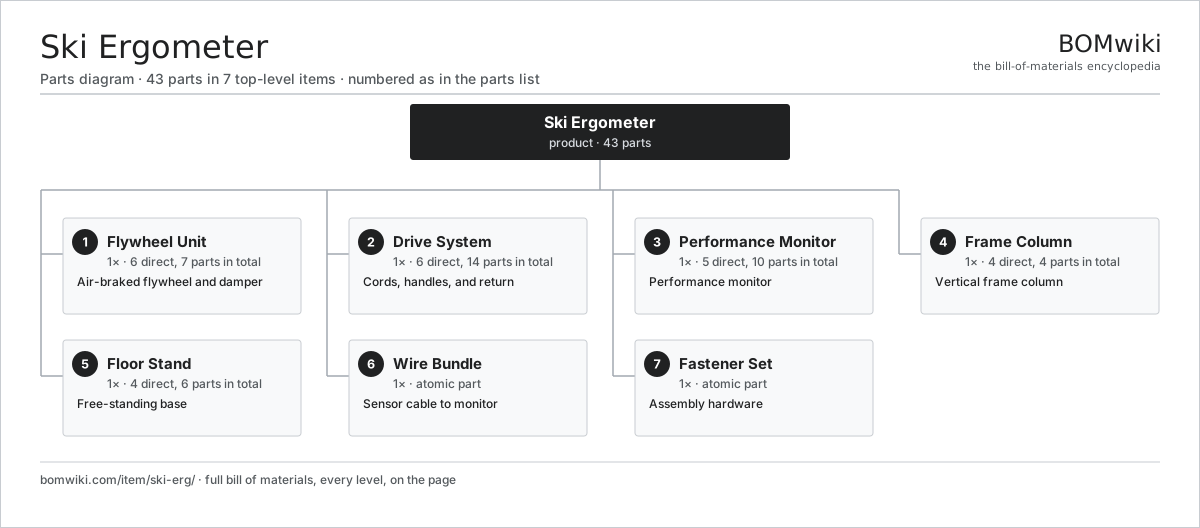
| # | Part | Qty | What it does |
|---|---|---|---|
| 1 | Flywheel Unit 6 parts | 1× | Air-braked flywheel and damper |
| 2 | Drive System 6 parts | 1× | Cords, handles, and return |
| 3 | Performance Monitor 5 parts | 1× | Performance monitor |
| 4 | Frame Column 4 parts | 1× | Vertical frame column |
| 5 | Floor Stand 4 parts | 1× | Free-standing base |
| 6 | Wire Bundle | 1× | Sensor cable to monitor |
| 7 | Fastener Set | 1× | Assembly hardware |
3D model
No 3D model yet. Have a CAD file of this? Add a 3D model. STL renders right on this page; STEP, FreeCAD, and OpenSCAD sources are welcome too (openly licensed, like all 3D models on BOMwiki).
Build & assembly graph
expand / collapse · shared sub-assemblies converge · links to related products · est. labourTap an assembly to expand/collapse · tap a part to open it · use “Open page” for any node · drag to pan, scroll to zoom.
Bill of materials for Ski Ergometer
7 top-level lines · 37 rows shown · 43 parts total · indented to 3 levels| # | Item / sub-assembly | Part no. | Qty/assy | Ext. qty | Parts | Type |
|---|---|---|---|---|---|---|
| 1 | Flywheel Unit 6 parts | ski-erg-flywheel-unit | 1× | 1 | 7 | assembly |
| 1.1 | Fan Flywheel | ski-erg-flywheel | 1× | 1 | · | part |
| 1.2 | Damper | ski-erg-damper | 1× | 1 | · | part |
| 1.3 | Fan Cage | ski-erg-fan-cage | 1× | 1 | · | part |
| 1.4 | Flywheel Shaft | ski-erg-flywheel-shaft | 1× | 1 | · | part |
| 1.5 | Ball Bearing | ball-bearing | 2× | 2 | · | part |
| 1.6 | Speed Pickup | ski-erg-speed-pickup | 1× | 1 | · | part |
| 2 | Drive System 6 parts | ski-erg-drive-system | 1× | 1 | 14 | assembly |
| 2.1 | Drive Cord | ski-erg-drive-cord | 2× | 2 | · | part |
| 2.2 | Handle | ski-erg-handle | 2× | 2 | · | part |
| 2.3 | Clutch Sprocket | ski-erg-clutch-sprocket | 2× | 2 | · | part |
| 2.4 | Return Spring | ski-erg-return-spring | 2× | 2 | · | part |
| 2.5 | Cord Guide Pulley | ski-erg-cord-guide | 2× | 2 | · | part |
| 2.6 | Ball Bearing | ball-bearing | 4× | 4 | · | part |
| 3 | Performance Monitor 5 parts | ski-erg-monitor | 1× | 1 | 10 | assembly |
| 3.1 | Monitor Board 5 parts | ski-erg-monitor-board | 1× | 1 | 6 | assembly |
| 3.1.1 | Bare PCB | pcb-bare | 1× | 1 | · | part |
| 3.1.2 | Microcontroller | mcu | 1× | 1 | · | part |
| 3.1.3 | Compute SoC Module | soc-module | 1× | 1 | · | part |
| 3.1.4 | SMD Passive (R/C/L) | smd-passives | 1× | 1 | · | part |
| 3.1.5 | Connector | connector | 2× | 2 | · | part |
| 3.2 | LCD Panel | lcd-panel | 1× | 1 | · | part |
| 3.3 | Monitor Housing | ski-erg-monitor-housing | 1× | 1 | · | part |
| 3.4 | Battery Holder | ski-erg-battery-holder | 1× | 1 | · | part |
| 3.5 | Monitor Arm | ski-erg-monitor-arm | 1× | 1 | · | part |
| 4 | Frame Column 4 parts | ski-erg-column | 1× | 1 | 4 | assembly |
| 4.1 | Column Extrusion | ski-erg-main-extrusion | 1× | 1 | · | part |
| 4.2 | Top Housing | ski-erg-top-housing | 1× | 1 | · | part |
| 4.3 | Wall Bracket | ski-erg-wall-bracket | 1× | 1 | · | part |
| 4.4 | Fastener Set | fastener-set | 1× | 1 | · | part |
| 5 | Floor Stand 4 parts | ski-erg-floor-stand | 1× | 1 | 6 | assembly |
| 5.1 | Stand Foot Platform | ski-erg-stand-foot | 1× | 1 | · | part |
| 5.2 | Stand Strut | ski-erg-stand-strut | 2× | 2 | · | part |
| 5.3 | Stand Crossbar | ski-erg-stand-crossbar | 1× | 1 | · | part |
| 5.4 | Leveling Foot | ski-erg-leveling-foot | 2× | 2 | · | part |
| 6 | Wire Bundle | wire-bundle | 1× | 1 | · | part |
| 7 | Fastener Set | fastener-set | 1× | 1 | · | part |
Something wrong in this list? Report a problem with this BOM.
Related products
same domain, ranked by shared parts Anti-Gravity Treadmill
96 parts · shares 7 with this page
Anti-Gravity Treadmill
96 parts · shares 7 with this page
 Smart Fitness Mirror
36 parts · shares 5 with this page
Smart Fitness Mirror
36 parts · shares 5 with this page
 Baseball Pitching Machine
144 parts · shares 6 with this page
Percussion Massage Gun
71 parts · shares 5 with this page
Curved Manual Treadmill
411 parts · shares 5 with this page
Baseball Pitching Machine
144 parts · shares 6 with this page
Percussion Massage Gun
71 parts · shares 5 with this page
Curved Manual Treadmill
411 parts · shares 5 with this page
 Elliptical Trainer
111 parts · shares 5 with this page
Elliptical Trainer
111 parts · shares 5 with this page
Sourcing: possible vendors
Browse the supplier directory → Prices, MOQ, and lead times are algorithmic estimates, not quotes, and not claims about these companies. Company mappings are curated by keyword; est. price band $100–$10k. How estimates work| Vendor | HQ | Specialty | MOQ | Lead time |
|---|---|---|---|---|
| lifefitness.com ↗ | Rosemont, US | Fitness equipment | 200 units | 8–14 wks |
| technogym.com ↗ | Cesena, IT | Fitness equipment | 200 units | 8–14 wks |
|
🇺🇸Peloton
onepeloton.com ↗
|
New York, US | Connected fitness | 200 units | 8–14 wks |
| johnsonhealthtech.com ↗ | Taichung, TW | Fitness (Matrix) | 200 units | 8–14 wks |
|
🇺🇸Precor
precor.com ↗
|
Woodinville, US | Fitness equipment | 200 units | 8–14 wks |
742-word article