Skidder
ProductOverview
The skidder is a rough-terrain log transport machine designed to drag or grapple logs from the stump to the roadside landing. Unlike forwarders that load logs into a cargo bunk, skidders use either a front-mounted Grapple Unit to carry logs or a winch-pulled Main Cable to drag them. Skidders are lighter and more nimble than forwarders, making them suited to steep terrain and selective harvesting where roads are minimal.
The skidder combines a rugged articulated 4WD chassis with a diesel engine, hydraulic pump, and multiple control circuits. A powered Winch System with grooved Winch Drum can pull 50 tonne loads, while the Grapple Unit holds 12 tonne loads in its Left Grapple Arm and Right Grapple Arm. An adjustable Ground Blade clears undergrowth and shapes the log path. The articulated frame allows tight maneuvering in confined forest space.
How it works
The operator controls the skidder from an enclosed Operator Cabin using a proportional Control Panel joystick connected to pilot-operated proportional valves in the Valve Manifold. The diesel Diesel Engine drives a variable displacement Main Pump supplying 250 bar to all circuits.
To retrieve a log, the operator positions the skidder alongside the felled stem using the dual-powered Front Axle and Rear Axle with Final Drive (Front) and Final Drive (Rear) motors. The front and rear axles are driven independently, allowing crab-like movement across steep or rutted terrain.
The operator then engages the Grapple Unit, closing the Left Grapple Arm and Right Grapple Arm around the log via proportional pilot pressure to the Grapple Cylinder cylinders. The gripper fingers grip via Gripper Pad elastomer pads, and the log is held against the grapple frame via a Grapple Hinge spherical bearing that allows the arms to open fully during loading.
Alternatively, the operator can use the Winch System: the rope is wrapped around the log and anchored to the Cable Anchor Block fairlead block at the machine's rear. The Winch Motor pulls, dragging the log toward the machine via the Main Cable wire rope. The Brake (Winch) spring-applied brake holds tension when the motor is idled.
Once the log is secured, the operator drives the skidder toward the landing. The Ground Blade is angled downward via the Blade Cylinder, cutting undergrowth and pushing it aside. As the machine advances, the grappled or winched log is skidded along the ground, compacting the path for easier return trips.
At the landing, the operator releases the grapple (opening the arm cylinders) or tensions the winch to hold the log in place while unhooking the cable. The skidder then returns to the forest for the next load.
Grapple and Winch Design
The Grapple Unit is a hinged two-arm system. Each arm is a welded steel beam approximately 2.0 m long, fitted with elastomer-coated Gripper Pad fingers. The left and right arms are controlled independently via Grapple Cylinder double-acting cylinders (80 mm bore, 900 mm stroke), allowing precise opening and closing. The Grapple Frame houses the pivot points and integrates with the frame via the Mounting Plate.
Grapple capacity is 12 tonnes, suitable for bundles of 3–6 logs depending on species and diameter. The elastomer pads prevent bark marring while gripping securely.
The Winch System comprises a Winch Drum (600 mm diameter, 1.5 m wide) powered by a Winch Motor bent-axis motor rated 100 cc/rev at 250 bar. The drum can hold 200 m of Main Cable (16 mm diameter, 6×36 lay wire rope, breaking strength 180 tonne). Pulling force at the drum is approximately 50 tonne at low motor speed, decreasing as drum speed increases due to the bent-axis pump's fixed displacement.
The Cable Anchor Block is a fairlead block bolted to the frame rear, allowing the rope to angle from the drum to the log without chafing. A Brake (Winch) spring-applied, pilot-release brake holds the drum when the motor is neutral, preventing rollback on slopes.
Ground Blade and Terrain Capability
The Ground Blade is a 3.0 m wide steel I-beam mounted on the machine's front via a Blade Hinge vertical pivot. Two Blade Cylinder cylinders control angle (left/right) and lift (up/down). The replaceable Cutting Shoe (hardened steel) at the blade's bottom edge cuts undergrowth and soil, shaping a clean path for the dragged log.
The Chassis Frame is articulated at the center via a Articulation Joint spherical bearing that allows ±30° bending. Two Left Steering Cylinder and Right Steering Cylinder cylinders control the articulation angle, enabling the machine to crab sideways and navigate confined spaces without requiring all-wheel steering.
Hydraulic System and Control
The Main Pump is a variable displacement axial piston unit with pressure compensation and load-check relief. It supplies the Valve Manifold, which houses a proportional spool valve integrated with a pilot-operated check valve. The operator's proportional joystick modulates pilot pressure to the valve spool, controlling the flow direction and magnitude to each actuator (grapple, winch, blade, and wheels).
The Cooler is an aluminum bar-plate type driven by a shaft-driven fan, maintaining oil temperature below 50°C during intensive dragging operations. The Hose Bundle is routed in a spiral wrap under the frame, reducing exposure to sharp branches and stones.
Performance and Applications
A typical skidder cycle time is 15–20 minutes: approach the log, grapple or cable it, skid to the landing (500–1000 m), unload, and return. One operator and one skidder can harvest 8–12 tonnes per shift depending on terrain steepness and log size.
Skidders are preferred in:
- Selective thinning operations (small clearings, retention of crop trees)
- Steep terrain unsuitable for forwarders (slopes 30–50%)
- Cable harvesting operations (where a skidder feeds logs to a skyline or haulback)
- Tropical hardwood harvesting (where roads are temporary and machines must navigate rocky ground)
Models from Caterpillar, John Deere, and Komatsu dominate the market, with proven track records in extreme conditions. The skidder's simplicity and rough-terrain ruggedness make it a cornerstone of sustainable low-impact forestry operations.
Skidder parts and their functions
8 top-level parts · 59 parts in total · full bill of materials below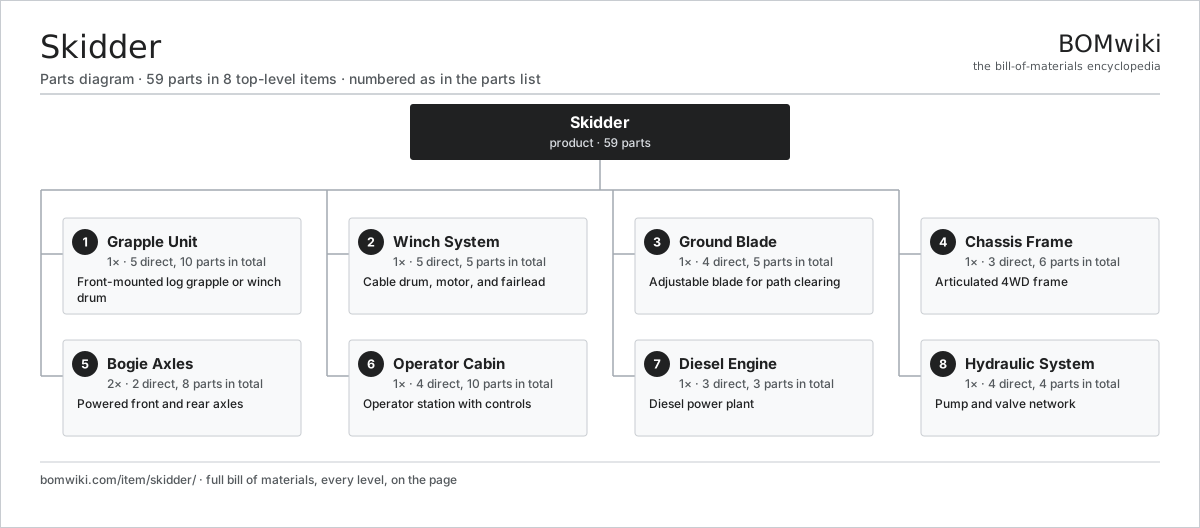
| # | Part | Qty | What it does |
|---|---|---|---|
| 1 | Grapple Unit 5 parts | 1× | Front-mounted log grapple or winch drum |
| 2 | Winch System 5 parts | 1× | Cable drum, motor, and fairlead |
| 3 | Ground Blade 4 parts | 1× | Adjustable blade for path clearing |
| 4 | Chassis Frame 3 parts | 1× | Articulated 4WD frame |
| 5 | Bogie Axles 2 parts | 2× | Powered front and rear axles |
| 6 | Operator Cabin 4 parts | 1× | Operator station with controls |
| 7 | Diesel Engine 3 parts | 1× | Diesel power plant |
| 8 | Hydraulic System 4 parts | 1× | Pump and valve network |
3D model
No 3D model yet. Have a CAD file of this? Add a 3D model. STL renders right on this page; STEP, FreeCAD, and OpenSCAD sources are welcome too (openly licensed, like all 3D models on BOMwiki).
Build & assembly graph
expand / collapse · shared sub-assemblies converge · links to related products · est. labourTap an assembly to expand/collapse · tap a part to open it · use “Open page” for any node · drag to pan, scroll to zoom.
Bill of materials for Skidder
8 top-level lines · 56 rows shown · 59 parts total · indented to 3 levels| # | Item / sub-assembly | Part no. | Qty/assy | Ext. qty | Parts | Type |
|---|---|---|---|---|---|---|
| 1 | Grapple Unit 5 parts | skidder-grapple-unit | 1× | 1 | 10 | assembly |
| 1.1 | Grapple Frame | skidder-grapple-frame | 1× | 1 | · | part |
| 1.2 | Left Grapple Arm 2 parts | skidder-grapple-arm-l | 1× | 1 | 3 | assembly |
| 1.2.1 | Grapple Link | skidder-grapple-link | 1× | 1 | · | part |
| 1.2.2 | Gripper Pad | skidder-gripper-pad | 2× | 2 | · | part |
| 1.3 | Right Grapple Arm 2 parts | skidder-grapple-arm-r | 1× | 1 | 3 | assembly |
| 1.3.1 | Grapple Link | skidder-grapple-link | 1× | 1 | · | part |
| 1.3.2 | Gripper Pad | skidder-gripper-pad | 2× | 2 | · | part |
| 1.4 | Grapple Hinge | skidder-grapple-hinge | 1× | 1 | · | part |
| 1.5 | Grapple Cylinder | skidder-grapple-cylinder | 2× | 2 | · | part |
| 2 | Winch System 5 parts | skidder-winch-system | 1× | 1 | 5 | assembly |
| 2.1 | Winch Drum | skidder-winch-drum | 1× | 1 | · | part |
| 2.2 | Winch Motor | skidder-winch-motor | 1× | 1 | · | part |
| 2.3 | Main Cable | skidder-cable-main | 1× | 1 | · | part |
| 2.4 | Cable Anchor Block | skidder-cable-anchor | 1× | 1 | · | part |
| 2.5 | Brake (Winch) | skidder-brake-drum | 1× | 1 | · | part |
| 3 | Ground Blade 4 parts | skidder-ground-blade | 1× | 1 | 5 | assembly |
| 3.1 | Blade Beam | skidder-blade-beam | 1× | 1 | · | part |
| 3.2 | Cutting Shoe | skidder-blade-shoe | 1× | 1 | · | part |
| 3.3 | Blade Cylinder | skidder-blade-cylinder | 2× | 2 | · | part |
| 3.4 | Blade Hinge | skidder-blade-hinge | 1× | 1 | · | part |
| 4 | Chassis Frame 3 parts | skidder-chassis-frame | 1× | 1 | 6 | assembly |
| 4.1 | Frame Main Beam | skidder-frame-main-beam | 2× | 2 | · | part |
| 4.2 | Articulation Joint 3 parts | skidder-articulation-joint | 1× | 1 | 3 | assembly |
| 4.2.1 | Pivot Bearing | skidder-pivot-bearing | 1× | 1 | · | part |
| 4.2.2 | Left Steering Cylinder | skidder-steer-cylinder-left | 1× | 1 | · | part |
| 4.2.3 | Right Steering Cylinder | skidder-steer-cylinder-right | 1× | 1 | · | part |
| 4.3 | Mounting Plate | skidder-frame-mounting-plate | 1× | 1 | · | part |
| 5 | Bogie Axles 2 parts | skidder-bogie-axles | 2× | 2 | 8 | assembly |
| 5.1 | Front Axle 3 parts | skidder-front-axle | 1× | 2 | 4 | assembly |
| 5.1.1 | Axle Beam | skidder-axle-beam | 1× | 2 | · | part |
| 5.1.2 | Final Drive (Front) | skidder-final-drive-front | 1× | 2 | · | part |
| 5.1.3 | Wheel Hub | skidder-wheel-hub-axle | 2× | 4 | · | part |
| 5.2 | Rear Axle 3 parts | skidder-rear-axle | 1× | 2 | 4 | assembly |
| 5.2.1 | Axle Beam | skidder-axle-beam | 1× | 2 | · | part |
| 5.2.2 | Final Drive (Rear) | skidder-final-drive-rear | 1× | 2 | · | part |
| 5.2.3 | Wheel Hub | skidder-wheel-hub-axle | 2× | 4 | · | part |
| 6 | Operator Cabin 4 parts | skidder-cab | 1× | 1 | 10 | assembly |
| 6.1 | Cab Frame | skidder-cab-frame | 1× | 1 | · | part |
| 6.2 | Cab Glazing | skidder-cab-glazing | 1× | 1 | · | part |
| 6.3 | Seat Assembly 5 parts | seat-assembly | 1× | 1 | 7 | assembly |
| 6.3.1 | Seat Frame | seat-frame | 1× | 1 | · | part |
| 6.3.2 | Seat Foam | seat-foam | 2× | 2 | · | part |
| 6.3.3 | Seat Cover | seat-cover | 1× | 1 | · | part |
| 6.3.4 | Seat Motor | seat-motor | 2× | 2 | · | part |
| 6.3.5 | Seat Heater Mat | seat-heater | 1× | 1 | · | part |
| 6.4 | Control Panel | skidder-control-panel | 1× | 1 | · | part |
| 7 | Diesel Engine 3 parts | skidder-engine | 1× | 1 | 3 | assembly |
| 7.1 | Engine Block | skidder-engine-block | 1× | 1 | · | part |
| 7.2 | Turbocharger | skidder-turbo | 1× | 1 | · | part |
| 7.3 | Fuel Tank | skidder-fuel-tank | 1× | 1 | · | part |
| 8 | Hydraulic System 4 parts | skidder-hydraulics | 1× | 1 | 4 | assembly |
| 8.1 | Main Pump | skidder-main-pump | 1× | 1 | · | part |
| 8.2 | Valve Manifold | skidder-valve-manifold | 1× | 1 | · | part |
| 8.3 | Cooler | skidder-cooler | 1× | 1 | · | part |
| 8.4 | Hose Bundle | skidder-hose-bundle | 1× | 1 | · | part |
Something wrong in this list? Report a problem with this BOM.
Related products
same domain, ranked by shared parts Agricultural Tractor
306 parts · shares 6 with this page
Agricultural Tractor
306 parts · shares 6 with this page
 Cane Harvester
287 parts · shares 6 with this page
Cane Harvester
287 parts · shares 6 with this page
 Combine Harvester
203 parts · shares 6 with this page
Combine Harvester
203 parts · shares 6 with this page
 Cotton Picker
2,623 parts · shares 6 with this page
Cotton Picker
2,623 parts · shares 6 with this page
 Cotton Stripper
208 parts · shares 6 with this page
Cotton Stripper
208 parts · shares 6 with this page
 Feller Buncher
175 parts · shares 6 with this page
Feller Buncher
175 parts · shares 6 with this page
Sourcing: possible vendors
Browse the supplier directory → Prices, MOQ, and lead times are algorithmic estimates, not quotes, and not claims about these companies. Company mappings are curated by keyword; est. price band $5k–$800k. How estimates work| Vendor | HQ | Specialty | MOQ | Lead time |
|---|---|---|---|---|
| deere.com ↗ | Moline, US | Agriculture & turf | made to order | 14–24 wks |
| cnh.com ↗ | Basildon, GB | Agriculture (Case IH, New Holland) | made to order | 14–24 wks |
|
🇺🇸AGCO
agcocorp.com ↗
|
Duluth, US | Agriculture (Fendt, Massey Ferguson) | made to order | 14–24 wks |
|
🇩🇪Claas
claas.com ↗
|
Harsewinkel, DE | Harvesters & tractors | made to order | 14–24 wks |
|
🇯🇵Kubota
kubota.com ↗
|
Osaka, JP | Compact tractors & equipment | made to order | 14–24 wks |
1,062-word article