Sliding-Door Wardrobe
ProductOverview
A sliding-door wardrobe replaces hinged doors with full-height leaves that roll sideways in parallel tracks, so the cabinet needs no clearance in front of it. The product is a marriage of two subsystems built by different industries: a knock-down chipboard Carcass of the kind used across flat-pack furniture, and a Sliding Door System whose extrusions, rollers, and dampers come from architectural sliding-hardware makers.
The carcass is a box of 18 mm melamine-faced chipboard: two Side Panels, a Top Panel and Bottom Panel, and a central Partition Panel that divides the interior and halves shelf spans. Exposed edges carry hot-glued ABS Edge Banding, which seals the chipboard core against moisture and chipping. The thin Back Panel looks incidental but is structural: nailed into a perimeter groove, it acts as a shear web and provides most of the box's racking stiffness.
How it works
Door weight is carried at the bottom. Each Door Leaf stands on two Bottom Roller units whose grooved Roller Wheels ride the raised ridges of the Bottom Track. The two channels of the track are offset front-to-back, so the leaves overlap and bypass each other; a Dust Brush Strip strip closes the overlap gap. At the top, the leaves do not hang, Top Guide shoes simply locate them in the Top Track channels so they cannot lean. This bottom-rolling arrangement keeps the heavy load path in compression through the Bottom Panel rather than asking the top panel to carry hanging doors, which is why it dominates wardrobe (as opposed to room-divider) applications.
Each roller contains a Ball Bearing and a Coil Spring that preloads the wheel against the track so it tracks the ridge over small floor irregularities. The Roller Adjuster Screw, reached through a hole in the door edge, raises or lowers each corner 3–5 mm; this is how the installer trues the leaf to the side panel after leveling. An Anti-Jump Clip above each wheel stops the door bouncing off its ridge if slammed. At each end of travel a Soft-Close Damper catches a striker on the leaf and a hydraulic damper pulls the door home over the final 30–50 mm, preventing rebound, the same mechanism used in soft-close drawers, scaled up for leaves of 10–50 kg.
Leveling matters more here than in hinged furniture. If the Bottom Track is not horizontal, doors drift open or closed on their own and the soft-closers fight gravity. The four Leveler Foot adjusters under the Plinth and Leveling give 10–25 mm of range, and installation instructions specify checking the track with a spirit level before the doors go in. The Anti-Tip Wall Brackets then strap the carcass top to the wall, tall wardrobes are within scope of furniture anti-tip requirements (EN 14749 in Europe, and the practices formalized in ASTM F2057 / the US STURDY Act for clothing storage).
Doors
A leaf is a picture frame of extruded aluminium Door Frame Profiles clamped around a Door Infill Panel. Infills are 10 mm chipboard, 4 mm mirror with a safety backing film, or lacquered glass; mirror leaves are the heaviest, which drives roller and track ratings. The stile profile doubles as a full-height finger pull, eliminating handles that would collide as leaves pass. Door Seal Strips cushion contact at the closed positions.
Interior and assembly
The Interior Fittings hangs off the 32 mm system: rows of 5 mm holes at 32 mm pitch drilled into the side and partition panels, a convention inherited from European cabinet line-boring machinery. Each Adjustable Shelf rests on four Shelf Support Pins and can move in 32 mm steps. The Hanging Rail, oval steel tube rated around 35 kg per metre, sits in screw-on Rail End Brackets, and the Internal Drawer Unit runs its Drawer Boxes on side-mount Drawer Slide Pairs sized so the drawers clear the bypassing door leaves.
The carcass assembles with the Cam-and-Dowel Hardware Kit: each joint pairs a Cam Dowel screwed into one panel with a Cam Lock disc in the mating panel, a quarter turn draws the panels together at about 1 kN clamp force, while fluted Wood Dowels align the parts and carry shear. A typical two-door unit weighs 90–140 kg assembled and ships in three to four flat cartons.
Sliding-Door Wardrobe parts and their functions
7 top-level parts · 155 parts in total · full bill of materials below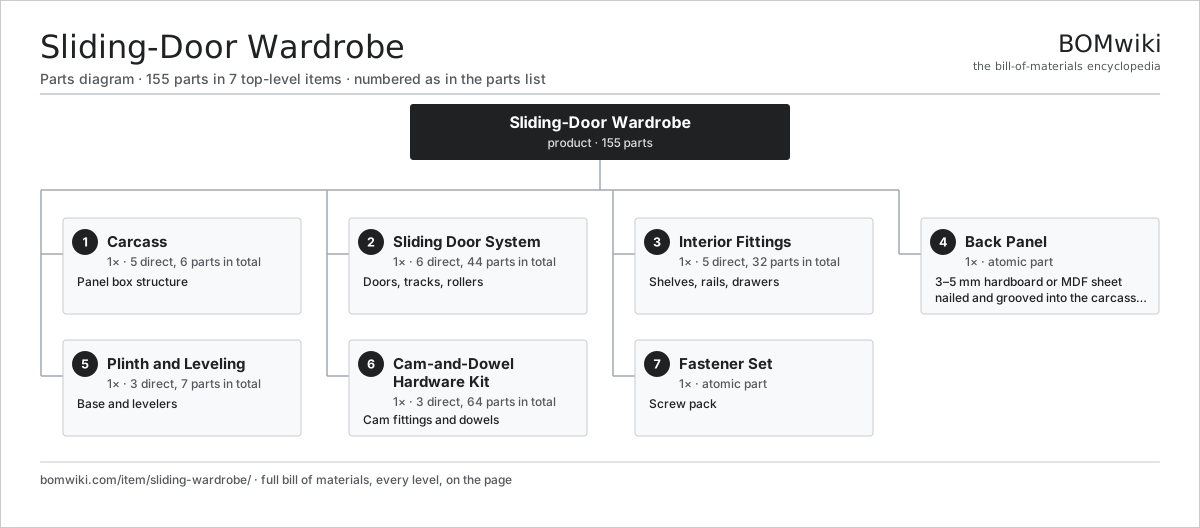
| # | Part | Qty | What it does |
|---|---|---|---|
| 1 | Carcass 5 parts | 1× | Panel box structure |
| 2 | Sliding Door System 6 parts | 1× | Doors, tracks, rollers |
| 3 | Interior Fittings 5 parts | 1× | Shelves, rails, drawers |
| 4 | Back Panel | 1× | 3–5 mm hardboard or MDF sheet nailed and grooved into the carcass rear, providing most of the racking stiffness. |
| 5 | Plinth and Leveling 3 parts | 1× | Base and levelers |
| 6 | Cam-and-Dowel Hardware Kit 3 parts | 1× | Cam fittings and dowels |
| 7 | Fastener Set | 1× | Screw pack |
3D model
No 3D model yet. Have a CAD file of this? Add a 3D model. STL renders right on this page; STEP, FreeCAD, and OpenSCAD sources are welcome too (openly licensed, like all 3D models on BOMwiki).
Build & assembly graph
expand / collapse · shared sub-assemblies converge · links to related products · est. labourTap an assembly to expand/collapse · tap a part to open it · use “Open page” for any node · drag to pan, scroll to zoom.
Bill of materials for Sliding-Door Wardrobe
7 top-level lines · 37 rows shown · 155 parts total · indented to 3 levels| # | Item / sub-assembly | Part no. | Qty/assy | Ext. qty | Parts | Type |
|---|---|---|---|---|---|---|
| 1 | Carcass 5 parts | sliding-wardrobe-carcass | 1× | 1 | 6 | assembly |
| 1.1 | Side Panel | sliding-wardrobe-side-panel | 2× | 2 | · | part |
| 1.2 | Top Panel | sliding-wardrobe-top-panel | 1× | 1 | · | part |
| 1.3 | Bottom Panel | sliding-wardrobe-bottom-panel | 1× | 1 | · | part |
| 1.4 | Partition Panel | sliding-wardrobe-partition-panel | 1× | 1 | · | part |
| 1.5 | Edge Banding | sliding-wardrobe-edge-banding | 1× | 1 | · | part |
| 2 | Sliding Door System 6 parts | sliding-wardrobe-door-system | 1× | 1 | 44 | assembly |
| 2.1 | Door Leaf 5 parts | sliding-wardrobe-door-leaf | 2× | 2 | 17 | assembly |
| 2.1.1 | Door Frame Profile | sliding-wardrobe-door-frame-profile | 4× | 8 | · | part |
| 2.1.2 | Door Infill Panel | sliding-wardrobe-door-infill | 1× | 2 | · | part |
| 2.1.3 | Bottom Roller 4 parts + deeper › | sliding-wardrobe-bottom-roller | 2× | 4 | 4 | assembly |
| 2.1.4 | Top Guide | sliding-wardrobe-top-guide | 2× | 4 | · | part |
| 2.1.5 | Door Seal Strip | sliding-wardrobe-door-seal-strip | 2× | 4 | · | part |
| 2.2 | Top Track | sliding-wardrobe-top-track | 1× | 1 | · | part |
| 2.3 | Bottom Track | sliding-wardrobe-bottom-track | 1× | 1 | · | part |
| 2.4 | Soft-Close Damper | sliding-wardrobe-soft-closer | 2× | 2 | · | part |
| 2.5 | Anti-Jump Clip | sliding-wardrobe-anti-jump-clip | 4× | 4 | · | part |
| 2.6 | Dust Brush Strip | sliding-wardrobe-dust-brush | 2× | 2 | · | part |
| 3 | Interior Fittings 5 parts | sliding-wardrobe-interior | 1× | 1 | 32 | assembly |
| 3.1 | Adjustable Shelf | sliding-wardrobe-shelf | 4× | 4 | · | part |
| 3.2 | Shelf Support Pin | sliding-wardrobe-shelf-pin | 16× | 16 | · | part |
| 3.3 | Hanging Rail | sliding-wardrobe-hanging-rail | 2× | 2 | · | part |
| 3.4 | Rail End Bracket | sliding-wardrobe-rail-bracket | 4× | 4 | · | part |
| 3.5 | Internal Drawer Unit 3 parts | sliding-wardrobe-drawer-unit | 1× | 1 | 6 | assembly |
| 3.5.1 | Drawer Box | sliding-wardrobe-drawer-box | 2× | 2 | · | part |
| 3.5.2 | Drawer Slide Pair | sliding-wardrobe-drawer-slide-pair | 2× | 2 | · | part |
| 3.5.3 | Drawer Front | sliding-wardrobe-drawer-front | 2× | 2 | · | part |
| 4 | Back Panel | sliding-wardrobe-back-panel | 1× | 1 | · | part |
| 5 | Plinth and Leveling 3 parts | sliding-wardrobe-plinth | 1× | 1 | 7 | assembly |
| 5.1 | Plinth Panel | sliding-wardrobe-plinth-panel | 1× | 1 | · | part |
| 5.2 | Leveler Foot | sliding-wardrobe-leveler-foot | 4× | 4 | · | part |
| 5.3 | Anti-Tip Wall Bracket | sliding-wardrobe-wall-bracket | 2× | 2 | · | part |
| 6 | Cam-and-Dowel Hardware Kit 3 parts | sliding-wardrobe-hardware-kit | 1× | 1 | 64 | assembly |
| 6.1 | Cam Lock | sliding-wardrobe-cam-lock | 24× | 24 | · | part |
| 6.2 | Cam Dowel | sliding-wardrobe-cam-dowel | 24× | 24 | · | part |
| 6.3 | Wood Dowel | sliding-wardrobe-wood-dowel | 16× | 16 | · | part |
| 7 | Fastener Set | fastener-set | 1× | 1 | · | part |
Something wrong in this list? Report a problem with this BOM.
Related products
same domain, ranked by shared parts Barber Chair
59 parts · shares 2 with this page
Cantilever Patio Umbrella
34 parts · shares 2 with this page
Cinema Recliner Seating
61 parts · shares 2 with this page
Barber Chair
59 parts · shares 2 with this page
Cantilever Patio Umbrella
34 parts · shares 2 with this page
Cinema Recliner Seating
61 parts · shares 2 with this page
 Ergonomic Office Chair
48 parts · shares 2 with this page
Ergonomic Office Chair
48 parts · shares 2 with this page
 Filing Cabinet
102 parts · shares 2 with this page
Filing Cabinet
102 parts · shares 2 with this page
 Gaming Chair
67 parts · shares 2 with this page
Gaming Chair
67 parts · shares 2 with this page
Sourcing: possible vendors
Browse the supplier directory → Prices, MOQ, and lead times are algorithmic estimates, not quotes, and not claims about these companies. Company mappings are curated by keyword; est. price band $50–$3k. How estimates work| Vendor | HQ | Specialty | MOQ | Lead time |
|---|---|---|---|---|
| steelcase.com ↗ | Grand Rapids, US | Office furniture | 200 units | 6–12 wks |
| millerknoll.com ↗ | Zeeland, US | Furniture (Herman Miller) | 200 units | 6–12 wks |
|
🇺🇸Haworth
haworth.com ↗
|
Holland, US | Office furniture | 200 units | 6–12 wks |
|
🇺🇸HNI
hnicorp.com ↗
|
Muscatine, US | Furniture & hearth | 200 units | 6–12 wks |
| ikea.com ↗ | Älmhult, SE | Furniture manufacturing | 200 units | 6–12 wks |
800-word article