Sludge Dryer
ProductOverview
A sludge dryer is a thermal treatment unit that reduces the moisture content of dewatered sludge cake from 20–30% solids to 85–95% solids, producing a dry, granular product suitable for incineration or beneficial reuse. Indirect heating (via steam or hot oil) transfers thermal energy through the dryer chamber walls to the sludge, evaporating free and bound moisture.
Drying dramatically reduces disposal volume and cost: a plant producing 10 tonne/day of 25% solids cake (40 tonne/day wet) becomes only 11.8 tonne/day at 85% solids, a 70% volume reduction. Dried sludge has improved handling properties and can be shipped longer distances for beneficial use (land application, compost, pelletized fuel).
Drying Mechanism
Sludge drying occurs in two stages:
Stage 1: Free Water Evaporation (0–50 min, typical) Water loosely bound to sludge particles evaporates readily. The evaporation rate is high (constant rate drying), limited by mass transfer from the particle surface to the vapor phase. Temperature remains near 100°C (boiling point) until most free water is gone.
Evaporation rate: 1–3 kg water/m³·min depending on chamber size and thermal input.
Stage 2: Bound Water Evaporation (50–120 min) As sludge dries below ~40% solids, remaining water is absorbed into or bound within the solids matrix. Evaporation rate decreases (falling rate period) as water must diffuse from the particle interior to the surface. Temperature rises toward 150–180°C to overcome stronger bonding.
The product becomes drier and fluffier; particle agglomeration occurs as capillary forces consolidate smaller pieces.
Heat Balance
The energy required to dry sludge is dominated by latent heat of vaporization:
Q_total = m_water × (c_p × ΔT + λ_vap) + Q_losses
Where:
- m_water = mass of water evaporated (kg)
- c_p = specific heat of water (~4.18 kJ/kg·K)
- ΔT = temperature rise from inlet to boiling (K)
- λ_vap = latent heat of vaporization (~2260 kJ/kg at 100°C, ~2100 kJ/kg at 150°C)
- Q_losses = heat loss through insulation and vapor discharge (~15–25%)
Example: Drying 10 kg wet cake (8 kg solids + 2 kg water at 25% solids) to 85% solids (9.4 kg wet final; 8 kg dry + 1.4 kg water):
- Water evaporated: 2 – 1.4 = 0.6 kg
- Energy for sensible heat: 0.6 × 4.18 × 75 = 188 kJ (raising water from 25°C to 100°C)
- Energy for latent heat: 0.6 × 2260 = 1356 kJ
- Q_sensible = 188 kJ; total ≈ 1544 kJ + losses (~15%) ≈ 1775 kJ
- Specific energy: 1775 kJ / 0.6 kg water = 2958 kJ/kg water ≈ 3.0 MJ/kg
Actual steam consumption: 3.0 MJ/kg ÷ (boiler efficiency × latent heat of steam) = 3.0 / (0.85 × 2260) ≈ 1.6 kg steam per kg water evaporated.
Chamber Design: Paddle vs. Belt Dryers
Paddle Dryer (Indirect):
- Hot water/steam jacket surrounding rotor
- Internal rotating shaft with staggered paddles or ribbons
- Advantages: High heat transfer (10–15 W/m²·K), compact footprint, low maintenance
- Disadvantages: Slow drying rate, residence time 30–45 min, limited to <20 tonne/day
Belt Dryer:
- Continuous belt conveyor in heated chamber (floor and ceiling heated)
- Product moves horizontally through drying zones
- Advantages: Fast drying (15–25 min), handles >50 tonne/day, good for final moisture control
- Disadvantages: Higher capital cost, more complex maintenance
Vapor Handling
The exhaust stream contains:
- Water vapor: 60–80% by mass (latent energy recovery potential)
- Odorous compounds: Ammonia, H₂S, mercaptans, amines (<1% by volume)
- Particulate: Fine sludge dust (<0.5–1% by mass)
The Mist Eliminator removes water droplets, preventing equipment corrosion downstream. The odor control system handles the remaining vapor:
Biofilter (~€50–100k capital):
- Wood chips or compost bed 10–30 minutes residence
- Biological oxidation of H₂S, ammonia, and volatile organics
- Requires periodic media replacement (every 2–5 years)
- Suitable for <10 odor units/m³ inlet
Thermal Oxidizer (~€150–300k capital):
- Gas-fired burner at 800–1000°C, 0.5–1 second residence
- Complete destruction of odor; 99%+ removal efficiency
- High operating cost (~€2–5/tonne dried sludge for fuel)
- Suitable for stringent odor limits or high inlet loads
Caustic Scrubber (~€80–150k capital):
- NaOH or lime solution absorbing H₂S and other acid gases
- Moderate cost; requires reagent ($0.5–1/kg) and sludge disposal
- Effective for H₂S but less effective for ammonia
Optional Vapor Condenser
A vapor condenser recovers 30–40% of the thermal energy in exhaust vapor, reducing both energy cost and odor-control burden. The recovered latent heat (re-heating inlet sludge or pre-warming inlet air) saves fuel.
Condensed water (typically 80–120 L/tonne dried solids) is acidic (pH 4–5) due to ammonia and sulfur compounds; it requires treatment before discharge or recycle.
Product Applications
Incineration:
- Dried sludge at 85–95% solids is self-sustaining (energy content ~13–15 MJ/kg dry)
- Reduces incineration-plant fuel consumption by 50–70% vs. 20% solids cake
- Incinerator throughput (tonne/h) improves; residence time shorter
Land Application / Agriculture:
- Dried granular product is easy to handle and transport
- Suitable for compost facilities (blending with green waste)
- Pathogen reduction via drying may reduce regulatory restrictions
Cement Kiln Co-Firing:
- Dried sewage sludge (DSS) is energy-dense alternative fuel
- Replaces coal or natural gas (energy offset: ~80% of fossil fuel)
- Reduces carbon footprint and landfill diversion
Pelletization/Briquetting:
- Dried product compressed into pellets or briquettes
- Increased density improves storage and transport
- End-use as boiler fuel or animal bedding
Operational Considerations
Startup: Cold dryer requires 1–2 hours pre-heating before processing begins.
Feed Rate Control: Excessive feed causes moisture in product; insufficient feed wastes thermal energy. Optimal is continuous feed at design capacity.
Residence Time: Typically 15–45 minutes. Longer times improve final moisture (85–95% solids) but reduce throughput.
Temperature Profile: Entry zone ~100°C for initial drying; discharge zone ~150–180°C for bound water removal. Too-high temperatures may cause product degradation or over-oxidation.
Cooling: Hot dried product (60–80°C) requires cooling to ~40°C before storage to prevent self-ignition (oxidation of highly reactive material) or dust explosion. A cooling screw conveyor with aeration typically reduces temperature in 5–10 minutes.
Emissions Control Regulations
Typical discharge limits:
- Odor: <2 odor units/m³ (Germany: GOAA standard)
- Particulate: <10 mg/m³ (dust)
- H₂S: <0.5 ppm (continuous)
- Ammonia: <5 ppm (continuous)
A combined system (mist eliminator + biofilter + thermal oxidizer) achieves these limits consistently.
Energy Efficiency Improvements
- Heat Recovery: Condenser on exhaust reduces boiler fuel by 20–30%
- Boiler Tuning: Maintain 3–5% O₂ in flue gas (minimize excess air loss)
- Insulation: 100 mm mineral wool reduces losses to 10–15%
- VFD on Exhaust Fan: Modulates fan speed based on chamber pressure; saves 15–20% fan power
Maintenance Schedule
- Daily: Check chamber temperature, discharge product moisture, exhaust odor
- Weekly: Inspect paddle wear (typical life 3–5 years); check steam trap function
- Monthly: Boiler flue gas analysis; sample product for moisture; inspect seals
- Quarterly: Clean condenser tubes if scale buildup observed
- Annually: Bearing service, insulation inspection, thermal imaging for hot spots
Environmental Impact
Sludge drying is energy-intensive but enables circular economy closure:
- Volume reduction: 70–80% smaller landfill footprint
- Product reuse: Dried sludge as fuel or soil amendment (vs. landfill disposal)
- Carbon footprint: ~1–2 kg CO₂ per kg water evaporated (including boiler fuel and electricity)
Net benefit vs. landfill disposal: reduced methane emissions from decomposition; reduced transport volume and fuel.
Standards and References
- ASTM D4972: Moisture analysis of sewage sludge
- ISO 6468: Drying of sludge, determination of moisture
- WERF MOP 8: Design of Municipal Treatment Plants
- DIN 51187: Thermal value of dry sewage sludge
Sludge Dryer parts and their functions
8 top-level parts · 36 parts in total · full bill of materials below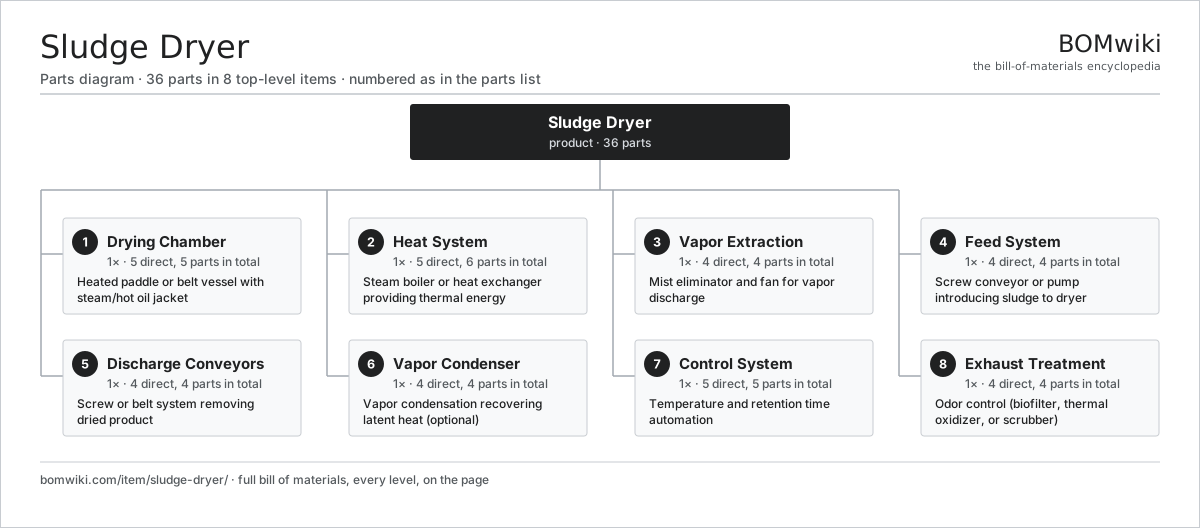
| # | Part | Qty | What it does |
|---|---|---|---|
| 1 | Drying Chamber 5 parts | 1× | Heated paddle or belt vessel with steam/hot oil jacket |
| 2 | Heat System 5 parts | 1× | Steam boiler or heat exchanger providing thermal energy |
| 3 | Vapor Extraction 4 parts | 1× | Mist eliminator and fan for vapor discharge |
| 4 | Feed System 4 parts | 1× | Screw conveyor or pump introducing sludge to dryer |
| 5 | Discharge Conveyors 4 parts | 1× | Screw or belt system removing dried product |
| 6 | Vapor Condenser 4 parts | 1× | Vapor condensation recovering latent heat (optional) |
| 7 | Control System 5 parts | 1× | Temperature and retention time automation |
| 8 | Exhaust Treatment 4 parts | 1× | Odor control (biofilter, thermal oxidizer, or scrubber) |
3D model
No 3D model yet. Have a CAD file of this? Add a 3D model. STL renders right on this page; STEP, FreeCAD, and OpenSCAD sources are welcome too (openly licensed, like all 3D models on BOMwiki).
Build & assembly graph
expand / collapse · shared sub-assemblies converge · links to related products · est. labourTap an assembly to expand/collapse · tap a part to open it · use “Open page” for any node · drag to pan, scroll to zoom.
Bill of materials for Sludge Dryer
8 top-level lines · 43 rows shown · 36 parts total · indented to 3 levels| # | Item / sub-assembly | Part no. | Qty/assy | Ext. qty | Parts | Type |
|---|---|---|---|---|---|---|
| 1 | Drying Chamber 5 parts | sludge-dryer-drying-chamber | 1× | 1 | 5 | assembly |
| 1.1 | Drum Vessel | sludge-dryer-drum-vessel | 1× | 1 | · | part |
| 1.2 | Paddle Rotor | sludge-dryer-paddle-rotor | 1× | 1 | · | part |
| 1.3 | Inlet Bearing | sludge-dryer-bearing-inlet | 1× | 1 | · | part |
| 1.4 | Discharge Bearing | sludge-dryer-bearing-discharge | 1× | 1 | · | part |
| 1.5 | Jacket Seals | sludge-dryer-jacket-seals | 1× | 1 | · | part |
| 2 | Heat System 5 parts | sludge-dryer-heat-system | 1× | 1 | 6 | assembly |
| 2.1 | Steam Boiler | sludge-dryer-steam-boiler | 1× | 1 | · | part |
| 2.2 | Heat Exchanger | sludge-dryer-heat-exchanger | 1× | 1 | · | part |
| 2.3 | Steam Trap | sludge-dryer-steam-trap | 1× | 1 | · | part |
| 2.4 | Insulation Jacket | sludge-dryer-insulation-jacket | 1× | 1 | · | part |
| 2.5 | Pressure Sensor | pressure-sensor | 2× | 2 | · | part |
| 3 | Vapor Extraction 4 parts | sludge-dryer-vapor-extraction | 1× | 1 | 4 | assembly |
| 3.1 | Exhaust Fan | sludge-dryer-exhaust-fan | 1× | 1 | · | part |
| 3.2 | Mist Eliminator | sludge-dryer-mist-eliminator | 1× | 1 | · | part |
| 3.3 | Exhaust Duct | sludge-dryer-exhaust-duct | 1× | 1 | · | part |
| 3.4 | Pressure Sensor | pressure-sensor | 1× | 1 | · | part |
| 4 | Feed System 4 parts | sludge-dryer-feed-system | 1× | 1 | 4 | assembly |
| 4.1 | Feed Hopper | sludge-dryer-feed-hopper | 1× | 1 | · | part |
| 4.2 | Feed Screw | sludge-dryer-screw-conveyor | 1× | 1 | · | part |
| 4.3 | Feed Flow Meter | sludge-dryer-flow-meter | 1× | 1 | · | part |
| 4.4 | Feed Control Valve | sludge-dryer-feed-valve | 1× | 1 | · | part |
| 5 | Discharge Conveyors 4 parts | sludge-dryer-discharge-conveyors | 1× | 1 | 4 | assembly |
| 5.1 | Discharge Screw | sludge-dryer-discharge-screw | 1× | 1 | · | part |
| 5.2 | Cooling Fan | sludge-dryer-cooling-fan | 1× | 1 | · | part |
| 5.3 | Discharge Chute | sludge-dryer-discharge-chute | 1× | 1 | · | part |
| 5.4 | Temperature Sensor | temperature-sensor | 1× | 1 | · | part |
| 6 | Vapor Condenser 4 parts | sludge-dryer-condenser | 1× | 1 | 4 | assembly |
| 6.1 | Condenser Coils | sludge-dryer-condenser-coils | 1× | 1 | · | part |
| 6.2 | Cooling Water Pump | sludge-dryer-cooling-water-pump | 1× | 1 | · | part |
| 6.3 | Condensate Tank | sludge-dryer-condensate-tank | 1× | 1 | · | part |
| 6.4 | Temperature Sensor | temperature-sensor | 1× | 1 | · | part |
| 7 | Control System 5 parts | sludge-dryer-controls | 1× | 1 | 5 | assembly |
| 7.1 | Temperature Probe | sludge-dryer-temperature-probe | 1× | 1 | · | part |
| 7.2 | Moisture Sensor | sludge-dryer-moisture-sensor | 1× | 1 | · | part |
| 7.3 | Microcontroller | mcu | 1× | 1 | · | part |
| 7.4 | Steam Control Valve | sludge-dryer-steam-control-valve | 1× | 1 | · | part |
| 7.5 | LCD Panel | lcd-panel | 1× | 1 | · | part |
| 8 | Exhaust Treatment 4 parts | sludge-dryer-exhaust-treatment | 1× | 1 | 4 | assembly |
| 8.1 | Biofilter | sludge-dryer-biofilter | 1× | 1 | · | part |
| 8.2 | Thermal Oxidizer | sludge-dryer-thermal-oxidizer | 1× | 1 | · | part |
| 8.3 | Caustic Scrubber | sludge-dryer-caustic-scrubber | 1× | 1 | · | part |
| 8.4 | Final Discharge Fan | sludge-dryer-exhaust-fan-stage2 | 1× | 1 | · | part |
Something wrong in this list? Report a problem with this BOM.
Related products
same domain, ranked by shared parts Pipe Extrusion Line
85 parts · shares 4 with this page
Pipe Extrusion Line
85 parts · shares 4 with this page
 Profile Extrusion Line
78 parts · shares 4 with this page
Profile Extrusion Line
78 parts · shares 4 with this page
 Sheet Extrusion Line
81 parts · shares 4 with this page
Sheet Extrusion Line
81 parts · shares 4 with this page
 Thermoforming Machine
82 parts · shares 4 with this page
Underwater Pelletizer
73 parts · shares 4 with this page
Thermoforming Machine
82 parts · shares 4 with this page
Underwater Pelletizer
73 parts · shares 4 with this page
Sourcing: possible vendors
Browse the supplier directory → Prices, MOQ, and lead times are algorithmic estimates, not quotes, and not claims about these companies. Company mappings are curated by keyword; est. price band $5k–$2M. How estimates work| Vendor | HQ | Specialty | MOQ | Lead time |
|---|---|---|---|---|
| atlascopco.com ↗ | Stockholm, SE | Compressors & industrial | 10 units | 12–20 wks |
|
🇦🇹Andritz
andritz.com ↗
|
Graz, AT | Process plants & machinery | 10 units | 12–20 wks |
| buhlergroup.com ↗ | Uzwil, CH | Food & materials processing | 10 units | 12–20 wks |
| gea.com ↗ | Düsseldorf, DE | Process technology | 10 units | 12–20 wks |
| mhi.com ↗ | Tokyo, JP | Heavy machinery | 10 units | 12–20 wks |
1,264-word article