Sludge Screw Press
ProductOverview
A sludge screw press is an auger-based dewatering machine that uses an incrementally tapered screw to compress and convey sludge from inlet to discharge. As the screw diameter decreases and pitch tightens toward the discharge end, the sludge is progressively compressed against a fixed perforated screen basket, expelling moisture. The result is dewatered cake at 20–28% solids, requiring less subsequent processing than belt filter presses while tolerating higher inlet solids concentrations and grit content.
The screw press is particularly suited for sludge with high sand and grit loads, volatile solids swings, and applications where footprint or operator attention is limited. Compared to belt presses, it offers lower water consumption (no wash spray), simpler controls, and more compact installation. Compared to centrifuges, it has lower noise, easier maintenance, and lower vibration.
How it works
Conditioned sludge from the hopper enters the inlet zone of the rotating screw, which rotates at 10–100 rpm. The screw's initial pitch (typically 200 mm) is wide, allowing sludge to fill the voids between the root and the screen basket. As the screw rotates, the Archimedean flights convey the sludge forward and, critically, toward the screen surface due to the helical geometry.
Water forced through the screen openings (0.5–2 mm slots) drains into the first collection tray surrounding the inlet zone. This is the highest-quality filtrate: 150–250 mg/L suspended solids, 40–80 mg/L BOD.
As sludge advances along the screw, the rotor diameter decreases and pitch reduces (tightening to 50–100 mm at discharge), dramatically increasing compression. The screw roots approach the screen basket surface, reducing free volume and forcing sludge deeper into the screen. Water is expressed at increasing pressure (0.5–3 bar in the middle zone), draining into the second collection tray.
In the final compression zone (the tapered conical discharge section), the rotor diameter narrows further to 50–80 mm and the screen diameter contracts to maintain compression. Here, pressure peaks at 2–5 bar. Maximum water removal occurs: the final filtrate (50–150 mg/L suspended solids) is collected in the discharge tray.
At the discharge end, concentrated cake (20–28% solids) is forced into the discharge cone and expelled through a chute. The entire process is continuous with variable throughput control: increasing screw speed from 20 to 80 rpm increases flow capacity by ~4×, but reduces dewatering efficiency (higher cake moisture).
Polymer Conditioning
The Polymer System injects polyelectrolyte into the sludge stream 0.5–2 meters ahead of the screw inlet. Optimal polymer dose depends on sludge source:
- Waste Activated Sludge (WAS): 5–8 kg/tonne, cationic PAM (40–60% charge)
- Digested Sludge: 3–5 kg/tonne, anionic PAM (20–30% charge)
- Mixed Sludge: 6–10 kg/tonne, trial dosing required
A static mixer in the feed line ensures homogeneous distribution before the screw inlet. Under-dosed polymers result in wet cake and poor release; over-dosed sludge exhibits colloidal instability, increasing filtrate turbidity.
Filtrate Quality
| Zone | Suspended Solids | BOD | TVSS |
|---|---|---|---|
| Inlet tray | 150–250 mg/L | 40–80 mg/L | 80–150 mg/L |
| Middle tray | 100–200 mg/L | 25–50 mg/L | 50–100 mg/L |
| Discharge tray | 50–150 mg/L | 15–35 mg/L | 20–60 mg/L |
All filtrate is combined and returned to the plant clarifier or aeration tank inlet. Some plants introduce inlet-tray filtrate to the return sludge line to boost MLSS, reducing the need for further return-sludge pumping.
Performance Characteristics
Grit and Sand Tolerance: Screw presses excel at handling inlet sludge with >5% grit by weight. Particles <0.1 mm pass through; larger particles bridge and compact in the conical section, requiring periodic manual removal or vibration assistance.
Cake Release: Unlike belt presses, screw presses do not require mechanical blade removal. Cake is naturally expelled by pressure and gravity into the discharge chute. Flow rate adjustment (via screw speed) is the primary release-quality control.
Throughput Variability: Capacity scales linearly with screw speed (10–100 rpm). A small speed change (5–10 rpm) quickly adjusts feed rate without stopping the machine, enabling responsive control to variable inlet sludge flow.
Maintenance and Wear
- Screw Flights: Wear at a rate of 0.1–0.5 mm per 1000 operating hours depending on grit load. Inspection annually; replacement every 3–5 years typical.
- Screen Basket: Fine cracks or partial plugging reduce filtrate quality; basket life 2–4 years.
- Bearings: Sealed units require no greasing; service life 2000–3000 hours before replacement.
- Polymer Injection: Nozzle cleaning weekly; pump seals replaced annually.
Control Strategy
Modern screw presses employ soft-start drives or VFDs to ramp screw speed smoothly. A hopper-level sensor maintains continuous feed. Discharge cake moisture is typically monitored indirectly via backpressure (current draw on the motor increases as cake moisture drops and compression rises). Manual observation and cake sampling (monthly) confirm steady-state performance.
Advantages vs. Alternatives
| Feature | Screw Press | Belt Press | Centrifuge |
|---|---|---|---|
| Capital Cost | Low–Medium | Medium | High |
| Operating Cost | Low | Medium | High |
| Footprint | Small | Medium–Large | Small |
| Noise | 75–85 dB | 70–80 dB | 85–95 dB |
| Grit Tolerance | High | Medium | Low |
| Cake Solids | 20–28% | 18–25% | 20–30% |
| Wash Water | None | 2–5 m³/h | None |
| Simplicity | High | Medium | Low |
Energy and Utilities
- Electrical: 7.5–37 kW continuous, ~0.5–2 kWh/tonne dry solids
- Water: Nil (no wash spray); polymer solution is the only liquid additive
- Polymer: 3–12 kg/tonne dry solids (cost: $1–3/kg)
- Sludge Disposal: Reduced volume = 60–75% of inlet mass at 20–28% cake solids
Standards and Regulations
- ISO 3057 (Test methods for separators and decanters)
- EN 12255-5 (Screw presses)
- WERF MOP 8 (Design of Municipal Wastewater Treatment Plants)
- Local environmental regulations on final cake disposal (typically <5 mg/L bioavailable phosphorus, <100 mg/kg Cd, <500 mg/kg Zn for land application)
Sludge Screw Press parts and their functions
8 top-level parts · 31 parts in total · full bill of materials below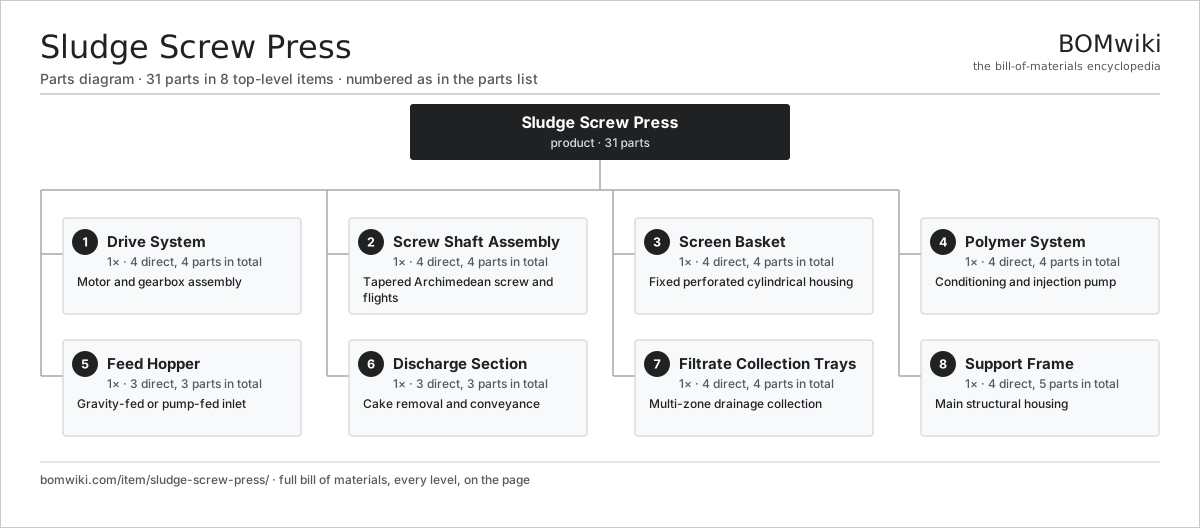
| # | Part | Qty | What it does |
|---|---|---|---|
| 1 | Drive System 4 parts | 1× | Motor and gearbox assembly |
| 2 | Screw Shaft Assembly 4 parts | 1× | Tapered Archimedean screw and flights |
| 3 | Screen Basket 4 parts | 1× | Fixed perforated cylindrical housing |
| 4 | Polymer System 4 parts | 1× | Conditioning and injection pump |
| 5 | Feed Hopper 3 parts | 1× | Gravity-fed or pump-fed inlet |
| 6 | Discharge Section 3 parts | 1× | Cake removal and conveyance |
| 7 | Filtrate Collection Trays 4 parts | 1× | Multi-zone drainage collection |
| 8 | Support Frame 4 parts | 1× | Main structural housing |
3D model
No 3D model yet. Have a CAD file of this? Add a 3D model. STL renders right on this page; STEP, FreeCAD, and OpenSCAD sources are welcome too (openly licensed, like all 3D models on BOMwiki).
Build & assembly graph
expand / collapse · shared sub-assemblies converge · links to related products · est. labourTap an assembly to expand/collapse · tap a part to open it · use “Open page” for any node · drag to pan, scroll to zoom.
Bill of materials for Sludge Screw Press
8 top-level lines · 38 rows shown · 31 parts total · indented to 3 levels| # | Item / sub-assembly | Part no. | Qty/assy | Ext. qty | Parts | Type |
|---|---|---|---|---|---|---|
| 1 | Drive System 4 parts | sludge-screw-press-drive | 1× | 1 | 4 | assembly |
| 1.1 | Blower Motor | blower-motor | 1× | 1 | · | part |
| 1.2 | Gearbox | sludge-screw-press-gearbox | 1× | 1 | · | part |
| 1.3 | Motor Coupling | sludge-screw-press-motor-coupling | 1× | 1 | · | part |
| 1.4 | Motor Starter | package-wastewater-plant-motor-starter | 1× | 1 | · | part |
| 2 | Screw Shaft Assembly 4 parts | sludge-screw-press-screw-shaft | 1× | 1 | 4 | assembly |
| 2.1 | Main Screw | sludge-screw-press-main-screw | 1× | 1 | · | part |
| 2.2 | Inlet Bearing | sludge-screw-press-bearing-inlet | 1× | 1 | · | part |
| 2.3 | Discharge Bearing | sludge-screw-press-bearing-discharge | 1× | 1 | · | part |
| 2.4 | Drive Coupling | sludge-screw-press-drive-coupling | 1× | 1 | · | part |
| 3 | Screen Basket 4 parts | sludge-screw-press-screen-basket | 1× | 1 | 4 | assembly |
| 3.1 | Screen Cylinder | sludge-screw-press-screen-cylinder | 1× | 1 | · | part |
| 3.2 | Conical Neck | sludge-screw-press-conical-neck | 1× | 1 | · | part |
| 3.3 | Screen Support | sludge-screw-press-screen-support | 1× | 1 | · | part |
| 3.4 | Fastener Set | fastener-set | 1× | 1 | · | part |
| 4 | Polymer System 4 parts | sludge-screw-press-polymer-system | 1× | 1 | 4 | assembly |
| 4.1 | Package Wastewater Plant Polymer Tank | sludge-screw-press-package-wastewater-plant-polymer-tank | 1× | 1 | · | part |
| 4.2 | Polymer Pump | sludge-screw-press-polymer-pump | 1× | 1 | · | part |
| 4.3 | Static Mixer | sludge-screw-press-static-mixer | 1× | 1 | · | part |
| 4.4 | Pressure Sensor | pressure-sensor | 1× | 1 | · | part |
| 5 | Feed Hopper 3 parts | sludge-screw-press-feed-hopper | 1× | 1 | 3 | assembly |
| 5.1 | Hopper Cone | sludge-screw-press-hopper-cone | 1× | 1 | · | part |
| 5.2 | Feed Valve | sludge-screw-press-feed-valve | 1× | 1 | · | part |
| 5.3 | Level Sensor | sludge-screw-press-level-sensor | 1× | 1 | · | part |
| 6 | Discharge Section 3 parts | sludge-screw-press-discharge-section | 1× | 1 | 3 | assembly |
| 6.1 | Discharge Cone | sludge-screw-press-discharge-cone | 1× | 1 | · | part |
| 6.2 | Discharge Chute | sludge-screw-press-discharge-chute | 1× | 1 | · | part |
| 6.3 | Cake Conveyor | sludge-screw-press-cake-conveyor | 1× | 1 | · | part |
| 7 | Filtrate Collection Trays 4 parts | sludge-screw-press-filtrate-trays | 1× | 1 | 4 | assembly |
| 7.1 | Inlet Tray | sludge-screw-press-inlet-tray | 1× | 1 | · | part |
| 7.2 | Middle Tray | sludge-screw-press-middle-tray | 1× | 1 | · | part |
| 7.3 | Discharge Tray | sludge-screw-press-discharge-tray | 1× | 1 | · | part |
| 7.4 | Sump Basin | sludge-screw-press-sump-basin | 1× | 1 | · | part |
| 8 | Support Frame 4 parts | sludge-screw-press-support-frame | 1× | 1 | 5 | assembly |
| 8.1 | Base Frame | sludge-screw-press-base-frame | 1× | 1 | · | part |
| 8.2 | Motor Mount | sludge-screw-press-motor-mount | 1× | 1 | · | part |
| 8.3 | Fastener Set | fastener-set | 2× | 2 | · | part |
| 8.4 | Vibration Isolator | sludge-screw-press-vibration-isolator | 1× | 1 | · | part |
Something wrong in this list? Report a problem with this BOM.
Related products
same domain, ranked by shared parts Belt Filter Press
57 parts · shares 3 with this page
Grit Classifier
35 parts · shares 3 with this page
Package Wastewater Plant
139 parts · shares 3 with this page
Binder Jetting Printer
112 parts · shares 2 with this page
Belt Filter Press
57 parts · shares 3 with this page
Grit Classifier
35 parts · shares 3 with this page
Package Wastewater Plant
139 parts · shares 3 with this page
Binder Jetting Printer
112 parts · shares 2 with this page
 Brush Making Machine
50 parts · shares 2 with this page
Cable Armoring Machine
37 parts · shares 2 with this page
Brush Making Machine
50 parts · shares 2 with this page
Cable Armoring Machine
37 parts · shares 2 with this page
Sourcing: possible vendors
Browse the supplier directory → Prices, MOQ, and lead times are algorithmic estimates, not quotes, and not claims about these companies. Company mappings are curated by keyword; est. price band $5k–$2M. How estimates work| Vendor | HQ | Specialty | MOQ | Lead time |
|---|---|---|---|---|
| atlascopco.com ↗ | Stockholm, SE | Compressors & industrial | 10 units | 12–20 wks |
|
🇦🇹Andritz
andritz.com ↗
|
Graz, AT | Process plants & machinery | 10 units | 12–20 wks |
| buhlergroup.com ↗ | Uzwil, CH | Food & materials processing | 10 units | 12–20 wks |
| gea.com ↗ | Düsseldorf, DE | Process technology | 10 units | 12–20 wks |
| mhi.com ↗ | Tokyo, JP | Heavy machinery | 10 units | 12–20 wks |
978-word article