Smart Electricity Meter
ProductOverview
A smart electricity meter is an electronic replacement for mechanical analog meters, recording real-time consumption data and transmitting it wirelessly or via power-line carrier to utility headquarters. The Energy Metering IC is the core, a highly integrated analog front-end chip that samples voltage and current hundreds of times per second, computing RMS power, reactive power (VAR), and harmonic content. The Main Microcontroller stores consumption profiles (typically 15–30 minute snapshots) in flash memory for 16 years, and the Communication Module modem sends data hourly or on-demand to the utility's Advanced Metering Infrastructure (AMI) network.
Smart meters enable real-time demand response, time-of-use (TOU) pricing, and early fault detection. A utility can remotely disconnect customers for non-payment (via Communication Module) and identifies outages by monitoring which meters stop reporting. Residential customers see consumption in near real-time via web portal, reducing phantom loads and encouraging conservation.
How it works
The customer's main service line (120/240 V single-phase or 208/277 V three-phase) enters the meter socket. The Voltage Measurement Network sample line-to-neutral voltage via a precision resistor divider, stepping down 240 V to a safe 2.4 V for the analog-to-digital converter. The Current Sensors (toroidal current transformers or Hall-effect sensors) convert line current (0–200 A) to a proportional 2.5 V signal.
The Energy Metering IC continuously samples these signals at 8 kHz per channel, computing instantaneous power (P = V × I × cos θ) and integrating over each metering interval (typically 15 minutes). The RMS Engine ensures true RMS calculation, handling non-sinusoidal waveforms (harmonics) gracefully. The Phase Calculator determines phase angle, computing reactive power (VAR) and power factor.
The Main Microcontroller reads the metering IC's registers once per second, buffers data, and at each interval boundary (15:00, 15:15, 15:30, etc.) writes the interval demand (kW, kVAR, power factor) to flash. This creates a 16-year history consumed monthly by the utility and customer portals for analysis.
The Time Synchronization module maintains an independent real-time clock, synchronized to utility time daily via NTP (Network Time Protocol) transmitted through the RF or PLC modem. This ensures all meters across the grid timestamp events identically.
Communication architecture
The Communication Module modem can operate in three modes:
RF Mesh (ZigBee 2.4 GHz): Meters relay data peer-to-peer, hopping through neighborhood meters to reach a collector device (2–3 hops typical). Range ~100 m line-of-sight. Latency 1–10 seconds per hop.
LoRaWAN (868/915 MHz): Long-range narrow-band modulation covering 10+ km from a single gateway. Latency 1–30 minutes (scheduled transmission windows). Power-efficient, supporting 10-year battery operation (where applicable).
Power Line Communications (PLC): Meter transmits 50–200 kHz signal on the utility neutral/ground. No RF antenna required. Bandwidth-limited (9600 baud typical), but reaches 100 % of metered homes (every customer has power lines). Susceptible to high-frequency noise from switching supplies and electric vehicle chargers.
Data payload is typically 50–200 bytes (meter ID, interval kWh, demand, power factor, fault flags) encrypted with AES-128. Transmission occurs hourly or on-demand (on-peak TOU events).
Tamper and fraud detection
The Tamper Detection & Sealing system prevents modification:
- Case open: Tamper switch detects meter case removal, recording event timestamp.
- Backward connection: Reverse Power Logic logic flags negative power flow (export to grid when meter should import).
- Recalibration attempts: Certain metering IC registers are write-protected by firmware; physical ROM or PROM prevents casual modification.
- Communication jamming: Communication Watchdog detects loss of signal for >24 hours, logging outage.
All tamper events are logged with timestamp in non-volatile flash, creating an immutable audit trail. Utilities verify meter authenticity during installation using SHA-256 certificates.
Accuracy and Class ratings
The Energy Metering IC and Current Sensors are calibrated to Class 1 accuracy (±1 % per IEC 62052-11 international standard). Factory calibration involves:
- Temperature correction of current sensor gain over −20 to +60 °C.
- Linearity verification: current measured at 5 %, 20 %, 50 %, and 100 % of full-scale must agree within ±1 %.
- Power factor correction: reactive power computed from phase angle must agree with reference instrumentation within ±2 degrees.
Over a year, ±1 % accuracy means the meter may over- or under-read a customer's actual consumption by 1 %. This is split equally between utility and customer under standard regulations; both parties accept ±0.5 % error on average.
Demand-side response
Utilities leverage smart meters for demand response: during peak pricing hours (4–9 PM summer), the utility can signal participating customers to reduce load (via broadcast to RF mesh). The customer's home energy management system responds by delaying EV charging, raising thermostat setpoint, or shedding water heating. The meter captures reduced consumption, and the customer receives a bill credit.
Peak shaving reduces peak demand by 5–15 %, deferring expensive gas turbine generation and reducing wholesale electricity costs. A typical peak-shaving event saves utilities $10–50/home annually, offsetting meter hardware cost within 5 years.
Privacy and data security
Meter data contains sensitive information: hourly consumption patterns can reveal occupancy, appliance use, and personal routines. Utilities employ encryption (AES-128 minimum) and secure key distribution (pre-provisioned per unit, unique). Many jurisdictions require utilities to anonymize meter data before sharing with third-party analytics firms.
A compromised meter (physically tampered or firmware exploited) could under-report consumption (revenue theft). Utilities mitigate by:
- Auditing a random 1–5 % of meters annually against reference instrumentation.
- Monitoring for statistical anomalies (meter kWh vs. neighborhood average).
- Employing secure boot (cryptographically verified firmware) preventing unauthorized code injection.
Installation and field replacement
Smart meters fit into standard utility meter sockets (Type 01/20 in North America, with regional variants elsewhere). Installation is a 5-minute swap: utility technician disconnects power (via socket disconnect switch, breaker, or momentary power isolation), removes old meter, inserts new meter, reconnects power. The meter auto-detects voltage (120 V vs. 240 V) and CT ratio (if applicable) from firmware configuration.
Data migration from the old meter is not needed; the utility loads only the new meter ID into the billing system. Consumption history is retained separately (old meter archived). First data point from new meter is logged at the next interval boundary (e.g., 12:30 AM if installed at 12:23 AM, waiting for 12:30 boundary).
Evolution: Battery-Backed and Distributed
Next-generation designs add:
- Integrated battery backup: Small Li-ion cell (5 Wh) maintaining 4–8 hours operation during outage, capturing restoration moment precisely.
- Distributed solar + storage support: Meters bidirectional, measuring both import (grid to home) and export (home to grid), settling net consumption monthly.
- Blockchain ledger integration: P2P microgrid transactions (peer-to-peer solar energy trading) recorded on distributed ledger.
These features are in pilot with utilities; cost and regulatory barriers currently limit mainstream adoption.
Smart Electricity Meter parts and their functions
9 top-level parts · 40 parts in total · full bill of materials below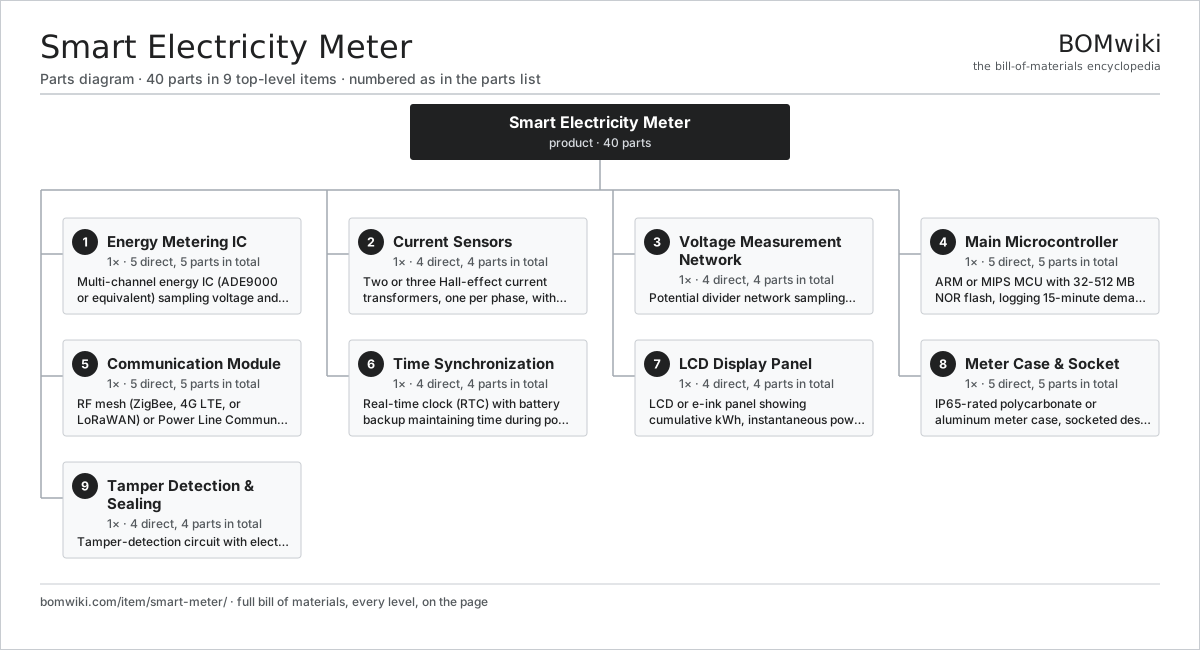
| # | Part | Qty | What it does |
|---|---|---|---|
| 1 | Energy Metering IC 5 parts | 1× | Multi-channel energy IC (ADE9000 or equivalent) sampling voltage and current at >4 kHz, calculating kWh and kVAR |
| 2 | Current Sensors 4 parts | 1× | Two or three Hall-effect current transformers, one per phase, with temperature-compensated output |
| 3 | Voltage Measurement Network 4 parts | 1× | Potential divider network sampling line-to-neutral voltage, filtered for harmonic rejection |
| 4 | Main Microcontroller 5 parts | 1× | ARM or MIPS MCU with 32-512 MB NOR flash, logging 15-minute demand profiles and event logs |
| 5 | Communication Module 5 parts | 1× | RF mesh (ZigBee, 4G LTE, or LoRaWAN) or Power Line Communications (PLC) modem for meter data transmission |
| 6 | Time Synchronization 4 parts | 1× | Real-time clock (RTC) with battery backup maintaining time during power loss, synchronized via NTP or utility network |
| 7 | LCD Display Panel 4 parts | 1× | LCD or e-ink panel showing cumulative kWh, instantaneous power, voltage, power factor, and tamper alerts |
| 8 | Meter Case & Socket 5 parts | 1× | IP65-rated polycarbonate or aluminum meter case, socketed design fitting into standard utility meter pole |
| 9 | Tamper Detection & Sealing 4 parts | 1× | Tamper-detection circuit with electronic sealing preventing unauthorized measurement alteration |
3D model
No 3D model yet. Have a CAD file of this? Add a 3D model. STL renders right on this page; STEP, FreeCAD, and OpenSCAD sources are welcome too (openly licensed, like all 3D models on BOMwiki).
Build & assembly graph
expand / collapse · shared sub-assemblies converge · links to related products · est. labourTap an assembly to expand/collapse · tap a part to open it · use “Open page” for any node · drag to pan, scroll to zoom.
Bill of materials for Smart Electricity Meter
9 top-level lines · 49 rows shown · 40 parts total · indented to 3 levels| # | Item / sub-assembly | Part no. | Qty/assy | Ext. qty | Parts | Type |
|---|---|---|---|---|---|---|
| 1 | Energy Metering IC 5 parts | smart-meter-metering-ic | 1× | 1 | 5 | assembly |
| 1.1 | 24-Bit ADC Array | smart-meter-adc-core | 1× | 1 | · | part |
| 1.2 | Anti-Aliasing Filters | smart-meter-adc-anti-alias | 1× | 1 | · | part |
| 1.3 | Phase Calculator | smart-meter-phase-calculator | 1× | 1 | · | part |
| 1.4 | RMS Engine | smart-meter-rms-calculator | 1× | 1 | · | part |
| 1.5 | FFT Engine | smart-meter-harmonic-processor | 1× | 1 | · | part |
| 2 | Current Sensors 4 parts | smart-meter-current-sensors | 1× | 1 | 4 | assembly |
| 2.1 | Toroidal Current Transformer | smart-meter-ct-toroidal | 1× | 1 | · | part |
| 2.2 | CT Burden Resistor | smart-meter-ct-burden-resistor | 1× | 1 | · | part |
| 2.3 | Temperature Compensation | smart-meter-ct-temperature-comp | 1× | 1 | · | part |
| 2.4 | CT Saturation Detector | smart-meter-ct-saturation-detector | 1× | 1 | · | part |
| 3 | Voltage Measurement Network 4 parts | smart-meter-voltage-sensors | 1× | 1 | 4 | assembly |
| 3.1 | HV Resistor Divider | smart-meter-hv-resistor-divider | 1× | 1 | · | part |
| 3.2 | Precision Resistors | smart-meter-voltage-precision | 1× | 1 | · | part |
| 3.3 | Voltage Low-Pass Filter | smart-meter-voltage-filter | 1× | 1 | · | part |
| 3.4 | Neutral Reference | smart-meter-neutral-reference | 1× | 1 | · | part |
| 4 | Main Microcontroller 5 parts | smart-meter-microcontroller | 1× | 1 | 5 | assembly |
| 4.1 | ARM Cortex-M4 Processor | smart-meter-mcu-core | 1× | 1 | · | part |
| 4.2 | NOR Flash Memory | smart-meter-nor-flash | 1× | 1 | · | part |
| 4.3 | SDRAM Buffer | smart-meter-sdram | 1× | 1 | · | part |
| 4.4 | RTC Module | smart-meter-rtc-module | 1× | 1 | · | part |
| 4.5 | Metering IC Interface | smart-meter-measurement-interface | 1× | 1 | · | part |
| 5 | Communication Module 5 parts | smart-meter-communications | 1× | 1 | 5 | assembly |
| 5.1 | RF Transceiver Module | smart-meter-rf-module | 1× | 1 | · | part |
| 5.2 | PLC Modem | smart-meter-plc-modem | 1× | 1 | · | part |
| 5.3 | Antenna | smart-meter-antenna | 1× | 1 | · | part |
| 5.4 | Security Provisioning | smart-meter-security-key | 1× | 1 | · | part |
| 5.5 | EMI Filtering | smart-meter-signal-conditioning | 1× | 1 | · | part |
| 6 | Time Synchronization 4 parts | smart-meter-time-sync | 1× | 1 | 4 | assembly |
| 6.1 | 32.768 kHz Crystal | smart-meter-rtc-crystal | 1× | 1 | · | part |
| 6.2 | Backup Battery | smart-meter-backup-battery | 1× | 1 | · | part |
| 6.3 | RTC IC | smart-meter-rtc-ic | 1× | 1 | · | part |
| 6.4 | NTP Synchronization | smart-meter-ntp-sync | 1× | 1 | · | part |
| 7 | LCD Display Panel 4 parts | smart-meter-display | 1× | 1 | 4 | assembly |
| 7.1 | LCD Panel | lcd-panel | 1× | 1 | · | part |
| 7.2 | Backlight LED | smart-meter-display-backlight | 1× | 1 | · | part |
| 7.3 | LCD Driver IC | smart-meter-display-driver | 1× | 1 | · | part |
| 7.4 | Contrast Potentiometer | smart-meter-display-contrast-control | 1× | 1 | · | part |
| 8 | Meter Case & Socket 5 parts | smart-meter-housing | 1× | 1 | 5 | assembly |
| 8.1 | Polycarbonate Case | smart-meter-polycarbonate-case | 1× | 1 | · | part |
| 8.2 | Meter Socket Base | smart-meter-meter-socket | 1× | 1 | · | part |
| 8.3 | Terminal Blocks | smart-meter-terminal-blocks | 1× | 1 | · | part |
| 8.4 | Gasket Seal | smart-meter-sealing-gasket | 1× | 1 | · | part |
| 8.5 | Wall Mount Bracket | smart-meter-mounting-bracket | 1× | 1 | · | part |
| 9 | Tamper Detection & Sealing 4 parts | smart-meter-metrology-seal | 1× | 1 | 4 | assembly |
| 9.1 | Tamper Switch | smart-meter-tamper-switch | 1× | 1 | · | part |
| 9.2 | Reverse Power Logic | smart-meter-reverse-power-detector | 1× | 1 | · | part |
| 9.3 | Electronic Seal Flag | smart-meter-seal-flag | 1× | 1 | · | part |
| 9.4 | Communication Watchdog | smart-meter-communication-watchdog | 1× | 1 | · | part |
Something wrong in this list? Report a problem with this BOM.
Related products
same domain, ranked by shared parts Air-Insulated Substation Bay
1,329 parts · shares 1 with this page
Air-Insulated Substation Bay
1,329 parts · shares 1 with this page
 Automatic Circuit Recloser
64 parts · shares 1 with this page
Automatic Transfer Switch
212 parts · shares 1 with this page
Automatic Circuit Recloser
64 parts · shares 1 with this page
Automatic Transfer Switch
212 parts · shares 1 with this page
 Automatic Voltage Regulator
83 parts · shares 1 with this page
Biogas Generator (CHP)
338 parts · shares 1 with this page
Automatic Voltage Regulator
83 parts · shares 1 with this page
Biogas Generator (CHP)
338 parts · shares 1 with this page
Sourcing: possible vendors
Browse the supplier directory → Prices, MOQ, and lead times are algorithmic estimates, not quotes, and not claims about these companies. Company mappings are curated by keyword; est. price band $5k–$50M. How estimates work| Vendor | HQ | Specialty | MOQ | Lead time |
|---|---|---|---|---|
| gevernova.com ↗ | Cambridge, US | Power generation | made to order | 20–40 wks |
| siemens-energy.com ↗ | Munich, DE | Power & grid | made to order | 20–40 wks |
| hitachienergy.com ↗ | Zurich, CH | Grid & transformers | made to order | 20–40 wks |
|
🇨🇭ABB
abb.com ↗
|
Zurich, CH | Electrification & automation | made to order | 20–40 wks |
| se.com ↗ | Rueil-Malmaison, FR | Electrical & automation | made to order | 20–40 wks |
1,193-word article