Smart Compacting Bin
ProductOverview
A smart waste bin is an autonomous waste container equipped with solar power generation, internal compaction mechanism, fill-level sensing, and cellular telemetry. The system allows waste collection operators to optimize collection routes and schedules based on real-time bin-fullness data, reducing unnecessary pickups and fuel consumption. A municipality deploying 500 smart bins across residential or commercial districts can reduce collection vehicle miles by 20–40% while improving operational efficiency.
The bin compacts waste internally as it accumulates, extending the time between collection events from 2–3 days to 7–14 days in typical applications. Solar charging ensures the compaction mechanism and telemetry system operate indefinitely without external power connection, enabling deployment in unelectrified locations (parks, remote campuses, rural areas).
How it works
Solar Power Generation and Charging
A rooftop monocrystalline solar array (100 W rated, mounted at 30° angle for optimal irradiance) generates electricity during daylight hours. The PWM charge controller with maximum power point tracking (MPPT) converts variable voltage from the solar panel to regulated 24 VDC for the internal LiFePO4 battery pack.
On a typical sunny day (4–6 peak sun hours), the 100 W panel generates 400–600 Wh of energy. The battery system (200 Wh capacity, LiFePO4 chemistry) charges fully and can store excess energy for cloudy days or night-time operation. Battery management ensures safe charging (preventing over-charge) and discharging (preventing deep depletion that damages cells).
Waste Compaction Mechanism
As waste is deposited into the bin through the top opening, a fill-level sensor (ultrasonic distance sensor or weight-based) continuously monitors fullness. When the sensor detects the waste level rising (or when scheduled compaction triggers automatically), the main microcontroller energizes the brushless motor (24 VDC, 500 W peak).
The motor drives a 10:1 reduction gearbox that outputs low-speed, high-torque rotation (200 rpm). An eccentric crank mechanism converts the rotational motion into linear motion, operating the compression ram plate with a stroke of ~50 mm.
The ram plate descends with ~100 kg downforce (from the motor torque and gearbox ratio), compressing waste at the bottom of the bin. Compaction increases density from ~150 kg/m³ (loose refuse) to ~400–500 kg/m³ (compacted), achieving 3–4:1 volume reduction.
A return spring ejects the ram plate upward, resetting the mechanism for the next compaction cycle. Limit switches detect top and bottom positions, preventing over-travel. The motor automatically stops after completing the compression stroke.
Each compaction cycle consumes ~50 Wh of battery energy (including motor operation, mechanical losses, and controller overhead). With a 200 Wh battery and favorable solar charging, the bin can perform 10–20 compaction cycles per day, depending on waste input rate and solar availability.
Autonomous Fill Monitoring
A ultrasonic fill-level sensor (mounted in the bin's top interior) continuously measures the distance from the sensor to the waste surface. As waste accumulates and is compacted, the distance decreases. The sensor reports distance to the main microcontroller, which calculates remaining capacity as a percentage (0% = empty, 100% = full).
The microcontroller logic operates in one of three modes:
- Manual compaction mode: Users press a mechanical button to trigger immediate compaction.
- Automatic level-based mode: When fill level exceeds 60%, the controller automatically triggers compaction to consolidate waste and extend bin capacity.
- Scheduled mode: Compaction occurs at fixed times (e.g., every 2 hours) regardless of fill level, useful for high-traffic areas.
Cellular Telemetry and Cloud Reporting
At regular intervals (typically once per day, configurable to real-time if needed), the cellular modem (LTE-M Cat-M1 with embedded SIM) establishes a connection to the IoT cloud platform. The modem transmits:
- Current fill percentage (0–100%)
- Battery state of charge (SOC, %)
- Number of compaction cycles performed since last report
- Bin location (GPS coordinates if GNSS receiver included)
- Error codes (if sensor malfunction or motor jam detected)
Cloud software processes this data and generates insights for waste-collection schedulers:
- Route optimization: Collection vehicles are dispatched only to bins exceeding 85% fullness, rather than visiting every bin on a fixed schedule.
- Predictive scheduling: Historical data identifies which bins fill fastest and plans future pickups accordingly.
- Fault detection: If a bin fails to report or reports error codes, maintenance personnel are alerted.
Motorized Lid with Security
A motorized hinged lid (12 VDC motor with solenoid latch) can be controlled remotely. The cloud application can:
- Lock the lid (solenoid engages mechanical latch) to prevent unauthorized dumping or scavenging.
- Unlock and open the lid to allow authorized users (residents or staff) to deposit waste.
- Log all open/close events with timestamps for security and auditing.
A magnetic reed switch detects whether the lid is open or closed, providing feedback to the controller and cloud system.
Power Management and Sleep Modes
The microcontroller implements aggressive power-saving strategies:
- Deep sleep mode: Between sensor checks and telemetry transmissions, the MCU enters low-power sleep state (<1 mW consumption).
- Wake-on-event: The sensor or button press wakes the MCU from sleep, triggering compaction or data transmission.
- Cellular modem shutdown: After each data transmission, the modem powers down (modem is the largest power consumer, drawing ~100 mA during active connection).
This power-managed design extends battery life and reduces solar-panel size requirements. On a typical day (one compaction cycle, one telemetry transmission, 24 hours idle), the bin consumes ~100–150 Wh, well within the 200 Wh battery capacity topped up by the 100 W solar panel.
Operational Safety and Failures
The compaction mechanism includes mechanical interlocks preventing hazardous operation:
- Lid sensing: If the lid is opened while compaction is active, a safety switch interrupts motor power.
- Motor jam detection: If the motor stalls (e.g., compacting too much dense waste), the controller detects high current draw and stops the motor to prevent damage.
- Battery depletion protection: If battery voltage drops below a safe threshold, the controller disables all non-essential functions, preventing deep discharge that damages LiFePO4 cells.
In the event of a mechanical jam or compaction failure, the bin sends an alert to the cloud platform. Maintenance personnel can visit, manually override the solenoid latch, and clear the obstruction.
Deployment and Configuration
Smart bins are deployed at:
- Residential areas: Multi-family apartment complexes, condominium buildings
- Commercial zones: Office parks, shopping centers, restaurants
- Public spaces: Parks, transit stations, university campuses
- Industrial sites: Manufacturing facilities, distribution centers
Each bin is assigned a QR code (printed on the exterior) linking to its cloud profile. Waste haulers scan the code with a mobile app to confirm bin identity and fetch the latest fill-level data before pickup.
Economic Impact
Capital cost: ~$1200–1500 per unit (solar + motor + sensor + modem + battery + enclosure).
Operating cost: Minimal. No fuel to compactor. Solar charging is free. Cellular data plan costs ~$5–10/month per bin. Maintenance is limited (compactor rarely fails).
Collection savings: A waste-hauling company managing 500 smart bins in a district can reduce:
- Vehicle routes: 3 vehicles making 2 collections/day (6 stops) → 2 vehicles making 1 collection/day (5 stops) = 17% route reduction
- Fuel consumption: 200 gallons/week → 165 gallons/week = 17% fuel savings
- Labor: 6 drivers → 4 drivers = 33% labor savings
Annual savings: (165 × $3.50/gallon) + (2 drivers × $50k salary) = ~$120k for 500 bins. ROI: $120k savings / (500 bins × $1350/bin) = 0.18 years ≈ 2 months payback period (very profitable).
Maintenance and Troubleshooting
Daily: Visual inspection of bin exterior (vandalism, dents). Check solar panel for dirt/debris and wipe if necessary.
Weekly: Verify cellular signal strength by checking modem LED (should blink when transmitting). Confirm compaction cycles are occurring (listen for motor hum if triggered by schedule).
Monthly: Empty the battery monitoring data log in the cloud. Review fill-level trends to identify stuck sensors (always reporting 100% or 0%).
Quarterly: Replace the bin if internal compactor jams or motor fails (field replacement of motor or gearbox is not economical for a $1500 unit; instead, swap full unit). Recalibrate ultrasonic sensor if drift is detected (sensor reads empty when bin is actually 50% full).
Annually: Inspect battery pack for swelling or corrosion (LiFePO4 cells degrade after 3000+ cycles or 5 years; plan replacement accordingly). Re-tighten all fasteners on solar-panel mounting (vibration from wind and traffic can loosen hardware over time).
Environmental and Social Benefit
By optimizing collection routes and reducing unnecessary pickups, smart bins help municipalities:
- Reduce carbon emissions from waste-hauling vehicles (17–25% fuel reduction typical).
- Lower operational costs and reinvest savings in additional services (recycling expansion, clean-up programs).
- Improve neighborhood aesthetics (compaction prevents overfilled bins and scattered litter).
- Enable data-driven planning (historical fill patterns inform facility capacity expansion).
A city of 500,000 residents deploying 5,000 smart bins across neighborhoods reduces annual waste-hauling emissions by ~400 tonnes of CO2 equivalent, equivalent to planting 6,000 trees annually.
Smart Compacting Bin parts and their functions
9 top-level parts · 41 parts in total · full bill of materials below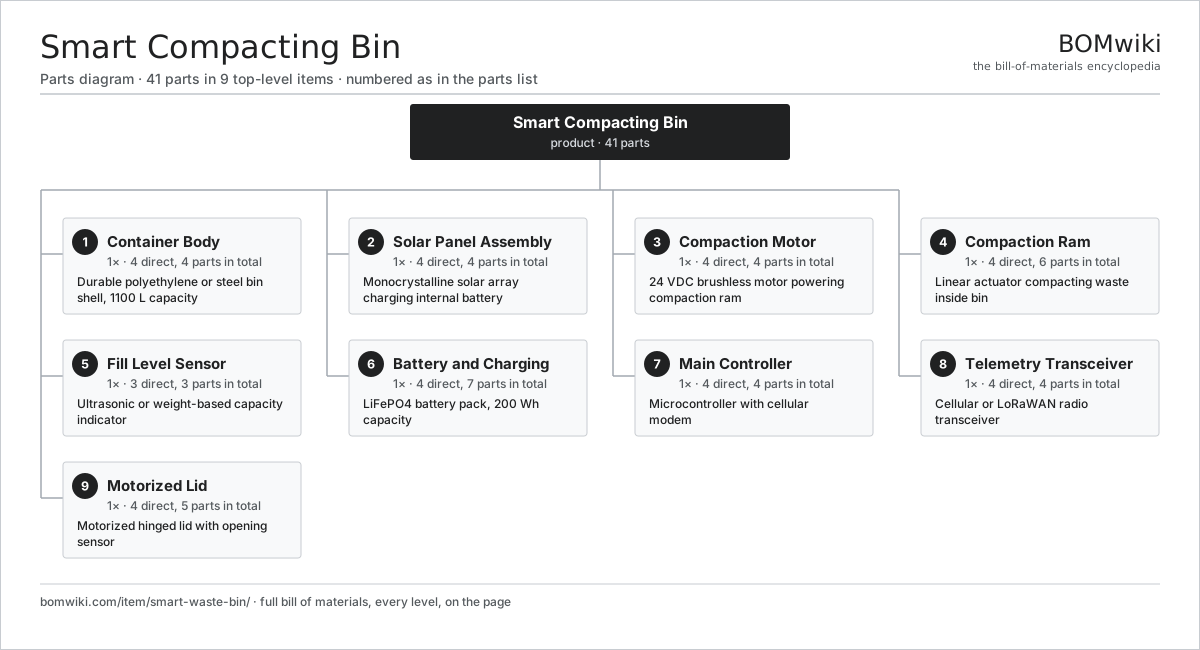
| # | Part | Qty | What it does |
|---|---|---|---|
| 1 | Container Body 4 parts | 1× | Durable polyethylene or steel bin shell, 1100 L capacity |
| 2 | Solar Panel Assembly 4 parts | 1× | Monocrystalline solar array charging internal battery |
| 3 | Compaction Motor 4 parts | 1× | 24 VDC brushless motor powering compaction ram |
| 4 | Compaction Ram 4 parts | 1× | Linear actuator compacting waste inside bin |
| 5 | Fill Level Sensor 3 parts | 1× | Ultrasonic or weight-based capacity indicator |
| 6 | Battery and Charging 4 parts | 1× | LiFePO4 battery pack, 200 Wh capacity |
| 7 | Main Controller 4 parts | 1× | Microcontroller with cellular modem |
| 8 | Telemetry Transceiver 4 parts | 1× | Cellular or LoRaWAN radio transceiver |
| 9 | Motorized Lid 4 parts | 1× | Motorized hinged lid with opening sensor |
3D model
No 3D model yet. Have a CAD file of this? Add a 3D model. STL renders right on this page; STEP, FreeCAD, and OpenSCAD sources are welcome too (openly licensed, like all 3D models on BOMwiki).
Build & assembly graph
expand / collapse · shared sub-assemblies converge · links to related products · est. labourTap an assembly to expand/collapse · tap a part to open it · use “Open page” for any node · drag to pan, scroll to zoom.
Bill of materials for Smart Compacting Bin
9 top-level lines · 44 rows shown · 41 parts total · indented to 3 levels| # | Item / sub-assembly | Part no. | Qty/assy | Ext. qty | Parts | Type |
|---|---|---|---|---|---|---|
| 1 | Container Body 4 parts | smart-waste-bin-container-body | 1× | 1 | 4 | assembly |
| 1.1 | Plastic Shell | smart-waste-bin-shell-plastic | 1× | 1 | · | part |
| 1.2 | Steel Base Frame | smart-waste-bin-base-frame | 1× | 1 | · | part |
| 1.3 | Rim Gasket | smart-waste-bin-rim-gasket | 1× | 1 | · | part |
| 1.4 | Drain Valve | smart-waste-bin-drain-plug | 1× | 1 | · | part |
| 2 | Solar Panel Assembly 4 parts | smart-waste-bin-solar-panel | 1× | 1 | 4 | assembly |
| 2.1 | Solar Module | smart-waste-bin-solar-cells | 1× | 1 | · | part |
| 2.2 | Solar Frame | smart-waste-bin-solar-frame | 1× | 1 | · | part |
| 2.3 | Solar Charger | smart-waste-bin-solar-controller | 1× | 1 | · | part |
| 2.4 | Solar Cabling | smart-waste-bin-solar-wiring | 1× | 1 | · | part |
| 3 | Compaction Motor 4 parts | smart-waste-bin-compaction-motor | 1× | 1 | 4 | assembly |
| 3.1 | Brushless Motor | smart-waste-bin-motor-brushless | 1× | 1 | · | part |
| 3.2 | Planetary Gearbox | smart-waste-bin-motor-gearbox | 1× | 1 | · | part |
| 3.3 | Motor ESC | smart-waste-bin-motor-controller | 1× | 1 | · | part |
| 3.4 | Crank Linkage | smart-waste-bin-motor-crank-linkage | 1× | 1 | · | part |
| 4 | Compaction Ram 4 parts | smart-waste-bin-compaction-ram | 1× | 1 | 6 | assembly |
| 4.1 | Compression Plate | smart-waste-bin-ram-plate | 1× | 1 | · | part |
| 4.2 | Guide Rod | smart-waste-bin-ram-guide-rod | 2× | 2 | · | part |
| 4.3 | Return Spring | smart-waste-bin-ram-spring-return | 1× | 1 | · | part |
| 4.4 | Limit Switch | smart-waste-bin-ram-limit-switch | 2× | 2 | · | part |
| 5 | Fill Level Sensor 3 parts | smart-waste-bin-fill-sensor | 1× | 1 | 3 | assembly |
| 5.1 | Ultrasonic Sensor | smart-waste-bin-sensor-ultrasonic | 1× | 1 | · | part |
| 5.2 | Load Cell | smart-waste-bin-sensor-weight-cell | 1× | 1 | · | part |
| 5.3 | ADC Module | smart-waste-bin-sensor-analog-converter | 1× | 1 | · | part |
| 6 | Battery and Charging 4 parts | smart-waste-bin-battery-system | 1× | 1 | 7 | assembly |
| 6.1 | LiFePO4 Battery Cell | smart-waste-bin-battery-cells | 4× | 4 | · | part |
| 6.2 | Battery Management System | smart-waste-bin-battery-bms | 1× | 1 | · | part |
| 6.3 | Battery Monitor IC | smart-waste-bin-battery-monitoring | 1× | 1 | · | part |
| 6.4 | External Charge Port | smart-waste-bin-charge-cable | 1× | 1 | · | part |
| 7 | Main Controller 4 parts | smart-waste-bin-controller-board | 1× | 1 | 4 | assembly |
| 7.1 | Microcontroller | smart-waste-bin-mcu | 1× | 1 | · | part |
| 7.2 | Real-Time Clock | smart-waste-bin-rtc-clock | 1× | 1 | · | part |
| 7.3 | Flash Memory | smart-waste-bin-memory-flash | 1× | 1 | · | part |
| 7.4 | Power Regulator | smart-waste-bin-power-management | 1× | 1 | · | part |
| 8 | Telemetry Transceiver 4 parts | smart-waste-bin-telemetry-module | 1× | 1 | 4 | assembly |
| 8.1 | Cellular Modem | smart-waste-bin-cellular-module | 1× | 1 | · | part |
| 8.2 | Cellular Antenna | smart-waste-bin-antenna-lte | 1× | 1 | · | part |
| 8.3 | GNSS Receiver | smart-waste-bin-gnss-receiver | 1× | 1 | · | part |
| 8.4 | Embedded SIM | smart-waste-bin-sim-card | 1× | 1 | · | part |
| 9 | Motorized Lid 4 parts | smart-waste-bin-lid-mechanism | 1× | 1 | 5 | assembly |
| 9.1 | Lid Motor | smart-waste-bin-lid-motor | 1× | 1 | · | part |
| 9.2 | Lid Hinge | smart-waste-bin-lid-hinge | 2× | 2 | · | part |
| 9.3 | Solenoid Latch | smart-waste-bin-lid-latch | 1× | 1 | · | part |
| 9.4 | Lid Sensor | smart-waste-bin-lid-sensor | 1× | 1 | · | part |
Something wrong in this list? Report a problem with this BOM.
Sourcing: possible vendors
Browse the supplier directory → Prices, MOQ, and lead times are algorithmic estimates, not quotes, and not claims about these companies. Company mappings are curated by keyword; est. price band $5k–$2M. How estimates work| Vendor | HQ | Specialty | MOQ | Lead time |
|---|---|---|---|---|
| atlascopco.com ↗ | Stockholm, SE | Compressors & industrial | 10 units | 12–20 wks |
|
🇦🇹Andritz
andritz.com ↗
|
Graz, AT | Process plants & machinery | 10 units | 12–20 wks |
| buhlergroup.com ↗ | Uzwil, CH | Food & materials processing | 10 units | 12–20 wks |
| gea.com ↗ | Düsseldorf, DE | Process technology | 10 units | 12–20 wks |
| mhi.com ↗ | Tokyo, JP | Heavy machinery | 10 units | 12–20 wks |
1,568-word article