MPPT Solar Charge Controller
ProductOverview
An MPPT (maximum power point tracking) solar charge controller sits between a photovoltaic array and a battery bank. It solves two problems at once: a PV array delivers maximum power only at one specific voltage that moves with sunlight and temperature, and a battery must be charged with a precisely staged voltage and current profile or its life is shortened. The controller is a DC-DC converter that lets each side operate at its own optimal voltage, converting between them at 96-99% efficiency.
The gain over the older PWM controller type, which simply connects the array to the battery and accepts whatever operating point results, is largest when array and battery voltages differ most: a 72-cell module charging a 12 V bank, or a cold winter morning when module voltage rises. Real-world harvest gains run 10-30%.
How it works
The heart of the unit is the Buck Power Stage, a synchronous buck converter. Four Power MOSFET switches chop the PV input at 20-100 kHz; the Power Inductor stores energy each cycle and releases it to the battery side, with the Input Capacitor Bank and Output Capacitor Bank smoothing both ends. A Gate Driver IC sequences the switches with controlled dead time, and synchronous rectification (a MOSFET in place of the freewheel diode) is what pushes efficiency near 99%. The Blocking MOSFET stops the battery back-feeding the dark array at night while wasting far less power than a series diode; the Input Fuse protects against array faults.
By varying the converter duty cycle, the Microcontroller on the MPPT Control Board can place the array at any voltage it likes regardless of battery voltage. The MPPT algorithm, most commonly perturb-and-observe, nudges the operating voltage a small step, recomputes power from the Current Shunt and Voltage Divider readings, and keeps stepping in whichever direction power increased. The loop runs many times per second and converges on the maximum power point, typically around 80% of open-circuit voltage, capturing over 99% of available array power. Better firmware also performs a periodic full-range sweep to escape local maxima caused by partial shading of series strings.
Battery charging
Toward the battery, the controller is a multi-stage charger. In bulk stage it delivers all available array current until the bank reaches the absorption voltage, 14.4-14.8 V for a 12 V lead-acid bank. Absorption holds that voltage for one to several hours while current tapers, completing the charge without gassing. Float then drops to about 13.5-13.8 V to hold the bank full indefinitely, and an optional monthly equalize stage deliberately overcharges flooded cells at 15.5 V to stir electrolyte and balance cells. Lithium iron phosphate profiles use a flat 14.2-14.6 V absorption with no float or equalization and no temperature compensation.
For lead-acid chemistry, charge voltage must fall as temperature rises; the Battery Temperature Probe strapped to the bank shifts all setpoints by -3 to -5 mV per °C per cell. The Load Output Terminals provide a switched DC output with low-voltage disconnect that cuts loads near 11.0-11.5 V before deep discharge damages the battery.
Thermal design and protection
One to four percent of throughput power becomes heat in the MOSFETs and inductor, so a 60 A unit must reject up to 100 W. The Extruded Heatsink extrusion, usually the entire rear face of the case, handles this by natural convection, which is why the Mounting Plate instructions insist on vertical wall mounting with clearance above and below. The Thermal Interface Pad isolates the MOSFET tabs electrically while conducting their heat out. The Heatsink NTC derates output current above roughly 80 °C internally, and units above 40 A often add a Cooling Fan. Protection logic covers PV reverse polarity, battery reverse connection, output short circuit, and over-voltage, generally without sacrificial damage.
Interfaces
The Display and Interface shows live watts, daily kilowatt-hours, battery voltage, and charge stage on an LCD Panel, with Status LEDs for at-a-glance state. The Communications Port streams the same telemetry over VE.Direct, RS-485 Modbus, CAN, or Bluetooth to system monitors and phone apps, and accepts custom charge profiles. Wiring lands on the Terminal Block Set: array input rated for up to 250 V open-circuit, battery output sized for full charge current, and the chassis Ground Lug required by NEC Article 690. Standby self-consumption is 10-35 mA, small enough to ignore in any system large enough to justify MPPT hardware.
MPPT Solar Charge Controller parts and their functions
8 top-level parts · 45 parts in total · full bill of materials below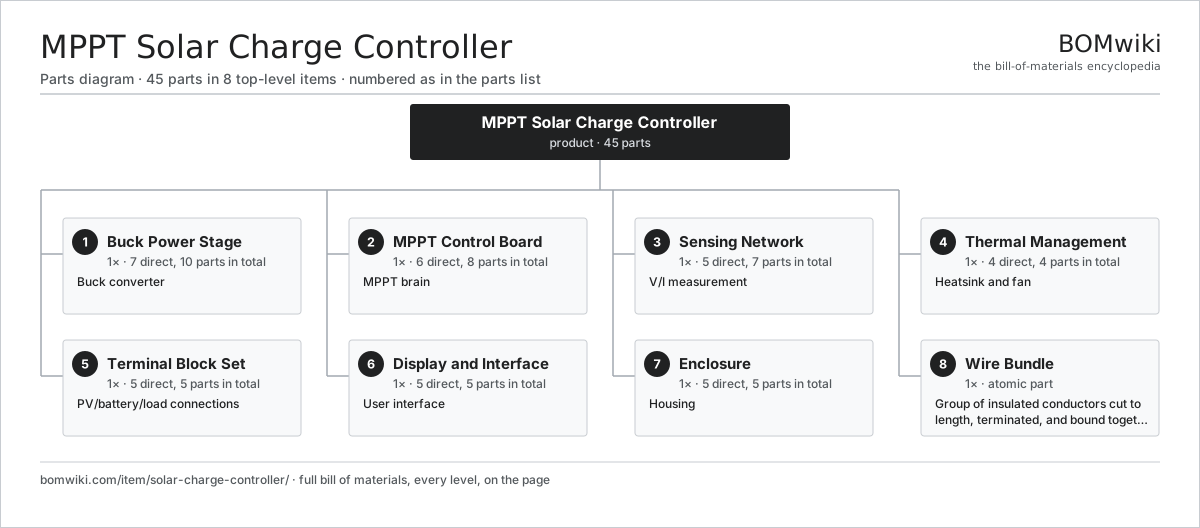
| # | Part | Qty | What it does |
|---|---|---|---|
| 1 | Buck Power Stage 7 parts | 1× | Buck converter |
| 2 | MPPT Control Board 6 parts | 1× | MPPT brain |
| 3 | Sensing Network 5 parts | 1× | V/I measurement |
| 4 | Thermal Management 4 parts | 1× | Heatsink and fan |
| 5 | Terminal Block Set 5 parts | 1× | PV/battery/load connections |
| 6 | Display and Interface 5 parts | 1× | User interface |
| 7 | Enclosure 5 parts | 1× | Housing |
| 8 | Wire Bundle | 1× | Group of insulated conductors cut to length, terminated, and bound together to carry power and signals between the assemblies of a machine. |
3D model
No 3D model yet. Have a CAD file of this? Add a 3D model. STL renders right on this page; STEP, FreeCAD, and OpenSCAD sources are welcome too (openly licensed, like all 3D models on BOMwiki).
Build & assembly graph
expand / collapse · shared sub-assemblies converge · links to related products · est. labourTap an assembly to expand/collapse · tap a part to open it · use “Open page” for any node · drag to pan, scroll to zoom.
Bill of materials for MPPT Solar Charge Controller
8 top-level lines · 45 rows shown · 45 parts total · indented to 3 levels| # | Item / sub-assembly | Part no. | Qty/assy | Ext. qty | Parts | Type |
|---|---|---|---|---|---|---|
| 1 | Buck Power Stage 7 parts | solar-charge-controller-power-stage | 1× | 1 | 10 | assembly |
| 1.1 | Power MOSFET | mosfet | 4× | 4 | · | part |
| 1.2 | Power Inductor | solar-charge-controller-inductor | 1× | 1 | · | part |
| 1.3 | Input Capacitor Bank | solar-charge-controller-input-caps | 1× | 1 | · | part |
| 1.4 | Output Capacitor Bank | solar-charge-controller-output-caps | 1× | 1 | · | part |
| 1.5 | Gate Driver IC | solar-charge-controller-gate-driver | 1× | 1 | · | part |
| 1.6 | Input Fuse | solar-charge-controller-input-fuse | 1× | 1 | · | part |
| 1.7 | Blocking MOSFET | solar-charge-controller-blocking-fet | 1× | 1 | · | part |
| 2 | MPPT Control Board 6 parts | solar-charge-controller-control-board | 1× | 1 | 8 | assembly |
| 2.1 | Bare PCB | pcb-bare | 1× | 1 | · | part |
| 2.2 | Microcontroller | mcu | 1× | 1 | · | part |
| 2.3 | SMD Passive (R/C/L) | smd-passives | 1× | 1 | · | part |
| 2.4 | Auxiliary Supply | solar-charge-controller-aux-supply | 1× | 1 | · | part |
| 2.5 | Communications Port | solar-charge-controller-comms-port | 1× | 1 | · | part |
| 2.6 | Connector | connector | 3× | 3 | · | part |
| 3 | Sensing Network 5 parts | solar-charge-controller-sensing | 1× | 1 | 7 | assembly |
| 3.1 | Current Shunt | solar-charge-controller-current-shunt | 2× | 2 | · | part |
| 3.2 | Voltage Divider | solar-charge-controller-voltage-divider | 2× | 2 | · | part |
| 3.3 | Battery Temperature Probe | solar-charge-controller-battery-temp-probe | 1× | 1 | · | part |
| 3.4 | Heatsink NTC | solar-charge-controller-internal-ntc | 1× | 1 | · | part |
| 3.5 | SMD Passive (R/C/L) | smd-passives | 1× | 1 | · | part |
| 4 | Thermal Management 4 parts | solar-charge-controller-thermal | 1× | 1 | 4 | assembly |
| 4.1 | Extruded Heatsink | solar-charge-controller-heatsink | 1× | 1 | · | part |
| 4.2 | Thermal Interface Pad | solar-charge-controller-thermal-pad | 1× | 1 | · | part |
| 4.3 | Cooling Fan | solar-charge-controller-fan | 1× | 1 | · | part |
| 4.4 | Fastener Set | fastener-set | 1× | 1 | · | part |
| 5 | Terminal Block Set 5 parts | solar-charge-controller-terminals | 1× | 1 | 5 | assembly |
| 5.1 | PV Input Terminals | solar-charge-controller-pv-terminals | 1× | 1 | · | part |
| 5.2 | Battery Terminals | solar-charge-controller-batt-terminals | 1× | 1 | · | part |
| 5.3 | Load Output Terminals | solar-charge-controller-load-terminals | 1× | 1 | · | part |
| 5.4 | Ground Lug | solar-charge-controller-ground-lug | 1× | 1 | · | part |
| 5.5 | Connector | connector | 1× | 1 | · | part |
| 6 | Display and Interface 5 parts | solar-charge-controller-display | 1× | 1 | 5 | assembly |
| 6.1 | LCD Panel | lcd-panel | 1× | 1 | · | part |
| 6.2 | Button Set | solar-charge-controller-button-set | 1× | 1 | · | part |
| 6.3 | Status LEDs | solar-charge-controller-status-leds | 1× | 1 | · | part |
| 6.4 | Bare PCB | pcb-bare | 1× | 1 | · | part |
| 6.5 | Connector | connector | 1× | 1 | · | part |
| 7 | Enclosure 5 parts | solar-charge-controller-enclosure | 1× | 1 | 5 | assembly |
| 7.1 | Front Shell | solar-charge-controller-front-shell | 1× | 1 | · | part |
| 7.2 | Sheet Metal Panel | sheet-panel | 1× | 1 | · | part |
| 7.3 | Mounting Plate | solar-charge-controller-mount-plate | 1× | 1 | · | part |
| 7.4 | Fastener Set | fastener-set | 1× | 1 | · | part |
| 7.5 | O-Ring Set | oring-set | 1× | 1 | · | part |
| 8 | Wire Bundle | wire-bundle | 1× | 1 | · | part |
Something wrong in this list? Report a problem with this BOM.
Related products
same domain, ranked by shared parts Wind Turbine
28,312 parts · shares 4 with this page
Solar Water Pump System
83 parts · shares 3 with this page
Wind Turbine
28,312 parts · shares 4 with this page
Solar Water Pump System
83 parts · shares 3 with this page
 Vertical-Axis Wind Turbine
99 parts · shares 2 with this page
Biomass Pellet Boiler
139 parts · shares 3 with this page
Green Hydrogen Electrolyzer Plant
2,171 parts · shares 3 with this page
Vertical-Axis Wind Turbine
99 parts · shares 2 with this page
Biomass Pellet Boiler
139 parts · shares 3 with this page
Green Hydrogen Electrolyzer Plant
2,171 parts · shares 3 with this page
 Micro Hydro Turbine
159 parts · shares 3 with this page
Micro Hydro Turbine
159 parts · shares 3 with this page
Sourcing: possible vendors
Browse the supplier directory → Prices, MOQ, and lead times are algorithmic estimates, not quotes, and not claims about these companies. Company mappings are curated by keyword; est. price band $100–$20M. How estimates work| Vendor | HQ | Specialty | MOQ | Lead time |
|---|---|---|---|---|
|
🇩🇰Vestas
vestas.com ↗
|
Aarhus, DK | Wind turbines | 500 units | 12–24 wks |
| firstsolar.com ↗ | Tempe, US | PV modules | 500 units | 12–24 wks |
|
🇨🇳LONGi
longi.com ↗
|
Xi'an, CN | Solar wafers & modules | 500 units | 12–24 wks |
| enphase.com ↗ | Fremont, US | Microinverters & storage | 500 units | 12–24 wks |
|
🇨🇳Sungrow
sungrowpower.com ↗
|
Hefei, CN | Solar inverters & storage | 500 units | 12–24 wks |
811-word article