Solar Microinverter
ProductOverview
A solar microinverter converts the DC output of a single photovoltaic module to grid-synchronized AC right at the panel. Where a string inverter wires 8-20 panels in series and processes them together, a microinverter gives every panel its own maximum power point tracker and its own 230/240 V output, paralleled onto a trunk cable running along the roof. The architecture eliminates the string problem: with series-wired panels, one shaded or failing module drags down the whole string, while per-module conversion lets every panel contribute whatever it can. The cost is more electronics in a harsher location, which drives the entire design toward sealed, fanless, 25-year reliability.
Units rate 300-500 W AC and pair with modules of 400-550 W; the deliberate undersizing reflects how rarely a fixed rooftop module reaches nameplate, and clipping losses are typically under 2% annually.
Power conversion chain
Conversion happens in two stages. The DC Input Stage filters the panel input through the Input EMI Filter and buffers it with the Bulk Input Capacitors. These capacitors deserve their reputation: a single-phase output pulses at twice line frequency, and that 100/120 Hz energy swing must be stored somewhere each cycle. Early microinverters died at the electrolytics; modern designs use long-life capacitors run well below rated temperature, or shift the buffering to film capacitors on the high-voltage link, and underpin the 25-year warranty with accelerated life testing.
The Isolated DC-DC Converter then boosts 25-60 V from the panel to a 380-420 V DC link. An interleaved flyback or LLC resonant topology switches at 50-150 kHz through the Isolation Transformer, which provides both the roughly 1:10 step-up and the galvanic isolation that separates the touchable panel circuit from the grid. The Output Rectifier fills the DC-Link Capacitor, with a Snubber Network clamping leakage-inductance spikes off the primary Power MOSFET switches.
The DC-AC Inverter Stage chops the link into the grid: an H-bridge under sinusoidal PWM, smoothed by the Output Filter Inductor chokes into a current waveform with under 3% distortion, then through the AC EMI Filter onto the trunk. Peak efficiency across both stages reaches 96.5-97.5%, a point or two below the best string inverters, a deficit the per-module MPPT gain usually repays on any roof with shade, soiling, or mixed orientations.
Control and grid protection
The Microcontroller on the Digital Control Board board runs three loops at once: perturb-and-observe MPPT on the panel side, a current regulator shaping the output sine, and a phase-locked loop tracking grid phase through the Grid Sense Network network. Grid codes (IEEE 1547, VDE-AR-N 4105) define the protective envelope: the unit must disconnect within fractions of a second if voltage or frequency leave their windows, must detect islanding, the condition where a dead grid section is unintentionally kept alive by distributed generation, and must ride through minor disturbances rather than tripping. Disconnection is physical, through the twin Grid Disconnect Relay contacts in series that IEC 62109-2 requires. Because the inverter needs the grid as its phase reference, panels stop producing in a blackout unless the system includes batteries and an islanding-capable gateway.
Per-panel telemetry leaves through the Monitoring Communications block, most commonly a PLC Modem IC that modulates data onto the AC trunk itself, so monitoring needs no extra wiring. The gateway reports each panel's production every few minutes, which turns fault-finding from string-level guesswork into a map showing exactly which panel underperforms.
Packaging for the rooftop
The unit lives bolted under a panel via the Mounting Bracket, cycling daily between cold nights and 65 °C-plus afternoons for decades. The Potted Enclosure answers with a die-cast Base Casting that conducts the 8-15 W of internal loss into the shaded air gap, full encapsulation in Potting Compound silicone for IP67 sealing and vibration damping, and no fan, no vent, no serviceable parts. Field connections are tool-free: MC4 Connector Pair plugs onto the module leads, a AC Trunk Connector drop onto the AC bus, and chassis grounding through the Ground Bond Point in the bracket.
A further system-level benefit is regulatory: because no DC above 60 V exists anywhere on the roof, microinverter systems inherently satisfy rapid-shutdown rules (NEC 690.12) that string systems must meet with added module-level electronics, and firefighters face no high-voltage DC conductors.
Solar Microinverter parts and their functions
7 top-level parts · 45 parts in total · full bill of materials below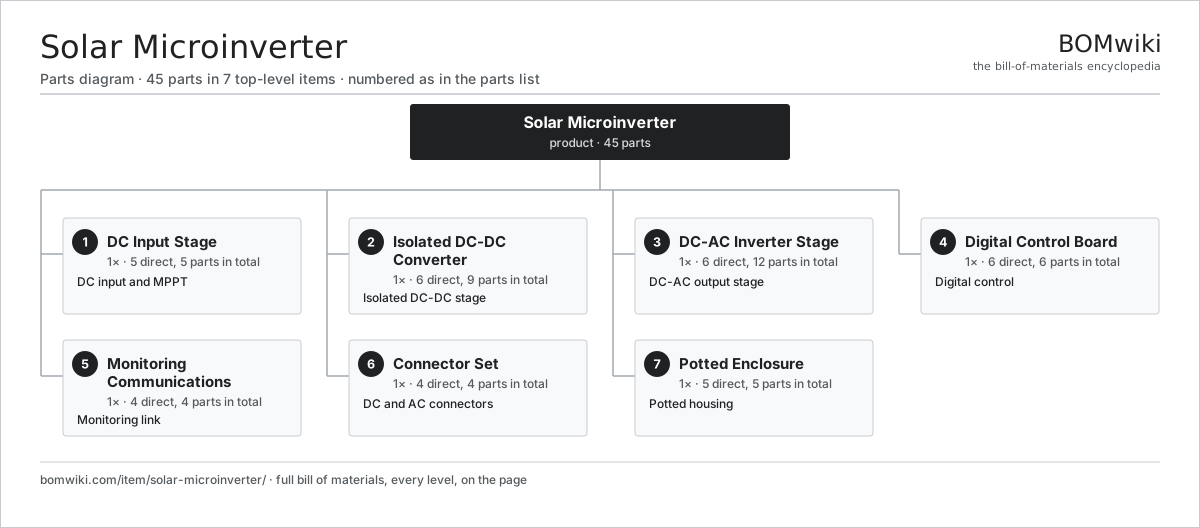
| # | Part | Qty | What it does |
|---|---|---|---|
| 1 | DC Input Stage 5 parts | 1× | DC input and MPPT |
| 2 | Isolated DC-DC Converter 6 parts | 1× | Isolated DC-DC stage |
| 3 | DC-AC Inverter Stage 6 parts | 1× | DC-AC output stage |
| 4 | Digital Control Board 6 parts | 1× | Digital control |
| 5 | Monitoring Communications 4 parts | 1× | Monitoring link |
| 6 | Connector Set 4 parts | 1× | DC and AC connectors |
| 7 | Potted Enclosure 5 parts | 1× | Potted housing |
3D model
No 3D model yet. Have a CAD file of this? Add a 3D model. STL renders right on this page; STEP, FreeCAD, and OpenSCAD sources are welcome too (openly licensed, like all 3D models on BOMwiki).
Build & assembly graph
expand / collapse · shared sub-assemblies converge · links to related products · est. labourTap an assembly to expand/collapse · tap a part to open it · use “Open page” for any node · drag to pan, scroll to zoom.
Bill of materials for Solar Microinverter
7 top-level lines · 43 rows shown · 45 parts total · indented to 3 levels| # | Item / sub-assembly | Part no. | Qty/assy | Ext. qty | Parts | Type |
|---|---|---|---|---|---|---|
| 1 | DC Input Stage 5 parts | solar-microinverter-input-stage | 1× | 1 | 5 | assembly |
| 1.1 | Input EMI Filter | solar-microinverter-input-filter | 1× | 1 | · | part |
| 1.2 | Bulk Input Capacitors | solar-microinverter-bulk-caps | 1× | 1 | · | part |
| 1.3 | Input Current Sense | solar-microinverter-current-sense | 1× | 1 | · | part |
| 1.4 | Input TVS Diode | solar-microinverter-input-tvs | 1× | 1 | · | part |
| 1.5 | SMD Passive (R/C/L) | smd-passives | 1× | 1 | · | part |
| 2 | Isolated DC-DC Converter 6 parts | solar-microinverter-converter | 1× | 1 | 9 | assembly |
| 2.1 | Power MOSFET | mosfet | 4× | 4 | · | part |
| 2.2 | Isolation Transformer | solar-microinverter-transformer | 1× | 1 | · | part |
| 2.3 | Output Rectifier | solar-microinverter-output-rectifier | 1× | 1 | · | part |
| 2.4 | DC-Link Capacitor | solar-microinverter-dc-link-cap | 1× | 1 | · | part |
| 2.5 | Snubber Network | solar-microinverter-snubber | 1× | 1 | · | part |
| 2.6 | SMD Passive (R/C/L) | smd-passives | 1× | 1 | · | part |
| 3 | DC-AC Inverter Stage 6 parts | solar-microinverter-inverter-stage | 1× | 1 | 12 | assembly |
| 3.1 | Power MOSFET | mosfet | 4× | 4 | · | part |
| 3.2 | Gate Driver Set | solar-microinverter-gate-drivers | 1× | 1 | · | part |
| 3.3 | Output Filter Inductor | solar-microinverter-output-inductor | 2× | 2 | · | part |
| 3.4 | AC EMI Filter | solar-microinverter-ac-emi-filter | 1× | 1 | · | part |
| 3.5 | Grid Disconnect Relay | solar-microinverter-grid-relay | 2× | 2 | · | part |
| 3.6 | AC Varistor | solar-microinverter-varistor | 2× | 2 | · | part |
| 4 | Digital Control Board 6 parts | solar-microinverter-control | 1× | 1 | 6 | assembly |
| 4.1 | Bare PCB | pcb-bare | 1× | 1 | · | part |
| 4.2 | Microcontroller | mcu | 1× | 1 | · | part |
| 4.3 | Grid Sense Network | solar-microinverter-grid-sense | 1× | 1 | · | part |
| 4.4 | Auxiliary Flyback Supply | solar-microinverter-aux-flyback | 1× | 1 | · | part |
| 4.5 | SMD Passive (R/C/L) | smd-passives | 1× | 1 | · | part |
| 4.6 | Temperature Sensor | solar-microinverter-temp-sensor | 1× | 1 | · | part |
| 5 | Monitoring Communications 4 parts | solar-microinverter-comms | 1× | 1 | 4 | assembly |
| 5.1 | PLC Modem IC | solar-microinverter-plc-modem | 1× | 1 | · | part |
| 5.2 | PLC Coupling Network | solar-microinverter-coupling-network | 1× | 1 | · | part |
| 5.3 | Sub-GHz Radio | solar-microinverter-radio | 1× | 1 | · | part |
| 5.4 | SMD Passive (R/C/L) | smd-passives | 1× | 1 | · | part |
| 6 | Connector Set 4 parts | solar-microinverter-connectors | 1× | 1 | 4 | assembly |
| 6.1 | MC4 Connector Pair | solar-microinverter-mc4-pair | 1× | 1 | · | part |
| 6.2 | AC Trunk Connector | solar-microinverter-trunk-connector | 1× | 1 | · | part |
| 6.3 | Ground Bond Point | solar-microinverter-ground-bond | 1× | 1 | · | part |
| 6.4 | Connector | connector | 1× | 1 | · | part |
| 7 | Potted Enclosure 5 parts | solar-microinverter-enclosure | 1× | 1 | 5 | assembly |
| 7.1 | Base Casting | solar-microinverter-base-casting | 1× | 1 | · | part |
| 7.2 | Potting Compound | solar-microinverter-potting | 1× | 1 | · | part |
| 7.3 | Enclosure Lid | solar-microinverter-lid | 1× | 1 | · | part |
| 7.4 | Mounting Bracket | solar-microinverter-mount-bracket | 1× | 1 | · | part |
| 7.5 | Fastener Set | fastener-set | 1× | 1 | · | part |
Something wrong in this list? Report a problem with this BOM.
Related products
same domain, ranked by shared parts MPPT Solar Charge Controller
45 parts · shares 1 with this page
MPPT Solar Charge Controller
45 parts · shares 1 with this page
 Solar Air Heater
55 parts · shares 1 with this page
Solar Water Pump System
83 parts · shares 1 with this page
Solar Air Heater
55 parts · shares 1 with this page
Solar Water Pump System
83 parts · shares 1 with this page
 Vertical-Axis Wind Turbine
99 parts · shares 1 with this page
Vertical-Axis Wind Turbine
99 parts · shares 1 with this page
 Wind Turbine
28,312 parts · shares 1 with this page
Wind Turbine
28,312 parts · shares 1 with this page
 Wind Turbine Pitch System
1,566 parts · shares 1 with this page
Wind Turbine Pitch System
1,566 parts · shares 1 with this page
Sourcing: possible vendors
Browse the supplier directory → Prices, MOQ, and lead times are algorithmic estimates, not quotes, and not claims about these companies. Company mappings are curated by keyword; est. price band $100–$20M. How estimates work| Vendor | HQ | Specialty | MOQ | Lead time |
|---|---|---|---|---|
|
🇩🇰Vestas
vestas.com ↗
|
Aarhus, DK | Wind turbines | 500 units | 12–24 wks |
| firstsolar.com ↗ | Tempe, US | PV modules | 500 units | 12–24 wks |
|
🇨🇳LONGi
longi.com ↗
|
Xi'an, CN | Solar wafers & modules | 500 units | 12–24 wks |
| enphase.com ↗ | Fremont, US | Microinverters & storage | 500 units | 12–24 wks |
|
🇨🇳Sungrow
sungrowpower.com ↗
|
Hefei, CN | Solar inverters & storage | 500 units | 12–24 wks |
771-word article