Solar Sail Spacecraft
ProductOverview
A solar sail spacecraft uses the momentum of solar photons to accelerate without onboard propellant, offering unlimited delta-V for deep-space missions. The design couples an ultrathin reflective membrane with a boom deployment system, a central spacecraft bus, and four attitude-control vanes that steer the craft by asymmetric solar reflection.
Unlike conventional ion or chemical propulsion, solar sails scale favorably for long-duration missions: as fuel is depleted, thrust remains constant. A 40 m × 40 m sail with 40 kg of deployment hardware and 300 kg spacecraft bus experiences an acceleration of approximately 0.6 mm/s² in Earth orbit, dropping as inverse-square with heliocentric distance. No radiation damage, no throttling, no finite impulse, only photon momentum transfer.
The membrane itself is the critical technology node: a 0.75 µm aluminum-coated polyimide layer must remain flat and specular across square kilometers of area while folding and unfolding without tearing. Deployment is sequential: springs and pyrotechnic releases unfold the four booms, which are held by latches during launch. Once in space, mechanical actuators fire cutters to unlock the booms; centrifugal force and stored spring energy drive them to their fully deployed geometry. The membrane is then tensioned gradually by the boom curvature.
The attitude control vanes are the steering mechanism. Four reflective panels, each ~6 m² and pivoted by servo motors, sit at the boom corners. By angling one or more vanes, the craft reflects sunlight asymmetrically, generating a torque that precesses its attitude. This method requires no fuel, only electrical power and thermal dissipation of the rejected photons.
The spacecraft bus is a conventional aluminum chassis housing a flight computer, solar cell arrays, lithium batteries for eclipse periods, a UHF transceiver, and power distribution. No large wheels, gyroscopes, or reaction thrusters are needed because attitude control is delegated to the vanes. The computer runs autonomous navigation software, updating course corrections based on sun-referenced attitude estimates.
How it Works
At launch, the entire sail is folded inside a compact stowage container within the spacecraft bus. After orbital insertion, pyrotechnic devices fire in a choreographed sequence. First, rotor-actuators release the boom latches. Spring-loaded hinges then propel the four boom segments outward, guided by flexure joints that allow them to unfold into their curved deployment geometry, typically pre-bent at a slight angle to store mechanical energy. As the booms reach full extension, their own curvature pulls the membrane taut, and the membrane's internal stresses lock it into a parabolic sail shape.
The power system charges immediately upon sun exposure. Solar cells on the spacecraft bus convert sunlight into 28 VDC. A MPPT charge controller harvests maximum power and topples it into lithium battery packs, which supply eclipsed periods (roughly 30 minutes per orbit in LEO). The UHF transceiver draws ~2 W during transmission and ~0.5 W in receive mode.
Attitude control operates on a command loop from the flight computer. The computer samples a three-axis magnetometer and sun-referenced coarse sun sensors to estimate attitude error. It then commands specific servo motors to position the attitude vanes at appropriate angles. The symmetric pressure of unblocked sunlight on the main sail produces a reference thrust vector; the vanes create differential pressure to rotate that vector. A typical maneuver might rotate the sail by 1° over one orbit by positioning vanes at ±5° angles.
As the spacecraft flies deeper into space, the solar flux decreases as inverse-square, but the acceleration does not change, because the sail area is fixed and the craft carries no propellant to expend. This makes solar sails ideal for slow, continuous-acceleration trajectories to the outer planets or into heliocentric orbits. A 1600 m² sail accelerates a 300 kg bus at ~0.6 mm/s² in Earth orbit; by 5 AU heliocentric distance, this becomes ~0.024 mm/s², but it continues indefinitely.
Key Subsystems
Membrane Assembly: Four quadrants of aluminized polyimide are edge-taped and seamed along boom radii. The reflectance is critical: even 1% absorptance generates significant thermal stress, potentially causing creep or delamination. Coatings are regularly benchmarked in thermal-vacuum chambers to confirm long-term stability.
Boom System: Carbon-fiber tubes minimize mass while maintaining stiffness. Torsional hinges allow compact folding; spring energy couples to hinges to ensure reliable deployment in zero-gravity and microgravity. Aluminum collars at hinges serve as damping nodes to dissipate deployment transients.
Attitude Vanes: Small mirrors at boom tips. Servo motors (typically 4–10 W peak) rotate vanes through ±60° to modulate thrust direction. Position encoders feed back to the flight computer to confirm moves and detect mechanical failure.
Performance and Limits
Maximum acceleration occurs near the sun (e.g., at Mercury orbit, ~10× the solar flux of Earth). A 1600 m² sail reaches ~0.006 m/s² or 600 µg. Far from the sun, the acceleration becomes vanishingly small, but the craft still accelerates without fuel consumption. The primary limit is sail degradation: solar wind erosion, atomic oxygen attack in low Earth orbit, and UV-induced yellowing of polyimide reduce reflectance over months or years. Secondarily, attitude control becomes challenging at large heliocentric distances because sun angles become small relative to the sail's spin stability threshold.
Solar sails are uniquely suited for missions that combine high delta-V requirements with low acceleration tolerances: fast solar-system precursor probes, comet rendez-vous, interstellar precursor spacecraft, and polar heliospheric monitoring.
Solar Sail Spacecraft parts and their functions
7 top-level parts · 170 parts in total · full bill of materials below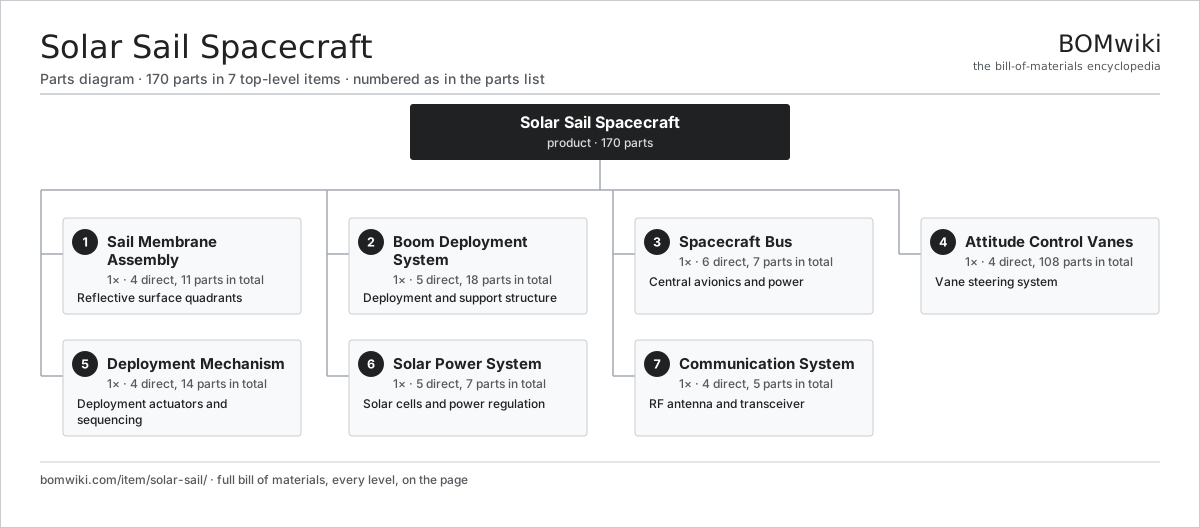
| # | Part | Qty | What it does |
|---|---|---|---|
| 1 | Sail Membrane Assembly 4 parts | 1× | Reflective surface quadrants |
| 2 | Boom Deployment System 5 parts | 1× | Deployment and support structure |
| 3 | Spacecraft Bus 6 parts | 1× | Central avionics and power |
| 4 | Attitude Control Vanes 4 parts | 1× | Vane steering system |
| 5 | Deployment Mechanism 4 parts | 1× | Deployment actuators and sequencing |
| 6 | Solar Power System 5 parts | 1× | Solar cells and power regulation |
| 7 | Communication System 4 parts | 1× | RF antenna and transceiver |
3D model
No 3D model yet. Have a CAD file of this? Add a 3D model. STL renders right on this page; STEP, FreeCAD, and OpenSCAD sources are welcome too (openly licensed, like all 3D models on BOMwiki).
Build & assembly graph
expand / collapse · shared sub-assemblies converge · links to related products · est. labourTap an assembly to expand/collapse · tap a part to open it · use “Open page” for any node · drag to pan, scroll to zoom.
Bill of materials for Solar Sail Spacecraft
7 top-level lines · 43 rows shown · 170 parts total · indented to 3 levels| # | Item / sub-assembly | Part no. | Qty/assy | Ext. qty | Parts | Type |
|---|---|---|---|---|---|---|
| 1 | Sail Membrane Assembly 4 parts | solar-sail-membrane | 1× | 1 | 11 | assembly |
| 1.1 | Aluminized Polyimide Film | solar-sail-membrane-film | 4× | 4 | · | part |
| 1.2 | Reinforced Edge Tape | solar-sail-membrane-edge-tape | 4× | 4 | · | part |
| 1.3 | Fastener Set | fastener-set | 2× | 2 | · | part |
| 1.4 | Wire Bundle | wire-bundle | 1× | 1 | · | part |
| 2 | Boom Deployment System 5 parts | solar-sail-boom-system | 1× | 1 | 18 | assembly |
| 2.1 | Composite Boom Tube | solar-sail-boom-segment | 4× | 4 | · | part |
| 2.2 | Boom Torsional Hinge | solar-sail-boom-hinge | 4× | 4 | · | part |
| 2.3 | Boom Deployment Latch | solar-sail-boom-latch | 4× | 4 | · | part |
| 2.4 | Coil Spring | coil-spring | 4× | 4 | · | part |
| 2.5 | Fastener Set | fastener-set | 2× | 2 | · | part |
| 3 | Spacecraft Bus 6 parts | solar-sail-spacecraft-bus | 1× | 1 | 7 | assembly |
| 3.1 | Spacecraft Bus Frame | solar-sail-bus-frame | 1× | 1 | · | part |
| 3.2 | Flight Computer Board | solar-sail-avionics-board | 1× | 1 | · | part |
| 3.3 | Power Supply | power-supply | 1× | 1 | · | part |
| 3.4 | Bare PCB | pcb-bare | 2× | 2 | · | part |
| 3.5 | Fastener Set | fastener-set | 1× | 1 | · | part |
| 3.6 | Thermal Fuse | thermal-fuse | 1× | 1 | · | part |
| 4 | Attitude Control Vanes 4 parts | solar-sail-attitude-control | 1× | 1 | 108 | assembly |
| 4.1 | Attitude Vane Panel | solar-sail-vane-assembly | 4× | 4 | · | part |
| 4.2 | Servo Motor 4 parts | servo-motor | 4× | 4 | 24 | assembly |
| 4.2.1 | Stator Assembly 3 parts + deeper › | stator-assembly | 1× | 4 | 3 | assembly |
| 4.2.2 | Rotor Assembly 4 parts + deeper › | rotor-assembly | 1× | 4 | 19 | assembly |
| 4.2.3 | Encoder | encoder | 1× | 4 | · | part |
| 4.2.4 | Motor Housing | motor-housing | 1× | 4 | · | part |
| 4.3 | Vane Mounting Bracket | solar-sail-vane-bracket | 4× | 4 | · | part |
| 4.4 | Encoder | encoder | 4× | 4 | · | part |
| 5 | Deployment Mechanism 4 parts | solar-sail-deployment-mech | 1× | 1 | 14 | assembly |
| 5.1 | Miniature Rotary Actuator | solar-sail-rotor-actuator | 2× | 2 | · | part |
| 5.2 | Relay | relay | 2× | 2 | · | part |
| 5.3 | Pyrotechnic Bridge Wire | solar-sail-pyro-bridge-wire | 8× | 8 | · | part |
| 5.4 | Connector | connector | 2× | 2 | · | part |
| 6 | Solar Power System 5 parts | solar-sail-power-system | 1× | 1 | 7 | assembly |
| 6.1 | Silicon Solar Cell Array | solar-sail-solar-panel | 2× | 2 | · | part |
| 6.2 | Power Supply | power-supply | 1× | 1 | · | part |
| 6.3 | LiPo Cell | lipo-cell | 2× | 2 | · | part |
| 6.4 | BMS Board | bms-board | 1× | 1 | · | part |
| 6.5 | Fastener Set | fastener-set | 1× | 1 | · | part |
| 7 | Communication System 4 parts | solar-sail-comm-system | 1× | 1 | 5 | assembly |
| 7.1 | UHF Transceiver Module | solar-sail-transceiver-board | 1× | 1 | · | part |
| 7.2 | Folding Dipole Antenna | solar-sail-antenna-dipole | 1× | 1 | · | part |
| 7.3 | Bare PCB | pcb-bare | 1× | 1 | · | part |
| 7.4 | Connector | connector | 2× | 2 | · | part |
Something wrong in this list? Report a problem with this BOM.
Related products
same domain, ranked by shared parts Crewed Space Capsule
7,222 parts · shares 14 with this page
Crewed Space Capsule
7,222 parts · shares 14 with this page
 Lunar Lander
1,803 parts · shares 14 with this page
Lunar Lander
1,803 parts · shares 14 with this page
 Satellite Ground Station Antenna
274 parts · shares 12 with this page
Satellite Ground Station Antenna
274 parts · shares 12 with this page
 Satellite Laser Communication Terminal
197 parts · shares 12 with this page
Satellite Laser Communication Terminal
197 parts · shares 12 with this page
 Cargo Resupply Spacecraft
574 parts · shares 13 with this page
Cargo Resupply Spacecraft
574 parts · shares 13 with this page
 GPS Navigation Satellite
2,640 parts · shares 13 with this page
GPS Navigation Satellite
2,640 parts · shares 13 with this page
Sourcing: possible vendors
Browse the supplier directory → Prices, MOQ, and lead times are algorithmic estimates, not quotes, and not claims about these companies. Company mappings are curated by keyword; est. price band $50k–$500M. How estimates work| Vendor | HQ | Specialty | MOQ | Lead time |
|---|---|---|---|---|
|
🇺🇸SpaceX
spacex.com ↗
|
Hawthorne, US | Launch & spacecraft | made to order | 52–104 wks |
| northropgrumman.com ↗ | Falls Church, US | Space & defense | made to order | 52–104 wks |
|
🇫🇷Airbus
airbus.com ↗
|
Toulouse, FR | Aerospace OEM | made to order | 52–104 wks |
| rocketlabusa.com ↗ | Long Beach, US | Launch & spacecraft | made to order | 52–104 wks |
| thalesaleniaspace.com ↗ | Cannes, FR | Satellites | made to order | 52–104 wks |
927-word article