Solar Simulator
ProductOverview
A solar simulator is an essential ground-support facility for spacecraft thermal testing. Satellites and deep-space probes must survive and operate in the intense thermal environment of space: direct solar radiation at 1367 W/m² (the AM0 constant), Earth's infrared emission, and albedo from planetary atmospheres. Testing prototypes in Earth's laboratories requires reproducing this radiation environment with controlled intensity, spectral content, and incident angle.
The solar simulator uses an array of high-power xenon arc lamps coupled with precision collimating optics to create a parallel, broadband light beam illuminating a 3 m × 3 m test plane. The intensity is adjustable from 0 to full solar constant (1367 W/m²); spectral content is tunable via filter wheels to match various standard spectra. Mounted on the test table are motorized positioning stages that rotate and tilt the test spacecraft, simulating different sun angles and mission geometries.
Xenon Arc Lamp Technology
The light source array comprises four 7 kW xenon arc lamps, each housed in a parabolic reflector focusing the arc radiation into a collimator. Xenon is chosen because:
Spectral match: Xenon arc lamps at 6000 K color temperature closely approximate the sun's spectrum (5778 K), with adequate IR and UV content for thermal modeling.
High brightness: A 7 kW xenon arc produces ~15,000 cd/cm² luminance, bright enough to achieve full solar irradiance over a 3 m² area when collimated.
Stability: Arc intensity is stable to ±2% over time scales of minutes, sufficient for steady-state thermal testing.
Each lamp is powered by a high-frequency electronic ballast operating at 50 kHz. Traditional 60 Hz ballasts cause 120 Hz flicker (visible in video recordings); high-frequency ballasts smooth the arc to <1% ripple. The ballast incorporates soft-start circuitry that gradually raises lamp current from zero to nominal, extending electrode life (reducing end-of-life erosion).
A mechanical solenoid shutter on each lamp prevents arc re-ignition transients. When the ballast is de-energized, closing the shutter prevents the arc from quenching and re-striking erratically, which would generate harmful transient spikes in downstream optics.
Lamp life is ~1000 hours of operation. Electrodes erode gradually; once erosion reaches ~10% of electrode mass, lamp output begins to drift and the lamp is replaced. For a facility running 2000–3000 hours/year, lamp replacement is budgeted quarterly.
Collimating Optics
The optical path converts the divergent radiation from four xenon arcs into a uniform, parallel beam. The path is:
Each arc is imaged by a parabolic reflector (~500 mm focal length) into the entrance of a common collimator.
The four arcs are combined by carefully positioning lamp modules around the collimator focal plane, their radiation converging into a combined beam.
A large 1.5 meter parabolic primary mirror (2 meter focal length) collimates the combined beam into parallel light. Ideally, rays at the edge of the mirror converge to within ±0.1° of parallel, meaning the far field intensity distribution is uniform.
A flat folding mirror redirects the beam downward 90°, reducing overall facility height and allowing vertical illumination of the test article below.
Aspheric correction lenses in the beam path correct spherical aberration from the primary mirror, ensuring uniform collimation across the full beam diameter (~1.5 meters).
The entire optical assembly is mounted on a rigid aluminum truss, designed to maintain mirror alignment to ±1 mm despite thermal cycling and vibration. Temperature-compensating motorized mirror tip-tilt stages allow field engineers to align the beam without manual adjustment, critical for maintaining uniformity as lamps age or new lamps are installed.
Spectral and Intensity Filtering
Raw xenon output is broadband (UV to near-IR) but does not perfectly match solar spectrum, xenon has relative excess in the blue and relative deficit in the red. A filter carousel holds three standard sets:
- AM0 filters: Match the space spectrum (outside Earth's atmosphere), used for satellite and spacecraft thermal testing.
- AM1 filters: Match sea-level noon spectrum with air mass 1, used for terrestrial solar panel testing.
- AM1.5 filters: Match terrestrial spectrum at 48° sun angle, standard for photovoltaic efficiency rating.
Each filter set comprises multiple layers of absorption glass or dichroic coatings tuning the spectral content. The filter wheels are motorized; selection takes <10 seconds, allowing rapid switching between test conditions.
Intensity is controlled by two mechanisms:
Neutral density filters: A filter wheel with ND1 through ND5 filters reduces intensity by factors of 10 (ND1), 100 (ND2), 1000 (ND3), 10,000 (ND4), and 100,000 (ND5). A test might use full xenon (28 kW @ 1367 W/m²) for qualification, then ND1 (136 W/m²) for low-power endurance tests.
Ballast power DAC: The 16-bit digital-to-analog converter outputs 0–10 V, which is fed to each ballast's reference voltage input. Reducing reference voltage smoothly dims the arc from 0% to 100% without discrete steps. Combined with filter wheels, this allows fine intensity tuning to any setpoint.
A pyranometer mounted at the test plane provides closed-loop feedback. The control system measures instantaneous irradiance and adjusts ballast DAC voltage to maintain target intensity, compensating for lamp aging and thermal drift.
Beam Uniformity and Diffusion
The collimated beam from the primary mirror has a Gaussian intensity profile, peak intensity at the center, falling off toward edges. To achieve uniform illumination (±5% across the test area), a ground-glass diffuser is placed in the beam path. The diffuser has sufficient surface roughness (typical RMS ~0.5 µm) to scatter light into a broader angular distribution, which recombines at the test plane into a more uniform intensity profile.
The trade-off: diffusion reduces peak intensity by ~15% due to scattering losses, and slightly increases beam divergence. For most thermal tests, this is acceptable; for high-precision solar array efficiency tests, the diffuser can be removed and the Gaussian profile is used (with carefully positioned samples at the peak).
Thermal Management
The xenon lamps dissipate ~20 kW as waste heat (xenon efficiency is ~50% light, ~50% heat). All four lamps are mounted in water-cooled jackets with integral cooling channels. A recirculation pump (11 kW, 50 L/min) draws coolant from a 2 m² radiator panel back through the lamp jackets, maintaining coolant temperature at 18–25 °C.
The radiator exhausts to ambient air; for indoor facilities, the radiator is located outside or on the roof. Typical thermal load is manageable by a modestly-sized radiator without requiring chiller units (which would consume additional power and maintenance).
A temperature sensor monitors coolant return temperature. If temperature rises above 30 °C, the control system automatically reduces lamp intensity (via ballast DAC) to prevent overheating. If coolant flow drops below minimum (detected by flow meter), the safety interlock shuts down all lamps within 100 milliseconds, preventing thermal damage to electrodes.
Control Architecture and Safety
The control system is a modern PLC-based design with multiple safety layers:
Main contactor: A high-current 480 VAC contactor switches utility power to all ballasts. This is the primary on/off switch.
Lamp ballast modules: Each ballast module controls its respective lamp, with independent soft-start and over-current protection.
Intensity DAC: The 16-bit DAC sets lamp brightness. A hard-wired emergency stop button cuts ballast reference voltage to zero, extinguishing all lamps.
Safety interlocks: The safety relay module monitors:
- Cooling flow (alarm if <40 L/min; lamps shut down if <30 L/min).
- Chamber door (lamps shut down if access door opened).
- Over-temperature (lamps dimmed if coolant >30 °C).
Backup power: A 5 kVA UPS supplies the control circuits and E-stop relay if utility power fails, ensuring lamps extinguish safely even during a blackout.
The control room is typically 20+ meters away from the simulator chamber. Engineers operate the facility via a networked workstation, setting intensity setpoint, filter position, and mounting table angles. Real-time irradiance feedback from the pyranometer is displayed; if irradiance drifts >2% from setpoint over 30 seconds, an alarm sounds.
Mounting Structure and Test Positioning
The test mounting system enables repeatable positioning of spacecraft at arbitrary sun angles. The system comprises:
Precision base table: A rigid aluminum honeycomb table (3 × 3 m, <1 mm flatness) supporting up to 5 metric tons of test hardware.
Azimuth rotation stage: A motorized precision rotary table rotating the test article around a vertical axis (±180° travel, 0.05° repeatability). This simulates satellite precession or spacecraft roll maneuvers.
Elevation tilt stage: A motorized tilt mechanism rotating the test article around a horizontal axis perpendicular to the beam. This varies the sun incidence angle from 0° (normal incidence) to 90° (grazing).
Linear translation stage: Moves the test article along the beam axis, changing the distance from the collimator and thus the illuminated area size and intensity gradient.
A custom adapter bracket connects the spacecraft interface (typically a truss node or mechanical pad) to the motorized stages. All stages are servo-motor driven with closed-loop position feedback; repeatability is ±0.1°.
Test Scenarios and Data Acquisition
Typical tests include:
Thermal balance: The spacecraft is positioned normal to the solar beam (0° incidence) and illuminated at full solar constant. Infrared cameras (mounted at observation viewports) record surface temperatures. This validates the spacecraft's thermal-balance computational model, accounting for solar absorptance, infrared emittance, and internal heat dissipation.
Sun angle sweep: The spacecraft is rotated through sun angles (0° to 90°) while maintaining constant total irradiance. This stresses different sides of the spacecraft, testing thermal uniformity and thermal distortion (warping due to temperature gradients).
Power-loss scenario: Internal heaters are turned off; the spacecraft is illuminated. This tests passive thermal stability, whether the spacecraft can maintain acceptable temperatures on solar input alone (critical for safe mode operations).
Day-night cycle simulation: The xenon lamps are pulsed on/off in a 90-minute LEO orbit profile (45 min sun, 45 min eclipse). Temperature sensors record cycling rate and thermal transients, validating thermal oscillation models.
Survival testing: Spacecraft is illuminated at 1.5× solar constant (sun-magnified) or exposed to worst-case sun angles to confirm survival margins.
All tests are accompanied by real-time data logging: irradiance (pyranometer), spacecraft surface temperature (IR cameras + thermocouples), mounting table angles, internal power dissipation. Post-test, the data is compared to thermal analysis predictions, and discrepancies are investigated and corrected before flight hardware commitment.
Modern solar simulators (Eppley, Oriel, Thermal Equipment) achieve excellent spectral match and uniformity, enabling confidence-building thermal validation that has become standard for all spacecraft missions.
Solar Simulator parts and their functions
7 top-level parts · 97 parts in total · full bill of materials below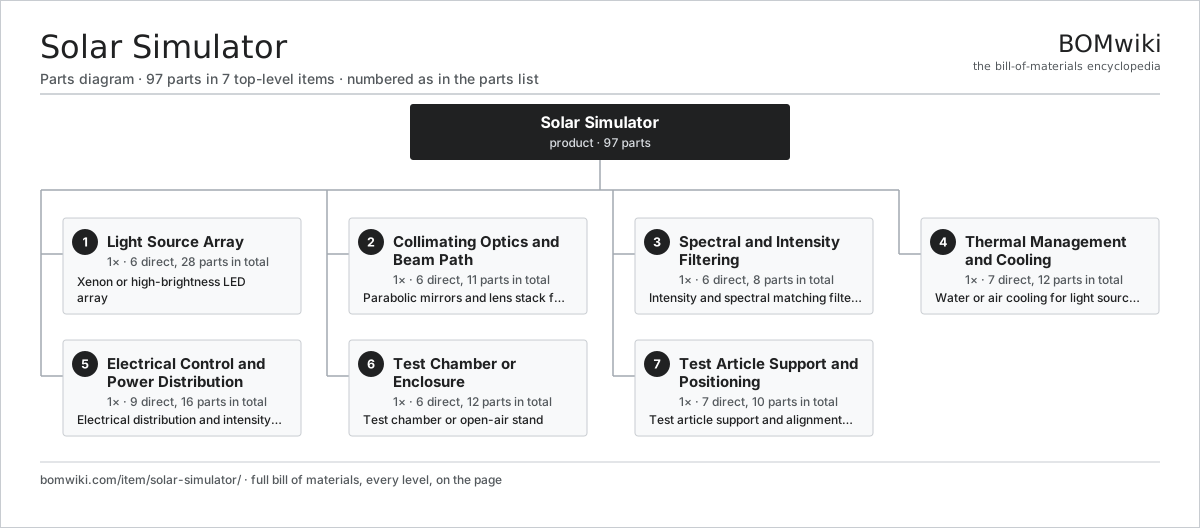
| # | Part | Qty | What it does |
|---|---|---|---|
| 1 | Light Source Array 6 parts | 1× | Xenon or high-brightness LED array |
| 2 | Collimating Optics and Beam Path 6 parts | 1× | Parabolic mirrors and lens stack for beam collimation |
| 3 | Spectral and Intensity Filtering 6 parts | 1× | Intensity and spectral matching filters |
| 4 | Thermal Management and Cooling 7 parts | 1× | Water or air cooling for light source and optics |
| 5 | Electrical Control and Power Distribution 9 parts | 1× | Electrical distribution and intensity control |
| 6 | Test Chamber or Enclosure 6 parts | 1× | Test chamber or open-air stand |
| 7 | Test Article Support and Positioning 7 parts | 1× | Test article support and alignment stages |
3D model
No 3D model yet. Have a CAD file of this? Add a 3D model. STL renders right on this page; STEP, FreeCAD, and OpenSCAD sources are welcome too (openly licensed, like all 3D models on BOMwiki).
Build & assembly graph
expand / collapse · shared sub-assemblies converge · links to related products · est. labourTap an assembly to expand/collapse · tap a part to open it · use “Open page” for any node · drag to pan, scroll to zoom.
Bill of materials for Solar Simulator
7 top-level lines · 54 rows shown · 97 parts total · indented to 3 levels| # | Item / sub-assembly | Part no. | Qty/assy | Ext. qty | Parts | Type |
|---|---|---|---|---|---|---|
| 1 | Light Source Array 6 parts | ss-light-source | 1× | 1 | 28 | assembly |
| 1.1 | Xenon Arc Lamp 7 kW | ss-xenon-lamp | 4× | 4 | · | part |
| 1.2 | Parabolic Lamp Reflector | ss-lamp-reflector | 4× | 4 | · | part |
| 1.3 | Xenon Lamp Ballast Module | ss-lamp-ballast | 4× | 4 | · | part |
| 1.4 | Mechanical Lamp Shutter | ss-lamp-shutter | 4× | 4 | · | part |
| 1.5 | Xenon Lamp Electrode | ss-lamp-electrode | 8× | 8 | · | part |
| 1.6 | Connector | connector | 4× | 4 | · | part |
| 2 | Collimating Optics and Beam Path 6 parts | ss-collimator-optics | 1× | 1 | 11 | assembly |
| 2.1 | Primary Parabolic Mirror | ss-primary-reflector | 1× | 1 | · | part |
| 2.2 | Folding Flat Mirror | ss-secondary-reflector | 1× | 1 | · | part |
| 2.3 | Aspheric Correction Lens | ss-collimator-lens | 4× | 4 | · | part |
| 2.4 | Optical Mirror Support Truss | ss-mirror-support | 2× | 2 | · | part |
| 2.5 | Mirror Alignment Motorized Stage | ss-alignment-stage | 1× | 1 | · | part |
| 2.6 | Fastener Set | fastener-set | 2× | 2 | · | part |
| 3 | Spectral and Intensity Filtering 6 parts | ss-uniformity-filter | 1× | 1 | 8 | assembly |
| 3.1 | Neutral Density Filter Wheel | ss-neutral-density-wheel | 1× | 1 | · | part |
| 3.2 | Spectral Matching Filter Wheel | ss-spectral-filter-wheel | 1× | 1 | · | part |
| 3.3 | Beam Diffuser and Homogenizer | ss-diffuser-plate | 1× | 1 | · | part |
| 3.4 | Filter Wheel Stepper Motor | ss-filter-motor | 2× | 2 | · | part |
| 3.5 | Broadband Irradiance Sensor | ss-intensity-sensor | 1× | 1 | · | part |
| 3.6 | Connector | connector | 2× | 2 | · | part |
| 4 | Thermal Management and Cooling 7 parts | ss-cooling-system | 1× | 1 | 12 | assembly |
| 4.1 | Coolant Recirculation Pump | ss-cooling-pump | 1× | 1 | · | part |
| 4.2 | Water-Cooled Lamp Housing Jacket | ss-lamp-cooler | 4× | 4 | · | part |
| 4.3 | Cooling Radiator Panel | ss-radiator-panel | 1× | 1 | · | part |
| 4.4 | Coolant Temperature RTD | ss-temperature-sensor | 1× | 1 | · | part |
| 4.5 | Coolant Flow Rate Indicator | ss-flow-meter | 1× | 1 | · | part |
| 4.6 | High-Pressure Hydraulic Hose | hose-assembly | 1× | 1 | · | part |
| 4.7 | Connector | connector | 3× | 3 | · | part |
| 5 | Electrical Control and Power Distribution 9 parts | ss-control-rack | 1× | 1 | 16 | assembly |
| 5.1 | Main Power Contactor | ss-main-contactor | 1× | 1 | · | part |
| 5.2 | Electronic Lamp Ballast | ss-lamp-ballast-module | 4× | 4 | · | part |
| 5.3 | 16-Bit Intensity Control DAC | ss-intensity-control-dac | 1× | 1 | · | part |
| 5.4 | Interlock Safety Relay Module | ss-safety-interlocks | 1× | 1 | · | part |
| 5.5 | Hard-Wired E-Stop Button | ss-emergency-stop-button | 1× | 1 | · | part |
| 5.6 | Uninterruptible Power Supply | ss-ups-backup | 1× | 1 | · | part |
| 5.7 | 24 VDC Control Power Supply | ss-power-supply | 2× | 2 | · | part |
| 5.8 | Connector | connector | 4× | 4 | · | part |
| 5.9 | Bare PCB | pcb-bare | 1× | 1 | · | part |
| 6 | Test Chamber or Enclosure 6 parts | ss-chamber-enclosure | 1× | 1 | 12 | assembly |
| 6.1 | Aluminum Extrusion Chamber Frame | ss-chamber-frame | 1× | 1 | · | part |
| 6.2 | Chamber Wall Panel | ss-chamber-wall | 4× | 4 | · | part |
| 6.3 | Chamber Access Door | ss-access-door | 2× | 2 | · | part |
| 6.4 | Black-Anodized Thermal Background | ss-thermal-shroud | 1× | 1 | · | part |
| 6.5 | Observation Window | ss-viewport | 2× | 2 | · | part |
| 6.6 | Fastener Set | fastener-set | 2× | 2 | · | part |
| 7 | Test Article Support and Positioning 7 parts | ss-mounting-structure | 1× | 1 | 10 | assembly |
| 7.1 | Precision Test Article Support Table | ss-base-table | 1× | 1 | · | part |
| 7.2 | Motorized Azimuth Rotation Stage | ss-rotary-stage | 1× | 1 | · | part |
| 7.3 | Motorized Elevation Tilt Stage | ss-tilt-stage | 1× | 1 | · | part |
| 7.4 | Linear Translation Stage | ss-linear-stage | 1× | 1 | · | part |
| 7.5 | Spacecraft Interface Adapter Bracket | ss-mounting-bracket | 1× | 1 | · | part |
| 7.6 | Connector | connector | 3× | 3 | · | part |
| 7.7 | Fastener Set | fastener-set | 2× | 2 | · | part |
Something wrong in this list? Report a problem with this BOM.
Sourcing: possible vendors
Browse the supplier directory → Prices, MOQ, and lead times are algorithmic estimates, not quotes, and not claims about these companies. Company mappings are curated by keyword; est. price band $50k–$500M. How estimates work| Vendor | HQ | Specialty | MOQ | Lead time |
|---|---|---|---|---|
|
🇺🇸SpaceX
spacex.com ↗
|
Hawthorne, US | Launch & spacecraft | made to order | 52–104 wks |
| northropgrumman.com ↗ | Falls Church, US | Space & defense | made to order | 52–104 wks |
|
🇫🇷Airbus
airbus.com ↗
|
Toulouse, FR | Aerospace OEM | made to order | 52–104 wks |
| rocketlabusa.com ↗ | Long Beach, US | Launch & spacecraft | made to order | 52–104 wks |
| thalesaleniaspace.com ↗ | Cannes, FR | Satellites | made to order | 52–104 wks |
1,892-word article