Sole Injection Machine
ProductOverview
Direct injection molding of shoe soles eliminates the need for adhesive bonding and allows soles and uppers to be chemically welded in a single operation. The sole injection machine dispenses molten polyurethane or rubber directly into a mold cavity housing a lasted shoe upper, fusing the materials at the molecular level.
This "direct attach" process is common in athletic footwear, casual sneakers, and sandals. Advantages include:
- Faster production: No adhesive cure time (24+ hours); shoes are ready to wear immediately.
- Stronger bond: Chemical cross-linking between sole and upper is stronger than adhesive alone.
- Lower labor: Eliminates adhesive application and pressing steps.
- Flexibility: Sole can be molded to any geometric profile (curved, ergonomic, etc.) without separate sole-shaping dies.
A typical direct-attach injection machine operates at 4–6 indexed stations, allowing continuous cycling: one shoe is injecting while others cool.
Polyurethane Injection Material Chemistry
Polyurethane injection compounds for footwear are two-part systems:
- Polyol: A hydroxyl-terminated polyether or polyester with 2–3 OH groups per molecule.
- Isocyanate: A diisocyanate (MDI or TDI) providing the reactive NCO groups.
When mixed (typically 1:1 by volume), the hydroxyl and isocyanate groups react exothermically, forming urethane linkage (–NH–CO–O–) and eventually a three-dimensional cross-linked elastomer.
Injection Machine's Role in Polymerization
The injection unit does NOT pre-mix the polyol and isocyanate, mixing would cause immediate reaction and curing inside the screw, blocking flow. Instead:
- Two-feed system: Polyol and isocyanate are fed separately through dual screws or a special rotary mixer immediately before nozzle entry.
- Low residence time: Material dwells in the heated barrel only 20–30 seconds, preventing premature cure.
- Dynamic mixing: The two components mix at the nozzle or inline mixer, allowing reaction to begin only after injection into the mold.
The molten polyurethane (180–220 °C) is dispensed into the cool mold cavity (~25 °C), where it immediately begins to cure. Exothermic reaction heat accelerates curing; a typical shoe sole cures from liquid to hard elastomer in 20–40 seconds, allowing the mold to cool passively while the next cavity is being filled.
Mold Architecture and Cooling
The mold dies are precision-machined tool steel containing:
- Cavity geometry: The inverse of the desired shoe sole profile (grip pattern, heel wedge, arch support, etc.).
- Cooling galleries: Embedded water passages following the cavity contour, allowing rapid heat extraction. Water flows at 5–10 L/min at 25–35 °C, cooling the cavity from ~100 °C (post-cure) to ~40 °C within 30–40 seconds.
- Ejector pins: 8–12 hardened steel pins that push the cured sole out of the cavity after cooling.
Mold cost is high ($10,000–50,000 per set depending on complexity), but useful life is long (500,000+ cycles) if properly maintained.
Rotary Indexing and Cycle Timing
The rotary station table indexes between positions after each injection cycle:
Station 1 (Injection): Upper is positioned in mold; injection gun dispenses molten polyurethane into cavity. Duration: 10–20 seconds for fill.
Station 2 (Initial Cure & Cooling): Mold clamps closed; polyurethane exothermic reaction heats sole to peak temperature (60–80 °C). Cooling water begins circulation. Duration: 20–30 seconds.
Station 3 (Advanced Cooling): Continued cooling as cure progresses. Mold temperature drops to ~40 °C. Duration: 20–40 seconds.
Station 4 (Demold): Mold opens; ejector pins push cured shoe out of cavity. Operator unloads finished shoe and loads fresh lasted upper. Duration: 10–15 seconds.
Total cycle time: 60–120 seconds depending on material, sole thickness, and mold geometry.
Pressure Control and Fill Quality
Injection pressure must be high enough to fill the cavity completely, but not so high as to cause mold deflection or distortion. A proportional relief valve limits peak pressure (typically 100–300 bar setpoint).
Under-packing (insufficient pressure): Results in incomplete fill, the sole lacks grip pattern detail or has voids, weakening the structure.
Over-packing (excessive pressure): Mold deflects; the sole wall thickness becomes uneven, or the mold seam line produces visible flash (excess material squeezed out).
Feedback is provided by pressure transducers; if pressure varies cycle-to-cycle (indicating mold wear or temperature drift), the operator adjusts pressure setpoint to maintain consistency.
Temperature Zones and Material Degradation
The barrel temperature control maintains three independent zones:
- Hopper zone (~150 °C): Low temperature, minimal reaction, keeping bulk material feed stable.
- Transition zone (~190 °C): Material begins melting and polyol/isocyanate mixing occurs.
- Nozzle zone (~210 °C): Hot zone ensuring fluidity for injection.
Temperature management is critical: if barrel temperature drops below 180 °C, viscosity rises and injection becomes sluggish; if it exceeds 230 °C, polyurethane begins to decompose (releasing toxic isocyanate vapor and producing dark discoloration in the sole).
Many factories employ a three-zone temperature controller with individual setpoints per zone, allowing fine-tuning for different polyurethane formulations.
Post-Injection Finishing
Immediately after demold, the sole is still slightly warm (40–50 °C) and may be soft. Shoes are typically placed on an aging rack in ambient air for 2–4 hours, allowing the elastomer to fully set and cool to room temperature. Some factories apply a light surface treatment (brushing or buffing) to remove injection seam flashing and improve appearance.
Unlike adhesive-bonded shoes, direct-attached soles require no additional cure time; shoes are ready to wear after the brief aging period.
Common Defects and Quality Control
- Flash: Excess material squeezed out at mold seam, creating a ridge along the sole edge. Indicates excessive pressure or worn mold.
- Voids: Air pockets or incomplete fill due to low pressure or trapped air in cavity. Weakens sole structure.
- Discoloration: Dark spots or yellowing indicates overheating (decomposition). Temperature control malfunction.
- Delamination: Sole peels from upper post-cure, indicating insufficient adhesion between polyurethane and lasted upper. Usually due to contaminated upper surface or incompatible surface chemistry.
Quality checks are performed via visual inspection and peel testing. A properly cured sole resists >10 kg/cm² peel force; delaminated soles peel easily by hand.
Sole Injection Machine parts and their functions
7 top-level parts · 64 parts in total · full bill of materials below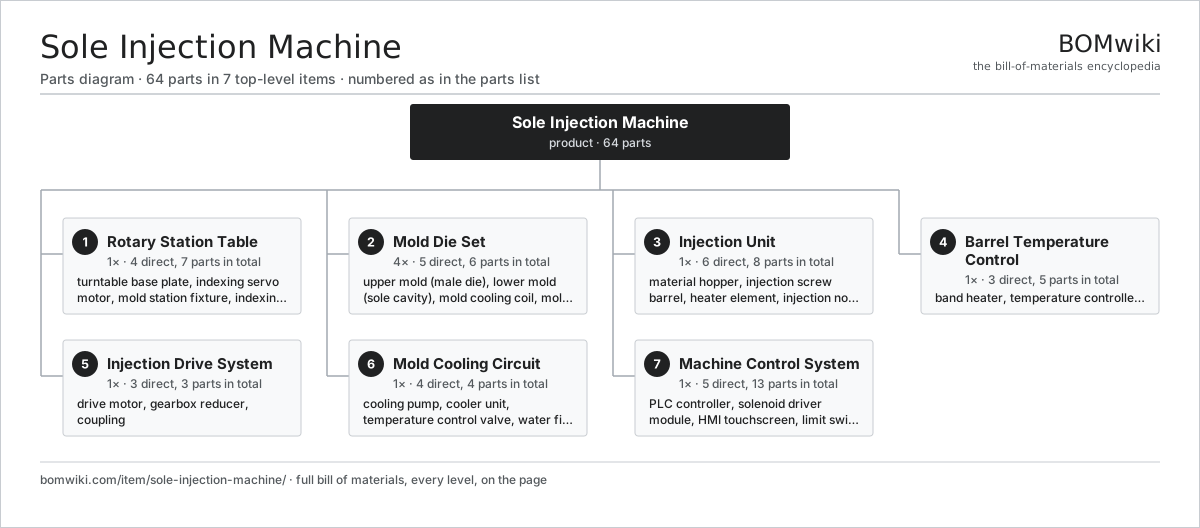
| # | Part | Qty | What it does |
|---|---|---|---|
| 1 | Rotary Station Table 4 parts | 1× | Indexed carousel carrying shoe lasts and mold dies through injection, cooling, and demold stations. |
| 2 | Mold Die Set 5 parts | 4× | Matched upper and lower mold dies shaped to shoe geometry, containing cooling passages. |
| 3 | Injection Unit 6 parts | 1× | Heated screw and nozzle assembly metering and injecting molten polyurethane or rubber into mold cavity. |
| 4 | Barrel Temperature Control 3 parts | 1× | Electric heater and thermostat maintaining barrel temperature for material fluidity (180–220 °C for PU). |
| 5 | Injection Drive System 3 parts | 1× | Motor and transmission powering screw rotation for material melting and injection. |
| 6 | Mold Cooling Circuit 4 parts | 1× | Water circulation cooling molds between injection cycles, reducing cycle time. |
| 7 | Machine Control System 5 parts | 1× | PLC-based sequencer managing injection pressure, temperature, timing, and station indexing. |
3D model
No 3D model yet. Have a CAD file of this? Add a 3D model. STL renders right on this page; STEP, FreeCAD, and OpenSCAD sources are welcome too (openly licensed, like all 3D models on BOMwiki).
Build & assembly graph
expand / collapse · shared sub-assemblies converge · links to related products · est. labourTap an assembly to expand/collapse · tap a part to open it · use “Open page” for any node · drag to pan, scroll to zoom.
Bill of materials for Sole Injection Machine
7 top-level lines · 37 rows shown · 64 parts total · indented to 3 levels| # | Item / sub-assembly | Part no. | Qty/assy | Ext. qty | Parts | Type |
|---|---|---|---|---|---|---|
| 1 | Rotary Station Table 4 parts | sole-injection-machine-rotary-table | 1× | 1 | 7 | assembly |
| 1.1 | Turntable Base Plate | sole-injection-machine-turntable-base | 1× | 1 | · | part |
| 1.2 | Indexing Servo Motor | sole-injection-machine-servo-motor | 1× | 1 | · | part |
| 1.3 | Mold Station Fixture | sole-injection-machine-mold-stations | 4× | 4 | · | part |
| 1.4 | Indexing Brake | sole-injection-machine-indexing-brake | 1× | 1 | · | part |
| 2 | Mold Die Set 5 parts | sole-injection-machine-station-mold | 4× | 4 | 6 | assembly |
| 2.1 | Upper Mold (Male Die) | sole-injection-machine-upper-mold | 1× | 4 | · | part |
| 2.2 | Lower Mold (Sole Cavity) | sole-injection-machine-lower-mold | 1× | 4 | · | part |
| 2.3 | Mold Cooling Coil | sole-injection-machine-mold-cooling-coil | 2× | 8 | · | part |
| 2.4 | Mold Clamp | sole-injection-machine-mold-clamp | 1× | 4 | · | part |
| 2.5 | Ejector Pin Set | sole-injection-machine-ejector-pin-set | 1× | 4 | · | part |
| 3 | Injection Unit 6 parts | sole-injection-machine-injection-unit | 1× | 1 | 8 | assembly |
| 3.1 | Material Hopper | sole-injection-machine-hopper | 1× | 1 | · | part |
| 3.2 | Injection Screw Barrel | sole-injection-machine-screw-barrel | 1× | 1 | · | part |
| 3.3 | Heater Element | sole-injection-machine-heater-elements | 3× | 3 | · | part |
| 3.4 | Injection Nozzle | sole-injection-machine-nozzle-assembly | 1× | 1 | · | part |
| 3.5 | Pressure Transducer | sole-injection-machine-pressure-gauge | 1× | 1 | · | part |
| 3.6 | Flow Control Valve | sole-injection-machine-flow-control-valve | 1× | 1 | · | part |
| 4 | Barrel Temperature Control 3 parts | sole-injection-machine-heating-system | 1× | 1 | 5 | assembly |
| 4.1 | Band Heater | sole-injection-machine-band-heater | 3× | 3 | · | part |
| 4.2 | Temperature Controller | sole-injection-machine-temperature-controller | 1× | 1 | · | part |
| 4.3 | Temperature Display | sole-injection-machine-temperature-display | 1× | 1 | · | part |
| 5 | Injection Drive System 3 parts | sole-injection-machine-pump-motor | 1× | 1 | 3 | assembly |
| 5.1 | Drive Motor | sole-injection-machine-motor | 1× | 1 | · | part |
| 5.2 | Gearbox Reducer | sole-injection-machine-gearbox | 1× | 1 | · | part |
| 5.3 | Coupling | sole-injection-machine-drive-coupling | 1× | 1 | · | part |
| 6 | Mold Cooling Circuit 4 parts | sole-injection-machine-cooling-system | 1× | 1 | 4 | assembly |
| 6.1 | Cooling Pump | sole-injection-machine-cooling-pump | 1× | 1 | · | part |
| 6.2 | Cooler Unit | sole-injection-machine-cooler-unit | 1× | 1 | · | part |
| 6.3 | Temperature Control Valve | sole-injection-machine-temperature-setpoint | 1× | 1 | · | part |
| 6.4 | Water Filter | sole-injection-machine-filter-cartridge | 1× | 1 | · | part |
| 7 | Machine Control System 5 parts | sole-injection-machine-control-panel | 1× | 1 | 13 | assembly |
| 7.1 | PLC Controller | sole-injection-machine-plc | 1× | 1 | · | part |
| 7.2 | Solenoid Driver Module | sole-injection-machine-solenoid-driver | 2× | 2 | · | part |
| 7.3 | HMI Touchscreen | sole-injection-machine-hmi-panel | 1× | 1 | · | part |
| 7.4 | Limit Switch | sole-injection-machine-limit-switch | 8× | 8 | · | part |
| 7.5 | Power Supply | power-supply | 1× | 1 | · | part |
Something wrong in this list? Report a problem with this BOM.
Sourcing: possible vendors
Browse the supplier directory → Prices, MOQ, and lead times are algorithmic estimates, not quotes, and not claims about these companies. Company mappings are curated by keyword; est. price band $10k–$1M. How estimates work| Vendor | HQ | Specialty | MOQ | Lead time |
|---|---|---|---|---|
|
🇨🇭Rieter
rieter.com ↗
|
Winterthur, CH | Spinning machinery | 10 units | 14–24 wks |
| truetzschler.com ↗ | Mönchengladbach, DE | Textile machinery | 10 units | 14–24 wks |
|
🇧🇪Picanol
picanol.be ↗
|
Ypres, BE | Weaving machines | 10 units | 14–24 wks |
| karlmayer.com ↗ | Obertshausen, DE | Warp knitting machines | 10 units | 14–24 wks |
|
🇨🇭Saurer
saurer.com ↗
|
Arbon, CH | Spinning & embroidery | 10 units | 14–24 wks |
1,035-word article