Sonobuoy
ProductOverview
A sonobuoy is a disposable listening post. Maritime patrol aircraft and helicopters cannot dip a sonar everywhere at once, so they seed the ocean with these tube-launched buoys, each one a complete sonar receiver, radio station, and power plant packed into a standardized cylinder, and listen to the pattern. A single P-8 Poseidon carries over a hundred; a serious submarine prosecution can expend dozens. The buoy is engineered to cost little, store for years, work for hours, and then sink itself.
The entire device fits the NATO A-size envelope, 124 mm diameter by 914 mm long, defined by the Launch Housing so that every allied aircraft launcher accepts every allied buoy. Inside, packed in deployment order, are the Descent System, Flotation System, Hydrophone Array, Electronics Package, RF Transmitter, Battery Section, and Scuttle System system.
Deployment sequence
Launch is violent: a cartridge-actuated device fires the buoy from a pressurized tube against the Base Plate, or gravity drops it from a rotary launcher, anywhere from wave-top height to 9,000 m. The Nose Cap separates and the Descent Parachute deploys, holding descent to 25-40 m/s and the body nose-down. At splash the Water-Entry Release cuts the canopy away before it can foul anything, seawater floods the Seawater-Activated Cell, inert through years of magazine storage, at full output within seconds of immersion, and the Deployment Sequencer begins its timed program: the Gas Generator inflates the Float Bag, the Antenna Erector snaps the VHF whip vertical, and the Suspension Cable pays out hydrophones to the depth set before launch on the Depth Selector. Within about a minute of water entry the buoy is on the air.
Listening
Depth selection is tactical physics. Sound in the ocean refracts along temperature gradients; a submarine below the thermocline can be acoustically invisible to a sensor above it. Crews therefore set hydrophone depth, typically one of several stops between 27 and 300 m, to put the Hydrophone Element string in the same acoustic duct as the expected target.
A passive buoy hears the target's own noise: propeller blade-rate lines, machinery tonals, flow noise, mostly below a few hundred hertz. The dominant passive type, DIFAR, pairs an omnidirectional element with two orthogonal directional ones and a DIFAR Compass, so the aircraft receives not just a detection but a magnetic bearing; two buoys with crossing bearings produce a fix. Because target signals can sit at microvolts, self-noise is the enemy. The Compliance Element in the suspension decouples wave heave from the array, the Array Damper stills residual motion, and the Hydrophone Preamplifier amplifies at the sensor before the signal travels up hundreds of meters of cable. Active variants (DICASS) add a pinger and report echoes instead, at the cost of alerting the target.
Telemetry
The buoy does no target classification itself, that happens in the aircraft, where acoustic operators and processors run spectral analysis on the raw feed. The Signal Conditioning Board multiplexes acoustic and compass channels into a composite baseband, and the Transmitter Module FM-modulates it onto one of 96 standard VHF channels between 136 and 173.5 MHz, set pre-launch on the RF Channel Selector so a field of buoys shares the band without collision. One watt into the quarter-wave Antenna Mast reaches a patrol aircraft tens of kilometers away at altitude. The Sea Anchor limits wind drift so the buoy stays near its plotted drop point, which is what makes bearings from multiple buoys geometrically useful.
Power and end of life
The seawater battery is sized to the mission, not maximized: the Operating-Life Selector sets transmit life anywhere from 30 minutes for a quick localization pattern to 8 hours for a barrier watch, and the Power Conditioner holds clean rails for the preamplifiers as the cell voltage sags. When the timer expires, the Soluble Burn Plug erodes through, the Flood Port openings admit the sea, and the buoy sinks, a deliberate requirement, enforced by an independent Scuttle Timer, so spent buoys cannot be recovered for exploitation or accumulate as surface debris. Tens of thousands are expended in exercises and operations every year; the scuttle system is why the ocean surface is not littered with them.
Sonobuoy parts and their functions
8 top-level parts · 315 parts in total · full bill of materials below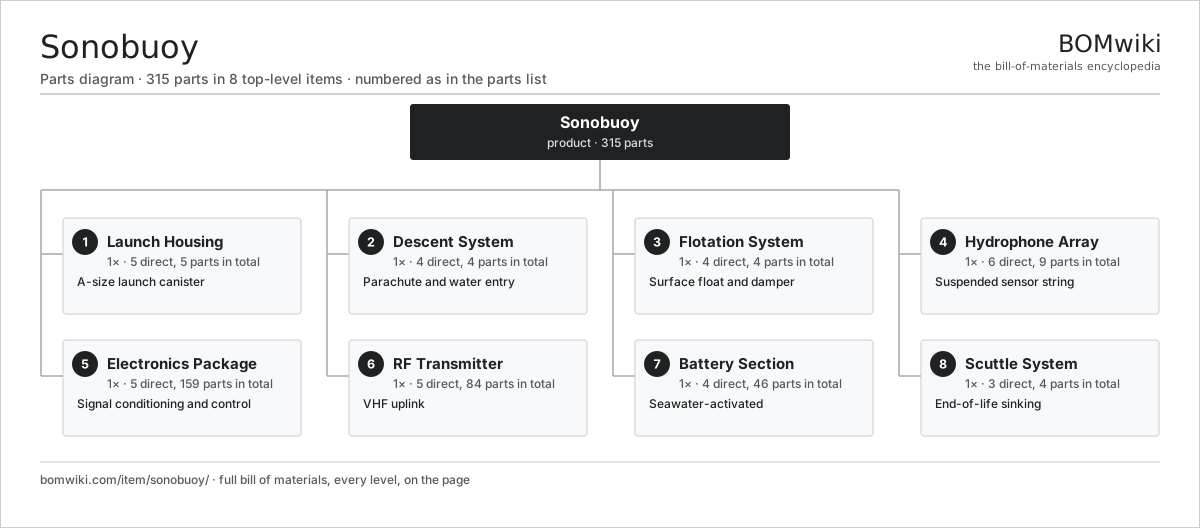
| # | Part | Qty | What it does |
|---|---|---|---|
| 1 | Launch Housing 5 parts | 1× | A-size launch canister |
| 2 | Descent System 4 parts | 1× | Parachute and water entry |
| 3 | Flotation System 4 parts | 1× | Surface float and damper |
| 4 | Hydrophone Array 6 parts | 1× | Suspended sensor string |
| 5 | Electronics Package 5 parts | 1× | Signal conditioning and control |
| 6 | RF Transmitter 5 parts | 1× | VHF uplink |
| 7 | Battery Section 4 parts | 1× | Seawater-activated |
| 8 | Scuttle System 3 parts | 1× | End-of-life sinking |
3D model
No 3D model yet. Have a CAD file of this? Add a 3D model. STL renders right on this page; STEP, FreeCAD, and OpenSCAD sources are welcome too (openly licensed, like all 3D models on BOMwiki).
Build & assembly graph
expand / collapse · shared sub-assemblies converge · links to related products · est. labourTap an assembly to expand/collapse · tap a part to open it · use “Open page” for any node · drag to pan, scroll to zoom.
Bill of materials for Sonobuoy
8 top-level lines · 50 rows shown · 315 parts total · indented to 3 levels| # | Item / sub-assembly | Part no. | Qty/assy | Ext. qty | Parts | Type |
|---|---|---|---|---|---|---|
| 1 | Launch Housing 5 parts | sonobuoy-housing | 1× | 1 | 5 | assembly |
| 1.1 | Outer Tube | sonobuoy-outer-tube | 1× | 1 | · | part |
| 1.2 | Nose Cap | sonobuoy-nose-cap | 1× | 1 | · | part |
| 1.3 | Base Plate | sonobuoy-base-plate | 1× | 1 | · | part |
| 1.4 | Launch Cartridge Seat | sonobuoy-cad-charge | 1× | 1 | · | part |
| 1.5 | O-Ring Set | oring-set | 1× | 1 | · | part |
| 2 | Descent System 4 parts | sonobuoy-descent-system | 1× | 1 | 4 | assembly |
| 2.1 | Descent Parachute | sonobuoy-parachute | 1× | 1 | · | part |
| 2.2 | Parachute Riser | sonobuoy-riser | 1× | 1 | · | part |
| 2.3 | Water-Entry Release | sonobuoy-release-mechanism | 1× | 1 | · | part |
| 2.4 | Rotochute Vanes | sonobuoy-rotochute-vanes | 1× | 1 | · | part |
| 3 | Flotation System 4 parts | sonobuoy-flotation | 1× | 1 | 4 | assembly |
| 3.1 | Float Bag | sonobuoy-float-bag | 1× | 1 | · | part |
| 3.2 | Gas Generator | sonobuoy-gas-generator | 1× | 1 | · | part |
| 3.3 | Compliance Element | sonobuoy-compliance-spring | 1× | 1 | · | part |
| 3.4 | Sea Anchor | sonobuoy-sea-anchor | 1× | 1 | · | part |
| 4 | Hydrophone Array 6 parts | sonobuoy-hydrophone-array | 1× | 1 | 9 | assembly |
| 4.1 | Hydrophone Element | sonobuoy-hydrophone-element | 4× | 4 | · | part |
| 4.2 | DIFAR Compass | sonobuoy-difar-compass | 1× | 1 | · | part |
| 4.3 | Hydrophone Preamplifier | sonobuoy-preamp | 1× | 1 | · | part |
| 4.4 | Suspension Cable | sonobuoy-suspension-cable | 1× | 1 | · | part |
| 4.5 | Depth Selector | sonobuoy-depth-selector | 1× | 1 | · | part |
| 4.6 | Array Damper | sonobuoy-array-damper | 1× | 1 | · | part |
| 5 | Electronics Package 5 parts | sonobuoy-electronics | 1× | 1 | 159 | assembly |
| 5.1 | Signal Conditioning Board 3 parts | sonobuoy-signal-board | 1× | 1 | 152 | assembly |
| 5.1.1 | Bare PCB | pcb-bare | 1× | 1 | · | part |
| 5.1.2 | SMD Passive (R/C/L) | smd-passives | 150× | 150 | · | part |
| 5.1.3 | Microcontroller | mcu | 1× | 1 | · | part |
| 5.2 | Deployment Sequencer | sonobuoy-sequencer | 1× | 1 | · | part |
| 5.3 | RF Channel Selector | sonobuoy-channel-selector | 1× | 1 | · | part |
| 5.4 | Wire Bundle | wire-bundle | 1× | 1 | · | part |
| 5.5 | Connector | connector | 4× | 4 | · | part |
| 6 | RF Transmitter 5 parts | sonobuoy-rf-transmitter | 1× | 1 | 84 | assembly |
| 6.1 | Transmitter Module | sonobuoy-tx-module | 1× | 1 | · | part |
| 6.2 | Antenna Mast | sonobuoy-antenna-mast | 1× | 1 | · | part |
| 6.3 | Antenna Erector | sonobuoy-antenna-erector | 1× | 1 | · | part |
| 6.4 | Bare PCB | pcb-bare | 1× | 1 | · | part |
| 6.5 | SMD Passive (R/C/L) | smd-passives | 80× | 80 | · | part |
| 7 | Battery Section 4 parts | sonobuoy-battery | 1× | 1 | 46 | assembly |
| 7.1 | Seawater-Activated Cell | sonobuoy-seawater-cell | 1× | 1 | · | part |
| 7.2 | Operating-Life Selector | sonobuoy-life-selector | 1× | 1 | · | part |
| 7.3 | Power Conditioner 3 parts | sonobuoy-power-conditioner | 1× | 1 | 43 | assembly |
| 7.3.1 | Bare PCB | pcb-bare | 1× | 1 | · | part |
| 7.3.2 | Power MOSFET | mosfet | 2× | 2 | · | part |
| 7.3.3 | SMD Passive (R/C/L) | smd-passives | 40× | 40 | · | part |
| 7.4 | Wire Bundle | wire-bundle | 1× | 1 | · | part |
| 8 | Scuttle System 3 parts | sonobuoy-scuttle | 1× | 1 | 4 | assembly |
| 8.1 | Soluble Burn Plug | sonobuoy-burn-plug | 1× | 1 | · | part |
| 8.2 | Flood Port | sonobuoy-flood-port | 2× | 2 | · | part |
| 8.3 | Scuttle Timer | sonobuoy-scuttle-timer | 1× | 1 | · | part |
Something wrong in this list? Report a problem with this BOM.
Related products
same domain, ranked by shared parts EOD Robot
1,224 parts · shares 3 with this page
EOD Robot
1,224 parts · shares 3 with this page
 Handheld Mine Detector
318 parts · shares 3 with this page
Handheld Mine Detector
318 parts · shares 3 with this page
 Optronic Periscope Mast
369 parts · shares 3 with this page
Optronic Periscope Mast
369 parts · shares 3 with this page
 Ground Surveillance Radar
70 parts · shares 2 with this page
Ground Surveillance Radar
70 parts · shares 2 with this page
 Ruggedized Field Laptop
94 parts · shares 1 with this page
Ruggedized Field Laptop
94 parts · shares 1 with this page
 Amphibious Assault Vehicle
894 parts · shares 2 with this page
Amphibious Assault Vehicle
894 parts · shares 2 with this page
Sourcing: possible vendors
Browse the supplier directory → Prices, MOQ, and lead times are algorithmic estimates, not quotes, and not claims about these companies. Company mappings are curated by keyword; est. price band $200–$100M. How estimates work| Vendor | HQ | Specialty | MOQ | Lead time |
|---|---|---|---|---|
| smithsdetection.com ↗ | London, GB | Security screening | made to order | 24–52 wks |
|
🇺🇸Leidos
leidos.com ↗
|
Reston, US | Security & screening | made to order | 24–52 wks |
|
🇺🇸Rapiscan
rapiscansystems.com ↗
|
Torrance, US | X-ray screening | made to order | 24–52 wks |
|
🇫🇷Thales
thalesgroup.com ↗
|
Paris, FR | Defense electronics | made to order | 24–52 wks |
| baesystems.com ↗ | London, GB | Defense | made to order | 24–52 wks |
726-word article