Space Plant Growth Chamber
ProductOverview
The space plant growth chamber is a closed-loop life-support device that produces fresh food and oxygen while consuming CO₂ and water in microgravity. Unlike Earth greenhouses, this system must function without gravity's help: water drains passively cannot work, air circulation must be active, and every component must prevent microbial contamination and water escape into the cabin.
The design grows fast-growing leafy crops (lettuce, spinach, radish) and medicinal plants (Chinese medicinal herbs, microgreens) using hydroponics (nutrient solution in water) or aeroponics (roots misted with nutrient solution). Current systems on the ISS use the "Advanced Plant Habitat" (APH) principle: enclosed chamber, optimized LED spectrum, automated environment control, and data downlink to Earth.
LED Light Engine
The LED lighting array is the energy source for photosynthesis. It uses two spectral bands:
- Red (660 nm): 160 W total from two red LED panels. This wavelength drives photosynthesis directly (peak absorption by chlorophyll A) and stimulates fruiting/flowering.
- Blue (450 nm): 80 W total from two blue LED panels. This wavelength controls photomorphogenesis (plant shape, leaf angle) and guard cell opening.
The red/blue ratio of 2:1 is empirically optimized for leafy greens. Total electrical input to the lights is 240 W; assuming ~40% photosynthetic efficiency (that is, 40% of photons are absorbed and converted to plant dry mass), the system produces roughly 96 W of photosynthetic power output. For comparison, an equivalent 0.24 m² area on Earth at noon receives ~2.5 kW of solar radiation; this chamber delivers 240 W, a compromise between energy availability on ISS (budget is typically 20–30 A @ 28 V) and plant growth rates.
The constant-current LED driver maintains steady brightness throughout the life of the LEDs (which degrade slowly over 2000+ hours). A programmed day/night cycle (16 hours light, 8 hours dark) simulates Earth photoperiod, triggering circadian responses in plants and allowing rest periods for photosynthetic machinery.
Heat from the 240 W LED array (~200 W rejected as heat) is dissipated via the aluminum heatsink to the ISS cabin air. Passive cooling (no fans) is preferred to avoid acoustic noise and power consumption.
Aeroponic Root Zone
The root zone system is aeroponic: plant roots hang in air and are periodically misted with nutrient solution rather than submerged. This approach offers advantages in microgravity:
- No gravity-driven drainage: Aeroponic systems pump nutrient on demand; they don't rely on water pooling and draining.
- High oxygen availability: Roots remain in air (high O₂) except during brief misting pulses, maximizing respiration.
- Water efficiency: Excess water is collected as condensate and recirculated, reducing resupply needs.
The system comprises:
- Two root chamber modules (300 × 200 × 150 mm each), clear acrylic so roots and growth are visible.
- Recirculation pump (0.5 L/min): draws solution from the nutrient reservoir and drives it through a distribution line.
- Four solenoid valves (12 VDC, <5 W each): controlled by the flight computer, they gate flow to individual root chambers on a timed schedule (e.g., 30 second mist every 15 minutes).
- Eight precision nozzles: produce 50–200 micron droplets that settle onto roots without splattering outside the chamber.
The nutrient solution (a mixture of NPK macronutrients and trace elements, similar to commercial hydroponic fertilizers) is mixed by ground teams before launch. As water is consumed (transpired and photosynthetically converted to plant biomass), the solution becomes more concentrated; periodic addition of fresh deionized water keeps osmotic potential near optimal. The 10 L reservoir supports 3–4 weeks of continuous growth without resupply.
Environment Control
Three environmental parameters are actively managed:
1. Carbon Dioxide: Plants consume CO₂ during photosynthesis (typically 0.5–1.5 g CO₂ per liter of water transpired). ISS cabin CO₂ is ~4 mmHg (roughly 400 ppm in normal breathing but can rise to 1000+ ppm in enclosed volumes), which is below optimal for photosynthesis. The chamber injects CO₂ from pressurized cartridges to maintain 1200 ppm setpoint.
The CO₂ regulator and solenoid allow programmed injection: the NDIR CO₂ sensor measures chamber ppm, and the flight computer opens the solenoid valve to pulse CO₂ when concentration drops below 1100 ppm.
2. Humidity: The root misting creates high local humidity (85–95% RH during 30 second spray), but humidity drops between misters. The capacitive RH sensor monitors chamber moisture, and the solenoid valve is programmed to maintain a specific inter-misting humidity. Excess moisture condenses on the chamber walls and is collected by condensation trays, then pumped back to the reservoir by a small peristaltic pump.
3. Temperature: The thermistor tracks chamber temperature. The ISS cabin is maintained at 18–22 °C, which is acceptable for most crops. The 200 W of LED heat warms the chamber to typically 22–25 °C, which is optimal for leafy greens. No active cooling is needed.
An HEPA intake filter prevents ISS dust and microbes from entering the sealed chamber, reducing contamination risk.
Plant Monitoring via Imaging
Two cameras provide daily progress tracking:
RGB camera (12 MP): records color plant images with a 660 nm shortpass optical filter. This filter blocks red light and passes green, enabling direct visualization of chlorophyll autofluorescence, a marker of photosynthetic health. Images are captured daily at the same local solar time (relative to the chamber's light cycle) to ensure consistency.
NIR camera (2 MP, 780–900 nm): captures near-infrared images used to compute the Normalized Difference Vegetation Index (NDVI = (NIR − Red) / (NIR + Red)). NDVI is a standard remote-sensing metric for plant vigor: healthy, photosynthetically active plants have NDVI > 0.6, while stressed plants drop to < 0.4.
The white LED ring provides consistent illumination for both cameras, compensating for variations in ambient ISS cabin lighting.
All images are logged to an SD card and downlinked to Earth via ISS communication systems. Ground-based biologists analyze growth curves, stress responses, and crop readiness for harvest.
Power and Control Architecture
The system draws 28 VDC (standard ISS voltage) from the station's main bus. A power distribution module with step-down converters provides 12 V for the pump, solenoid valves, and LED driver, plus 5 V for the camera system and 3.3 V for the main control processor.
The control computer is an embedded Linux board (e.g., Raspberry Pi 4) running Python-based automation logic:
- Timed solenoid sequencing: Fire each of 4 solenoid valves for 30 seconds every 15 minutes.
- CO₂ feedback control: Sample the NDIR CO₂ sensor; if ppm < 1100, pulse the CO₂ solenoid for 2 seconds.
- Humidity monitoring: Log RH from the capacitive sensor every minute; alert if chamber becomes too dry (risks root desiccation).
- Image capture: Trigger both cameras daily at a fixed time, save to SD card.
- Telemetry downlink: Pack all sensor data (temperature, RH, CO₂, pump runtime, valve actuations) into a telemetry frame and transmit to ISS data network.
A secondary real-time MCU (STM32) handles the tightly-timed solenoid/pump control loops (millisecond-level precision), while the main CPU handles slower sensor logging and image processing.
Condensate and Water Recovery
A critical innovation is passive water recovery. As humid air inside the chamber contacts the cooler polycarbonate walls (which radiate heat to the ISS cabin interior), water condenses. The sloped collection trays beneath the walls direct this water via check valves to a peristaltic pump, which returns it to the nutrient reservoir.
Typical water balance:
- Input: Initial 10 L nutrient solution + CO₂-derived water (negligible) + periodic deionized water top-offs.
- Loss: Plant transpiration (~1 L per week per crop cycle) + condensate recovery (captures ~50% of transpired water) = net loss of ~0.5 L per week.
- Result: Chamber operates for 3–4 weeks before requiring fresh-water resupply.
This is critical for ISS logistics: water is precious, and every kilogram saved reduces launch costs.
Typical Crop Cycle
A complete growing cycle from seed to harvest takes 21–28 days for fast crops like lettuce and spinach:
- Days 1–4 (germination): Seeds are submerged briefly, then allowed to air-dry in the misted root zone. Temperature is maintained at 20–22 °C, and the light cycle begins (16 h on, 8 h off).
- Days 5–10 (seedling): First true leaves emerge. Misting frequency ensures 85–95% RH. CO₂ is maintained at 1200 ppm.
- Days 11–21 (vegetative growth): Leaves expand rapidly. NDVI from the NIR camera climbs from 0.3 to 0.6+. Root development accelerates; nutrient uptake increases.
- Days 22–28 (harvest readiness): Leaves reach full size. Harvest window opens when NDVI stabilizes above 0.65.
At harvest, plants are removed, weighed, and subsampled for nutrient analysis. Roots and remaining plant material are composted (or packaged for return to Earth) for analysis. Fresh seeds are then planted, and the cycle repeats.
Challenges and Lessons Learned
Microbial contamination: In enclosed, humid systems, molds and bacteria proliferate if not controlled. Solutions include:
- HEPA intake filtering.
- Periodic sterilization of tubing and nozzles with dilute hypochlorite between cycles.
- Monitoring for visible fungal growth on root zones; removing affected plants immediately.
Water salts accumulation: Nutrient solution can become hypertonic if water is lost faster than nutrients. Periodic fresh-water additions and nutrient analysis keep osmotic potential balanced.
Uneven growth: Plants at the center of the chamber receive higher light intensity than edge plants. Staggering planting times or rotating plants during the cycle improves uniformity.
Power budget: 240 W for lights + 20 W for pumps/solenoids = 260 W total draw is significant on ISS, which has ~120 kW capacity but is heavily loaded. Future improvements include higher-efficiency LEDs (current GaAs/GaN red/blue LEDs are ~50% efficient; III-nitride advances may reach 70%+).
Future Directions
Current systems have validated the core concept. Future enhancements include:
- Spectral tunability: Programmable LED array allowing different light recipes for different crops or growth stages.
- Mechanical harvest: Automated scissors or shears for selective leaf removal without uprooting the plant.
- Modular stacking: Two or three chambers in series, on a rotating schedule (one being harvested while others grow).
- Seed/seedling uplink: Sealed seed containers launched on resupply missions, allowing crew to initiate new crops without ground processing.
The ultimate goal is for ISS crews to harvest fresh salad (or medicine) regularly, improving morale, nutrition, and demonstrating life-support regeneration for long-duration lunar and Mars missions.
Space Plant Growth Chamber parts and their functions
7 top-level parts · 82 parts in total · full bill of materials below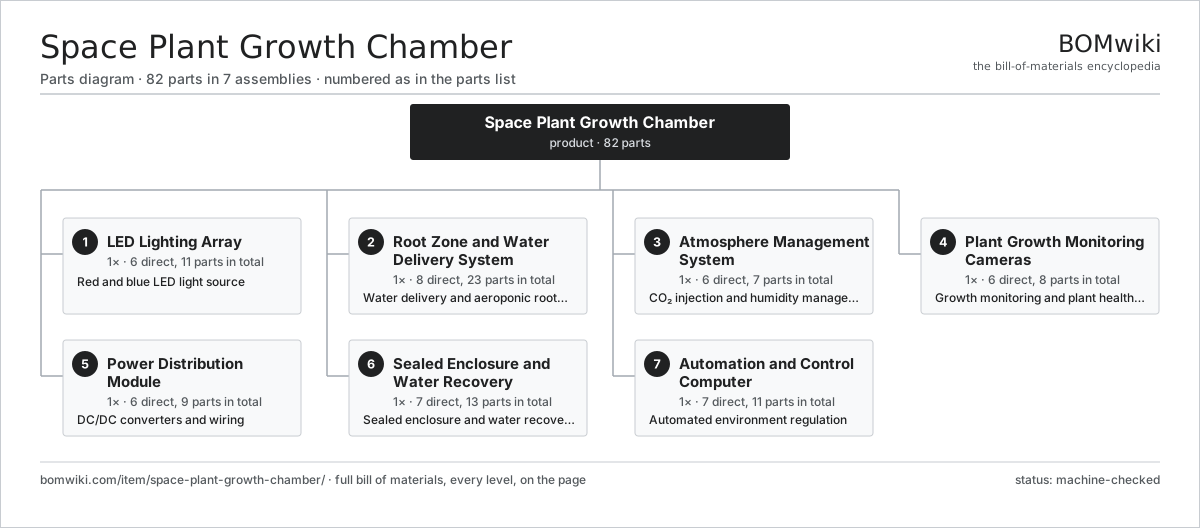
| # | Part | Qty | What it does |
|---|---|---|---|
| 1 | LED Lighting Array 6 parts | 1× | Red and blue LED light source |
| 2 | Root Zone and Water Delivery System 8 parts | 1× | Water delivery and aeroponic root zone |
| 3 | Atmosphere Management System 6 parts | 1× | CO₂ injection and humidity management |
| 4 | Plant Growth Monitoring Cameras 6 parts | 1× | Growth monitoring and plant health imaging |
| 5 | Power Distribution Module 6 parts | 1× | DC/DC converters and wiring |
| 6 | Sealed Enclosure and Water Recovery 7 parts | 1× | Sealed enclosure and water recovery |
| 7 | Automation and Control Computer 7 parts | 1× | Automated environment regulation |
3D model
No 3D model yet. Have a CAD file of this? Add a 3D model — STL renders right on this page; STEP, FreeCAD, and OpenSCAD sources are welcome too (openly licensed, like all 3D models on BOMwiki).
Build & assembly graph
expand / collapse · shared sub-assemblies converge · links to related products · est. labourTap an assembly to expand/collapse · tap a part to open it · use “Open page” for any node · drag to pan, scroll to zoom.
Bill of materials for Space Plant Growth Chamber
7 top-level lines · 53 rows shown · 82 parts total · indented to 3 levels| # | Item / sub-assembly | Part no. | Qty/assy | Ext. qty | Parts | Type |
|---|---|---|---|---|---|---|
| 1 | LED Lighting Array 6 parts | space-pgc-led-array | 1× | 1 | 11 | assembly |
| 1.1 | Red 660 nm LED Panel | space-pgc-led-red-panel | 2× | 2 | · | part |
| 1.2 | Blue 450 nm LED Panel | space-pgc-led-blue-panel | 2× | 2 | · | part |
| 1.3 | LED Heat Dissipation Assembly | space-pgc-led-heatsink | 1× | 1 | · | part |
| 1.4 | LED Driver and Dimmer Board | space-pgc-led-driver | 1× | 1 | · | part |
| 1.5 | Connector | connector | 4× | 4 | · | part |
| 1.6 | Bare PCB | pcb-bare | 1× | 1 | · | part |
| 2 | Root Zone and Water Delivery System 8 parts | space-pgc-root-module | 1× | 1 | 23 | assembly |
| 2.1 | Acrylic Root Zone Chamber | space-pgc-root-chamber | 2× | 2 | · | part |
| 2.2 | Brushless Recirculation Pump | space-pgc-water-pump | 1× | 1 | · | part |
| 2.3 | Solenoid-Controlled Misting Valve | space-pgc-solenoid-valve | 4× | 4 | · | part |
| 2.4 | Micro Aeroponic Nozzle | space-pgc-spray-nozzle | 8× | 8 | · | part |
| 2.5 | Nutrient Solution Reservoir | space-pgc-nutrient-reservoir | 1× | 1 | · | part |
| 2.6 | One-Way Check Valve | space-pgc-check-valve | 2× | 2 | · | part |
| 2.7 | Connector | connector | 4× | 4 | · | part |
| 2.8 | Silicone Tubing Bundle | tube-assembly | 1× | 1 | · | part |
| 3 | Atmosphere Management System 6 parts | space-pgc-atmosphere-control | 1× | 1 | 7 | assembly |
| 3.1 | Pressurized CO₂ Cartridge | space-pgc-co2-cartridge | 2× | 2 | · | part |
| 3.2 | CO₂ Pressure Regulator with Solenoid | space-pgc-co2-regulator | 1× | 1 | · | part |
| 3.3 | Capacitive Humidity Sensor | space-pgc-humidity-sensor | 1× | 1 | · | part |
| 3.4 | Temperature Thermistor | space-pgc-temp-sensor | 1× | 1 | · | part |
| 3.5 | NDIR CO₂ Sensor | space-pgc-co2-sensor | 1× | 1 | · | part |
| 3.6 | HEPA Air Intake Filter | space-pgc-air-intake-filter | 1× | 1 | · | part |
| 4 | Plant Growth Monitoring Cameras 6 parts | space-pgc-camera-system | 1× | 1 | 8 | assembly |
| 4.1 | RGB Growth Monitoring Camera | space-pgc-rgb-camera | 1× | 1 | · | part |
| 4.2 | Near-Infrared Monochrome Camera | space-pgc-nir-camera | 1× | 1 | · | part |
| 4.3 | Lens Assembly | camera-lens | 2× | 2 | · | part |
| 4.4 | LED Ring Illumination | space-pgc-led-ring-light | 1× | 1 | · | part |
| 4.5 | Bare PCB | pcb-bare | 1× | 1 | · | part |
| 4.6 | Connector | connector | 2× | 2 | · | part |
| 5 | Power Distribution Module 6 parts | space-pgc-power-distribution | 1× | 1 | 9 | assembly |
| 5.1 | DC/DC Converter 28V→12V | space-pgc-dcdc-28v-12v | 1× | 1 | · | part |
| 5.2 | DC/DC Converter 12V→5V | space-pgc-dcdc-12v-5v | 1× | 1 | · | part |
| 5.3 | DC/DC Converter 12V→3.3V | space-pgc-dcdc-12v-3v3 | 1× | 1 | · | part |
| 5.4 | Power Bus Distribution Board | space-pgc-distribution-board | 1× | 1 | · | part |
| 5.5 | Thermal Fuse | thermal-fuse | 2× | 2 | · | part |
| 5.6 | Connector | connector | 3× | 3 | · | part |
| 6 | Sealed Enclosure and Water Recovery 7 parts | space-pgc-containment-box | 1× | 1 | 13 | assembly |
| 6.1 | Aluminum Extrusion Frame | space-pgc-box-frame | 1× | 1 | · | part |
| 6.2 | Clear Polycarbonate Walls | space-pgc-polycarbonate-walls | 4× | 4 | · | part |
| 6.3 | Condensation Collection Tray | space-pgc-condensate-tray | 2× | 2 | · | part |
| 6.4 | Peristaltic Condensate Pump | space-pgc-drain-pump | 1× | 1 | · | part |
| 6.5 | Hydrophobic Membrane Barrier | space-pgc-humidity-barrier | 1× | 1 | · | part |
| 6.6 | Fastener Set | fastener-set | 2× | 2 | · | part |
| 6.7 | Silicone Sealing Gaskets | gasket-set | 2× | 2 | · | part |
| 7 | Automation and Control Computer 7 parts | space-pgc-control-computer | 1× | 1 | 11 | assembly |
| 7.1 | Single-Board Linux Computer | space-pgc-main-cpu | 1× | 1 | · | part |
| 7.2 | Multi-Channel I/O Expansion Board | space-pgc-io-board | 1× | 1 | · | part |
| 7.3 | Real-Time Control MCU | space-pgc-mcu-secondary | 1× | 1 | · | part |
| 7.4 | Bare PCB | pcb-bare | 2× | 2 | · | part |
| 7.5 | SD Card Module | sd-card-storage | 1× | 1 | · | part |
| 7.6 | Connector | connector | 4× | 4 | · | part |
| 7.7 | LiPo Cell | lipo-cell | 1× | 1 | · | part |
Related products
same domain, ranked by shared parts Spacecraft Cryocooler
66 parts · shares 2 with this page
Spacecraft Cryocooler
66 parts · shares 2 with this page
 Thermal Vacuum Chamber
89 parts · shares 2 with this page
Thermal Vacuum Chamber
89 parts · shares 2 with this page
 Satellite Propellant Tank
54 parts · shares 1 with this page
Satellite Propellant Tank
54 parts · shares 1 with this page
 Crewed Space Capsule
7,222 parts · shares 2 with this page
Crewed Space Capsule
7,222 parts · shares 2 with this page
 Sample Return Capsule
53 parts · shares 2 with this page
Solar Sail Spacecraft
170 parts · shares 2 with this page
Sample Return Capsule
53 parts · shares 2 with this page
Solar Sail Spacecraft
170 parts · shares 2 with this page
Sourcing: possible vendors
Prices, MOQ, and lead times are algorithmic estimates, not quotes, and not claims about these companies. Company mappings are curated by keyword; est. price band $50k–$500M. How estimates work| Vendor | HQ | Specialty | MOQ | Lead time |
|---|---|---|---|---|
|
🇺🇸SpaceX
spacex.com ↗
|
Hawthorne, US | Launch & spacecraft | made to order | 52–104 wks |
| northropgrumman.com ↗ | Falls Church, US | Space & defense | made to order | 52–104 wks |
|
🇫🇷Airbus
airbus.com ↗
|
Toulouse, FR | Aerospace OEM | made to order | 52–104 wks |
| rocketlabusa.com ↗ | Long Beach, US | Launch & spacecraft | made to order | 52–104 wks |
| thalesaleniaspace.com ↗ | Cannes, FR | Satellites | made to order | 52–104 wks |
1,831-word article