Space Station Module
ProductOverview
A space station module is a pressurized cylinder that keeps roughly one atmosphere of breathable air against hard vacuum for fifteen or more years while serving as laboratory, habitat, and structural backbone of an orbital station. The Destiny-class element described here is 8.5 m long, 4.4 m in diameter, and weighs about 14,500 kg at launch. Its Pressure Shell carries the 101.3 kPa pressure load; everything else, life support, power, cooling, computers, mounts inside on standardized racks or outside under debris shielding.
The governing design problem is that the module must be light enough to launch yet stiff enough to survive launch loads of several g, then spend decades cycling through 90-minute orbits with +120 °C sun and −120 °C shadow on opposite walls, all while leaking less than 0.23 kg of air per day.
Structure
The Pressure Shell is built from 2219 aluminum plate machined into a waffle (isogrid) pattern that removes about 90% of the material while keeping bending stiffness. Each Barrel Section is rolled to the 4.4 m diameter and friction-stir welded to its neighbors and to the Ring Frame stiffeners. A conical End Cone closes each end and reacts the docking loads into the cylinder. The shell is proof-tested to 1.5× operating pressure; every weld is X-rayed and dye-penetrant inspected. Penetrations are limited to qualified Shell Feedthrough fittings, two Viewport Window viewports with redundant pressure panes, and the Pressure Hatch at each end, which opens inward so cabin pressure assists the seal.
Outside the hull, the MMOD Shield handles micrometeoroid and orbital debris. A thin Whipple Bumper Panel spaced about 100 mm off the wall shocks an incoming particle, typical impact speeds are 7–10 km/s, into a cloud of vapor and fragments, which the Nextel/Kevlar Blanket then arrests before it reaches structure. An MLI Blanket under the shield limits radiative heat loss. This stuffed-Whipple arrangement stops aluminum particles of roughly 1 cm at orbital velocity for a few percent of the mass an equivalent monolithic wall would need.
Docking and berthing
Each Docking Port follows the International Docking System Standard. An incoming vehicle contacts the extended Soft-Capture Ring, whose actuators absorb the residual closing energy (capture works at approach rates near 0.05 m/s) and align the two vehicles. Twelve Hard-Capture Hook then draw the interfaces together with a preload of several hundred kilonewtons total, compressing the dual seal beads. After a vestibule leak check using Pressure Sensor readings on both sides, the Umbilical Plate mates power, data, and air lines, and the crew opens the hatches through the 800 mm Docking Tunnel.
Life support
The ECLSS Rack Set rack set maintains the cabin atmosphere. A CO2 Scrubber using four Zeolite Sorbent Bed canisters of zeolite 5A runs a swing-adsorption cycle: two beds adsorb CO2 from process air while the other two are heated to ~200 °C and exposed to vacuum to desorb, keeping cabin CO2 below about 3 mmHg partial pressure. The Oxygen Generator electrolyzes recycled water at roughly 1 kg O2 per crew-day, and the Condensate Processor recovers the ~1.5 kg of humidity each crew member exhales daily. Because warm air does not rise in microgravity, four Cabin Fan units and the Air Duct Network network keep air moving continuously; the duct-mounted Smoke Detector sensors rely on that forced flow to see a fire at all.
Power and thermal
Station solar power arrives at 120 VDC. Two DC-DC Converter Unit converters step it to 28 VDC for module loads, and six Remote Power Controller solid-state switch modules let ground controllers energize or isolate every circuit individually, there are no crew-replaceable fuses on the primary distribution. Heat from the racks is collected by Coldplate surfaces into a pumped single-phase water loop (water is used inside because an ammonia leak in the cabin would be lethal), driven by redundant Coolant Pump units. The loop rejects its load through the Interface Heat Exchanger to the station's external ammonia system, with a Loop Accumulator holding loop pressure as temperatures swing. Shell Heater films keep the hull above the cabin dew point so condensation never forms behind equipment.
Avionics and outfitting
Two redundant MDM Computer units run the module: they execute thermal and ECLSS control loops, monitor several hundred sensors, and exchange commands with the station tier over a MIL-STD-1553B bus through 1553 Bus Coupler couplers. The Caution & Warning Panel gives the crew immediate fire, depressurization, and toxic-atmosphere alarms independent of the displays.
Internally, up to 24 Payload Rack positions line the four walls, in microgravity, floor and ceiling are rack bays too. Each rack tilts out on pivots for access to the Utility Standoff raceways behind, where utilities run under Closeout Panel covers. Twenty or more Handrail grips and eight LED Luminaire fixtures, dimmable and spectrum-tunable for circadian support, complete the crew interior.
Space Station Module parts and their functions
8 top-level parts · 700 parts in total · full bill of materials below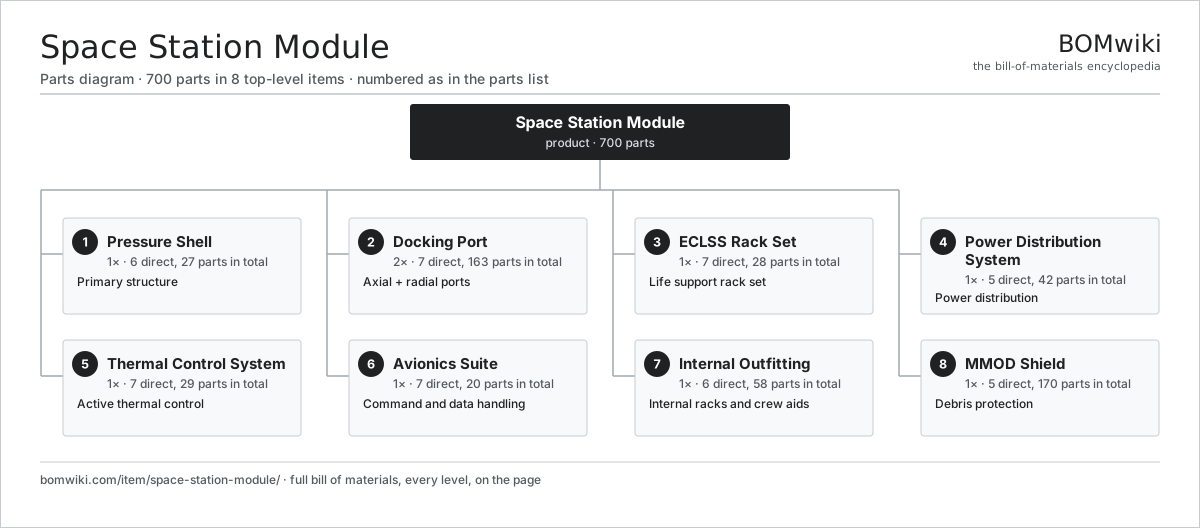
| # | Part | Qty | What it does |
|---|---|---|---|
| 1 | Pressure Shell 6 parts | 1× | Primary structure |
| 2 | Docking Port 7 parts | 2× | Axial + radial ports |
| 3 | ECLSS Rack Set 7 parts | 1× | Life support rack set |
| 4 | Power Distribution System 5 parts | 1× | Power distribution |
| 5 | Thermal Control System 7 parts | 1× | Active thermal control |
| 6 | Avionics Suite 7 parts | 1× | Command and data handling |
| 7 | Internal Outfitting 6 parts | 1× | Internal racks and crew aids |
| 8 | MMOD Shield 5 parts | 1× | Debris protection |
Diagrams & photos

3D model
No 3D model yet. Have a CAD file of this? Add a 3D model. STL renders right on this page; STEP, FreeCAD, and OpenSCAD sources are welcome too (openly licensed, like all 3D models on BOMwiki).
Build & assembly graph
expand / collapse · shared sub-assemblies converge · links to related products · est. labourTap an assembly to expand/collapse · tap a part to open it · use “Open page” for any node · drag to pan, scroll to zoom.
Bill of materials for Space Station Module
8 top-level lines · 66 rows shown · 700 parts total · indented to 3 levels| # | Item / sub-assembly | Part no. | Qty/assy | Ext. qty | Parts | Type |
|---|---|---|---|---|---|---|
| 1 | Pressure Shell 6 parts | space-station-module-pressure-shell | 1× | 1 | 27 | assembly |
| 1.1 | Barrel Section | space-station-module-barrel-section | 3× | 3 | · | part |
| 1.2 | End Cone | space-station-module-end-cone | 2× | 2 | · | part |
| 1.3 | Ring Frame | space-station-module-ring-frame | 6× | 6 | · | part |
| 1.4 | Viewport Window | space-station-module-window | 2× | 2 | · | part |
| 1.5 | Shell Feedthrough | space-station-module-feedthrough | 12× | 12 | · | part |
| 1.6 | Pressure Hatch | space-station-module-hatch | 2× | 2 | · | part |
| 2 | Docking Port 7 parts | space-station-module-docking-port | 2× | 2 | 163 | assembly |
| 2.1 | Soft-Capture Ring | space-station-module-soft-capture-ring | 1× | 2 | · | part |
| 2.2 | Hard-Capture Hook | space-station-module-hard-capture-hooks | 12× | 24 | · | part |
| 2.3 | Docking Tunnel | space-station-module-docking-tunnel | 1× | 2 | · | part |
| 2.4 | Umbilical Plate | space-station-module-umbilical-plate | 1× | 2 | · | part |
| 2.5 | O-Ring Set | oring-set | 2× | 4 | · | part |
| 2.6 | Servo Motor 4 parts | servo-motor | 6× | 12 | 24 | assembly |
| 2.6.1 | Stator Assembly 3 parts + deeper › | stator-assembly | 1× | 12 | 3 | assembly |
| 2.6.2 | Rotor Assembly 4 parts + deeper › | rotor-assembly | 1× | 12 | 19 | assembly |
| 2.6.3 | Encoder | encoder | 1× | 12 | · | part |
| 2.6.4 | Motor Housing | motor-housing | 1× | 12 | · | part |
| 2.7 | Pressure Sensor | pressure-sensor | 2× | 4 | · | part |
| 3 | ECLSS Rack Set 7 parts | space-station-module-eclss | 1× | 1 | 28 | assembly |
| 3.1 | CO2 Scrubber 4 parts | space-station-module-co2-scrubber | 1× | 1 | 11 | assembly |
| 3.1.1 | Zeolite Sorbent Bed | space-station-module-sorbent-bed | 4× | 4 | · | part |
| 3.1.2 | Blower Motor | blower-motor | 1× | 1 | · | part |
| 3.1.3 | Heating Element | heating-element | 2× | 2 | · | part |
| 3.1.4 | Relay | relay | 4× | 4 | · | part |
| 3.2 | Oxygen Generator | space-station-module-oxygen-generator | 1× | 1 | · | part |
| 3.3 | Condensate Processor | space-station-module-condensate-processor | 1× | 1 | · | part |
| 3.4 | Cabin Fan | space-station-module-cabin-fan | 4× | 4 | · | part |
| 3.5 | Smoke Detector | space-station-module-smoke-detector | 4× | 4 | · | part |
| 3.6 | Pressure Sensor | pressure-sensor | 6× | 6 | · | part |
| 3.7 | Air Duct Network | space-station-module-air-duct | 1× | 1 | · | part |
| 4 | Power Distribution System 5 parts | space-station-module-power-system | 1× | 1 | 42 | assembly |
| 4.1 | DC-DC Converter Unit | space-station-module-ddcu | 2× | 2 | · | part |
| 4.2 | Remote Power Controller | space-station-module-rpcm | 6× | 6 | · | part |
| 4.3 | Power Bus Bar | space-station-module-power-bus-bar | 2× | 2 | · | part |
| 4.4 | Wire Bundle | wire-bundle | 8× | 8 | · | part |
| 4.5 | Connector | connector | 24× | 24 | · | part |
| 5 | Thermal Control System 7 parts | space-station-module-thermal-system | 1× | 1 | 29 | assembly |
| 5.1 | Coolant Pump | coolant-pump | 2× | 2 | · | part |
| 5.2 | Coldplate | space-station-module-coldplate | 8× | 8 | · | part |
| 5.3 | Interface Heat Exchanger | space-station-module-heat-exchanger | 1× | 1 | · | part |
| 5.4 | Loop Accumulator | space-station-module-accumulator | 1× | 1 | · | part |
| 5.5 | Coolant Line Set | space-station-module-coolant-line | 1× | 1 | · | part |
| 5.6 | Shell Heater | space-station-module-shell-heater | 12× | 12 | · | part |
| 5.7 | Pressure Sensor | pressure-sensor | 4× | 4 | · | part |
| 6 | Avionics Suite 7 parts | space-station-module-avionics | 1× | 1 | 20 | assembly |
| 6.1 | MDM Computer | space-station-module-mdm-computer | 2× | 2 | · | part |
| 6.2 | 1553 Bus Coupler | space-station-module-data-bus | 2× | 2 | · | part |
| 6.3 | Caution & Warning Panel | space-station-module-caution-panel | 1× | 1 | · | part |
| 6.4 | Microcontroller | mcu | 4× | 4 | · | part |
| 6.5 | Bare PCB | pcb-bare | 4× | 4 | · | part |
| 6.6 | SMD Passive (R/C/L) | smd-passives | 1× | 1 | · | part |
| 6.7 | Wire Bundle | wire-bundle | 6× | 6 | · | part |
| 7 | Internal Outfitting 6 parts | space-station-module-outfitting | 1× | 1 | 58 | assembly |
| 7.1 | Payload Rack | space-station-module-payload-rack | 6× | 6 | · | part |
| 7.2 | Utility Standoff | space-station-module-standoff | 4× | 4 | · | part |
| 7.3 | Closeout Panel | space-station-module-closeout-panel | 16× | 16 | · | part |
| 7.4 | Handrail | space-station-module-handrail | 20× | 20 | · | part |
| 7.5 | LED Luminaire | space-station-module-led-luminaire | 8× | 8 | · | part |
| 7.6 | Fastener Set | fastener-set | 4× | 4 | · | part |
| 8 | MMOD Shield 5 parts | space-station-module-mmod-shield | 1× | 1 | 170 | assembly |
| 8.1 | Whipple Bumper Panel | space-station-module-bumper-panel | 24× | 24 | · | part |
| 8.2 | Nextel/Kevlar Blanket | space-station-module-nextel-blanket | 24× | 24 | · | part |
| 8.3 | MLI Blanket | space-station-module-mli-blanket | 24× | 24 | · | part |
| 8.4 | Shield Standoff Bracket | space-station-module-shield-standoff | 96× | 96 | · | part |
| 8.5 | Fastener Set | fastener-set | 2× | 2 | · | part |
Something wrong in this list? Report a problem with this BOM.
Related products
same domain, ranked by shared parts Crewed Space Capsule
7,222 parts · shares 14 with this page
Crewed Space Capsule
7,222 parts · shares 14 with this page
 GPS Navigation Satellite
2,640 parts · shares 14 with this page
GPS Navigation Satellite
2,640 parts · shares 14 with this page
 Lunar Lander
1,803 parts · shares 14 with this page
Lunar Lander
1,803 parts · shares 14 with this page
 Weather Satellite
1,765 parts · shares 14 with this page
Weather Satellite
1,765 parts · shares 14 with this page
 Cargo Resupply Spacecraft
574 parts · shares 13 with this page
Cargo Resupply Spacecraft
574 parts · shares 13 with this page
 Rocket Upper Stage
1,459 parts · shares 13 with this page
Rocket Upper Stage
1,459 parts · shares 13 with this page
Sourcing: possible vendors
Browse the supplier directory → Prices, MOQ, and lead times are algorithmic estimates, not quotes, and not claims about these companies. Company mappings are curated by keyword; est. price band $50k–$500M. How estimates work| Vendor | HQ | Specialty | MOQ | Lead time |
|---|---|---|---|---|
|
🇺🇸SpaceX
spacex.com ↗
|
Hawthorne, US | Launch & spacecraft | made to order | 52–104 wks |
| northropgrumman.com ↗ | Falls Church, US | Space & defense | made to order | 52–104 wks |
|
🇫🇷Airbus
airbus.com ↗
|
Toulouse, FR | Aerospace OEM | made to order | 52–104 wks |
| rocketlabusa.com ↗ | Long Beach, US | Launch & spacecraft | made to order | 52–104 wks |
| thalesaleniaspace.com ↗ | Cannes, FR | Satellites | made to order | 52–104 wks |
927-word article