Spindle Moulder
ProductOverview
A spindle moulder (also called a European shaper or spindle shaper) is a precision woodworking machine that shapes, molds, and profiles wooden edges and surfaces using rotating cutting tool heads. The machine excels at one-off and small-batch custom work: door frames, cabinet doors, decorative molding, edge rounding, and complex profile cuts.
Unlike a table saw (which primarily rips) or edge bander (which applies edges), a spindle moulder cuts the profile into solid wood, creating custom forms and reducing subsequent hand-finishing labor.
Spindle Head Assembly
Spindle Orientation
The spindle can tilt from -90° (horizontal plunge cuts) to +45° (angled profile cuts), enabling:
- Vertical cuts: Standard edge profiling (rounding, beveling).
- Angled cuts: Shaping curved cabinet doors or decorative edges at compound angles.
- Horizontal cuts: Slot mortising or tenon profiling on end grain.
Cutting Tools
The spindle head accepts various tool types via ISO 40 taper chuck:
Shaper cutterheads: Rectangular block (100–150 mm dia.) with 2–4 replaceable knife inserts. Standard for production runs and repetitive profiles.
Router bits: Standard shank bits (1/4", 1/2") via collet adapter. Faster tool changes, wider profile variety. Typical for one-off custom work.
Molding heads: Assembled cutterhead with interchangeable profile knives (similar to a hand plane), offering classic woodworking profiles: ogee, beading, fluting, etc.
Power Feeder Interface
The optional power feeder mounts to the back fence, providing motorized horizontal feed at controlled speed (2–8 m/min). Critical safety feature: power feeder keeps operator hands away from spinning cutters while ensuring uniform feed pressure.
Sliding Table and Fencing
Precision Sliding Carriage
A cast-iron table (1000 × 600 mm) slides on precision ground rails. The workpiece sits flat on this table, which moves toward the spinning cutter at controlled speed. Positioning stops and hold-down clamps secure the workpiece, preventing kickback.
Repeatability: ±0.5 mm with adjustable mechanical stops, ideal for gang cutting identical parts.
Fence Adjustments
Top fence: Sits above the spindle, guiding the workpiece horizontally. Infeed edge (entry side) is moveable to accommodate increasing cutter diameter as cutting pressure displaces the workpiece.
Bottom fence: Supports the workpiece underside, removable for through-cuts (mortising).
Outfeed adjustment: Precision scale allows fine lateral adjustment to compensate for cutter wear or offset profiles.
Typical setup: Top and bottom fences parallel, infeed fence adjusted 2–5 mm forward to match cutter perimeter, ensuring smooth chip evacuation.
Operating Workflow
Tool Setup
- Insert cutting tool into spindle chuck; tighten hand screw or power chuck.
- Rotate spindle by hand to verify tool clears fence and table.
- Adjust top fence position; measure from cutter perimeter to fence (e.g., 10 mm for rounding cut).
- Set spindle speed: slower for hardwood/large tools (2000–3000 rpm), faster for softwood/small bits (4000–6000 rpm).
Cutting Procedure
- Position workpiece on sliding table; clamp against fence.
- Enable spindle: Spin to full speed (typically 30 seconds warmup).
- Feed control: Operator manually pushes carriage forward (hand feed) or engages power feeder.
- Cutting action: Workpiece edge slides against fences and rotating cutter, removing material in a continuous pass.
- Retreat: After completing profile, operator pulls workpiece back out of cutter, spins down, and unclamps.
Typical cycle: 30–60 seconds per workpiece (5–10 m/min feed rate).
Spindle Brake
The electromagnetic brake halts spindle rotation within 3 seconds of power shutoff, critical safety feature. All modern moulders include brakes meeting European safety standards (CE marking).
Power Feeder Optional Feature
A motorized power feeder provides:
- Consistent feed speed: Eliminates hand-fed variation, improving surface finish.
- Operator safety: Hands remain behind feeder, away from cutters.
- Production rate: 6–12 parts per minute (vs. 4–6 by hand).
Power feeders interface via quick-connect pneumatic/electrical socket, allowing single-tool setup to serve multiple spindle moulders on a shop floor.
Applications
Decorative Molding
Custom crown molding, baseboard, casing trim. Multiple-knife cutterheads create ogee, scotia, or bead profiles. Typical production: 200–500 linear meters per shift.
Cabinet Components
Door frames, edge rounding on cabinet sides, mortise-and-tenon joinery. Combined with boring machine or mortiser, spindle moulder forms a complete cabinet-making station.
Solid Edge Banding
Alternative to automatic edge banders: hand-feed solid wood edges into profile-cutting head. Labor-intensive but superior for exotic veneers or custom profiles.
Tenon Profiling
Shaping tenon cheeks or mortise slots on end grain. Requires tilted spindle (45°) and precision table positioning.
Tool Selection
Production runs (100+ identical parts):
- Assembled shaper cutterhead: lower cost per part, professional finish, rapid tool changes.
- Example: door frame profile, 150 mm width, 1/4" kerf. Tool cost ~$120–200; produces 500 parts before dull.
One-off custom work:
- Router bits: wider variety, easy to find specialty profiles, but slower tool change and less aggressive feed rates.
- Example: bead edge on single walnut plank; use 1/2" bead bit, hand feed at 3 m/min.
High-speed production:
- Rigid cutter block, 6000 rpm spindle, power feeder. Production rates 800–1200 parts/shift (8 hours).
Maintenance
Daily:
- Inspect cutterhead for dull edges (test on scrap wood; dull tools cause tearout).
- Check fence alignment with straightedge; adjust if skewed >0.5 mm.
- Clear chip chute; accumulated chips impede feed.
Weekly:
- Test spindle brake engagement (stop time <3 seconds after power-off).
- Inspect sliding table rollers; clean and re-grease if sticky.
- Verify spindle speed consistency (tachometer check).
Monthly:
- Replace or resharpen dull cutterheads (professional tool service recommended).
- Clean spindle taper and chuck; apply light machine oil.
- Recalibrate fence infeed scale.
Annually:
- Overhaul spindle bearings if noisy or leaking.
- Replace worn table rollers if causing excessive lateral play.
Safety Considerations
- Never remove guard while spindle is running. Modern guards cover most of cutter head; custom guards can be fabricated for unusual profiles.
- Power feeder mandatory for production work; hand feeding high-speed cutters is dangerous.
- Kickback protection: Infeed fence positioned to prevent workpiece ejection if binding occurs. Anti-kickback pawls are standard on some machines.
- Training required: Operator must understand cutter behavior, spindle speed selection, and proper feed direction (always feed against rotation for stability).
Limitations
Spindle moulders excel at linear profiles (edges, straight molding). Curved surfaces (roundover on curved cabinet door) require template tracing or plunge jigs. Narrow stock (<50 mm width) is hazardous to hand-feed; feeder or jig is mandatory. **Very thick stock** (>100 mm) may exceed spindle torque; slower speeds and lighter depth of cut required.
Spindle Moulder parts and their functions
8 top-level parts · 40 parts in total · full bill of materials below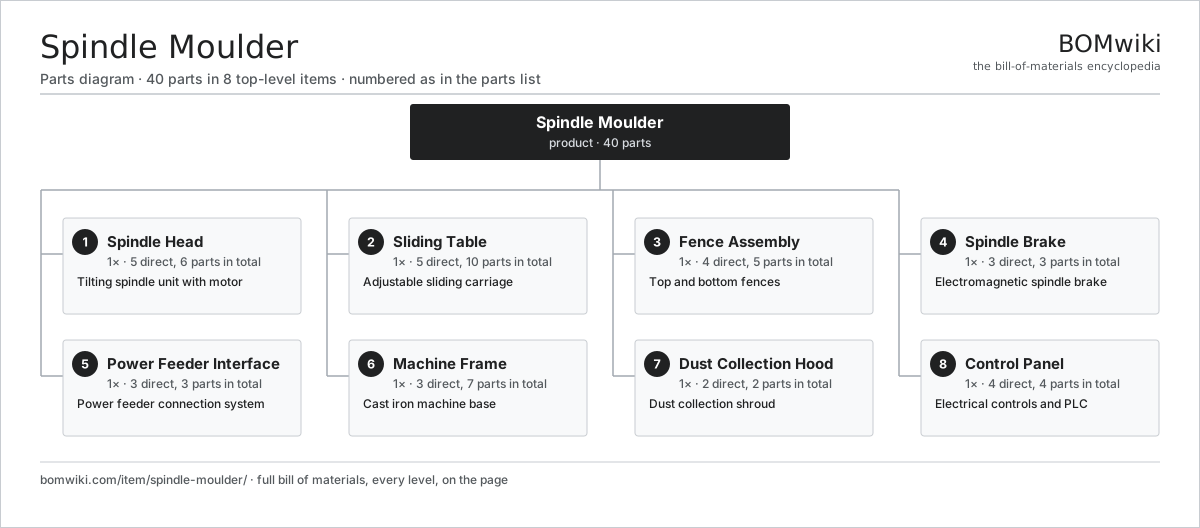
| # | Part | Qty | What it does |
|---|---|---|---|
| 1 | Spindle Head 5 parts | 1× | Tilting spindle unit with motor |
| 2 | Sliding Table 5 parts | 1× | Adjustable sliding carriage |
| 3 | Fence Assembly 4 parts | 1× | Top and bottom fences |
| 4 | Spindle Brake 3 parts | 1× | Electromagnetic spindle brake |
| 5 | Power Feeder Interface 3 parts | 1× | Power feeder connection system |
| 6 | Machine Frame 3 parts | 1× | Cast iron machine base |
| 7 | Dust Collection Hood 2 parts | 1× | Dust collection shroud |
| 8 | Control Panel 4 parts | 1× | Electrical controls and PLC |
3D model
No 3D model yet. Have a CAD file of this? Add a 3D model. STL renders right on this page; STEP, FreeCAD, and OpenSCAD sources are welcome too (openly licensed, like all 3D models on BOMwiki).
Build & assembly graph
expand / collapse · shared sub-assemblies converge · links to related products · est. labourTap an assembly to expand/collapse · tap a part to open it · use “Open page” for any node · drag to pan, scroll to zoom.
Bill of materials for Spindle Moulder
8 top-level lines · 37 rows shown · 40 parts total · indented to 3 levels| # | Item / sub-assembly | Part no. | Qty/assy | Ext. qty | Parts | Type |
|---|---|---|---|---|---|---|
| 1 | Spindle Head 5 parts | spindle-moulder-spindle-head | 1× | 1 | 6 | assembly |
| 1.1 | Spindle Motor | spindle-moulder-spindle-motor | 1× | 1 | · | part |
| 1.2 | Spindle Arbor | spindle-moulder-spindle-arbor | 1× | 1 | · | part |
| 1.3 | Spindle Bearing | spindle-moulder-spindle-bearing | 2× | 2 | · | part |
| 1.4 | Tilting Base | spindle-moulder-tilting-base | 1× | 1 | · | part |
| 1.5 | Tool Chuck | spindle-moulder-tool-changeover | 1× | 1 | · | part |
| 2 | Sliding Table 5 parts | spindle-moulder-sliding-table | 1× | 1 | 10 | assembly |
| 2.1 | Table Plate | spindle-moulder-table-plate | 1× | 1 | · | part |
| 2.2 | Table Rail | spindle-moulder-table-rails | 2× | 2 | · | part |
| 2.3 | Rail Bearing Block | spindle-moulder-table-bearings | 4× | 4 | · | part |
| 2.4 | Clamp Pad | spindle-moulder-clamp-system | 2× | 2 | · | part |
| 2.5 | Positioning Stop | spindle-moulder-positioning-stops | 1× | 1 | · | part |
| 3 | Fence Assembly 4 parts | spindle-moulder-fence-system | 1× | 1 | 5 | assembly |
| 3.1 | Top Fence | spindle-moulder-top-fence | 1× | 1 | · | part |
| 3.2 | Bottom Fence | spindle-moulder-bottom-fence | 1× | 1 | · | part |
| 3.3 | Fence Rail | spindle-moulder-fence-rails | 2× | 2 | · | part |
| 3.4 | Outfeed Scale | spindle-moulder-outfeed-scale | 1× | 1 | · | part |
| 4 | Spindle Brake 3 parts | spindle-moulder-spindle-brake | 1× | 1 | 3 | assembly |
| 4.1 | Brake Coil | spindle-moulder-brake-coil | 1× | 1 | · | part |
| 4.2 | Brake Pads | spindle-moulder-brake-pads | 1× | 1 | · | part |
| 4.3 | Brake Controller | spindle-moulder-brake-controller | 1× | 1 | · | part |
| 5 | Power Feeder Interface 3 parts | spindle-moulder-power-feeder-interface | 1× | 1 | 3 | assembly |
| 5.1 | Feeder Bracket | spindle-moulder-feeder-bracket | 1× | 1 | · | part |
| 5.2 | Feeder Socket | spindle-moulder-feeder-socket | 1× | 1 | · | part |
| 5.3 | Control Connector | spindle-moulder-control-connector | 1× | 1 | · | part |
| 6 | Machine Frame 3 parts | spindle-moulder-frame | 1× | 1 | 7 | assembly |
| 6.1 | Base Casting | spindle-moulder-base-casting | 1× | 1 | · | part |
| 6.2 | Isolation Foot | spindle-moulder-isolation-feet | 4× | 4 | · | part |
| 6.3 | Sheet Metal Panel | sheet-panel | 2× | 2 | · | part |
| 7 | Dust Collection Hood 2 parts | spindle-moulder-dust-hood | 1× | 1 | 2 | assembly |
| 7.1 | Hood Cover | spindle-moulder-hood-cover | 1× | 1 | · | part |
| 7.2 | Dust Port | spindle-moulder-dust-port | 1× | 1 | · | part |
| 8 | Control Panel 4 parts | spindle-moulder-control-panel | 1× | 1 | 4 | assembly |
| 8.1 | PLC | spindle-moulder-plc | 1× | 1 | · | part |
| 8.2 | VFD | spindle-moulder-frequency-drive | 1× | 1 | · | part |
| 8.3 | Speed Control | spindle-moulder-speed-potentiometer | 1× | 1 | · | part |
| 8.4 | E-Stop | spindle-moulder-emergency-stop | 1× | 1 | · | part |
Something wrong in this list? Report a problem with this BOM.
Related products
same domain, ranked by shared parts All-Electric Injection Molding Machine
851 parts · shares 1 with this page
Automated Paint Spray Line
2,003 parts · shares 1 with this page
Blown Film Extrusion Line
436 parts · shares 1 with this page
All-Electric Injection Molding Machine
851 parts · shares 1 with this page
Automated Paint Spray Line
2,003 parts · shares 1 with this page
Blown Film Extrusion Line
436 parts · shares 1 with this page
 Briquetting Press
92 parts · shares 1 with this page
Can Densifier
44 parts · shares 1 with this page
Briquetting Press
92 parts · shares 1 with this page
Can Densifier
44 parts · shares 1 with this page
Sourcing: possible vendors
Browse the supplier directory → Prices, MOQ, and lead times are algorithmic estimates, not quotes, and not claims about these companies. Company mappings are curated by keyword; est. price band $5k–$2M. How estimates work| Vendor | HQ | Specialty | MOQ | Lead time |
|---|---|---|---|---|
| atlascopco.com ↗ | Stockholm, SE | Compressors & industrial | 10 units | 12–20 wks |
|
🇦🇹Andritz
andritz.com ↗
|
Graz, AT | Process plants & machinery | 10 units | 12–20 wks |
| buhlergroup.com ↗ | Uzwil, CH | Food & materials processing | 10 units | 12–20 wks |
| gea.com ↗ | Düsseldorf, DE | Process technology | 10 units | 12–20 wks |
| mhi.com ↗ | Tokyo, JP | Heavy machinery | 10 units | 12–20 wks |
1,086-word article