Teacup Ride
ProductOverview
A teacup ride is a spinning family attraction featuring colorful fiberglass teacup vehicles arranged radially on a rotating carousel platform. Each teacup spins independently about its own vertical axis while the entire platform rotates. This dual-axis motion (carousel rotation plus individual cup spinning) creates moderate g-forces of 0.5–1.5 g and a whimsical, disorienting sensation. Capacity ranges from 40–80 riders depending on cup size and quantity. The ride is typically operated for 3–5 minute cycles and appeals to families with young children and teenagers.
Teacup rides emerged in the 1960s as a gentle alternative to high-thrill attractions. Modern variants include interactive features (manual steering cups or hydraulic tilting) and synchronized light shows.
How It Works
Dual-Axis Rotation System
The ride architecture uses two independent drive systems:
Main platform rotation: A large electric motor (10–20 kW) drives a gearbox that rotates the entire carousel platform at 5–12 rpm. The platform is mounted on a large slew bearing (8–10 meters diameter) that accommodates radial and thrust loads from the teacups and passengers.
Individual cup spinning: Each teacup contains a small motor (0.5–2 kW) and gearbox that rotates the cup about its own vertical axis at 3–8 rpm, independent of the platform motion.
As the platform rotates counter-clockwise at 8 rpm and each cup spins clockwise at 5 rpm, passengers experience combined centripetal acceleration from both motions. The resultant g-force vector points outward and slightly upward, creating a sensation of being pressed against the cup wall.
Platform Drive
The center drive motor is mounted at the base of the tower. Power is transmitted via a multi-stage helical gearbox (reduction ratio 15:1 to 40:1) to the main platform shaft. A flexible coupling connects the gearbox output to the platform, accommodating minor misalignment and isolating vibration.
An encoder monitors the motor output speed; the control system uses feedback to maintain constant rpm or to ramp speed up and down during the ride cycle. Typical operation is:
- Ramp-up: 10–15 seconds to reach 50 % speed.
- Cruise: Hold platform at constant rpm for 2–3 minutes.
- Ramp-down: 10–15 seconds decelerating to full stop.
Cup Spin Mechanism
Each cup motor is a fractional-horsepower unit (0.5–2 kW, typically 1 kW) mounted inside or below the cup body. The motor drives a small harmonic-drive or planetary gearbox (reduction ratio 10:1 to 30:1), which in turn spins the cup interior via friction tires or a direct-drive spindle.
Cup motors operate independently, allowing some cups to spin faster or in opposite directions. This can be:
- Synchronized: All cups spin at the same speed and direction, simple and predictable.
- Manual control: Riders use a hand wheel or lever inside the cup to control spin speed, adding an interactive element.
- Randomized: The PLC varies cup speed randomly within a range, enhancing unpredictability and replay value.
Modern teacups use variable-frequency-drive (VFD) motor controllers, allowing smooth speed ramping and braking for individual cups.
Control and Safety
The control PLC orchestrates:
- Gate and load check: A gate sensor and load cells confirm that the gate is closed and passengers are distributed normally before motor startup.
- Platform ramp-up: Center motor accelerates at a constant rate over 10–15 seconds.
- Cup activation: Once platform reaches 50 % speed, cup motors energize and ramp up in parallel.
- Steady-state: Both motors cruise at constant speed for 2–3 minutes (adjustable by operator).
- Coordinated ramp-down: Both motors decelerate simultaneously over 10–15 seconds.
- Final stop and unlock: Once velocity drops below a threshold, brake solenoids release and gates unlock.
The PLC monitors:
- Motor current on each motor circuit (overload detection).
- Encoder feedback from platform and sample cups (speed verification).
- Gate sensor (confirming closure).
- Restraint sensors on a sample of cups (if equipped with electronic locks).
If any fault is detected, the PLC activates an emergency stop, de-energizing all motor contactors and applying friction or spring-applied brakes.
Mechanical Design
Cup Vehicle Construction
Modern teacups are made from hand-laid or vacuum-infused fiberglass composite over a steel internal frame. The fiberglass shell is glossy and colorfully painted (typically bright primary colors like red, yellow, or blue). Internal cavity is roughly 2–3 meters in diameter and 1–1.5 meters tall, with a flat floor and curved side walls.
Inside, a welded steel frame is bonded or bolted to the shell, providing:
- Seat mounting hard-points (typically 4 bolted-on molded-plastic seats).
- Motor bracket and gearbox support.
- Rotation axis bearing blocks.
The cup-rotation axis is a vertical spindle, typically 50–75 mm diameter, supported by two angular-contact ball bearings (one at the floor level, one near the roof). The motor and gearbox are compact and mounted low to keep weight distribution centered.
Four to six passengers sit in molded plastic or upholstered seats bolted to the frame. Simple lap bars (bolted-on or hinged) secure passengers. No restraint sensors are typically used; operator relies on visual confirmation of lap-bar closure before ride start.
Platform and Support Structure
The main rotating platform is a steel or aluminum deck, typically 10–15 meters in diameter and 0.5–1 meter thick. It is bolted to a large slew bearing mounted on top of a vertical tower (8–12 meters tall).
The platform has 10–16 radially-spaced mounting points for the teacups. Each cup is bolted via a pedestal or bracket, allowing quick disconnection for maintenance. Power and control cables are routed along radial arms from the central electrical cabinet (located at the tower base) to each cup via flexible conduit.
The tower itself is a tubular steel structure (square or circular cross-section) welded together and anchored to a concrete foundation. Four corner legs transfer load into 4–6 meter deep pile caps, each with multiple threaded anchor rods. Diagonal bracing or guy-cables prevent sideways sway.
Electrical Distribution
Each cup motor is powered and controlled independently via a separate variable-frequency drive (VFD) unit housed in the main electrical cabinet. This allows:
- Individual speed control per cup.
- Fault isolation (one cup motor failure does not affect others).
- Smooth acceleration/deceleration ramps (reducing jerky motion).
- Energy regeneration during braking (optional, reduces heat dissipation).
The main platform motor is fed by a separate larger VFD. All motors are 3-phase AC induction (or newer brushless DC) units operating from 480 V 3-phase power.
Ride Experience and Variations
Standard Version
Passengers enter one of the cups via a platform or ramp. Operator manually checks lap-bar closure and confirms safe seating. Gate closes. Platform and cup motors energize. Passengers spin and orbit simultaneously for 3–5 minutes, experiencing combined g-forces and disorientation. The double-axis motion is fun but not extreme; the ride appeals to a broad age range.
Interactive Manual Steering
Some teacup installations include a hand wheel inside each cup that allows passengers to control cup spin speed manually. Rotating the hand wheel engages a friction clutch, allowing passengers to spin faster or slower than the default. This adds an interactive element and increases re-ride appeal.
Rotating Canopy
Newer teacup rides add a rotating canopy or roof structure above the main platform. The canopy rotates at a different speed than the platform (e.g., counter-rotating), creating a third axis of visual motion and enhancing the disorienting effect.
Synchronized Light and Sound
Modern teacups are often paired with a synchronized music and light show. LEDs around the platform and teacups pulse to the music rhythm. This extends ride appeal, especially for nighttime operation, and provides immersive theming.
Standards and Safety
Teacup rides are governed by ASTM F24 (F2374) and international EN 13814. Key design factors:
- Restraint forces: 1–2 kN per connection point (lap bars do not need to be as strong as harnesses for high-g inversion rides).
- Emergency stop: E-stop button must de-energize motors and apply parking brakes within 0.5 seconds.
- Enclosure: Riders must not be able to fall out; maximum gap through railings is 100 mm (per EN standards).
- Ride limit: A 3:1 safety factor is applied to critical structural and bearing components, targeting 50-year life with 10 million+ cycles.
Maintenance and Reliability
Key maintenance items:
- Cup motor gearbox: Lubricant inspection and changeout every 1,000–2,000 operating hours.
- Platform slew bearing: Lubrication check every 500 hours; bearing inspection every 3–5 years.
- Deck bolts: Torque verification quarterly; replacement if loose.
- Electrical connectors: Inspection for corrosion and moisture ingress annually.
- Lap bars and seats: Inspection for cracks and loose fasteners every 200 operating hours.
Teacup rides typically achieve 97–99 % uptime. Seasonal rides (6-month operation) require minimal downtime. Year-round installations in cold climates may need bearing heaters and lubrication adjustments for cold-weather operation.
Operational Economics
A typical 12-cup teacup ride with 4–5 riders per cup (50–60 total capacity) costs $1.5–4 million including design, fabrication, and installation. Annual operating costs are $100,000–$300,000 (primarily labor, electricity, and bearing maintenance).
Revenue potential is $500,000–$1.5 million per season, depending on park location, ticket price, and operating hours. Capacity is typically 600–1,200 riders per hour, making teacup rides economically attractive for mid-size parks.
Teacup rides are popular in:
- Regional amusement parks (family-oriented markets).
- Carnivals and traveling fairs (modular design allows disassembly and relocation).
- Hotel and resort parks (space-efficient and low-thrill appeal).
- Waterpark arcades (dry alternative to water attractions).
Modern teacup rides are experiencing a revival due to Instagram-worthy aesthetics (bright colors, whimsical design) and broad demographic appeal spanning young children to adult thrill-seekers with interactive options.
Teacup Ride parts and their functions
6 top-level parts · 660 parts in total · full bill of materials below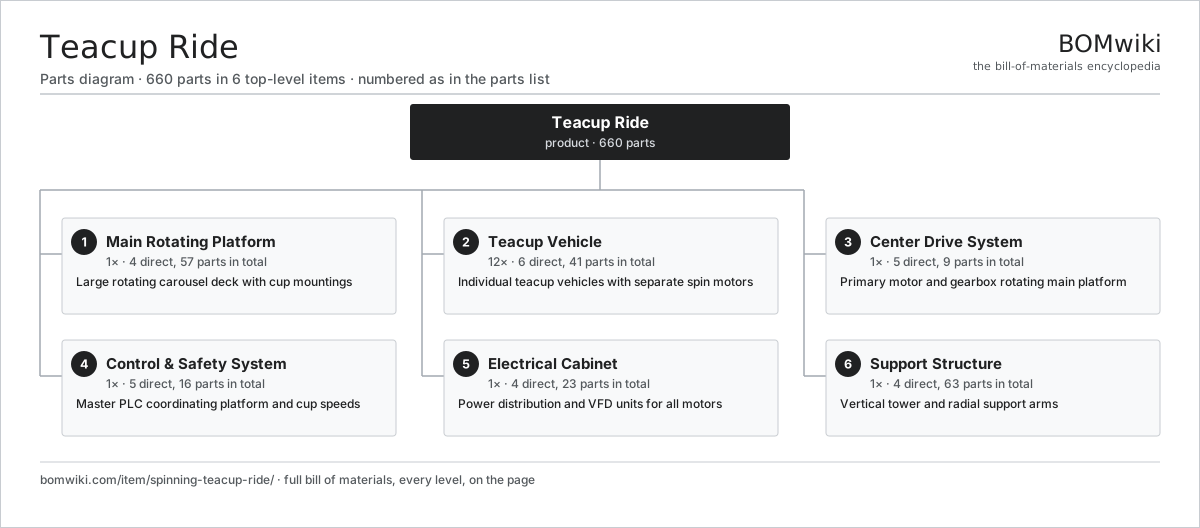
| # | Part | Qty | What it does |
|---|---|---|---|
| 1 | Main Rotating Platform 4 parts | 1× | Large rotating carousel deck with cup mountings |
| 2 | Teacup Vehicle 6 parts | 12× | Individual teacup vehicles with separate spin motors |
| 3 | Center Drive System 5 parts | 1× | Primary motor and gearbox rotating main platform |
| 4 | Control & Safety System 5 parts | 1× | Master PLC coordinating platform and cup speeds |
| 5 | Electrical Cabinet 4 parts | 1× | Power distribution and VFD units for all motors |
| 6 | Support Structure 4 parts | 1× | Vertical tower and radial support arms |
3D model
No 3D model yet. Have a CAD file of this? Add a 3D model. STL renders right on this page; STEP, FreeCAD, and OpenSCAD sources are welcome too (openly licensed, like all 3D models on BOMwiki).
Build & assembly graph
expand / collapse · shared sub-assemblies converge · links to related products · est. labourTap an assembly to expand/collapse · tap a part to open it · use “Open page” for any node · drag to pan, scroll to zoom.
Bill of materials for Teacup Ride
6 top-level lines · 44 rows shown · 660 parts total · indented to 3 levels| # | Item / sub-assembly | Part no. | Qty/assy | Ext. qty | Parts | Type |
|---|---|---|---|---|---|---|
| 1 | Main Rotating Platform 4 parts | spinning-teacup-main-platform | 1× | 1 | 57 | assembly |
| 1.1 | Sheet Metal Panel | sheet-panel | 40× | 40 | · | part |
| 1.2 | Fastener Set | fastener-set | 8× | 8 | · | part |
| 1.3 | Ball Bearing | ball-bearing | 6× | 6 | · | part |
| 1.4 | Cable Bundle | cable-bundle | 3× | 3 | · | part |
| 2 | Teacup Vehicle 6 parts | spinning-teacup-cup-unit | 12× | 12 | 41 | assembly |
| 2.1 | Teacup Shell | spinning-teacup-cup-shell | 1× | 12 | · | part |
| 2.2 | Seat Assembly 5 parts | seat-assembly | 4× | 48 | 7 | assembly |
| 2.2.1 | Seat Frame | seat-frame | 1× | 48 | · | part |
| 2.2.2 | Seat Foam | seat-foam | 2× | 96 | · | part |
| 2.2.3 | Seat Cover | seat-cover | 1× | 48 | · | part |
| 2.2.4 | Seat Motor | seat-motor | 2× | 96 | · | part |
| 2.2.5 | Seat Heater Mat | seat-heater | 1× | 48 | · | part |
| 2.3 | Cup Spin Motor 5 parts | spinning-teacup-cup-motor | 1× | 12 | 7 | assembly |
| 2.3.1 | Blower Motor | blower-motor | 1× | 12 | · | part |
| 2.3.2 | Gearbox Housing | gearbox-housing | 1× | 12 | · | part |
| 2.3.3 | Drive Belt | drive-belt | 2× | 24 | · | part |
| 2.3.4 | Ball Bearing | ball-bearing | 2× | 24 | · | part |
| 2.3.5 | Hall Sensor | hall-sensor | 1× | 12 | · | part |
| 2.4 | Cup Internal Frame | spinning-teacup-cup-frame | 1× | 12 | · | part |
| 2.5 | Ball Bearing | ball-bearing | 2× | 24 | · | part |
| 2.6 | Fastener Set | fastener-set | 2× | 24 | · | part |
| 3 | Center Drive System 5 parts | spinning-teacup-center-drive | 1× | 1 | 9 | assembly |
| 3.1 | Blower Motor | blower-motor | 1× | 1 | · | part |
| 3.2 | Gearbox Housing | gearbox-housing | 1× | 1 | · | part |
| 3.3 | Ball Bearing | ball-bearing | 4× | 4 | · | part |
| 3.4 | Fastener Set | fastener-set | 2× | 2 | · | part |
| 3.5 | Encoder | encoder | 1× | 1 | · | part |
| 4 | Control & Safety System 5 parts | spinning-teacup-control-system | 1× | 1 | 16 | assembly |
| 4.1 | Microcontroller | mcu | 1× | 1 | · | part |
| 4.2 | Relay | relay | 8× | 8 | · | part |
| 4.3 | Bare PCB | pcb-bare | 2× | 2 | · | part |
| 4.4 | LCD Panel | lcd-panel | 1× | 1 | · | part |
| 4.5 | Connector | connector | 4× | 4 | · | part |
| 5 | Electrical Cabinet 4 parts | spinning-teacup-electrical-cabinet | 1× | 1 | 23 | assembly |
| 5.1 | Relay | relay | 12× | 12 | · | part |
| 5.2 | Power Supply | power-supply | 3× | 3 | · | part |
| 5.3 | Connector | connector | 6× | 6 | · | part |
| 5.4 | Fastener Set | fastener-set | 2× | 2 | · | part |
| 6 | Support Structure 4 parts | spinning-teacup-support-structure | 1× | 1 | 63 | assembly |
| 6.1 | Sheet Metal Panel | sheet-panel | 50× | 50 | · | part |
| 6.2 | Fastener Set | fastener-set | 10× | 10 | · | part |
| 6.3 | Ball Bearing | ball-bearing | 2× | 2 | · | part |
| 6.4 | Cable Bundle | cable-bundle | 1× | 1 | · | part |
Something wrong in this list? Report a problem with this BOM.
Related products
same domain, ranked by shared parts Pirate Ship Ride
478 parts · shares 17 with this page
Pirate Ship Ride
478 parts · shares 17 with this page
 Drop Tower Ride
308 parts · shares 15 with this page
Drop Tower Ride
308 parts · shares 15 with this page
 Roller Coaster
657 parts · shares 15 with this page
Roller Coaster
657 parts · shares 15 with this page
 Dark Ride System
1,005 parts · shares 13 with this page
Dark Ride System
1,005 parts · shares 13 with this page
 Log Flume Ride
486 parts · shares 13 with this page
Log Flume Ride
486 parts · shares 13 with this page
 Ferris Wheel
3,547 parts · shares 13 with this page
Ferris Wheel
3,547 parts · shares 13 with this page
Sourcing: possible vendors
Browse the supplier directory → Prices, MOQ, and lead times are algorithmic estimates, not quotes, and not claims about these companies. Company mappings are curated by keyword; est. price band $20–$3k. How estimates work| Vendor | HQ | Specialty | MOQ | Lead time |
|---|---|---|---|---|
|
🇩🇰LEGO
lego.com ↗
|
Billund, DK | Construction toys | 2,000 units | 6–10 wks |
|
🇺🇸Mattel
mattel.com ↗
|
El Segundo, US | Toys | 2,000 units | 6–10 wks |
|
🇺🇸Hasbro
hasbro.com ↗
|
Pawtucket, US | Toys & games | 2,000 units | 6–10 wks |
| bandainamco.co.jp ↗ | Tokyo, JP | Toys & amusement | 2,000 units | 6–10 wks |
| spinmaster.com ↗ | Toronto, CA | Toys | 2,000 units | 6–10 wks |
1,673-word article