Spinning Wheel
ProductOverview
The spinning wheel is a mechanical device that twists individual fibers into continuous thread or yarn through rotary motion. Unlike the ancient spindle and whorl (hand-held spinning tool), the spinning wheel uses a foot-powered treadle and crank mechanism to drive a large wooden wheel, which in turn drives a rapidly rotating flyer-bobbin assembly through a belt drive. The flyer, a hooked arm, guides fiber as it spins, twisting it into yarn, while the bobbin simultaneously winds the finished yarn.
The spinning wheel became the dominant textile-production machine from the 16th century onward, replacing hand-spinning and dramatically increasing yarn production rates. Even after the Industrial Revolution and mechanization of spinning mills, hand spinning wheels remain in use by artisans, hobbyists, and communities preserving traditional textile arts.
Frame and Structure
The Frame is a wooden assembly comprising four legs, cross-connecting rails, and a top table. Traditional spinning wheels are made from hardwoods, oak for strength, pine or ash for lighter components. The frame dimensions are typically 600 mm × 400 mm × 200 mm (height), sized to accommodate a seated operator with foot access to the treadle.
The Drive Wheel is mounted horizontally or slightly tilted on the frame, supported by a low-friction Wheel Bearing at its axis. The flyer-bobbin spindle runs parallel to the drive wheel, positioned 100–200 mm away. The operator sits to one side, tending the fiber supply and adjusting thread quality in real time.
Drive Mechanism
The Treadle and Crank converts the operator''s rhythmic foot motion into continuous rotational drive:
The operator''s foot pushes down on the Treadle Board, a wooden platform connected via a Treadle Rod to a Connecting Rod.
The connecting rod is pinned to a Crank Arm, an eccentric arm extending from the hub of the Drive Wheel.
As the wheel rotates, the crank-arm position changes. When the crank is at the "bottom" of its rotation (nearest the floor), the treadle is at maximum downward position. As the crank rotates upward, it pulls the treadle upward via the connecting rod. When the crank is at the "top," the operator''s foot rebounds to its highest position.
The operator then pushes down again, completing one cycle per drive-wheel revolution.
The large wheel (400–600 mm diameter) stores rotational inertia. This inertia smooths the pedaling motion, without the wheel, each foot stroke would create jerky, uneven flyer rotation. With the wheel, the operator achieves nearly constant flyer speed despite the sinusoidal input from the treadle.
The drive wheel rim is typically 30–50 mm thick and made from hardwood (oak). Six radial wooden spokes connect the rim to the central hub. The wheel rotates at 30–100 rpm, depending on treadle cadence.
Belt Drive to Flyer
A belt, traditionally made of leather or twisted yarn, connects a pulley on the drive-wheel hub to a pulley on the flyer spindle. The drive pulley is typically 80–120 mm diameter; the flyer pulley is 30–50 mm diameter. This gear ratio (typically 2.5–4:1) multiplies the wheel rpm to produce flyer rotation of 1500–3000 rpm.
A spring maintains constant belt tension, automatically compensating as the leather stretches or as the geometry changes.
The drive pulley may be made variable-pitch (with movable rings or adjustable sheaves) to allow speed changes without swapping belts. A tension control mechanism allows the operator to adjust fiber tension, critical for controlling yarn fineness and twist character.
Flyer-Bobbin Assembly
The heart of the spinning wheel is the flyer-bobbin assembly. It consists of:
Flyer: A U-shaped arm (typically 100–150 mm wide) with 2–4 small hooks along its length. As the flyer rotates, the hooks guide fiber into the bobbin while simultaneously twisting it. The fiber is fed by hand through the hooks in sequence, with the last hook lying closest to the bobbin entrance. As the fiber passes through each hook and twists, the operator controls the rate of fiber feed by hand, adjusting tension and draft (stretching).
Bobbin: A wooden spool (20–30 mm diameter, 50–100 mm long) rotating on a shaft coaxial with the flyer. The bobbin also rotates at ~1500–3000 rpm. Yarn emerging from the flyer hooks winds onto the bobbin. The bobbin is not free-running; instead, a brake band (leather or cord) applies controllable friction, causing slight resistance. This resistance prevents the bobbin from winding faster than the flyer is twisting, ensuring proper twist insertion. As the bobbin fills, the operator adjusts the brake tension to maintain consistent yarn quality.
Spindle: A steel or hardwood shaft supporting both the flyer and bobbin. The flyer sits on a flyer bearing (allowing free rotation), while the bobbin sits on a bobbin bearing (with adjustable drag from the brake).
Fiber Processing
Spinning wheels process prepared fiber, typically roving or sliver, which is a loosely drafted bundle 1–5 mm in diameter. The operator pinches off a small portion of the roving (this process is called "drafting"), pulling it out as the flyer rotates, and feeding it into the first hook of the flyer.
As the fiber enters the flyer, two competing forces act:
- The flyer's rotation twists the fiber, consolidating loose fibers into yarn.
- The operator's hand pulls the fiber outward, stretching (drafting) it to increase length and reduce diameter.
The balance between these forces determines yarn properties:
- Tight twist, light draft → thick, overtwisted yarn (crispy, less supple).
- Loose twist, heavy draft → thin, undertwisted yarn (weak, liable to break).
- Moderate twist, moderate draft → balanced yarn (strong and flexible).
Through practice, experienced spinners develop consistent hand motion, producing yarn of uniform thickness and twist. Output rates vary: 5–15 grams of yarn per hour is typical for hand-spun production.
Bobbin and Brake Control
The tension control mechanism modulates the brake band pressure. A screw-based adjuster or lever tightens or loosens the band around the bobbin. If the brake is too loose, the bobbin over-winds relative to the flyer, causing excessive twist insertion and yarn breakage. If too tight, the bobbin lags, fiber bunches at the flyer, and the wheel slips.
As the bobbin fills (typically after 20–30 grams of yarn), the operator removes it, winds off the yarn onto a niddy-noddy (a small hand-turned frame), and replaces the bobbin with a fresh one. The wound yarn is then set (rinsed and dried to set the twist) before weaving or further processing.
Variations and Design
Spinning wheels exist in several configurations:
Great Wheel (Hhigh Wheel): Very large (900 mm+ diameter) horizontal wheel; spinner stands beside the wheel, walking backward while feeding fiber. Used for heavy woolen yarn production. Slower but higher-torque delivery.
Saxony Wheel: Compact wheel mounted above a wooden frame; popular from 18th century onward. Features the treadle-crank mechanism described above. Most common modern design.
Turkish Spindle: Horizontal wheel with horizontal bobbin assembly; used in Mediterranean and Middle Eastern traditions.
Charkha: Indian and Afghan low-wheel design, sometimes purely hand-powered without a pedal.
The Saxony wheel, with its seated operation and foot treadle, is the most ergonomic for long spinning sessions and dominates modern production.
Yarn Characteristics
Hand-spun yarn has distinctive aesthetic qualities, subtle variations in thickness, plying (multiple yarns twisted together), and color (from hand-dyed fiber). These irregularities are valued in handweaving and artisan textile work for their visual liveliness and tactile character, distinguishing them from industrial uniform machine-spun yarns.
Yarn counts (thickness) range from 10 microns (ultrasmall for detail weaving) to 500 microns (thick lopi or roving yarn) depending on fiber type, draft, and twist. Sheep wool yields 20–40 microns; cotton 10–20 microns; specialty fibers (camel, alpaca) vary widely.
Historical and Modern Context
Spinning wheels were revolutionary when introduced (~16th century in Europe, earlier in Asia): they increased production rates 5–10× versus hand-spindle spinning. Entire economies and trade routes, the wool trade in medieval England, cotton production in colonial India, were structured around spinning wheel productivity.
The Industrial Revolution (1780s onward) mechanized spinning: jennies, frames, and water-powered mills displaced hand spinning for commercial production. However, hand spinning persisted in rural and artisanal contexts. Today, spinning wheels experience a revival through the "slow-fiber" and "handcraft revival" movements, fibex festivals, artisan spinners, and hobbyist communities worldwide maintain the tradition.
Modern reproductions and archaeological reconstructions of historical wheels also support textile historians'' experimental studies of period techniques and materials. The spinning wheel remains a quintessential example of mechanical elegance: simple, human-scaled, and capable of producing high-quality output with minimal tooling or maintenance.
Spinning Wheel parts and their functions
6 top-level parts · 39 parts in total · full bill of materials below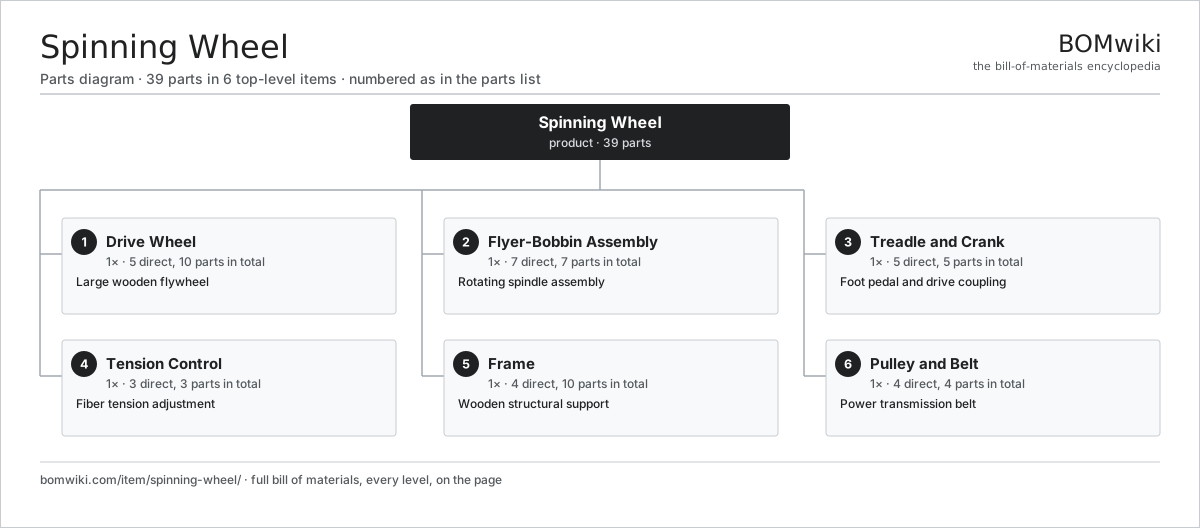
| # | Part | Qty | What it does |
|---|---|---|---|
| 1 | Drive Wheel 5 parts | 1× | Large wooden flywheel |
| 2 | Flyer-Bobbin Assembly 7 parts | 1× | Rotating spindle assembly |
| 3 | Treadle and Crank 5 parts | 1× | Foot pedal and drive coupling |
| 4 | Tension Control 3 parts | 1× | Fiber tension adjustment |
| 5 | Frame 4 parts | 1× | Wooden structural support |
| 6 | Pulley and Belt 4 parts | 1× | Power transmission belt |
3D model
No 3D model yet. Have a CAD file of this? Add a 3D model. STL renders right on this page; STEP, FreeCAD, and OpenSCAD sources are welcome too (openly licensed, like all 3D models on BOMwiki).
Build & assembly graph
expand / collapse · shared sub-assemblies converge · links to related products · est. labourTap an assembly to expand/collapse · tap a part to open it · use “Open page” for any node · drag to pan, scroll to zoom.
Bill of materials for Spinning Wheel
6 top-level lines · 34 rows shown · 39 parts total · indented to 3 levels| # | Item / sub-assembly | Part no. | Qty/assy | Ext. qty | Parts | Type |
|---|---|---|---|---|---|---|
| 1 | Drive Wheel 5 parts | spinning-wheel-drive-wheel | 1× | 1 | 10 | assembly |
| 1.1 | Wheel Rim | spinning-wheel-wheel-rim | 1× | 1 | · | part |
| 1.2 | Wheel Spokes | spinning-wheel-wheel-spokes | 6× | 6 | · | part |
| 1.3 | Wheel Hub | spinning-wheel-wheel-hub | 1× | 1 | · | part |
| 1.4 | Wheel Bearing | spinning-wheel-wheel-bearing | 1× | 1 | · | part |
| 1.5 | Crank Pin | spinning-wheel-crank-pin | 1× | 1 | · | part |
| 2 | Flyer-Bobbin Assembly 7 parts | spinning-wheel-flyer-bobbin | 1× | 1 | 7 | assembly |
| 2.1 | Flyer | spinning-wheel-flyer | 1× | 1 | · | part |
| 2.2 | Bobbin | spinning-wheel-bobbin | 1× | 1 | · | part |
| 2.3 | Spindle | spinning-wheel-spindle | 1× | 1 | · | part |
| 2.4 | Flyer Bearing | spinning-wheel-flyer-bearing | 1× | 1 | · | part |
| 2.5 | Bobbin Bearing | spinning-wheel-bobbin-bearing | 1× | 1 | · | part |
| 2.6 | Flyer Drive Pulley | spinning-wheel-flyer-drive-pulley | 1× | 1 | · | part |
| 2.7 | Bobbin Brake | spinning-wheel-bobbin-brake | 1× | 1 | · | part |
| 3 | Treadle and Crank 5 parts | spinning-wheel-treadle-crank | 1× | 1 | 5 | assembly |
| 3.1 | Treadle Board | spinning-wheel-treadle-board | 1× | 1 | · | part |
| 3.2 | Treadle Rod | spinning-wheel-treadle-rod | 1× | 1 | · | part |
| 3.3 | Crank Arm | spinning-wheel-crank-arm | 1× | 1 | · | part |
| 3.4 | Connecting Rod | spinning-wheel-connecting-rod | 1× | 1 | · | part |
| 3.5 | Treadle Pivot | spinning-wheel-treadle-pivot | 1× | 1 | · | part |
| 4 | Tension Control 3 parts | spinning-wheel-tension-control | 1× | 1 | 3 | assembly |
| 4.1 | Tension Band | spinning-wheel-tension-band | 1× | 1 | · | part |
| 4.2 | Tension Adjuster | spinning-wheel-tension-adjuster | 1× | 1 | · | part |
| 4.3 | Drafting Guides | spinning-wheel-drafting-guides | 1× | 1 | · | part |
| 5 | Frame 4 parts | spinning-wheel-frame | 1× | 1 | 10 | assembly |
| 5.1 | Frame Legs | spinning-wheel-frame-legs | 4× | 4 | · | part |
| 5.2 | Frame Rails | spinning-wheel-frame-rails | 4× | 4 | · | part |
| 5.3 | Frame Table | spinning-wheel-frame-table | 1× | 1 | · | part |
| 5.4 | Fastener Set | fastener-set | 1× | 1 | · | part |
| 6 | Pulley and Belt 4 parts | spinning-wheel-pulley-belt | 1× | 1 | 4 | assembly |
| 6.1 | Drive Pulley | spinning-wheel-drive-pulley | 1× | 1 | · | part |
| 6.2 | Flyer Pulley | spinning-wheel-flyer-pulley | 1× | 1 | · | part |
| 6.3 | Drive Belt | spinning-wheel-drive-belt | 1× | 1 | · | part |
| 6.4 | Belt Tension Spring | spinning-wheel-belt-tension-spring | 1× | 1 | · | part |
Something wrong in this list? Report a problem with this BOM.
Sourcing: possible vendors
Browse the supplier directory → Prices, MOQ, and lead times are algorithmic estimates, not quotes, and not claims about these companies. Company mappings are curated by keyword; est. price band $5k–$2M. How estimates work| Vendor | HQ | Specialty | MOQ | Lead time |
|---|---|---|---|---|
| atlascopco.com ↗ | Stockholm, SE | Compressors & industrial | 10 units | 12–20 wks |
|
🇦🇹Andritz
andritz.com ↗
|
Graz, AT | Process plants & machinery | 10 units | 12–20 wks |
| buhlergroup.com ↗ | Uzwil, CH | Food & materials processing | 10 units | 12–20 wks |
| gea.com ↗ | Düsseldorf, DE | Process technology | 10 units | 12–20 wks |
| mhi.com ↗ | Tokyo, JP | Heavy machinery | 10 units | 12–20 wks |
1,529-word article