Spray Tan Booth
ProductOverview
A spray tan booth is an enclosed spray system that applies self-tanning solution to the body via fine atomized mist. The booth eliminates wind drift, contains the misty aerosol, and provides even coverage that self-tanning solution cannot achieve with manual application or towel rub-down. Professional results require controlled environment, consistent spray parameters, and efficient ventilation to remove excess aerosol.
The system combines a Air Compressor that supplies atomization air pressure and booth circulation, an HVLP Spray Gun HVLP spray gun with metered solution feed, and an Extraction Fan System exhaust system removing aerosol and humidity. The Booth Enclosure fiberglass booth provides ergonomic dimensions (800 mm × 800 mm footprint) with a drying floor and drain pan for solution recovery.
Spray gun operation and HVLP principle
The HVLP Spray Gun operates on the high-volume low-pressure (HVLP) principle: using a large volume of compressed air at moderate pressure (40 PSI) rather than high pressure (80+ PSI). This reduces overspray and provides better solution atomization onto skin.
Compressed air from the Air Compressor flows into the Mixing Manifold, which combines atomization air with self-tanning solution drawn by the Solution Feed Pump from a supply reservoir. The solution and air meet at the Gun Nozzle (1.4–1.5 mm fluid orifice), where the rapid air velocity shears the solution into microscopic droplets.
The Air Cap focuses these droplets into a flat fan spray pattern approximately 250 mm wide at 300 mm distance. The operator holds the gun perpendicular to the body and moves it systematically across arms, legs, torso, and face in overlapping passes, ensuring even coverage without streaking.
Solution metering and pump control
The Solution Feed Pump is a variable-displacement Peristaltic Pump driven by a 24 V DC brushless motor. This pump draws self-tanning solution through a Pump Inlet Filter (100 µm mesh) that prevents particulate clogs, then delivers it to the spray gun at 0.5–1.5 mL/sec depending on pump speed.
The flow rate is adjustable via Speed Controller PWM modulation, allowing the technician to vary solution saturation. Faster flow rates deposit more pigment per pass; slower rates produce lighter tans. A Check Valve prevents backflow when the pump shuts off, maintaining primer priming for the next client.
Booth enclosure and drainage
The Booth Enclosure fiberglass shell is 800 mm × 800 mm × 2200 mm tall, providing adequate space for a standing person while minimizing overspray escape. The booth is open-top (no ceiling), allowing operator arm access for spraying the client's head and upper body.
The Drying Floor is a slatted fiberglass or rubber grating that allows solution to drain downward while supporting the client's weight. Excess solution collects in a Drain Pan stainless steel pan beneath the floor. The pan has a 50 L capacity and includes a drain cock for periodic emptying and solution recovery (many studios recycle excess solution).
An Access Door hinged or sliding door (600 mm × 1800 mm) provides client entry and exit, with a neoprene seal preventing mist leakage. A Viewing Window polycarbonate window allows the technician to monitor coverage from outside the booth.
Air circulation and extraction
The Extraction Fan System 1 HP centrifugal blower draws air out of the booth, removing aerosol mist, excess solution vapor, and humidity. Air is drawn through passive Intake Vents louvered ports equipped with replaceable 100 µm particle filters. This maintains negative booth pressure, preventing mist leakage into the surrounding spa or salon.
The Exit Ducting flexible ductwork (150 mm diameter) routes exhaust air to exterior, typically through a wall or roof penetration. The Centrifugal Wheel backward-curved impeller design minimizes noise.
Vibration isolation Vibration Isolator elastomer mounts decouple the fan from the booth structure, reducing noise transmission to the rest of the facility.
Solution composition and pigmentation
Professional self-tanning solutions contain dihydroxyacetone (DHA), a colorless sugar-derived compound that reacts with amino acids in the stratum corneum (outer dead skin layer), producing a brown melanoidin pigment. This reaction takes 6–8 hours to fully develop, during which the tan gradually darkens from light golden to medium to deep brown.
DHA-based tans fade gradually as the outer skin layer naturally sheds (approximately 0.5–1 mm per week), resulting in tan longevity of 7–14 days depending on sun exposure and skin exfoliation habits. Unlike UV tanning, DHA self-tanning does not cause skin photodamage or carcinoma risk; it is purely cosmetic.
Spray application technique
A professional spray-tan technician sprays the body in a systematic pattern: first one side (e.g., front torso, both arms, both legs), then the other side (back). Each pass overlaps slightly to avoid streaking. The spray gun moves continuously at ~20 cm/sec to ensure even deposition.
Application typically takes 45–90 seconds per client. Excess solution on the floor is swept into the drain pan immediately after application, and the floor is air-dried before the next client.
Standards and safety
Professional spray-tan booths must meet ventilation standards ensuring technician exposure to solution aerosol remains below occupational exposure limits (~2 mg/m³ 8-hour TWA for DHA per CDC guidelines). Proper hood extraction and makeup air (intake vents) are essential.
The Emergency Stop E-stop button disables the compressor and solution pump immediately in case of spill or medical emergency. All electrical connections are grounded per local electrical code.
Spray Tan Booth parts and their functions
8 top-level parts · 43 parts in total · full bill of materials below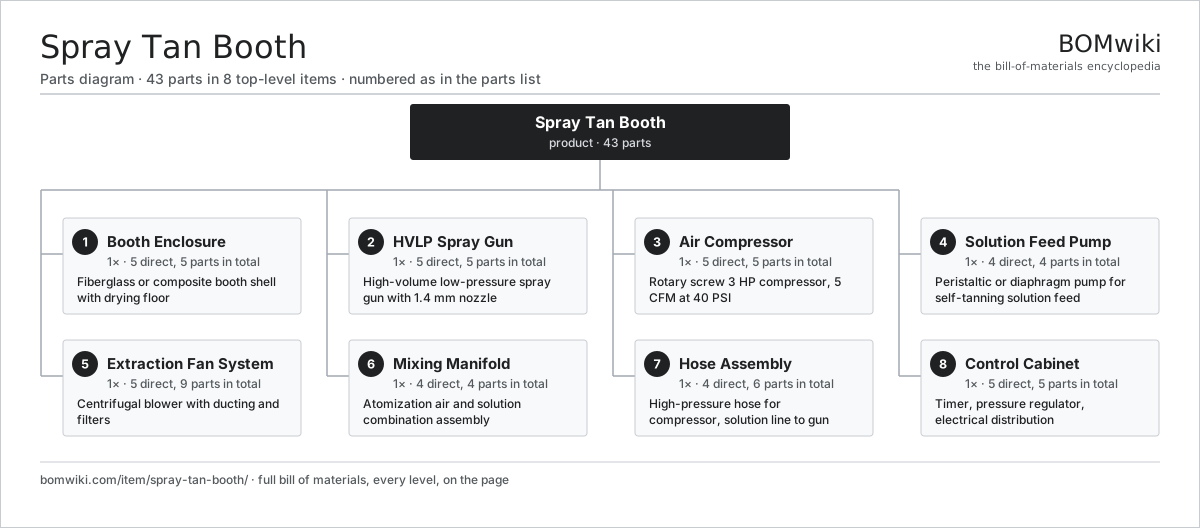
| # | Part | Qty | What it does |
|---|---|---|---|
| 1 | Booth Enclosure 5 parts | 1× | Fiberglass or composite booth shell with drying floor |
| 2 | HVLP Spray Gun 5 parts | 1× | High-volume low-pressure spray gun with 1.4 mm nozzle |
| 3 | Air Compressor 5 parts | 1× | Rotary screw 3 HP compressor, 5 CFM at 40 PSI |
| 4 | Solution Feed Pump 4 parts | 1× | Peristaltic or diaphragm pump for self-tanning solution feed |
| 5 | Extraction Fan System 5 parts | 1× | Centrifugal blower with ducting and filters |
| 6 | Mixing Manifold 4 parts | 1× | Atomization air and solution combination assembly |
| 7 | Hose Assembly 4 parts | 1× | High-pressure hose for compressor, solution line to gun |
| 8 | Control Cabinet 5 parts | 1× | Timer, pressure regulator, electrical distribution |
3D model
No 3D model yet. Have a CAD file of this? Add a 3D model. STL renders right on this page; STEP, FreeCAD, and OpenSCAD sources are welcome too (openly licensed, like all 3D models on BOMwiki).
Build & assembly graph
expand / collapse · shared sub-assemblies converge · links to related products · est. labourTap an assembly to expand/collapse · tap a part to open it · use “Open page” for any node · drag to pan, scroll to zoom.
Bill of materials for Spray Tan Booth
8 top-level lines · 45 rows shown · 43 parts total · indented to 3 levels| # | Item / sub-assembly | Part no. | Qty/assy | Ext. qty | Parts | Type |
|---|---|---|---|---|---|---|
| 1 | Booth Enclosure 5 parts | spray-tan-booth-enclosure | 1× | 1 | 5 | assembly |
| 1.1 | Fiberglass Shell | spray-tan-booth-fiberglass-shell | 1× | 1 | · | part |
| 1.2 | Drying Floor | spray-tan-booth-drying-floor | 1× | 1 | · | part |
| 1.3 | Access Door | spray-tan-booth-access-door | 1× | 1 | · | part |
| 1.4 | Viewing Window | spray-tan-booth-viewing-window | 1× | 1 | · | part |
| 1.5 | Drain Pan | spray-tan-booth-drain-pan | 1× | 1 | · | part |
| 2 | HVLP Spray Gun 5 parts | spray-tan-booth-hvlp-gun | 1× | 1 | 5 | assembly |
| 2.1 | Gun Nozzle | spray-tan-booth-gun-nozzle | 1× | 1 | · | part |
| 2.2 | Air Cap | spray-tan-booth-air-cap | 1× | 1 | · | part |
| 2.3 | Gun Handle | spray-tan-booth-gun-handle | 1× | 1 | · | part |
| 2.4 | Fluid Needle | spray-tan-booth-fluid-needle | 1× | 1 | · | part |
| 2.5 | Gun Cup | spray-tan-booth-gun-cup | 1× | 1 | · | part |
| 3 | Air Compressor 5 parts | spray-tan-booth-air-compressor | 1× | 1 | 5 | assembly |
| 3.1 | Compressor Motor | spray-tan-booth-compressor-motor | 1× | 1 | · | part |
| 3.2 | Compressor Pump | spray-tan-booth-compressor-pump | 1× | 1 | · | part |
| 3.3 | Intake Filter | spray-tan-booth-intake-filter | 1× | 1 | · | part |
| 3.4 | Aftercooler | spray-tan-booth-aftercooler | 1× | 1 | · | part |
| 3.5 | Storage Tank | spray-tan-booth-storage-tank | 1× | 1 | · | part |
| 4 | Solution Feed Pump 4 parts | spray-tan-booth-solution-pump | 1× | 1 | 4 | assembly |
| 4.1 | Pump Motor | spray-tan-booth-pump-motor | 1× | 1 | · | part |
| 4.2 | Peristaltic Pump | spray-tan-booth-peristaltic-pump | 1× | 1 | · | part |
| 4.3 | Pump Inlet Filter | spray-tan-booth-pump-inlet-filter | 1× | 1 | · | part |
| 4.4 | Check Valve | spray-tan-booth-check-valve | 1× | 1 | · | part |
| 5 | Extraction Fan System 5 parts | spray-tan-booth-extraction-fan | 1× | 1 | 9 | assembly |
| 5.1 | Extraction Motor | spray-tan-booth-extraction-motor | 1× | 1 | · | part |
| 5.2 | Centrifugal Wheel | spray-tan-booth-centrifugal-wheel | 1× | 1 | · | part |
| 5.3 | Exit Ducting | spray-tan-booth-exit-ducting | 1× | 1 | · | part |
| 5.4 | Intake Vents | spray-tan-booth-intake-vents | 2× | 2 | · | part |
| 5.5 | Vibration Isolator | spray-tan-booth-vibration-isolator | 4× | 4 | · | part |
| 6 | Mixing Manifold 4 parts | spray-tan-booth-mixing-manifold | 1× | 1 | 4 | assembly |
| 6.1 | Fluid Needle Valve | spray-tan-booth-fluid-needle-valve | 1× | 1 | · | part |
| 6.2 | Air Needle Valve | spray-tan-booth-air-needle-valve | 1× | 1 | · | part |
| 6.3 | Manifold Body | spray-tan-booth-manifold-body | 1× | 1 | · | part |
| 6.4 | Internal Porting | spray-tan-booth-internal-porting | 1× | 1 | · | part |
| 7 | Hose Assembly 4 parts | spray-tan-booth-hose-assembly | 1× | 1 | 6 | assembly |
| 7.1 | Air Hose | spray-tan-booth-air-hose | 1× | 1 | · | part |
| 7.2 | Fluid Hose | spray-tan-booth-fluid-hose | 1× | 1 | · | part |
| 7.3 | Quick-Couplers | spray-tan-booth-quick-couplers | 3× | 3 | · | part |
| 7.4 | Hose Coils | spray-tan-booth-hose-coils | 1× | 1 | · | part |
| 8 | Control Cabinet 5 parts | spray-tan-booth-control-cabinet | 1× | 1 | 5 | assembly |
| 8.1 | Timer Relay | spray-tan-booth-timer-relay | 1× | 1 | · | part |
| 8.2 | Pressure Gauge | spray-tan-booth-pressure-gauge | 1× | 1 | · | part |
| 8.3 | Air Regulator | spray-tan-booth-air-regulator | 1× | 1 | · | part |
| 8.4 | Speed Controller | spray-tan-booth-speed-controller | 1× | 1 | · | part |
| 8.5 | Emergency Stop | spray-tan-booth-emergency-stop | 1× | 1 | · | part |
Something wrong in this list? Report a problem with this BOM.
Sourcing: possible vendors
Browse the supplier directory → Prices, MOQ, and lead times are algorithmic estimates, not quotes, and not claims about these companies. Company mappings are curated by keyword; est. price band $15–$500. How estimates work| Vendor | HQ | Specialty | MOQ | Lead time |
|---|---|---|---|---|
| philips.com ↗ | Amsterdam, NL | Grooming & care | 2,000 units | 6–10 wks |
|
🇩🇪Braun
braun.com ↗
|
Kronberg, DE | Grooming (P&G) | 2,000 units | 6–10 wks |
|
🇺🇸Conair
conair.com ↗
|
Stamford, US | Personal care appliances | 2,000 units | 6–10 wks |
|
🇬🇧Dyson
dyson.com ↗
|
Malmesbury, GB | Vacuums & hair care | 2,000 units | 6–10 wks |
| panasonic.com ↗ | Osaka, JP | Electronics & appliances | 2,000 units | 6–10 wks |
964-word article