Stair-Climbing Wheelchair
ProductOverview
A stair-climbing wheelchair is a specialized powered mobility device enabling wheelchair users to independently ascend and descend stairs, a major accessibility barrier in many buildings. Most conventional wheelchairs cannot navigate stairs; users must transfer to a portable stair lift, use elevators, or find alternate routes. Stair-climbing wheelchairs eliminate this dependency, providing true universal access and independence for wheelchair users in multi-story homes, offices, and public buildings.
The device combines a standard powered wheelchair base (joystick control, seat, footrest) with a motorized climbing mechanism, typically continuous tracks or segmented wheels that engage stair edges and pull the user upward. Automatic seat leveling keeps the user horizontal even as the climbing mechanism tilts to follow the stair slope, preventing disorientation and maintaining comfort. Although expensive (typically $15,000–$50,000 USD), stair-climbing wheelchairs can be transformative for users whose lives are restricted by stair barriers.
How it works
In flat-surface mode, the main drive motor propels the chair via wheels or tracks at speeds of 0.5–1.5 m/s, controlled by the user's joystick. When approaching stairs, the user switches to stair-climbing mode via a mode selector switch.
In stair-climbing mode, the dedicated climb motors drive the left and right climbing tracks or segmented wheels. These tracks engage the stair edges, pulling the user up and over each step. As the mechanism tilts to follow the stair slope, the automatic leveling system tilts the seat in the opposite direction, keeping the user horizontal and preventing tipping sensation.
The inclinometer continuously measures the wheelchair's pitch angle; the leveling controller commands the seat motor to rotate the seat frame, maintaining a level, horizontal user position throughout the climb. Climbing speed is much slower than flat travel (0.1–0.3 m/s) due to the high mechanical loads; a single flight (12–15 steps) typically requires 60–120 seconds to climb.
Track vs. segmented-wheel climbing systems
Continuous track systems use rubber or steel tracks similar to bulldozers or tanks, with molded treads engaging stair edges. Tracks distribute user weight broadly and provide smooth climbing with less vibration. They are durable but add weight and complexity.
Segmented wheel systems use articulated wheels that deform and reform to grip stair edges. They are lighter and more compact than tracks but can be noisier and less comfortable on older legs with poor suspension.
Most modern designs use track systems for superior comfort and reliability.
Stair specifications and limitations
Stair-climbing wheelchairs typically negotiate stairs with risers (step heights) of 150–200 mm and treads (step depths) of 250–300 mm, standard residential and commercial specifications in most jurisdictions. Stairs with unusual geometry (very tall risers, shallow treads, curved steps) may exceed the wheelchair's climbing envelope.
The inclinometer sensor detects the slope and adjusts climbing motor power; steep stairs demand more power and reduce operating range on each charge. Some models include automatic stair detection, when the climbing mechanism contacts a stair edge, the system automatically shifts into climbing mode.
Limitations on horizontal speed and autonomy
The added weight of dual motors, large battery, and leveling system reduces horizontal speed (typically 1–1.5 m/s maximum, slower than standard power wheelchairs) and significantly reduces operating range. A typical battery pack yields 8–15 km range on flat surfaces but only 0.5–2 km range with frequent stair climbing due to the high power draw during climbs.
This limitation means stair-climbing wheelchairs are most practical in environments with predictable stair locations (a few known flights per day) rather than unpredictable, frequent stair encounters. Users typically plan routes and rest between climbs.
Seat leveling and user comfort
The automatic leveling is essential for user safety and comfort. During stair climbing, the wheelchair body tilts up to 30 degrees from horizontal as it follows the stair slope. Without leveling, the user would tilt with the chair, creating disorientation, blood pressure changes, and risk of pressure ulcers as the seat tilts. The servo motor continuously adjusts seat angle to maintain horizontality, typically keeping tilt under 5 degrees throughout the climb.
Battery capacity and charging
The large battery capacity (20–40 Ah at 48–96 V, or 960–3840 Wh) powers both main and climb motors. Stair climbing draws 2–5 kW continuously; a 3 kWh battery provides ~45 minutes of continuous stair climbing. Most users climb intermittently, interspersed with flat travel and rests, extending actual session duration to 4–8 hours per charge.
The charger typically requires 4–8 hours for full recharge. Users must plan daily charging or carry spare batteries for extended community outings.
Safety systems and manual descent
The multiple safety systems include:
- Multi-point seatbelt harness preventing ejection.
- Rollover protection bar absorbing impact if the wheelchair tips.
- Emergency stop button for instant motor shutdown.
- Manual brake lever enabling descent by gravity if motors fail (user must control descent speed via mechanical friction).
Descent is typically slower and more controlled than ascent; the system allows gentle rolling down stairs while the user applies manual brake force, similar to descending on a sit-down toboggan.
Clinical and social impact
For wheelchair users, stairs represent an absolute barrier to community participation and employment in multi-story buildings. Stair-climbing wheelchairs restore independence and dignity, enabling attendance at work, education, entertainment, and social events in buildings without elevators, particularly important in older buildings, developing countries, and rural areas where elevator infrastructure is limited.
Users report substantial improvements in psychological well-being, social participation, and sense of agency when they can navigate stairs independently rather than waiting for assistance or finding alternate routes.
Cost and accessibility
At $15,000–$50,000 USD, stair-climbing wheelchairs are expensive and often require special insurance or funding approval. In some countries, government disability support programs partially reimburse or subsidize purchase. Rental options are limited; most users must commit to purchase. This cost barrier means stair-climbing wheelchairs remain aspirational for many users despite their transformative potential.
Stair-Climbing Wheelchair parts and their functions
8 top-level parts · 58 parts in total · full bill of materials below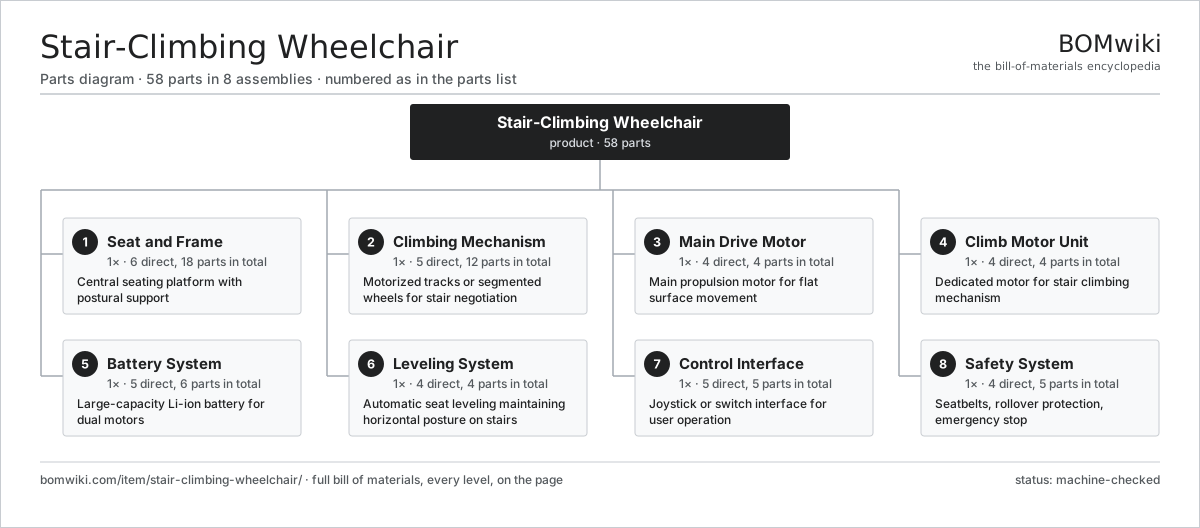
| # | Part | Qty | What it does |
|---|---|---|---|
| 1 | Seat and Frame 6 parts | 1× | Central seating platform with postural support |
| 2 | Climbing Mechanism 5 parts | 1× | Motorized tracks or segmented wheels for stair negotiation |
| 3 | Main Drive Motor 4 parts | 1× | Main propulsion motor for flat surface movement |
| 4 | Climb Motor Unit 4 parts | 1× | Dedicated motor for stair climbing mechanism |
| 5 | Battery System 5 parts | 1× | Large-capacity Li-ion battery for dual motors |
| 6 | Leveling System 4 parts | 1× | Automatic seat leveling maintaining horizontal posture on stairs |
| 7 | Control Interface 5 parts | 1× | Joystick or switch interface for user operation |
| 8 | Safety System 4 parts | 1× | Seatbelts, rollover protection, emergency stop |
3D model
No 3D model yet. Have a CAD file of this? Add a 3D model — STL renders right on this page; STEP, FreeCAD, and OpenSCAD sources are welcome too (openly licensed, like all 3D models on BOMwiki).
Build & assembly graph
expand / collapse · shared sub-assemblies converge · links to related products · est. labourTap an assembly to expand/collapse · tap a part to open it · use “Open page” for any node · drag to pan, scroll to zoom.
Bill of materials for Stair-Climbing Wheelchair
8 top-level lines · 45 rows shown · 58 parts total · indented to 3 levels| # | Item / sub-assembly | Part no. | Qty/assy | Ext. qty | Parts | Type |
|---|---|---|---|---|---|---|
| 1 | Seat and Frame 6 parts | stair-climbing-wheelchair-seat-frame | 1× | 1 | 18 | assembly |
| 1.1 | Seat Base | stair-climbing-wheelchair-seat-base | 1× | 1 | · | part |
| 1.2 | Backrest | stair-climbing-wheelchair-backrest | 1× | 1 | · | part |
| 1.3 | Armrests | stair-climbing-wheelchair-armrests | 2× | 2 | · | part |
| 1.4 | Footrests | stair-climbing-wheelchair-footrests | 1× | 1 | · | part |
| 1.5 | Seat Height Adjuster | stair-climbing-wheelchair-seat-height-adjuster | 1× | 1 | · | part |
| 1.6 | Fastener Set | fastener-set | 12× | 12 | · | part |
| 2 | Climbing Mechanism 5 parts | stair-climbing-wheelchair-climbing-system | 1× | 1 | 12 | assembly |
| 2.1 | Track Assembly | stair-climbing-wheelchair-track-assembly | 2× | 2 | · | part |
| 2.2 | Track Motors | stair-climbing-wheelchair-track-motor-pair | 2× | 2 | · | part |
| 2.3 | Track Tension | stair-climbing-wheelchair-track-tension | 2× | 2 | · | part |
| 2.4 | Drive Sprocket | stair-climbing-wheelchair-drive-sprocket | 2× | 2 | · | part |
| 2.5 | Idler Wheels | stair-climbing-wheelchair-idler-wheels | 4× | 4 | · | part |
| 3 | Main Drive Motor 4 parts | stair-climbing-wheelchair-drive-motor | 1× | 1 | 4 | assembly |
| 3.1 | Motor Unit | stair-climbing-wheelchair-motor-unit | 1× | 1 | · | part |
| 3.2 | Motor Controller | stair-climbing-wheelchair-motor-controller | 1× | 1 | · | part |
| 3.3 | Motor Coupling | stair-climbing-wheelchair-motor-coupling | 1× | 1 | · | part |
| 3.4 | Transmission | stair-climbing-wheelchair-transmission | 1× | 1 | · | part |
| 4 | Climb Motor Unit 4 parts | stair-climbing-wheelchair-climb-motor | 1× | 1 | 4 | assembly |
| 4.1 | Climb Motor | stair-climbing-wheelchair-climb-motor-spec | 1× | 1 | · | part |
| 4.2 | Climb Gearbox | stair-climbing-wheelchair-climb-gearbox | 1× | 1 | · | part |
| 4.3 | Climb Controller | stair-climbing-wheelchair-climb-controller | 1× | 1 | · | part |
| 4.4 | Climb Sensor | stair-climbing-wheelchair-climb-sensor | 1× | 1 | · | part |
| 5 | Battery System 5 parts | stair-climbing-wheelchair-battery-pack | 1× | 1 | 6 | assembly |
| 5.1 | Battery Cells | stair-climbing-wheelchair-battery-cells | 1× | 1 | · | part |
| 5.2 | Battery BMS | stair-climbing-wheelchair-battery-bms | 1× | 1 | · | part |
| 5.3 | Battery Enclosure | stair-climbing-wheelchair-battery-enclosure | 1× | 1 | · | part |
| 5.4 | Charger | stair-climbing-wheelchair-charger | 1× | 1 | · | part |
| 5.5 | Connector | connector | 2× | 2 | · | part |
| 6 | Leveling System 4 parts | stair-climbing-wheelchair-leveling-system | 1× | 1 | 4 | assembly |
| 6.1 | Leveling Motor | stair-climbing-wheelchair-leveling-motor | 1× | 1 | · | part |
| 6.2 | Leveling Frame | stair-climbing-wheelchair-leveling-frame | 1× | 1 | · | part |
| 6.3 | Tilt Sensor | stair-climbing-wheelchair-tilt-sensor | 1× | 1 | · | part |
| 6.4 | Leveling Controller | stair-climbing-wheelchair-leveling-controller | 1× | 1 | · | part |
| 7 | Control Interface 5 parts | stair-climbing-wheelchair-controls | 1× | 1 | 5 | assembly |
| 7.1 | Joystick Control | stair-climbing-wheelchair-joystick | 1× | 1 | · | part |
| 7.2 | Mode Selector | stair-climbing-wheelchair-mode-selector | 1× | 1 | · | part |
| 7.3 | Auto-Climb Button | stair-climbing-wheelchair-auto-climb | 1× | 1 | · | part |
| 7.4 | Emergency Stop | stair-climbing-wheelchair-emergency-stop | 1× | 1 | · | part |
| 7.5 | Control Display | stair-climbing-wheelchair-display | 1× | 1 | · | part |
| 8 | Safety System 4 parts | stair-climbing-wheelchair-safety-system | 1× | 1 | 5 | assembly |
| 8.1 | Seatbelt Harness | stair-climbing-wheelchair-seatbelt | 1× | 1 | · | part |
| 8.2 | Rollover Bar | stair-climbing-wheelchair-rollover-bar | 1× | 1 | · | part |
| 8.3 | Manual Override | stair-climbing-wheelchair-manual-override | 1× | 1 | · | part |
| 8.4 | Limit Switches | stair-climbing-wheelchair-limit-switch | 2× | 2 | · | part |
Sourcing: possible vendors
Prices, MOQ, and lead times are algorithmic estimates, not quotes, and not claims about these companies. Company mappings are curated by keyword; est. price band $500–$3M. How estimates work| Vendor | HQ | Specialty | MOQ | Lead time |
|---|---|---|---|---|
| gehealthcare.com ↗ | Chicago, US | Medical imaging & devices | 100 units | 12–20 wks |
| siemens-healthineers.com ↗ | Erlangen, DE | Medical systems | 100 units | 12–20 wks |
|
🇳🇱Philips
philips.com ↗
|
Amsterdam, NL | Health technology | 100 units | 12–20 wks |
| medtronic.com ↗ | Minneapolis, US | Medical devices | 100 units | 12–20 wks |
|
🇨🇳Mindray
mindray.com ↗
|
Shenzhen, CN | Medical devices | 100 units | 12–20 wks |
1,123-word article