Standing Frame
ProductOverview
A standing frame is a motorized orthotic device enabling patients with paraplegia, severe leg weakness, or neurological injury to achieve an upright, weight-bearing stance with minimal muscular effort. Used extensively in spinal cord injury rehabilitation, stroke recovery, and pediatric cerebral palsy therapy, standing frames facilitate cardiovascular conditioning, bone density preservation, urinary and bowel function, and psychological benefits of vertical posture, all impossible in seated or supine positions.
Unlike passive standing devices, motorized frames use electric or hydraulic lift mechanisms to smoothly raise the patient from a seated position to full standing over 20–45 seconds. Pneumatic knee locks hold the legs extended, while contoured pads at the knees, chest, and feet distribute load across large surface areas, preventing pressure sores.
How it works
The patient transfers onto the Foot Tray and positions feet in the foot locators. The chest and knee pads are adjusted to contact the patient's body without excessive pressure. The operator or patient holds the Control Pendant, pressing the lift button to activate the Pump Motor.
The motor drives a hydraulic pump (or electric actuators) pressurizing the Lift Actuators cylinders. The two synchronized actuators extend, smoothly raising the entire frame base upward. As the patient rises, body weight transfers from the seat to the feet, with the Knee Pads providing lateral stability and the Chest Pad Assembly preventing forward tilt. The Pressure Sensor monitors load and position.
Once fully upright, the operator presses the lock button, engaging the Leg Locks. Pneumatic solenoids route compressed air into pneumatic cylinders at the knees, locking the legs in full extension against spring-loaded detents. The patient now stands weight-bearing, supported by the frame, able to bear 30–100% of body weight depending on clinical goals.
Clinical applications
Spinal cord injury rehabilitation: Patients with complete or incomplete spinal cord transection regain standing tolerance and weight-bearing stimulus, reducing osteoporosis risk and improving circulation. Studies show standing 45 minutes, 3–5 times weekly, increases bone mineral density in lower limbs and reduces systemic infection risk.
Stroke recovery: Hemiplegic stroke patients use standing frames during physical therapy to re-activate paralyzed leg muscles through assisted weight transfer and proprioceptive feedback.
Cerebral palsy: Pediatric patients benefit from early weight-bearing in a growth-appropriate frame, improving bone strength and reducing contracture formation in spastic muscles.
Multiple sclerosis: During periods of remission, patients maintain standing endurance and cardiovascular fitness that would otherwise decline.
Pressure distribution and comfort
The Knee Pads are pneumatically inflatable (0.5–1.0 bar), conforming to the patient's knee contours rather than imposing fixed rigidity. This reduces peak pressure and risk of skin breakdown during prolonged standing. The Chest Pad Assembly distributes upper-body weight across the anterior ribcage rather than concentrating load at a single point. The Foot Tray and heel/toe locators ensure proper lower limb alignment, preventing inversion ankle strain.
Sessions typically last 15–60 minutes, prescribed by physiotherapists based on the patient's tolerance and therapeutic goals. Frequent transitions (standing → seated → standing) are preferred to continuous static standing, which can induce orthostatic hypotension in some patients.
Mechanical advantage and efficiency
The hydraulic Lift Mechanism uses a pump-and-actuator design to lift typically 100–150 kg from seated (center of mass ~200 mm behind hips) to standing (center of mass ~100 mm in front of hips, stable on feet). A 1 kW motor accomplishes this over 20–45 seconds by applying steady pressure (100–150 bar) to synchronized cylinders. This slow, controlled lift prevents sudden shifts in blood pressure that could cause dizziness or fainting in paralyzed patients.
The Pressure Accumulator (in some designs) stores energy during powered descent, reducing motor runtime and electrical demand when lowering the patient back to seated position.
Safety interlocks
The Control Pendant includes a deadman safety switch, the operator or patient must continuously grip or depress a key to enable lift motion. Release of the grip instantly stops and reverses motor motion, preventing runaway ascent. The Leg Locks are spring-locked in the engaged (extended) position and must be actively released by pressing a dedicated button, preventing unintended collapse.
The Relief Valve caps hydraulic pressure at 150 bar, protecting seals and hoses from catastrophic rupture. Weight sensors monitor actual patient load; if load suddenly drops (indicating a fall), the control system alarms and halts all motion.
Portability and storage
Standing frames typically weigh 80–150 kg fully assembled and occupy a 600 × 600 mm footprint. Some models fold at the base joints for reduced footprint during storage, though fully motorized systems do not collapse as compactly as passive standing devices. Most are designed for facility-based use in rehabilitation centers or home environments with adequate space.
Standing Frame parts and their functions
8 top-level parts · 128 parts in total · full bill of materials below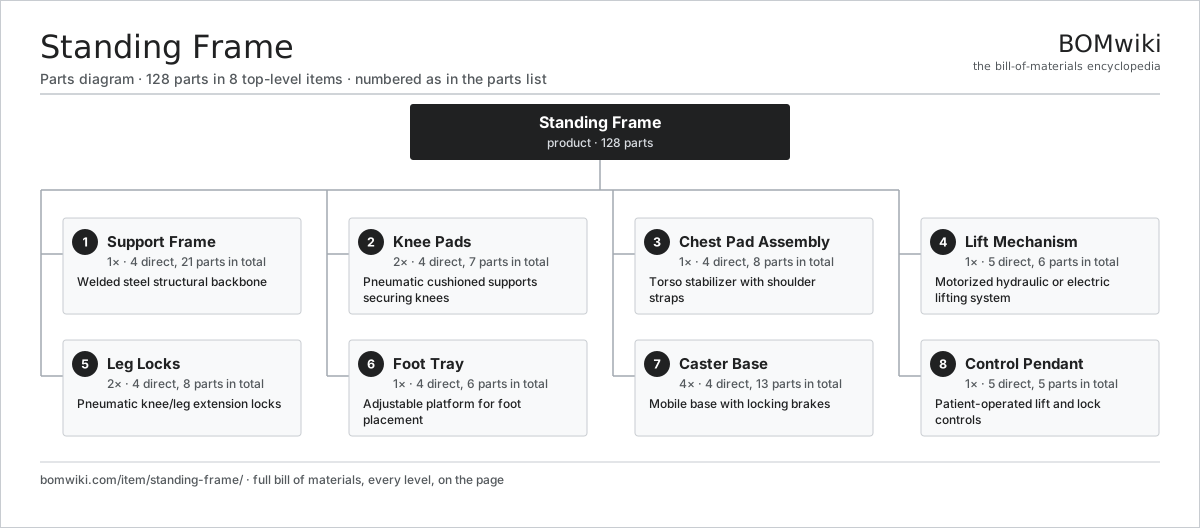
| # | Part | Qty | What it does |
|---|---|---|---|
| 1 | Support Frame 4 parts | 1× | Welded steel structural backbone |
| 2 | Knee Pads 4 parts | 2× | Pneumatic cushioned supports securing knees |
| 3 | Chest Pad Assembly 4 parts | 1× | Torso stabilizer with shoulder straps |
| 4 | Lift Mechanism 5 parts | 1× | Motorized hydraulic or electric lifting system |
| 5 | Leg Locks 4 parts | 2× | Pneumatic knee/leg extension locks |
| 6 | Foot Tray 4 parts | 1× | Adjustable platform for foot placement |
| 7 | Caster Base 4 parts | 4× | Mobile base with locking brakes |
| 8 | Control Pendant 5 parts | 1× | Patient-operated lift and lock controls |
3D model
No 3D model yet. Have a CAD file of this? Add a 3D model. STL renders right on this page; STEP, FreeCAD, and OpenSCAD sources are welcome too (openly licensed, like all 3D models on BOMwiki).
Build & assembly graph
expand / collapse · shared sub-assemblies converge · links to related products · est. labourTap an assembly to expand/collapse · tap a part to open it · use “Open page” for any node · drag to pan, scroll to zoom.
Bill of materials for Standing Frame
8 top-level lines · 42 rows shown · 128 parts total · indented to 3 levels| # | Item / sub-assembly | Part no. | Qty/assy | Ext. qty | Parts | Type |
|---|---|---|---|---|---|---|
| 1 | Support Frame 4 parts | standing-frame-support-frame | 1× | 1 | 21 | assembly |
| 1.1 | Vertical Posts | standing-frame-vertical-posts | 2× | 2 | · | part |
| 1.2 | Crossbars | standing-frame-crossbars | 3× | 3 | · | part |
| 1.3 | Diagonal Braces | standing-frame-diagonal-braces | 4× | 4 | · | part |
| 1.4 | Fastener Set | fastener-set | 12× | 12 | · | part |
| 2 | Knee Pads 4 parts | standing-frame-knee-pads | 2× | 2 | 7 | assembly |
| 2.1 | Pneumatic Bladder | standing-frame-pad-bladder | 2× | 4 | · | part |
| 2.2 | Pad Cover | standing-frame-pad-cover | 2× | 4 | · | part |
| 2.3 | Pad Mount | standing-frame-pad-mounting | 2× | 4 | · | part |
| 2.4 | Connector | connector | 1× | 2 | · | part |
| 3 | Chest Pad Assembly 4 parts | standing-frame-chest-pad | 1× | 1 | 8 | assembly |
| 3.1 | Chest Foam | standing-frame-chest-foam | 1× | 1 | · | part |
| 3.2 | Chest Straps | standing-frame-chest-straps | 2× | 2 | · | part |
| 3.3 | Chest Mount Bracket | standing-frame-chest-mount | 1× | 1 | · | part |
| 3.4 | Fastener Set | fastener-set | 4× | 4 | · | part |
| 4 | Lift Mechanism 5 parts | standing-frame-lift-mechanism | 1× | 1 | 6 | assembly |
| 4.1 | Lift Actuators | standing-frame-actuator-pair | 2× | 2 | · | part |
| 4.2 | Pump Motor | standing-frame-pump-motor | 1× | 1 | · | part |
| 4.3 | Pressure Accumulator | standing-frame-pressure-accumulator | 1× | 1 | · | part |
| 4.4 | Pressure Sensor | pressure-sensor | 1× | 1 | · | part |
| 4.5 | Relief Valve | standing-frame-relief-valve | 1× | 1 | · | part |
| 5 | Leg Locks 4 parts | standing-frame-leg-locks | 2× | 2 | 8 | assembly |
| 5.1 | Lock Solenoid | standing-frame-lock-solenoid | 2× | 4 | · | part |
| 5.2 | Lock Spring | standing-frame-lock-spring | 2× | 4 | · | part |
| 5.3 | Lock Indicator | standing-frame-lock-indicator | 2× | 4 | · | part |
| 5.4 | Connector | connector | 2× | 4 | · | part |
| 6 | Foot Tray 4 parts | standing-frame-foot-tray | 1× | 1 | 6 | assembly |
| 6.1 | Tray Plate | standing-frame-tray-plate | 1× | 1 | · | part |
| 6.2 | Foot Pegs | standing-frame-foot-pegs | 2× | 2 | · | part |
| 6.3 | Heel Cup | standing-frame-heel-cup | 2× | 2 | · | part |
| 6.4 | Tray Mount Bracket | standing-frame-tray-mount | 1× | 1 | · | part |
| 7 | Caster Base 4 parts | standing-frame-caster-wheels | 4× | 4 | 13 | assembly |
| 7.1 | Wheel Set | standing-frame-wheel-pair | 2× | 8 | · | part |
| 7.2 | Brake Pair | standing-frame-brake-pair | 2× | 8 | · | part |
| 7.3 | Base Frame | standing-frame-base-frame | 1× | 4 | · | part |
| 7.4 | Fastener Set | fastener-set | 8× | 32 | · | part |
| 8 | Control Pendant 5 parts | standing-frame-control-pendant | 1× | 1 | 5 | assembly |
| 8.1 | Pendant Housing | standing-frame-pendant-housing | 1× | 1 | · | part |
| 8.2 | Lift Button | standing-frame-lift-button | 1× | 1 | · | part |
| 8.3 | Lock Button | standing-frame-lock-button | 1× | 1 | · | part |
| 8.4 | Safety Switch | standing-frame-safety-switch | 1× | 1 | · | part |
| 8.5 | Wire Bundle | wire-bundle | 1× | 1 | · | part |
Something wrong in this list? Report a problem with this BOM.
Related products
same domain, ranked by shared parts Apheresis Machine
199 parts · shares 2 with this page
Apheresis Machine
199 parts · shares 2 with this page
 Blood Pressure Monitor
173 parts · shares 2 with this page
Blood Pressure Monitor
173 parts · shares 2 with this page
 ECMO Machine
142 parts · shares 2 with this page
ECMO Machine
142 parts · shares 2 with this page
 Fetal Monitor
312 parts · shares 2 with this page
Heart-Lung Machine
298 parts · shares 2 with this page
Fetal Monitor
312 parts · shares 2 with this page
Heart-Lung Machine
298 parts · shares 2 with this page
 Hyperbaric Oxygen Chamber
44 parts · shares 2 with this page
Hyperbaric Oxygen Chamber
44 parts · shares 2 with this page
Sourcing: possible vendors
Browse the supplier directory → Prices, MOQ, and lead times are algorithmic estimates, not quotes, and not claims about these companies. Company mappings are curated by keyword; est. price band $500–$3M. How estimates work| Vendor | HQ | Specialty | MOQ | Lead time |
|---|---|---|---|---|
| gehealthcare.com ↗ | Chicago, US | Medical imaging & devices | 100 units | 12–20 wks |
| siemens-healthineers.com ↗ | Erlangen, DE | Medical systems | 100 units | 12–20 wks |
|
🇳🇱Philips
philips.com ↗
|
Amsterdam, NL | Health technology | 100 units | 12–20 wks |
| medtronic.com ↗ | Minneapolis, US | Medical devices | 100 units | 12–20 wks |
|
🇨🇳Mindray
mindray.com ↗
|
Shenzhen, CN | Medical devices | 100 units | 12–20 wks |
816-word article