Star Tracker
ProductOverview
A star tracker is the most accurate attitude sensor flown on spacecraft. It photographs a patch of sky, identifies the stars in the image against an onboard catalog, and computes the rotation between the camera frame and the inertial frame, a three-axis attitude quaternion good to a few arcseconds, delivered several times per second with no prior knowledge of where the spacecraft is pointed. Sun sensors and magnetometers give degrees; gyros drift; the star field does neither.
The instrument is a short chain: the Optical Head forms star images on the Focal Plane Assembly, the Processing Unit turns pixels into a quaternion, and the Baffle Assembly keeps the Sun and the bright Earth limb from washing everything out. The whole unit weighs 1–3 kg and draws under 10 W.
How it works
Stars are point sources, so a sharp lens would put each one on a single pixel and limit measurement to pixel pitch. Trackers instead defocus deliberately: the Lens Stack spreads each star over a 3×3 to 5×5 pixel spot, set permanently by the Focus Shim Set, and the centroid of that spot can be computed to roughly 1/20 of a pixel. With a 20° field on a 1024×1024 CMOS Image Sensor, that sub-pixel interpolation is what turns ~70 arcsecond pixels into arcsecond-class star positions.
Each frame, the Processor Board thresholds the image, centroids the brightest 10–60 spots, and matches them against the catalog in Star Catalog Memory. The standard lost-in-space method hashes geometric features, angular distances between star pairs and triangles, into a lookup structure; a match against the ~5,000-star reduced Hipparcos catalog typically resolves in well under one frame period. Once identified, stars are tracked frame-to-frame in small windows, which is far cheaper and tolerant of slew rates up to a couple of degrees per second. The attitude solution is a least-squares fit (QUEST or similar) over all matched stars, so accuracy improves with the number of stars in view.
Output goes to the spacecraft attitude control system over the Interface Board bus, time-stamped against a sync pulse so the control computer can fuse it with gyro data: the gyro carries attitude between star fixes, the tracker removes the gyro drift.
Stray light and detector
Star signals are photons in the hundreds to thousands per frame; sunlight is over 10^9 times brighter. The Baffle Cone and its internal Vane Set force off-axis light through multiple absorbing bounces on the Black Coating before any path reaches the lens, achieving attenuation around 10^9 at the exclusion angle. Trackers still go blind within 30–40° of the Sun and near the sunlit Earth limb, which is why spacecraft routinely fly two or three heads on diverging boresights, at least one always sees dark sky, and fusing two heads also fixes the weak roll axis each individual tracker has about its own boresight.
The detector is a radiation-tolerant CMOS active-pixel sensor. The Thermoelectric Cooler holds it 20–30 °C below ambient because dark current doubles roughly every 6–7 °C and proton-induced hot pixels otherwise masquerade as stars; the processing unit also maintains a hot-pixel map updated in flight. The Bandpass Filter limits the band to roughly 450–850 nm to bound chromatic centroid shift across star colors.
Stability and integration
Arcsecond output is meaningless unless the boresight is stable and known. The Main Body is machined as a single metering structure, the Lens Barrel is athermalized so focus holds across temperature, and the Thermal Control subsystem, radiator, Heater Set, and MLI Blanket, keeps the bench inside its calibrated band. Mounting uses three quasi-kinematic Mounting Foot with Thermal Isolator so spacecraft panel distortion does not print through into pointing error. At integration the boresight is transferred to the vehicle frame by theodolite measurement of the Alignment Cube and trimmed with the Alignment Shim Set.
Calibration is a polynomial map of optical distortion plus a temperature correction, measured on a precision rotary table against simulated star fields and refined in flight against the real sky. Typical flight units hold 1–5 arcseconds cross-boresight and 10–30 arcseconds in roll over the qualified temperature range, with total-dose tolerance of 20–50 krad behind the Electronics Cover shielding.
Star Tracker parts and their functions
7 top-level parts · 48 parts in total · full bill of materials below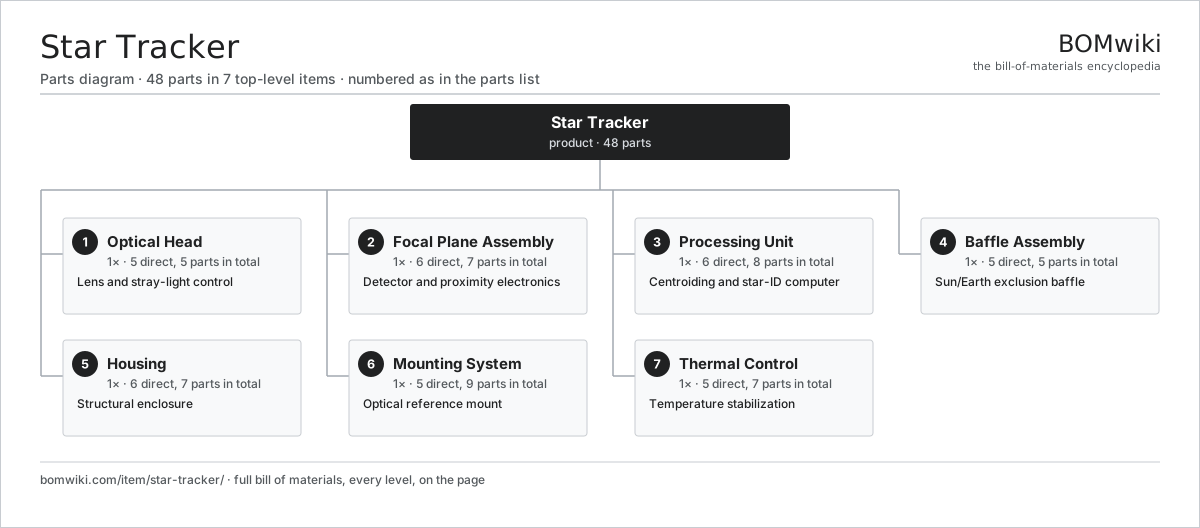
| # | Part | Qty | What it does |
|---|---|---|---|
| 1 | Optical Head 5 parts | 1× | Lens and stray-light control |
| 2 | Focal Plane Assembly 6 parts | 1× | Detector and proximity electronics |
| 3 | Processing Unit 6 parts | 1× | Centroiding and star-ID computer |
| 4 | Baffle Assembly 5 parts | 1× | Sun/Earth exclusion baffle |
| 5 | Housing 6 parts | 1× | Structural enclosure |
| 6 | Mounting System 5 parts | 1× | Optical reference mount |
| 7 | Thermal Control 5 parts | 1× | Temperature stabilization |
3D model
No 3D model yet. Have a CAD file of this? Add a 3D model. STL renders right on this page; STEP, FreeCAD, and OpenSCAD sources are welcome too (openly licensed, like all 3D models on BOMwiki).
Build & assembly graph
expand / collapse · shared sub-assemblies converge · links to related products · est. labourTap an assembly to expand/collapse · tap a part to open it · use “Open page” for any node · drag to pan, scroll to zoom.
Bill of materials for Star Tracker
7 top-level lines · 45 rows shown · 48 parts total · indented to 3 levels| # | Item / sub-assembly | Part no. | Qty/assy | Ext. qty | Parts | Type |
|---|---|---|---|---|---|---|
| 1 | Optical Head 5 parts | star-tracker-optical-head | 1× | 1 | 5 | assembly |
| 1.1 | Lens Stack | star-tracker-lens-stack | 1× | 1 | · | part |
| 1.2 | Lens Barrel | star-tracker-lens-barrel | 1× | 1 | · | part |
| 1.3 | Bandpass Filter | star-tracker-bandpass-filter | 1× | 1 | · | part |
| 1.4 | Field Stop | star-tracker-field-stop | 1× | 1 | · | part |
| 1.5 | Focus Shim Set | star-tracker-focus-shim-set | 1× | 1 | · | part |
| 2 | Focal Plane Assembly 6 parts | star-tracker-focal-plane | 1× | 1 | 7 | assembly |
| 2.1 | CMOS Image Sensor | image-sensor | 1× | 1 | · | part |
| 2.2 | Thermoelectric Cooler | star-tracker-tec | 1× | 1 | · | part |
| 2.3 | Detector Board | star-tracker-detector-board | 1× | 1 | · | part |
| 2.4 | Cold Finger | star-tracker-cold-finger | 1× | 1 | · | part |
| 2.5 | SMD Passive (R/C/L) | smd-passives | 1× | 1 | · | part |
| 2.6 | Connector | connector | 2× | 2 | · | part |
| 3 | Processing Unit 6 parts | star-tracker-processing-unit | 1× | 1 | 8 | assembly |
| 3.1 | Processor Board | star-tracker-processor-board | 1× | 1 | · | part |
| 3.2 | Star Catalog Memory | star-tracker-star-catalog-memory | 1× | 1 | · | part |
| 3.3 | Interface Board | star-tracker-interface-board | 1× | 1 | · | part |
| 3.4 | Power Conditioning Module | star-tracker-power-conditioning | 1× | 1 | · | part |
| 3.5 | Bare PCB | pcb-bare | 3× | 3 | · | part |
| 3.6 | SMD Passive (R/C/L) | smd-passives | 1× | 1 | · | part |
| 4 | Baffle Assembly 5 parts | star-tracker-baffle-assembly | 1× | 1 | 5 | assembly |
| 4.1 | Baffle Cone | star-tracker-baffle-cone | 1× | 1 | · | part |
| 4.2 | Vane Set | star-tracker-vane-set | 1× | 1 | · | part |
| 4.3 | Black Coating | star-tracker-black-coating | 1× | 1 | · | part |
| 4.4 | Aperture Cover | star-tracker-aperture-cover | 1× | 1 | · | part |
| 4.5 | Fastener Set | fastener-set | 1× | 1 | · | part |
| 5 | Housing 6 parts | star-tracker-housing | 1× | 1 | 7 | assembly |
| 5.1 | Main Body | star-tracker-main-body | 1× | 1 | · | part |
| 5.2 | Electronics Cover | star-tracker-electronics-cover | 1× | 1 | · | part |
| 5.3 | Vent Port | star-tracker-vent-port | 1× | 1 | · | part |
| 5.4 | O-Ring Set | oring-set | 1× | 1 | · | part |
| 5.5 | Fastener Set | fastener-set | 1× | 1 | · | part |
| 5.6 | Connector | connector | 2× | 2 | · | part |
| 6 | Mounting System 5 parts | star-tracker-mounting-system | 1× | 1 | 9 | assembly |
| 6.1 | Mounting Foot | star-tracker-mounting-feet | 3× | 3 | · | part |
| 6.2 | Alignment Cube | star-tracker-alignment-cube | 1× | 1 | · | part |
| 6.3 | Alignment Shim Set | star-tracker-shim-set | 1× | 1 | · | part |
| 6.4 | Thermal Isolator | star-tracker-thermal-isolators | 3× | 3 | · | part |
| 6.5 | Fastener Set | fastener-set | 1× | 1 | · | part |
| 7 | Thermal Control 5 parts | star-tracker-thermal-control | 1× | 1 | 7 | assembly |
| 7.1 | Radiator Surface | star-tracker-radiator-surface | 1× | 1 | · | part |
| 7.2 | Heater Set | star-tracker-heater-set | 2× | 2 | · | part |
| 7.3 | MLI Blanket | star-tracker-mli-blanket | 1× | 1 | · | part |
| 7.4 | Thermistor Set | star-tracker-thermistor-set | 1× | 1 | · | part |
| 7.5 | Thermal Fuse | thermal-fuse | 2× | 2 | · | part |
Something wrong in this list? Report a problem with this BOM.
Related products
same domain, ranked by shared parts Cargo Resupply Spacecraft
574 parts · shares 3 with this page
Cargo Resupply Spacecraft
574 parts · shares 3 with this page
 GPS Navigation Satellite
2,640 parts · shares 3 with this page
GPS Navigation Satellite
2,640 parts · shares 3 with this page
 Lunar Lander
1,803 parts · shares 3 with this page
Lunar Lander
1,803 parts · shares 3 with this page
 Weather Satellite
1,765 parts · shares 3 with this page
Weather Satellite
1,765 parts · shares 3 with this page
 Crewed Space Capsule
7,222 parts · shares 2 with this page
Crewed Space Capsule
7,222 parts · shares 2 with this page
 Mars Science Rover
1,624 parts · shares 2 with this page
Mars Science Rover
1,624 parts · shares 2 with this page
Sourcing: possible vendors
Browse the supplier directory → Prices, MOQ, and lead times are algorithmic estimates, not quotes, and not claims about these companies. Company mappings are curated by keyword; est. price band $50k–$500M. How estimates work| Vendor | HQ | Specialty | MOQ | Lead time |
|---|---|---|---|---|
|
🇺🇸SpaceX
spacex.com ↗
|
Hawthorne, US | Launch & spacecraft | made to order | 52–104 wks |
| northropgrumman.com ↗ | Falls Church, US | Space & defense | made to order | 52–104 wks |
|
🇫🇷Airbus
airbus.com ↗
|
Toulouse, FR | Aerospace OEM | made to order | 52–104 wks |
| rocketlabusa.com ↗ | Long Beach, US | Launch & spacecraft | made to order | 52–104 wks |
| thalesaleniaspace.com ↗ | Cannes, FR | Satellites | made to order | 52–104 wks |
766-word article