Stationary Waste Compactor
ProductOverview
A stationary waste compactor is a heavy-duty hydraulic machine designed for high-volume refuse processing at waste collection points, transfer stations, or industrial facilities. The device uses a powered ram driven by twin hydraulic cylinders to compress waste into a sealed removable container, achieving typical volume reductions of 6:1 or greater. The machine operates on a repeatable cycle: waste is fed into the open-top charge box, the motorized lid closes, the compaction ram descends under full hydraulic pressure, material is crushed against the container bottom, the ram retracts, the lid opens, and the cycle repeats. Container exchange takes 5–10 minutes, with full bins locked and clamped for transport to landfill or processing facilities.
Stationary compactors are fundamental to waste management infrastructure, reducing collection frequency and transport costs by consolidating loose refuse into dense bales. A single 2.2 m³ compacted bin can replace 8–12 loose collection barrels, cutting hauling trips and fuel consumption proportionally. They are installed outdoors at commercial sites, hotels, shopping centers, hospitals, and industrial yards where space and cost efficiency are critical.
How it works
Compaction Cycle
The operator initiates the cycle via a weatherproof control panel mounted on the frame. The cycle timer relay energizes a 24 VDC solenoid in the hydraulic directional valve, routing pump flow to the head-end ports of the twin Hydraulic Cylinder. The Hydraulic System is supplied by a vane pump driven directly through an electrically engaged clutch by the onboard Diesel Engine.
As the Compaction Ram descends, the Ram Head Plate contacts compacted waste and applies 50–70 kN of force. The Rod and Linkage Assembly ensures both cylinders remain synchronized, preventing binding or uneven loading. A Pressure Sensor monitors system pressure and provides feedback to the control panel; if pressure exceeds 210 bar, the Relief Valve opens, venting excess flow back to tank.
Compaction persists for 45–90 seconds, determined by the timer setting. The operator or automatic timer then deenergizes the solenoid, reversing the directional valve. Pump flow now feeds the rod-end side of the cylinders, retracting the ram. A check valve in the Accumulator releases stored energy, accelerating retraction. The ram rises fully, the motorized Motorized Lid opens via a 24 VDC linear actuator, and the cycle completes.
Container Management
Waste is fed into the open Charge Box, where a spring-hinged Floor Plate controls entry. Fresh waste pushes the floor open slightly; compaction force drives it deeper into the removal container below. The Container Latch System uses mechanical manual latches and a pneumatic Pneumatic Clamp to lock the bin during transport. Dual gasket seals prevent spillage and odor escape.
When full, the bin is unclamped, the Container Latch System is released, and a front-end loader or hook truck removes the container for disposal. A fresh bin is rolled into position, latched, and the next compaction cycle begins.
Hydraulic Circuit
The Variable Pump is a variable-displacement vane pump coupled to the diesel engine via an electrically engaged Electric Clutch. The pump draws from the Reservoir Tank through a suction strainer and delivers pressurized fluid to a NG10 cavity Manifold.
The manifold houses two solenoid-operated directional valves, one for each cylinder circuit. The pilot stage of each valve is energized by a 24 VDC solenoid coil; the main spool shifts, connecting pump pressure to the appropriate cylinder port. Return flow drains to tank through an integral manifold passage.
The Relief Valve is set to 210 bar and protects the entire circuit. An Accumulator (2 L, nitrile bladder, 210 bar rated) smooths pressure ripple from the pump and provides a small stored-energy reserve to accelerate ram retraction without waiting for full pump flow. Manual isolation and charging valve allow pre-charge adjustment and emergency depressurization.
Power and Controls
A naturally aspirated Diesel Engine supplies all mechanical and hydraulic power. The engine idles at 800 rpm when no cycle is active, consuming minimal fuel. The Electric Clutch is disengaged during idle; energizing the solenoid couples the engine crankshaft to the pump input shaft, spinning the pump to design speed (1500 rpm).
The Control Panel houses a single large red mushroom-head emergency-stop button, a momentary green start pushbutton, and an electronic cycle timer dial (0–120 s). Pressing start energizes the clutch solenoid and timer relay; the timer counts down and automatically deenergizes at zero, stopping the cycle. An operator can manually press the stop button any time to break the cycle immediately.
Dual interlock switches are mounted on the guard doors. If any door is opened during a live cycle, the switches break the solenoid circuits, halting compaction. The frame is mounted on four elastomer isolators to reduce vibration transmission to the site foundation and adjacent structures.
Applications
Stationary compactors are deployed at:
- Supermarkets and retail centers: Consolidating high-volume cardboard, plastic, and general waste.
- Hospitality: Hotels and restaurants compacting organic and mixed waste for weekly removal.
- Manufacturing and logistics: Industrial yards compacting scrap, packaging, and production waste.
- Waste transfer stations: High-throughput compaction before secondary transport to landfill or energy-recovery facilities.
- Healthcare facilities: Compacting non-hazardous waste under containment protocols.
Maintenance
Daily checks include visual inspection of guards, guard door latches, and the integrity of gasket seals. Weekly checks include hydraulic fluid level in the tank, checking the Air Filter for blockage, and testing the emergency-stop button function. Monthly maintenance includes draining sediment from the tank sump, changing the return filter element, and inspecting all fasteners for looseness.
Hydraulic fluid should be changed annually or after 2000 operating hours. The Relief Valve relief setting must be verified with a test gauge annually. Cylinder rod seals should be visually inspected for weeping; excessive leakage indicates Oil Seal replacement.
The Diesel Engine requires standard diesel engine maintenance: oil and filter change at 250-hour intervals, fuel filter change annually, and air-filter cartridge replacement every 200 hours of operation or sooner if operating in dusty environments.
Stationary Waste Compactor parts and their functions
8 top-level parts · 54 parts in total · full bill of materials below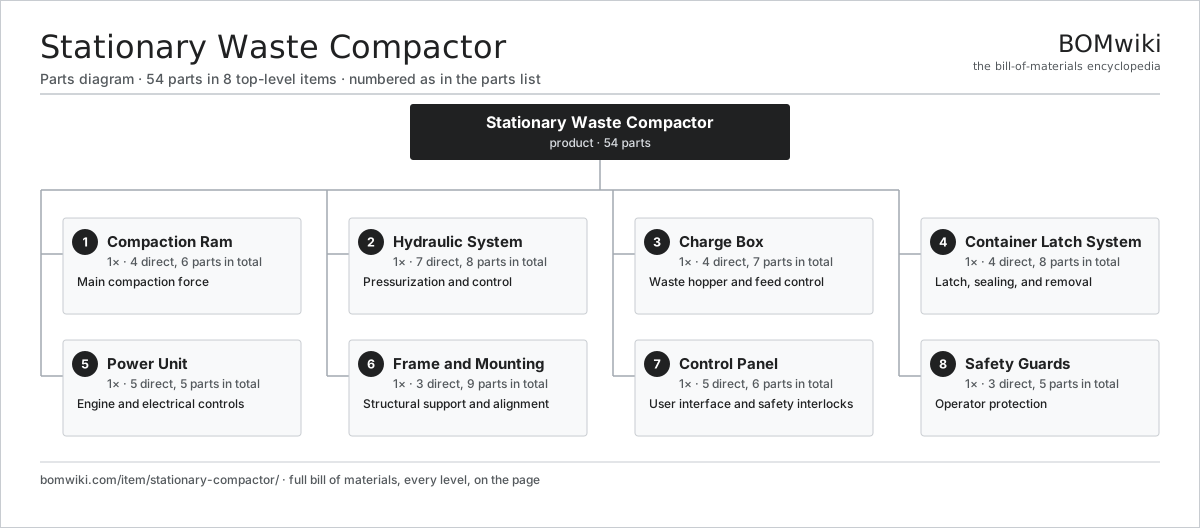
| # | Part | Qty | What it does |
|---|---|---|---|
| 1 | Compaction Ram 4 parts | 1× | Main compaction force |
| 2 | Hydraulic System 7 parts | 1× | Pressurization and control |
| 3 | Charge Box 4 parts | 1× | Waste hopper and feed control |
| 4 | Container Latch System 4 parts | 1× | Latch, sealing, and removal |
| 5 | Power Unit 5 parts | 1× | Engine and electrical controls |
| 6 | Frame and Mounting 3 parts | 1× | Structural support and alignment |
| 7 | Control Panel 5 parts | 1× | User interface and safety interlocks |
| 8 | Safety Guards 3 parts | 1× | Operator protection |
3D model
No 3D model yet. Have a CAD file of this? Add a 3D model. STL renders right on this page; STEP, FreeCAD, and OpenSCAD sources are welcome too (openly licensed, like all 3D models on BOMwiki).
Build & assembly graph
expand / collapse · shared sub-assemblies converge · links to related products · est. labourTap an assembly to expand/collapse · tap a part to open it · use “Open page” for any node · drag to pan, scroll to zoom.
Bill of materials for Stationary Waste Compactor
8 top-level lines · 43 rows shown · 54 parts total · indented to 3 levels| # | Item / sub-assembly | Part no. | Qty/assy | Ext. qty | Parts | Type |
|---|---|---|---|---|---|---|
| 1 | Compaction Ram 4 parts | stationary-compactor-ram-assembly | 1× | 1 | 6 | assembly |
| 1.1 | Ram Head Plate | stationary-compactor-ram-head | 1× | 1 | · | part |
| 1.2 | Hydraulic Cylinder | stationary-compactor-cylinder-pair | 2× | 2 | · | part |
| 1.3 | Rod and Linkage Assembly | stationary-compactor-rod-linkage | 1× | 1 | · | part |
| 1.4 | Sheet Metal Panel | sheet-panel | 2× | 2 | · | part |
| 2 | Hydraulic System 7 parts | stationary-compactor-hydraulic-system | 1× | 1 | 8 | assembly |
| 2.1 | Variable Pump | stationary-compactor-hydraulic-pump | 1× | 1 | · | part |
| 2.2 | Spool Valve | stationary-compactor-directional-valve | 2× | 2 | · | part |
| 2.3 | Relief Valve | stationary-compactor-pressure-relief | 1× | 1 | · | part |
| 2.4 | Accumulator | stationary-compactor-accumulator | 1× | 1 | · | part |
| 2.5 | Manifold | stationary-compactor-manifold-block | 1× | 1 | · | part |
| 2.6 | Reservoir Tank | stationary-compactor-fluid-tank | 1× | 1 | · | part |
| 2.7 | Pressure Sensor | pressure-sensor | 1× | 1 | · | part |
| 3 | Charge Box 4 parts | stationary-compactor-charge-box | 1× | 1 | 7 | assembly |
| 3.1 | Hopper Body | stationary-compactor-hopper-body | 1× | 1 | · | part |
| 3.2 | Floor Plate | stationary-compactor-floor-plate | 1× | 1 | · | part |
| 3.3 | Motorized Lid | stationary-compactor-lid-assembly | 1× | 1 | · | part |
| 3.4 | Fastener Set | fastener-set | 4× | 4 | · | part |
| 4 | Container Latch System 4 parts | stationary-compactor-container-system | 1× | 1 | 8 | assembly |
| 4.1 | Manual Latch | stationary-compactor-mechanical-latch | 2× | 2 | · | part |
| 4.2 | Pneumatic Clamp | stationary-compactor-pneumatic-clamp | 1× | 1 | · | part |
| 4.3 | Bin Gasket | stationary-compactor-container-seal | 2× | 2 | · | part |
| 4.4 | O-Ring Set | oring-set | 3× | 3 | · | part |
| 5 | Power Unit 5 parts | stationary-compactor-power-unit | 1× | 1 | 5 | assembly |
| 5.1 | Diesel Engine | stationary-compactor-diesel-engine | 1× | 1 | · | part |
| 5.2 | Electric Clutch | stationary-compactor-electric-clutch | 1× | 1 | · | part |
| 5.3 | Air Filter | stationary-compactor-air-filter | 1× | 1 | · | part |
| 5.4 | Power Supply | power-supply | 1× | 1 | · | part |
| 5.5 | Fuel Tank | stationary-compactor-fuel-tank | 1× | 1 | · | part |
| 6 | Frame and Mounting 3 parts | stationary-compactor-frame | 1× | 1 | 9 | assembly |
| 6.1 | Sheet Metal Panel | sheet-panel | 3× | 3 | · | part |
| 6.2 | Vibration Isolator | stationary-compactor-isolation-feet | 4× | 4 | · | part |
| 6.3 | Fastener Set | fastener-set | 2× | 2 | · | part |
| 7 | Control Panel 5 parts | stationary-compactor-control-panel | 1× | 1 | 6 | assembly |
| 7.1 | Control Enclosure | stationary-compactor-enclosure | 1× | 1 | · | part |
| 7.2 | Relay | relay | 2× | 2 | · | part |
| 7.3 | Push-Button Assembly | stationary-compactor-start-button | 1× | 1 | · | part |
| 7.4 | Cycle Timer | stationary-compactor-timer | 1× | 1 | · | part |
| 7.5 | Pressure Sensor | pressure-sensor | 1× | 1 | · | part |
| 8 | Safety Guards 3 parts | stationary-compactor-safety-guards | 1× | 1 | 5 | assembly |
| 8.1 | Sheet Metal Panel | sheet-panel | 2× | 2 | · | part |
| 8.2 | Interlock Switch | stationary-compactor-interlock-switch | 2× | 2 | · | part |
| 8.3 | Fastener Set | fastener-set | 1× | 1 | · | part |
Something wrong in this list? Report a problem with this BOM.
Related products
same domain, ranked by shared parts Candle Making Machine
73 parts · shares 4 with this page
Coil Coating Line
1,767 parts · shares 4 with this page
Candle Making Machine
73 parts · shares 4 with this page
Coil Coating Line
1,767 parts · shares 4 with this page
 Continuous Galvanizing Line
1,296 parts · shares 4 with this page
Continuous Galvanizing Line
1,296 parts · shares 4 with this page
 Dynamic Balancing Machine
573 parts · shares 4 with this page
Dynamic Balancing Machine
573 parts · shares 4 with this page
Sourcing: possible vendors
Browse the supplier directory → Prices, MOQ, and lead times are algorithmic estimates, not quotes, and not claims about these companies. Company mappings are curated by keyword; est. price band $5k–$2M. How estimates work| Vendor | HQ | Specialty | MOQ | Lead time |
|---|---|---|---|---|
| atlascopco.com ↗ | Stockholm, SE | Compressors & industrial | 10 units | 12–20 wks |
|
🇦🇹Andritz
andritz.com ↗
|
Graz, AT | Process plants & machinery | 10 units | 12–20 wks |
| buhlergroup.com ↗ | Uzwil, CH | Food & materials processing | 10 units | 12–20 wks |
| gea.com ↗ | Düsseldorf, DE | Process technology | 10 units | 12–20 wks |
| mhi.com ↗ | Tokyo, JP | Heavy machinery | 10 units | 12–20 wks |
1,068-word article