Steelpan
ProductOverview
The steelpan (or steel drum) is the only modern percussion instrument made entirely from sheet metal without any membrane or string. Born in Trinidad in the 1930s–1950s from the creative repurposing of industrial steel 55-gallon barrels, the steelpan has become a fully developed melodic instrument. A single player can perform complete melodies, harmonies, and accompaniments with a pair of mallets, making it an ensemble lead voice or soloist.
The magic of the steelpan lies entirely in the precision of the Playing Surface. Each of the 28–32 note areas has been individually shaped by hammering and heat-treating to vibrate at a specific pitch. The shape and depth of each Note Field determines its tone colour and sustain. The Skirt underneath acts as an acoustic reflector and Helmholtz cavity, controlling the overall brightness and resonance.
The barrel and shell
The Drum Shell begins as a standard 55-gallon industrial oil drum, typically recycled or new. The maker cuts off the bottom entirely and flattens the top from its original convex dome to a concave dish sunken roughly 10–15 cm. This shaping is done by hand and machine, stretching the metal carefully to avoid splits. The sides (the Skirt) remain roughly cylindrical, providing acoustic foundation and structural support.
Once shaped, the steel is annealed (heated to red heat and cooled slowly) to relieve internal stresses from the flattening process. Without this, the drum would continue to shift and detune. Modern makers may apply heat treatment multiple times throughout the tuning process, keeping the metal in a condition where it is responsive to fine adjustments.
Note field creation and tuning
The Note Fields are created by a process of hand-hammering and precise shaping. Starting with the mapped layout (arranged by ear and tradition to allow fast melodic movement), the maker uses hammers of various sizes to create concave depressions. A soprano pan (the lead voice) typically has 28–32 note fields arranged in three or four zones radiating outward from the central region.
Each Note Field is hemispherical or elliptical, typically 3–5 cm across, and precisely tuned to a specific pitch. The tuning process is acoustic and entirely ear-based: the maker strikes each note with a mallet, listens to the pitch and decay, and uses smaller hammers to stretch or compress the metal, raising or lowering the pitch imperceptibly. This is an extraordinarily skilled craft; a master tuner can adjust a single note by half a semitone using precise hammer strikes in the right location.
The notes are separated by Note Separation, grooves or ridges of slightly raised metal between note areas, both to prevent acoustic crosstalk (one note vibrating the adjacent one into detuning) and to provide visual landmarks so players can find the right note by sight without thinking. Advanced players learn the layout so thoroughly that they play visually and by muscle memory, never looking down.
Once the note fields are tuned to approximate pitches, the drum is subjected to a final Heat Treatment: heating to a controlled temperature (usually around 200–300 °C) and slow cooling, which stabilizes the microstructure of the steel and ''locks'' the tuning. Without this, the drum would gradually detune and shift over days or weeks due to residual metal stresses.
The skirt and acoustics
The Skirt is the cylindrical body below the playing surface, typically 12–18 cm tall. Its height and internal volume tune the acoustic properties of the drum as a whole. The Skirt Vents, drilled or cut holes in the sides, further tune the Helmholtz resonance, allowing air to couple between the internal cavity and the room, affecting brightness and sustain.
The Tuning Frame may include an internal Internal Brace to prevent the drum from flexing or warping, especially in tropical climates where heat and humidity cause metal to expand and contract. The Rim Reinforcement around the edge of the note fields stiffens the boundary and defines the ''active'' playing zone clearly.
Stand and playing position
The steelpan is mounted on a Stand, typically a three-point tripod or four-point frame of wood or metal, positioned with its face vertical or slightly tilted toward the player. The player strikes the note fields with two Mallets, usually one in each hand, executing rapid melodic passages or rhythmic accompaniment. The Mallet Head is typically wrapped in rubber, cork, or wound felt to produce a warm, defined tone without harshness.
A skilled pan player can play two independent melodic lines (one per hand) or alternate between melodic and rhythmic accompaniment, much like a pianist. The steelpan's range is typically 2.5 octaves, arranged logically to allow rapid scalar movement and chords. Different pan types (soprano, tenor, bass) are pitched higher and lower respectively, and orchestras of pans can cover an enormous harmonic range.
Maintenance and durability
A finished steelpan is stable if kept in reasonable environmental conditions, but temperature and humidity changes do cause slow detuning. Some makers seal the drum with paint or epoxy to protect it from rust and slow environmental drift; others prefer to leave bare metal, claiming better tone and response.
Rust is the primary enemy: salt spray from coastal locations and moisture from high humidity can corrode the metal, creating pits that degrade tone. An affected pan can be sanded back and sometimes retuned, but severe rust may require drum replacement.
Structural damage (cracks or dents in the note fields) is very difficult to repair without professional intervention. A well-made steelpan can last decades with minimal maintenance, and concert-grade pans are valued instruments, often owned by music schools or orchestras.
Tuning schemes and repertoire
Different regions and traditions use different tuning schemes. The original Trinidad pans use diatonic tuning (the major scale notes), while modern concert steelpans often use chromatic tuning (all 12 semitones in the octave). This allows playing modern music in any key, though it concentrates the notes more densely and requires more precise finger placement.
A steelpan ensemble typically has a ''lead pan'' (soprano, melody voice), ''double seconds'' (harmony and countermelody), ''cellos'' (bass-register harmony), and ''bass pans'' (lowest notes). Together, they can perform anything from classical transcriptions to calypso, pop, and contemporary compositions. The sound is bright, percussive, yet warm, unmistakably tropical and celebratory in character.
Steelpan parts and their functions
7 top-level parts · 57 parts in total · full bill of materials below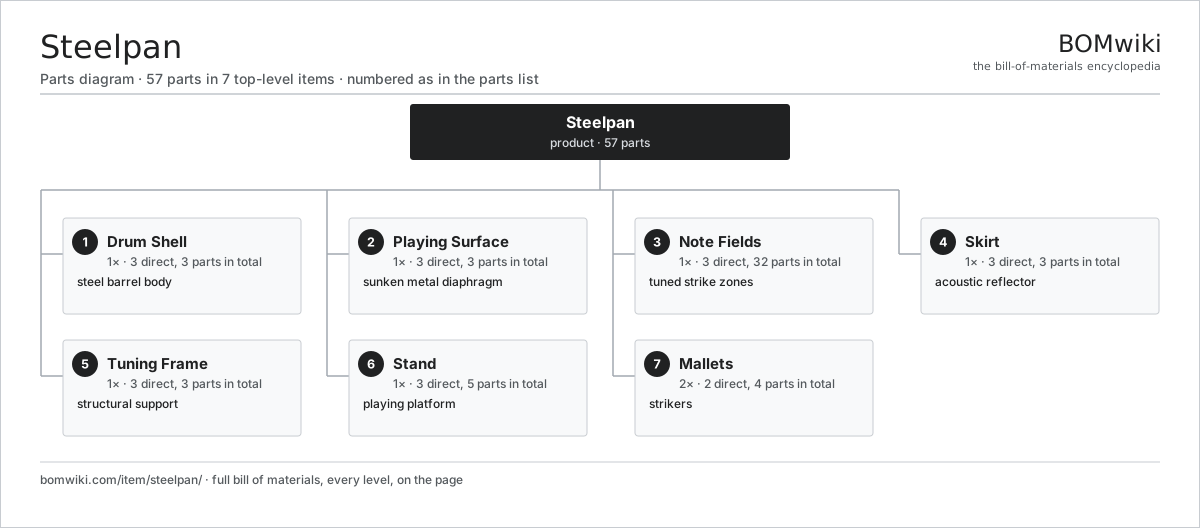
| # | Part | Qty | What it does |
|---|---|---|---|
| 1 | Drum Shell 3 parts | 1× | steel barrel body |
| 2 | Playing Surface 3 parts | 1× | sunken metal diaphragm |
| 3 | Note Fields 3 parts | 1× | tuned strike zones |
| 4 | Skirt 3 parts | 1× | acoustic reflector |
| 5 | Tuning Frame 3 parts | 1× | structural support |
| 6 | Stand 3 parts | 1× | playing platform |
| 7 | Mallets 2 parts | 2× | strikers |
3D model
No 3D model yet. Have a CAD file of this? Add a 3D model. STL renders right on this page; STEP, FreeCAD, and OpenSCAD sources are welcome too (openly licensed, like all 3D models on BOMwiki).
Build & assembly graph
expand / collapse · shared sub-assemblies converge · links to related products · est. labourTap an assembly to expand/collapse · tap a part to open it · use “Open page” for any node · drag to pan, scroll to zoom.
Bill of materials for Steelpan
7 top-level lines · 27 rows shown · 57 parts total · indented to 3 levels| # | Item / sub-assembly | Part no. | Qty/assy | Ext. qty | Parts | Type |
|---|---|---|---|---|---|---|
| 1 | Drum Shell 3 parts | steelpan-drum-shell | 1× | 1 | 3 | assembly |
| 1.1 | Barrel Stock | steelpan-barrel-stock | 1× | 1 | · | part |
| 1.2 | Flattened Crown | steelpan-flattened-crown | 1× | 1 | · | part |
| 1.3 | Skirt Attachment | steelpan-skirt-attachment | 1× | 1 | · | part |
| 2 | Playing Surface 3 parts | steelpan-playing-surface | 1× | 1 | 3 | assembly |
| 2.1 | Sunken Diaphragm | steelpan-sunken-diaphragm | 1× | 1 | · | part |
| 2.2 | Note Bumps | steelpan-note-bumps | 1× | 1 | · | part |
| 2.3 | Surface Finish | steelpan-surface-finish | 1× | 1 | · | part |
| 3 | Note Fields 3 parts | steelpan-note-fields | 1× | 1 | 32 | assembly |
| 3.1 | Note Field | steelpan-note-field | 30× | 30 | · | part |
| 3.2 | Note Separation | steelpan-note-separation | 1× | 1 | · | part |
| 3.3 | Tuning Dimples | steelpan-tuning-dimples | 1× | 1 | · | part |
| 4 | Skirt 3 parts | steelpan-skirt | 1× | 1 | 3 | assembly |
| 4.1 | Skirt Body | steelpan-skirt-body | 1× | 1 | · | part |
| 4.2 | Skirt Height | steelpan-skirt-height | 1× | 1 | · | part |
| 4.3 | Skirt Vents | steelpan-skirt-vents | 1× | 1 | · | part |
| 5 | Tuning Frame 3 parts | steelpan-tuning-frame | 1× | 1 | 3 | assembly |
| 5.1 | Internal Brace | steelpan-internal-brace | 1× | 1 | · | part |
| 5.2 | Rim Reinforcement | steelpan-rim-reinforcement | 1× | 1 | · | part |
| 5.3 | Heat Treatment | steelpan-heat-treatment | 1× | 1 | · | part |
| 6 | Stand 3 parts | steelpan-stand | 1× | 1 | 5 | assembly |
| 6.1 | Stand Legs | steelpan-stand-legs | 3× | 3 | · | part |
| 6.2 | Drum Cradle | steelpan-drum-cradle | 1× | 1 | · | part |
| 6.3 | Stand Height | steelpan-stand-height | 1× | 1 | · | part |
| 7 | Mallets 2 parts | steelpan-mallets | 2× | 2 | 4 | assembly |
| 7.1 | Mallet Shaft | steelpan-mallet-shaft | 2× | 4 | · | part |
| 7.2 | Mallet Head | steelpan-mallet-head | 2× | 4 | · | part |
Something wrong in this list? Report a problem with this BOM.
Sourcing: possible vendors
Browse the supplier directory → Prices, MOQ, and lead times are algorithmic estimates, not quotes, and not claims about these companies. Company mappings are curated by keyword; est. price band $50–$5k. How estimates work| Vendor | HQ | Specialty | MOQ | Lead time |
|---|---|---|---|---|
| yamaha.com ↗ | Hamamatsu, JP | Audio & instruments | 200 units | 8–14 wks |
|
🇺🇸Fender
fender.com ↗
|
Los Angeles, US | Guitars & amps | 200 units | 8–14 wks |
|
🇺🇸Gibson
gibson.com ↗
|
Nashville, US | Guitars | 200 units | 8–14 wks |
|
🇯🇵Roland
roland.com ↗
|
Hamamatsu, JP | Electronic instruments | 200 units | 8–14 wks |
| steinway.com ↗ | New York, US | Pianos | 200 units | 8–14 wks |
1,060-word article