Stirling Engine Generator
ProductOverview
A Stirling engine is an external-combustion heat engine operating on a closed thermodynamic cycle. Unlike spark-ignition or compression-ignition engines that burn fuel internally and create pressure spikes, a Stirling engine heats high-purity gas (helium or hydrogen) in an external burner, and this heat drives two pistons in a synchronized dance: a displacer piston shuttles gas between hot and cold chambers, while a power piston extracts mechanical work.
Stirling engines are prized for:
- Fuel flexibility: Any external heat source works, natural gas, wood, solar, waste heat from industry.
- Quiet operation: No explosions, no valve train noise.
- Long life: External combustion minimizes thermal stress; engines can run 20,000+ hours.
- High waste-heat recovery potential: 60–80% thermal CHP efficiency with recuperation.
A typical 5–10 kW Stirling generator retrofit into a residential solar system or connected to a biomass stove can provide baseload power in off-grid settings. Larger 25–50 kW units power small communities or industrial facilities.
How it Works
The Stirling Thermodynamic Cycle
The Stirling cycle consists of four processes:
Isothermal expansion (hot side): Gas at temperature T_H expands at constant temperature, pushing the power piston and extracting mechanical work. Heat Q_H flows in from the external burner.
Isochoric (constant volume) cooling: The displacer piston moves, pushing gas through the regenerator from hot side to cold side. The regenerator's wire mesh absorbs heat, cooling the gas.
Isothermal compression (cold side): Gas at temperature T_C is compressed at constant temperature by the power piston. The regenerator releases stored heat, reducing the work needed to compress (minimizing input). Heat Q_C flows out to the ambient cooler.
Isochoric (constant volume) heating: The displacer moves again, pushing gas through the regenerator from cold side to hot side. The regenerator releases its stored heat, warming the gas back to T_H.
The cycle repeats. Theoretical efficiency = 1 - T_C/T_H (Carnot efficiency). With T_H = 750 K and T_C = 300 K, theoretical maximum efficiency = 60%. Real Stirling engines achieve 30–40% due to pressure drops, thermal losses, and regenerator imperfection.
Piston Mechanism and Regenerator
The main cylinder contains two pistons separated by a regenerator. The displacer piston is large and low-mass (thin walls), allowing gas to flow freely around it. It is driven by a crank mechanism to move back-and-forth at engine frequency (typically 400–1000 rpm).
The power piston is smaller and higher-mass, with tight seals. It compresses and expands gas, converting pressure changes to mechanical work. The two pistons are phase-shifted: as the displacer moves, the power piston lags by 90°, optimizing the cycle.
The regenerator core is a wire-mesh matrix (50–200 μm stainless steel wires) with high surface area (~1000 m²/m³). Gas flows through the mesh twice per cycle:
- Hot-to-cold: mesh absorbs heat, cooling gas from T_H to T_C.
- Cold-to-hot: mesh releases heat, warming gas back to T_H.
Regenerator effectiveness is 85–95%, nearly achieving the theoretical ideal. Without the regenerator, the engine would need to provide extra heat during expansion and remove extra heat during compression, roughly doubling fuel consumption.
Heat Input and External Combustor
The heater head assembly is a heat exchanger receiving heat from the external combustor. The burner can run on:
- Natural gas: Clean burn, good transient control.
- Biomass or wood chips: Renewable, but requires fuel preprocessing (drying, sizing).
- Solar thermal: Concentrated solar mirrors heating a cavity receiver.
- Waste heat: Industrial exhaust, exhaust from a furnace, or geothermal.
The heater tubes are finned for high heat transfer. Combustion temperature (natural gas flame) is ~2000 K, but the tubes are cooled by the Stirling gas expanding at their inner surface. Tube wall temperature stabilizes at 700–800 K (the hot-side temperature of the Stirling cycle).
The burner controller modulates fuel flow to maintain constant heater temperature, ensuring steady power output. As engine load increases, more heat is extracted from the heater tubes, tending to cool them; the controller increases fuel flow to compensate.
Heat Rejection and Cooling
The cooler assembly rejects waste heat to ambient. The cooler tubes are finned aluminum or copper, with gas flowing through them at the cold-side temperature (30–50 °C).
A forced-air fan blows ambient air (typically 20–30 °C) across the fins. Heat transfer rate depends on temperature difference: Q = h × A × ΔT. With ΔT = 20 °C and finned area ~10 m², a 5 kW Stirling engine can reject ~5 kW of waste heat.
Alternatively, for CHP applications, cold water from a building heating loop (at 30–40 °C) can circulate through the cooler via a circulation pump. The engine preheats the water to 50–60 °C, which feeds a space heating radiator. This configuration recovers both electrical power and thermal power.
Power Output and Alternator
Mechanical power from the power piston is transmitted through a crankshaft (with crank pins) and connecting rods to a linear alternator.
A linear alternator differs from rotational generators: instead of a spinning rotor, a permanent-magnet array or moving coil oscillates in a magnetic field, inducing AC voltage. The frequency matches the engine's piston frequency (e.g., 400 rpm = 6.67 Hz for a single-piston oscillator).
Output voltage from the alternator is ~6–12 V AC at engine frequency (not 50/60 Hz). A power electronic converter:
- Rectifies the high-frequency AC to DC.
- Inverts the DC to grid-frequency AC (50 or 60 Hz), synchronized to the grid.
Some designs use a mechanical flywheel Flywheel Mass to smooth power pulsations before the alternator, improving power quality.
Starting and Speed Control
Starting a Stirling engine is gradual: the burner is lit, heat builds up, and gas expands. After 10–30 minutes, the engine reaches operating temperature (~700 K) and begins to rotate. No starter motor is needed.
Speed control is passive: as electrical load increases, the alternator load torque increases, slowing the engine. The power piston pressure rises, temperature increases, and more heat is required. The burner (via its temperature controller) increases fuel flow to maintain heater temperature. The engine automatically stabilizes at the load point.
At full load, the engine runs at rated speed (e.g., 700 rpm). At part load, it runs slower and produces proportionally less power, with excellent fuel efficiency.
Applications
Residential Baseload Power
A 5–10 kW Stirling generator connected to a natural gas supply or biomass stove provides continuous baseload power in off-grid homes or villages. Electrical efficiency is 25–30%; thermal efficiency (hot water or space heating) adds another 50–60%. Combined efficiency: 75–90%, far exceeding grid average.
Industrial Waste-Heat Recovery
A manufacturing facility with a high-temperature process (furnace, kiln, exhaust) can couple a 25–50 kW Stirling engine to its waste stream. The engine produces electricity while the remaining heat is still useful for facility heating. Payback on the capital cost typically occurs in 3–7 years.
Solar Thermal Power
Concentrated solar collectors (parabolic dishes or heliostats) focus sunlight onto a Stirling engine heater head, heating the working gas to 700–800 °C. Power output is proportional to solar irradiance and directly controllable (unlike photovoltaic solar, which is modulated by cloud cover and inverter dynamics). A 25 kW solar Stirling system can supply stable, predictable power to a small village or agricultural cooperative.
Biomass Combined Heat and Power
Burning wood chips or agricultural waste in a Stirling burner provides distributed power and heat. Rural communities often have biomass resources but limited electricity access. A 5–10 kW Stirling unit enables local power generation, reducing dependence on diesel generators or long transmission lines.
Maintenance and Reliability
Stirling engines are extremely reliable because:
- No explosions: combustion is external and controlled.
- No high-pressure transients: gas pressure is steady-state.
- Long component life: no rapid wear from thermal cycling.
Maintenance is minimal:
- Quarterly: Check heater tube cleanliness (coal or wood ash may deposit), inspect cooler fins for clogging.
- Annual: Renew working gas if purity degrades (water ingress reduces efficiency).
- Every 5 years: Overhaul pistons, regenerator, and seals.
Operating life is 10,000–20,000 hours (5–10 years of continuous operation or 20–30 years of intermittent operation). Cost of ownership is very low: fuel, plus minimal maintenance.
Disadvantages and Limitations
- Slow startup: 10–30 minutes to reach full power (unsuitable for emergency backup requiring immediate response).
- Lower electrical efficiency: 20–30% vs. 35–40% for modern gas turbines or reciprocating engines.
- Complex manufacturing: Double piston mechanism and regenerator require precision machining.
- Limited commercial availability: Far fewer Stirling manufacturers than internal-combustion engine makers; most units are custom-built or small-scale production.
- Working gas management: Helium or hydrogen must be kept pure; contamination (air, moisture) reduces performance.
Modern Development
Recent research focuses on:
- Lightweight pistons using composites (carbon fiber, ceramic) to reduce mass and enable higher frequencies, improving power density.
- Advanced regenerators using sintered metal or foam structures with higher effectiveness and lower pressure drop.
- Hybrid Stirling-PV systems: Solar Stirling provides stable baseload, photovoltaics handle peak demand, battery stores excess. Combined system cost and reliability exceed either alone.
- Microturbine-Stirling combinations: Microturbine exhaust heat feeds a Stirling engine, cascading energy recovery for 50%+ electrical efficiency.
Standards and Certification
Stirling engines are not standardized like automotive or utility equipment. Manufacturers design to API (American Petroleum Institute) or ISO 13372 (condition monitoring) standards. Safety is governed by:
- ASME Boiler and Pressure Vessel Code: Heater tubes and cylinder rated for design pressure.
- NFPA: Natural gas safety if applicable.
- Local emissions regulations: Exhaust NOx and CO limits; clean combustion makes compliance easy.
Grid interconnection (if applicable) requires IEEE 1547 compliance and third-party certification by UL or similar.
Stirling Engine Generator parts and their functions
8 top-level parts · 42 parts in total · full bill of materials below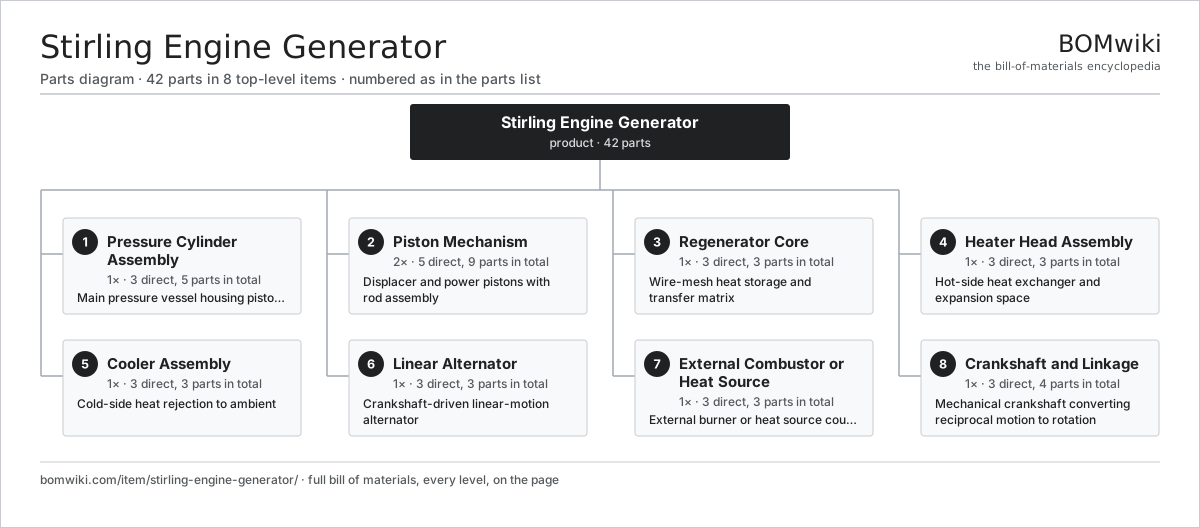
| # | Part | Qty | What it does |
|---|---|---|---|
| 1 | Pressure Cylinder Assembly 3 parts | 1× | Main pressure vessel housing pistons |
| 2 | Piston Mechanism 5 parts | 2× | Displacer and power pistons with rod assembly |
| 3 | Regenerator Core 3 parts | 1× | Wire-mesh heat storage and transfer matrix |
| 4 | Heater Head Assembly 3 parts | 1× | Hot-side heat exchanger and expansion space |
| 5 | Cooler Assembly 3 parts | 1× | Cold-side heat rejection to ambient |
| 6 | Linear Alternator 3 parts | 1× | Crankshaft-driven linear-motion alternator |
| 7 | External Combustor or Heat Source 3 parts | 1× | External burner or heat source coupler |
| 8 | Crankshaft and Linkage 3 parts | 1× | Mechanical crankshaft converting reciprocal motion to rotation |
3D model
No 3D model yet. Have a CAD file of this? Add a 3D model. STL renders right on this page; STEP, FreeCAD, and OpenSCAD sources are welcome too (openly licensed, like all 3D models on BOMwiki).
Build & assembly graph
expand / collapse · shared sub-assemblies converge · links to related products · est. labourTap an assembly to expand/collapse · tap a part to open it · use “Open page” for any node · drag to pan, scroll to zoom.
Bill of materials for Stirling Engine Generator
8 top-level lines · 34 rows shown · 42 parts total · indented to 3 levels| # | Item / sub-assembly | Part no. | Qty/assy | Ext. qty | Parts | Type |
|---|---|---|---|---|---|---|
| 1 | Pressure Cylinder Assembly 3 parts | stirling-engine-generator-cylinder | 1× | 1 | 5 | assembly |
| 1.1 | Cylinder Pressure Vessel | stirling-engine-generator-cylinder-body | 1× | 1 | · | part |
| 1.2 | Cylinder End Caps | stirling-engine-generator-cylinder-heads | 2× | 2 | · | part |
| 1.3 | Piston Rod Connector | stirling-engine-generator-piston-rods | 2× | 2 | · | part |
| 2 | Piston Mechanism 5 parts | stirling-engine-generator-pistons | 2× | 2 | 9 | assembly |
| 2.1 | Displacer Piston | stirling-engine-generator-displacer-piston | 1× | 2 | · | part |
| 2.2 | Power Piston | stirling-engine-generator-power-piston | 1× | 2 | · | part |
| 2.3 | Piston Rod | stirling-engine-generator-piston-rod | 2× | 4 | · | part |
| 2.4 | Piston Ring Set | stirling-engine-generator-piston-rings | 4× | 8 | · | part |
| 2.5 | Piston Seal Pack | stirling-engine-generator-seal-pack | 1× | 2 | · | part |
| 3 | Regenerator Core 3 parts | stirling-engine-generator-regenerator | 1× | 1 | 3 | assembly |
| 3.1 | Wire-Mesh Regenerator Matrix | stirling-engine-generator-regen-matrix | 1× | 1 | · | part |
| 3.2 | Regenerator Container | stirling-engine-generator-regen-housing | 1× | 1 | · | part |
| 3.3 | Thermal Insulation Wrap | stirling-engine-generator-regen-insulation | 1× | 1 | · | part |
| 4 | Heater Head Assembly 3 parts | stirling-engine-generator-heater-head | 1× | 1 | 3 | assembly |
| 4.1 | Heater Tube Bank | stirling-engine-generator-heater-tubes | 1× | 1 | · | part |
| 4.2 | Heater Manifold | stirling-engine-generator-heater-manifold | 1× | 1 | · | part |
| 4.3 | Heater-Cylinder Brazed Joint | stirling-engine-generator-thermal-interface | 1× | 1 | · | part |
| 5 | Cooler Assembly 3 parts | stirling-engine-generator-cooler | 1× | 1 | 3 | assembly |
| 5.1 | Cooler Tube Bank | stirling-engine-generator-cooler-tubes | 1× | 1 | · | part |
| 5.2 | Cooler Fan Motor | stirling-engine-generator-cooler-fan | 1× | 1 | · | part |
| 5.3 | Cooler Circulation Pump | stirling-engine-generator-cooler-pump | 1× | 1 | · | part |
| 6 | Linear Alternator 3 parts | stirling-engine-generator-alternator | 1× | 1 | 3 | assembly |
| 6.1 | Permanent-Magnet Array | stirling-engine-generator-magnet-array | 1× | 1 | · | part |
| 6.2 | Alternator Coil Winding | stirling-engine-generator-coil-assembly | 1× | 1 | · | part |
| 6.3 | Alternator Housing | stirling-engine-generator-alternator-housing | 1× | 1 | · | part |
| 7 | External Combustor or Heat Source 3 parts | stirling-engine-generator-combustor | 1× | 1 | 3 | assembly |
| 7.1 | Fuel Burner Assembly | stirling-engine-generator-burner | 1× | 1 | · | part |
| 7.2 | Burner Control Module | stirling-engine-generator-burner-controls | 1× | 1 | · | part |
| 7.3 | Exhaust Piping and Muffler | stirling-engine-generator-exhaust-path | 1× | 1 | · | part |
| 8 | Crankshaft and Linkage 3 parts | stirling-engine-generator-linkage | 1× | 1 | 4 | assembly |
| 8.1 | Main Crankshaft | stirling-engine-generator-crankshaft | 1× | 1 | · | part |
| 8.2 | Connecting Rod Assembly | stirling-engine-generator-connecting-rods | 2× | 2 | · | part |
| 8.3 | Flywheel Mass | stirling-engine-generator-flywheel | 1× | 1 | · | part |
Something wrong in this list? Report a problem with this BOM.
Sourcing: possible vendors
Browse the supplier directory → Prices, MOQ, and lead times are algorithmic estimates, not quotes, and not claims about these companies. Company mappings are curated by keyword; est. price band $5k–$50M. How estimates work| Vendor | HQ | Specialty | MOQ | Lead time |
|---|---|---|---|---|
| gevernova.com ↗ | Cambridge, US | Power generation | made to order | 20–40 wks |
| siemens-energy.com ↗ | Munich, DE | Power & grid | made to order | 20–40 wks |
| hitachienergy.com ↗ | Zurich, CH | Grid & transformers | made to order | 20–40 wks |
|
🇨🇭ABB
abb.com ↗
|
Zurich, CH | Electrification & automation | made to order | 20–40 wks |
| se.com ↗ | Rueil-Malmaison, FR | Electrical & automation | made to order | 20–40 wks |
1,710-word article