Stone Picker
ProductOverview
A stone picker is a tractor-mounted agricultural implement that systematically removes rocks and stones from freshly-tilled fields. Stones are a perennial problem in many soils: they damage combine harvesters, clog planters, and make hand-harvesting painful (especially in vegetable crops). The Pickup Reel Assembly, a rotating drum with spring-steel tines, drags through the top 200–300 mm of soil, lifting soil and stones into the machine. A Sieving Conveyor, a vibrating screen with 3–6 mm perforations, separates soil (which falls through) from stones (which travel forward). Stones are then elevated via a Elevation Auger into a hopper or trailer.
Machines have been in use since the 1950s; modern machines are hydraulically-driven and integrate proportional flow control, allowing fine adjustment of reel speed and auger speed from the tractor cabin. Stone picking is labor-intensive if done by hand (150–200 m³ of soil per hectare must be sifted); mechanization is cost-effective on fields where stone load exceeds 50 kg/hectare.
Pickup reel mechanism
The Pickup Reel Assembly is the core. A Reel Drum, typically 400–600 mm diameter and 2–2.5 m wide, is bolted with 12–16 Pickup Tines (spring steel fingers, 250–300 mm long). The drum is rotated at 40–80 rpm by a Reel Motor and Reel Gearbox (reduction 1:50 or so). As the machine advances, the rotating tines dig into freshly-tilled soil, rolling and lifting soil clumps and stones into the hopper above.
The tines are spring-loaded or hinged, not rigid. This allows them to flex backward when hitting hard soil or hidden stones, preventing the reel from jamming. After lifting material vertically, the tines flip backward (by centrifugal force and gravity) and return to the ground to begin the next cycle.
Reel design balances two needs: (1) sufficient aggressiveness to dislodge stones, and (2) enough spring compliance to avoid jamming and breaking. Worn or broken tines must be replaced seasonally; spares are kept on every farm.
Sieving and soil return
Material lifted by the Pickup Reel Assembly falls onto the Sieving Conveyor, a 2–3 m long, 1–1.5 m wide vibrating screen. The Sieve Screen has perforations of 3–6 mm diameter. Soil clumps, if dry or well-broken, fall through the holes; stones larger than the holes travel forward on the screen surface toward the Hopper Bin.
The Vibrating Motor (a 1–3 kW electromagnetic or hydraulic vibrator) oscillates the screen at 10–20 Hz, breaking soil clumps and promoting fines penetration. Moisture content is critical: wet or clay-rich soil doesn't fall through; farmers pick stones when soil is near the optimal moisture state (friable). A Return Blade at the discharge end of the screen scrapes any fine soil downward, ensuring as much soil as possible returns to the field.
Soil return is important both economically (avoiding topsoil loss) and for uniformity of field conditions. Removing topsoil concentrates nutrients and organic matter in the picked zone.
Stone elevation and collection
Stones reaching the end of the vibrating screen drop into the Hopper Bin, a welded steel box (1–2 m³ capacity). When the hopper is full (typically after processing 0.5–1 hectare, depending on stone density), the operator drives the picker to the field edge beside a truck or trailer. The Elevation Auger, a spiral conveyor angled 30° upward, is engaged via a proportional valve from the tractor.
The Auger Motor (3–5 kW) drives the Auger Shaft at 100–200 rpm, rotating the auger screw. Stones in the hopper are pushed upward by the screw flighting, exiting through a Discharge Chute into the truck bed. Auger systems are preferred to belt conveyors because stones don't slide well on rubber; they grip and roll forward against the screw flights.
Hydraulic power and control
The machine is powered by the tractor's PTO (540 rpm) driving a Hydraulic Pump (20–40 L/min). Flow is routed through a Valve Manifold with proportional Flow Dividers controlled by a joystick in the tractor cabin. The operator can adjust:
- Reel speed: via proportional valve spool opening to the Reel Motor
- Auger speed: via second proportional spool to the Auger Motor
Proportional control allows the operator to match reel speed to soil condition and travel speed. Soft soil may require slow reel rotation (40 rpm) to avoid overloading the screen; hard, compacted soil needs faster rotation (70–80 rpm) to break clumps. Auger speed is independently controlled to empty the hopper at the desired rate.
An optional Accumulator (5 L bladder tank) buffers pressure spikes and allows short-term operation even if the pump loses prime; however, it is not standard on most models.
Frame and ground engagement
The Frame & Structure is a welded steel structure supporting the reel, conveyor, and hopper. The Reel Mount Bracket positions the reel 200–300 mm above ground level at rest; as the tractor sinks from the weight of the implement, the reel engagement depth increases slightly. The reel mounting must be rigid to prevent vibration and bouncing, which degrades soil separation.
The Conveyor Bracket suspends the vibrating screen from spring mounts, isolating vibration from the frame. The Hopper Mount is a welded tower directly behind the conveyor, collecting discharged stones.
Working width is typically 2.0–2.5 m, matching or slightly narrower than typical combine harvester width (2.4–3.5 m), so a single pass per row is sufficient. Field capacity is 0.5–1.0 hectare/hour depending on stone density, soil condition, and number of hopper unloads needed.
Hitch and integration
The machine attaches via a standard Category 2 Hitch & Coupling (ISO 730 three-point linkage). The PTO Shaft is a universal-jointed shaft from the tractor's PTO to the pump. The Quick-Coupler connects the tractor's remote hydraulic circuit to the picker's proportional valves.
Stone pickers are integrated into the soil preparation workflow: after primary tillage (plow) or secondary tillage (disk harrow), the picker is run over the field to remove visible stones. Multiple passes may be needed if stone density is very high. On new land being brought into cultivation, 2–3 passes are typical.
Typical applications and stone load
Stone picking is especially important for:
- Vegetable crops: Hand-harvest crops like strawberries, asparagus, and root vegetables require stone-free soil to avoid bruising and hand injury.
- Potatoes: Stones cause damage during mechanical harvest; high-capacity harvesting (6–8 rows) requires very clean soil.
- Carrots, beets, onions: Similar reasons; stones damage root shape and create foreign-object hazards during post-harvest processing.
- Combine harvesting: Large grains and oilseeds require stone removal to protect rotor bars and chaffer; stones can cause fire risk.
Typical stone load varies:
- Glaciated soils (Northern USA, Canada): 50–150 kg/hectare
- Recently cleared land: 500+ kg/hectare (may require multiple passes)
- Alluvial fields: <50 kg/hectare (many fields don't pick stones annually)
A single pass removes 50–200 kg/hectare depending on operation and soil conditions.
Maintenance and wear
The Pickup Tines wear and break; a set of 12–16 replacement tines costs USD 50–100 and is replaced annually. The Sieve Screen gradually clogs and degrades; it is replaced every 2–3 years. The Reel Bearings require annual greasing and are replaced every 1000+ operating hours.
Hydraulic Hydraulic Hoses are prone to abrasion from soil dust; they should be shielded and replaced at 2–3 year intervals. The Valve Manifold proportional spools are sealed and sealed from dust; service intervals are 500 hours.
Soil moisture management extends machine life: operating in excessively wet soil (>field capacity) causes soil buildup and jamming; operating in dry, compacted soil increases power demand and wear. Optimal conditions are when soil crumbles readily, typically 1–3 days after rain, depending on soil texture.
Stone Picker parts and their functions
8 top-level parts · 59 parts in total · full bill of materials below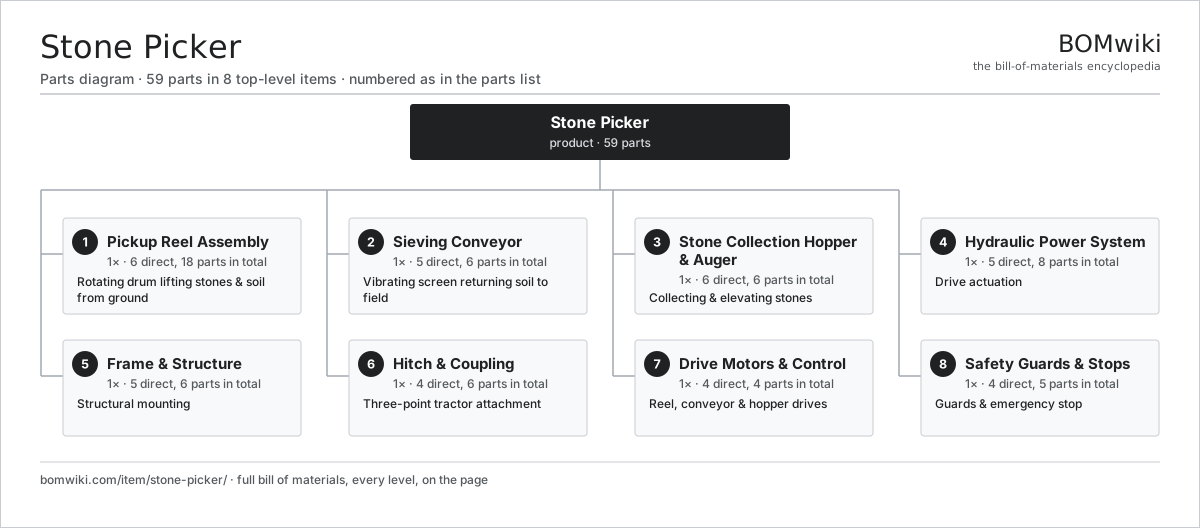
| # | Part | Qty | What it does |
|---|---|---|---|
| 1 | Pickup Reel Assembly 6 parts | 1× | Rotating drum lifting stones & soil from ground |
| 2 | Sieving Conveyor 5 parts | 1× | Vibrating screen returning soil to field |
| 3 | Stone Collection Hopper & Auger 6 parts | 1× | Collecting & elevating stones |
| 4 | Hydraulic Power System 5 parts | 1× | Drive actuation |
| 5 | Frame & Structure 5 parts | 1× | Structural mounting |
| 6 | Hitch & Coupling 4 parts | 1× | Three-point tractor attachment |
| 7 | Drive Motors & Control 4 parts | 1× | Reel, conveyor & hopper drives |
| 8 | Safety Guards & Stops 4 parts | 1× | Guards & emergency stop |
3D model
No 3D model yet. Have a CAD file of this? Add a 3D model. STL renders right on this page; STEP, FreeCAD, and OpenSCAD sources are welcome too (openly licensed, like all 3D models on BOMwiki).
Build & assembly graph
expand / collapse · shared sub-assemblies converge · links to related products · est. labourTap an assembly to expand/collapse · tap a part to open it · use “Open page” for any node · drag to pan, scroll to zoom.
Bill of materials for Stone Picker
8 top-level lines · 47 rows shown · 59 parts total · indented to 3 levels| # | Item / sub-assembly | Part no. | Qty/assy | Ext. qty | Parts | Type |
|---|---|---|---|---|---|---|
| 1 | Pickup Reel Assembly 6 parts | stone-picker-pickup-reel | 1× | 1 | 18 | assembly |
| 1.1 | Reel Shaft | stone-picker-reel-shaft | 1× | 1 | · | part |
| 1.2 | Reel Drum | stone-picker-reel-drum | 1× | 1 | · | part |
| 1.3 | Pickup Tine | stone-picker-reel-tine | 12× | 12 | · | part |
| 1.4 | Reel Bearing | stone-picker-reel-bearing | 2× | 2 | · | part |
| 1.5 | Reel Motor | stone-picker-reel-motor | 1× | 1 | · | part |
| 1.6 | Reel Gearbox | stone-picker-reel-gearbox | 1× | 1 | · | part |
| 2 | Sieving Conveyor 5 parts | stone-picker-sieving-conveyor | 1× | 1 | 6 | assembly |
| 2.1 | Conveyor Deck | stone-picker-conveyor-deck | 1× | 1 | · | part |
| 2.2 | Sieve Screen | stone-picker-conveyor-screen | 1× | 1 | · | part |
| 2.3 | Vibrating Motor | stone-picker-conveyor-vibrator | 1× | 1 | · | part |
| 2.4 | Vibrating Bearing | stone-picker-conveyor-bearing | 2× | 2 | · | part |
| 2.5 | Return Blade | stone-picker-conveyor-return-blade | 1× | 1 | · | part |
| 3 | Stone Collection Hopper & Auger 6 parts | stone-picker-hopper | 1× | 1 | 6 | assembly |
| 3.1 | Hopper Bin | stone-picker-hopper-bin | 1× | 1 | · | part |
| 3.2 | Elevation Auger | stone-picker-elevation-auger | 1× | 1 | · | part |
| 3.3 | Auger Motor | stone-picker-auger-motor | 1× | 1 | · | part |
| 3.4 | Auger Shaft | stone-picker-auger-shaft | 1× | 1 | · | part |
| 3.5 | Hopper Bearing | stone-picker-hopper-bearing | 1× | 1 | · | part |
| 3.6 | Discharge Chute | stone-picker-discharge-chute | 1× | 1 | · | part |
| 4 | Hydraulic Power System 5 parts | stone-picker-hydraulic-system | 1× | 1 | 8 | assembly |
| 4.1 | Hydraulic Pump | stone-picker-hydraulic-pump | 1× | 1 | · | part |
| 4.2 | Valve Manifold | stone-picker-valve-block | 1× | 1 | · | part |
| 4.3 | Flow Divider | stone-picker-flow-divider | 1× | 1 | · | part |
| 4.4 | Hydraulic Hose | stone-picker-hydraulic-line | 4× | 4 | · | part |
| 4.5 | Accumulator | stone-picker-accumulator | 1× | 1 | · | part |
| 5 | Frame & Structure 5 parts | stone-picker-frame | 1× | 1 | 6 | assembly |
| 5.1 | Frame Beam | stone-picker-frame-beam | 2× | 2 | · | part |
| 5.2 | Reel Mount Bracket | stone-picker-reel-support | 1× | 1 | · | part |
| 5.3 | Conveyor Bracket | stone-picker-conveyor-support | 1× | 1 | · | part |
| 5.4 | Hopper Mount | stone-picker-hopper-support | 1× | 1 | · | part |
| 5.5 | Fastener Set | fastener-set | 1× | 1 | · | part |
| 6 | Hitch & Coupling 4 parts | stone-picker-hitch | 1× | 1 | 6 | assembly |
| 6.1 | Hitch Bracket | stone-picker-hitch-bracket | 1× | 1 | · | part |
| 6.2 | Hitch Pin | stone-picker-hitch-pin | 3× | 3 | · | part |
| 6.3 | Quick-Coupler | stone-picker-quick-coupler | 1× | 1 | · | part |
| 6.4 | PTO Shaft | stone-picker-pto-shaft | 1× | 1 | · | part |
| 7 | Drive Motors & Control 4 parts | stone-picker-motor | 1× | 1 | 4 | assembly |
| 7.1 | Pump Drive | stone-picker-pump-motor | 1× | 1 | · | part |
| 7.2 | Speed Controller | stone-picker-speed-controller | 1× | 1 | · | part |
| 7.3 | Main Contactor | stone-picker-contactor | 1× | 1 | · | part |
| 7.4 | Soft-Starter | stone-picker-soft-start | 1× | 1 | · | part |
| 8 | Safety Guards & Stops 4 parts | stone-picker-safety-system | 1× | 1 | 5 | assembly |
| 8.1 | Reel Guard | stone-picker-reel-guard | 1× | 1 | · | part |
| 8.2 | Auger Guard | stone-picker-auger-guard | 1× | 1 | · | part |
| 8.3 | Emergency Stop | stone-picker-emergency-stop | 1× | 1 | · | part |
| 8.4 | Warning Sign | stone-picker-warning-sign | 2× | 2 | · | part |
Something wrong in this list? Report a problem with this BOM.
Sourcing: possible vendors
Browse the supplier directory → Prices, MOQ, and lead times are algorithmic estimates, not quotes, and not claims about these companies. Company mappings are curated by keyword; est. price band $5k–$800k. How estimates work| Vendor | HQ | Specialty | MOQ | Lead time |
|---|---|---|---|---|
| deere.com ↗ | Moline, US | Agriculture & turf | made to order | 14–24 wks |
| cnh.com ↗ | Basildon, GB | Agriculture (Case IH, New Holland) | made to order | 14–24 wks |
|
🇺🇸AGCO
agcocorp.com ↗
|
Duluth, US | Agriculture (Fendt, Massey Ferguson) | made to order | 14–24 wks |
|
🇩🇪Claas
claas.com ↗
|
Harsewinkel, DE | Harvesters & tractors | made to order | 14–24 wks |
|
🇯🇵Kubota
kubota.com ↗
|
Osaka, JP | Compact tractors & equipment | made to order | 14–24 wks |
1,373-word article