Structured-Light 3D Scanner
ProductOverview
A structured-light 3D scanner projects a known light pattern onto a surface, then images that pattern with two cameras to compute depth. The pattern acts like a reference grid: where the pattern is bright, where it's dark, and how it distorts tells the dual cameras exactly how far away every pixel is. This approach runs fast (5–100 Hz in many systems) and is accurate to millimeters, so it's favored for industrial metrology, quality inspection, and archaeological documentation.
The Projector Unit beams a DLP or laser pattern (often a sequence of stripes, grids, or random speckles) at the scene. The Stereo Camera Pair captures images of the lit surface from two slightly offset viewpoints. The Processing Unit compares the two views of the illuminated pattern, finds corresponding features, and solves for the 3D position of each pixel, traditional stereo vision, but with the pattern providing the texture that raw photogrammetry alone might miss on a blank wall.
For maximum accuracy, Calibration Target Board targets are imaged during factory calibration and in the field, establishing the exact camera intrinsics (focal length, principal point), distortion, and relative positions. Any deviation from this calibration introduces depth error, so careful setup is essential.
How it works
The core idea is stereo vision: if the left and right cameras see a point at pixel $(x_L, y_L)$ and $(x_R, y_R)$ respectively, the disparity $d = x_L - x_R$ is inversely proportional to distance. The Processing Unit scans both images for matching patterns, solves for disparity at every pixel, and converts to 3D coordinates using the known camera geometry (baseline distance and focal lengths).
The challenge is finding matches when the surface is featureless, a blank white wall has no obvious points to track in left and right images. The Illumination System solves this by projecting a known Pattern Light Source pattern. A stripe pattern is simple: vertical light stripes sweep across the scene, and the camera pair imagesenses which stripe fell on each pixel. A checkerboard pattern works similarly. Random speckle (infrared structured noise) is harder to decode but offers higher spatial resolution.
Multi-pattern strategies are common: the projector emits a sequence of different patterns, say, 8–16 frames, and the Processing Unit combines all the constraints to compute a depth map with minimal ambiguity. This takes time (100 ms to 1 sec per full 3D snapshot) but yields dense, accurate geometry.
The Stereo Camera Pair is synchronized to the projector. The Stereo Baseline Bracket determines the depth range and sensitivity: a wider baseline (camera separation) gives better depth accuracy for distant objects but reduces the close-range accuracy. Industrial scanners use baselines of 10–50 cm.
IR Bandpass Filters reject sunlight, which would wash out the infrared pattern. Outdoor use is difficult; most scanners work indoors or in controlled lighting.
Resolution depends on working distance and lens choice. At 0.5 m range with a 50 mm baseline, a 2 MP camera can yield 0.1 mm per-pixel depth resolution, enough for quality inspection of precision parts. At 2 m, the same setup covers a larger area but with ~0.5 mm resolution per pixel.
Post-processing is often essential: filtering noise, filling holes from reflective surfaces or occlusions, and meshing the point cloud into a watertight surface model. Modern systems push this computation to a GPU on the Processing Unit to provide real-time preview.
Structured-Light 3D Scanner parts and their functions
10 top-level parts · 373 parts in total · full bill of materials below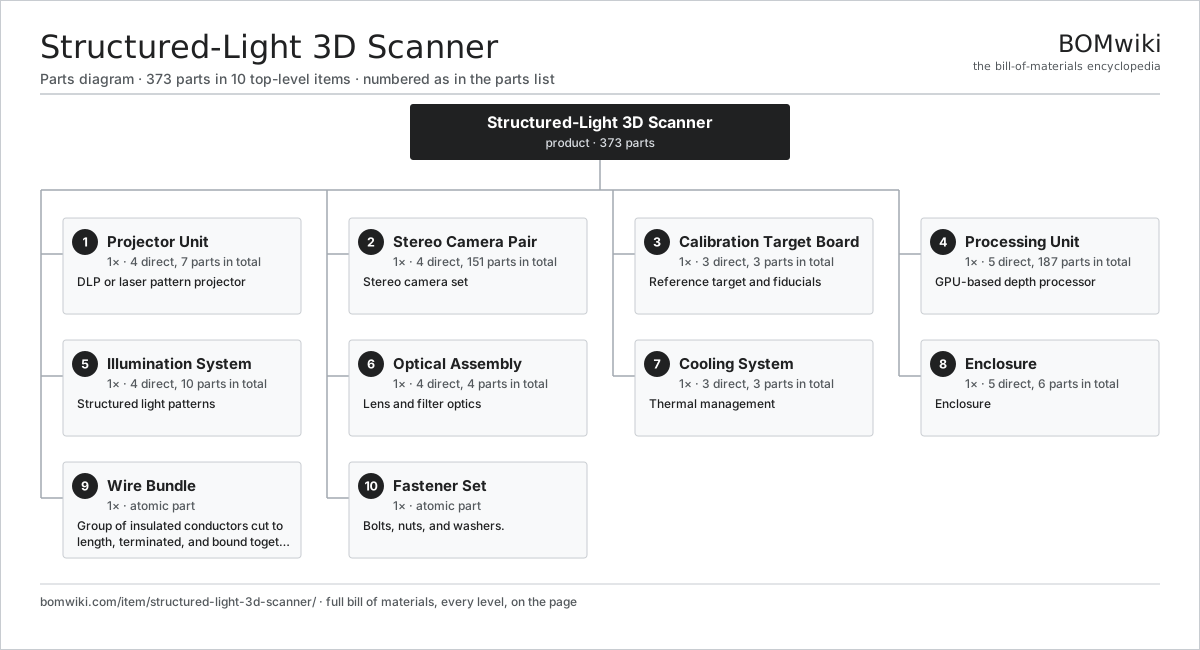
| # | Part | Qty | What it does |
|---|---|---|---|
| 1 | Projector Unit 4 parts | 1× | DLP or laser pattern projector |
| 2 | Stereo Camera Pair 4 parts | 1× | Stereo camera set |
| 3 | Calibration Target Board 3 parts | 1× | Reference target and fiducials |
| 4 | Processing Unit 5 parts | 1× | GPU-based depth processor |
| 5 | Illumination System 4 parts | 1× | Structured light patterns |
| 6 | Optical Assembly 4 parts | 1× | Lens and filter optics |
| 7 | Cooling System 3 parts | 1× | Thermal management |
| 8 | Enclosure 5 parts | 1× | Enclosure |
| 9 | Wire Bundle | 1× | Group of insulated conductors cut to length, terminated, and bound together to carry power and signals between the assemblies of a machine. |
| 10 | Fastener Set | 1× | Bolts, nuts, and washers. |
3D model
No 3D model yet. Have a CAD file of this? Add a 3D model. STL renders right on this page; STEP, FreeCAD, and OpenSCAD sources are welcome too (openly licensed, like all 3D models on BOMwiki).
Build & assembly graph
expand / collapse · shared sub-assemblies converge · links to related products · est. labourTap an assembly to expand/collapse · tap a part to open it · use “Open page” for any node · drag to pan, scroll to zoom.
Bill of materials for Structured-Light 3D Scanner
10 top-level lines · 61 rows shown · 373 parts total · indented to 3 levels| # | Item / sub-assembly | Part no. | Qty/assy | Ext. qty | Parts | Type |
|---|---|---|---|---|---|---|
| 1 | Projector Unit 4 parts | sl-projector-unit | 1× | 1 | 7 | assembly |
| 1.1 | DLP Chip | sl-dlp-chip | 1× | 1 | · | part |
| 1.2 | Projection Optics 3 parts | sl-projection-optics | 1× | 1 | 3 | assembly |
| 1.2.1 | Lens Assembly | camera-lens | 1× | 1 | · | part |
| 1.2.2 | Pattern Aperture | sl-aperture | 1× | 1 | · | part |
| 1.2.3 | Fastener Set | fastener-set | 1× | 1 | · | part |
| 1.3 | Power Supply | power-supply | 1× | 1 | · | part |
| 1.4 | Connector | connector | 2× | 2 | · | part |
| 2 | Stereo Camera Pair 4 parts | sl-camera-pair | 1× | 1 | 151 | assembly |
| 2.1 | Left Camera Module 5 parts | sl-camera-left | 1× | 1 | 74 | assembly |
| 2.1.1 | CMOS Image Sensor | image-sensor | 1× | 1 | · | part |
| 2.1.2 | Lens Assembly | camera-lens | 1× | 1 | · | part |
| 2.1.3 | Bare PCB | pcb-bare | 1× | 1 | · | part |
| 2.1.4 | Microcontroller | mcu | 1× | 1 | · | part |
| 2.1.5 | SMD Passive (R/C/L) | smd-passives | 70× | 70 | · | part |
| 2.2 | Right Camera Module 5 parts | sl-camera-right | 1× | 1 | 74 | assembly |
| 2.2.1 | CMOS Image Sensor | image-sensor | 1× | 1 | · | part |
| 2.2.2 | Lens Assembly | camera-lens | 1× | 1 | · | part |
| 2.2.3 | Bare PCB | pcb-bare | 1× | 1 | · | part |
| 2.2.4 | Microcontroller | mcu | 1× | 1 | · | part |
| 2.2.5 | SMD Passive (R/C/L) | smd-passives | 70× | 70 | · | part |
| 2.3 | Stereo Baseline Bracket | sl-stereo-baseline | 1× | 1 | · | part |
| 2.4 | Connector | connector | 2× | 2 | · | part |
| 3 | Calibration Target Board 3 parts | sl-calibration-board | 1× | 1 | 3 | assembly |
| 3.1 | Checkerboard Target | sl-checkerboard | 1× | 1 | · | part |
| 3.2 | Fiducial Marks | sl-fiducial-marks | 1× | 1 | · | part |
| 3.3 | Fastener Set | fastener-set | 1× | 1 | · | part |
| 4 | Processing Unit 5 parts | sl-processing-unit | 1× | 1 | 187 | assembly |
| 4.1 | Bare PCB | pcb-bare | 1× | 1 | · | part |
| 4.2 | Compute SoC Module | soc-module | 1× | 1 | · | part |
| 4.3 | Microcontroller | mcu | 1× | 1 | · | part |
| 4.4 | SMD Passive (R/C/L) | smd-passives | 180× | 180 | · | part |
| 4.5 | Connector | connector | 4× | 4 | · | part |
| 5 | Illumination System 4 parts | sl-illumination-system | 1× | 1 | 10 | assembly |
| 5.1 | Pattern Light Source | sl-laser-or-led | 1× | 1 | · | part |
| 5.2 | Pattern Optics 3 parts | sl-pattern-optics | 1× | 1 | 3 | assembly |
| 5.2.1 | Lens Assembly | camera-lens | 1× | 1 | · | part |
| 5.2.2 | Diffraction Grating | sl-diffraction-grating | 1× | 1 | · | part |
| 5.2.3 | Fastener Set | fastener-set | 1× | 1 | · | part |
| 5.3 | Illumination Driver 3 parts | sl-illumination-driver | 1× | 1 | 5 | assembly |
| 5.3.1 | Bare PCB | pcb-bare | 1× | 1 | · | part |
| 5.3.2 | Power MOSFET | mosfet | 2× | 2 | · | part |
| 5.3.3 | Connector | connector | 2× | 2 | · | part |
| 5.4 | Power Supply | power-supply | 1× | 1 | · | part |
| 6 | Optical Assembly 4 parts | sl-optics-assembly | 1× | 1 | 4 | assembly |
| 6.1 | IR Bandpass Filter | sl-ir-filter | 1× | 1 | · | part |
| 6.2 | Lens Correction Group | sl-lens-correction | 1× | 1 | · | part |
| 6.3 | O-Ring Set | oring-set | 1× | 1 | · | part |
| 6.4 | Fastener Set | fastener-set | 1× | 1 | · | part |
| 7 | Cooling System 3 parts | sl-cooling-system | 1× | 1 | 3 | assembly |
| 7.1 | Blower Motor | blower-motor | 1× | 1 | · | part |
| 7.2 | Radiator | radiator | 1× | 1 | · | part |
| 7.3 | Thermal Fuse | thermal-fuse | 1× | 1 | · | part |
| 8 | Enclosure 5 parts | sl-housing | 1× | 1 | 6 | assembly |
| 8.1 | Main Shell | sl-main-shell | 1× | 1 | · | part |
| 8.2 | Light Shield | sl-light-shield | 1× | 1 | · | part |
| 8.3 | Sheet Metal Panel | sheet-panel | 2× | 2 | · | part |
| 8.4 | O-Ring Set | oring-set | 1× | 1 | · | part |
| 8.5 | Fastener Set | fastener-set | 1× | 1 | · | part |
| 9 | Wire Bundle | wire-bundle | 1× | 1 | · | part |
| 10 | Fastener Set | fastener-set | 1× | 1 | · | part |
Something wrong in this list? Report a problem with this BOM.
Related products
same domain, ranked by shared parts Digital Cinema Projector
383 parts · shares 10 with this page
Digital Cinema Projector
383 parts · shares 10 with this page
 Photo Minilab
454 parts · shares 9 with this page
Photo Minilab
454 parts · shares 9 with this page
 Slide Projector
182 parts · shares 8 with this page
Terrestrial Laser Scanner
570 parts · shares 7 with this page
Slide Projector
182 parts · shares 8 with this page
Terrestrial Laser Scanner
570 parts · shares 7 with this page
 Digital Cinema Camera
305 parts · shares 5 with this page
Digital Cinema Camera
305 parts · shares 5 with this page
 Motorized Camera Slider
41 parts · shares 6 with this page
Motorized Camera Slider
41 parts · shares 6 with this page
Sourcing: possible vendors
Browse the supplier directory → Prices, MOQ, and lead times are algorithmic estimates, not quotes, and not claims about these companies. Company mappings are curated by keyword; est. price band $100–$8k. How estimates work| Vendor | HQ | Specialty | MOQ | Lead time |
|---|---|---|---|---|
|
🇯🇵Canon
canon.com ↗
|
Tokyo, JP | Imaging & optics | 500 units | 10–16 wks |
|
🇯🇵Nikon
nikon.com ↗
|
Tokyo, JP | Imaging & optics | 500 units | 10–16 wks |
|
🇩🇪ZEISS
zeiss.com ↗
|
Oberkochen, DE | Optics & optoelectronics | 500 units | 10–16 wks |
| leica-camera.com ↗ | Wetzlar, DE | Cameras & optics | 500 units | 10–16 wks |
| flir.com ↗ | Wilsonville, US | Thermal imaging | 500 units | 10–16 wks |
573-word article