Strut Spring Compressor
ProductOverview
The strut spring compressor is a safety-critical tool for suspension work, enabling technicians to safely compress coil springs before removing strut assemblies. A modern vehicle suspension spring is under enormous tension: a typical passenger car spring stores 400–600 lbs of compressive force (depending on spring rate, usually 1–1.5 kips per inch, and vehicle curb height). If a technician removes the top strut mount bolt while the spring is unloaded, the spring can suddenly expand, projecting the strut, top hat, and bearing plate upward with lethal force. The compressor holds the spring in a partially compressed state, reducing tension to safe levels, allowing removal of the upper strut hardware.
The Main C-Frame Structure is a rigid C-shaped vise, typically clamped to a work bench. The Spring Contact Yoke Assembly grip the spring coil (top and bottom surfaces), and a Compression Screw Assembly with manual handle compresses the spring by threaded motion. As the spring compresses, tension decreases linearly (spring force = spring constant × compression distance). When compressed 2–3 inches, the spring force is reduced to 100–150 lbs, safe to manage by hand. A protective Protective Safety Cage surrounds the spring, containing fragments if a spring fails catastrophically during compression (rare, but possible in corroded or aged springs).
How it Works
The technician places the coil spring vertically into the compressor, positioning it so the spring's outer coils contact both the Upper Yoke and Lower Yoke. The yokes grip the spring's outer diameter, creating a stable contact area approximately 2–3 inches in width (defined by the yoke saddle groove and Yoke Contact Pad). The Protective Safety Cage wire mesh is positioned around the spring as a precaution.
The technician then turns the Compression Handle. Each full turn of the handle raises the Lower Yoke approximately ¼ inch (one pitch of the screw). With a 4:1 mechanical advantage handle, the technician applies modest force to achieve the full 10,000-lb compression force. As compression increases, the spring's height decreases, and the internal force (spring stress) decreases proportionally.
Compression continues until the Spring Travel Limit Stop Blocks upper and lower blocks meet, limiting further travel. Stop position is adjusted for each spring type: a soft spring (0.8 kips/inch) might be compressed 3–4 inches to reach safe force levels; a stiff spring (1.5 kips/inch) might need only 2–3 inches. The technician consults the suspension design specification or experience to set stop position correctly.
Once the spring is compressed and held by the stops, the technician can safely access the upper strut mount area. The top hat nut is removed, the bearing plate is lifted away, and the upper strut hardware is freed. The strut body can then be extracted from the spring, allowing bearing or bushing replacement. After service, the strut is reassembled in reverse, the spring is still compressed (held by stops), and the upper mount is reattached and torqued. Only when the upper mount nut is fully tight is the compressor handle released, allowing the spring to push the strut back into position as the compressor slowly unloads.
Spring Failure Modes
Coil springs can fail during compression if:
- Rust or corrosion has weakened the wire, causing sudden brittle fracture
- Cyclic fatigue has developed a crack over thousands of miles, which propagates under compression
- Manufacturing defect (rare) causes internal stress concentration
- Incorrect compression (forcing the spring beyond design limits) overloads the wire
The protective Protective Safety Cage contains the fragments, preventing them from flying outward at high velocity. This is why cage installation is mandatory; a spring failure without the cage can result in serious injury.
Yoke Selection and Adjustment
The Spring Contact Yoke Assembly must contact the spring at the coil's outer diameter, not on the flat top or bottom face (which would concentrate stress and deform the coil). Yokes are typically adjustable vertically or horizontally to accommodate spring diameters from 4 to 8 inches. Some compressors offer interchangeable yoke pairs for different spring sizes; others feature sliding yokes that can be locked at any height.
The Yoke Contact Pad rubber or nylon saddle must be in good condition. A worn or hardened pad (from years of exposure to shop oil and dust) offers reduced friction and can slip on the spring coil. Pad replacement is straightforward: unbolt the old pad and adhere a new elastomer pad with contact cement or mechanical fasteners.
Bench-Mounted vs. Portable Configurations
Most compressors are designed for bench mounting: the Base Plate is clamped to a work bench via a C-clamp or bolted through the Mounting Boss. This provides maximum stability and allows two-handed control of the compression screw. Some mobile compressors offer a lighter C-Frame Body (~8 lbs) with an integral clamp for positioning over a strut, but these sacrifice some stability and are typically used by experienced technicians.
Maintenance and Service Life
The Compression Screw Shaft is hardened alloy steel; over decades it may develop slight wear in the threads, causing backlash. If the handle requires excessive force or jerks during compression (rather than smooth turning), thread cleaning or thread chasing is indicated. The Driving Nut Assembly bronze nut wears faster; replacement is simple (unbolt the old nut, slide on a new one, pin or lock it in place).
The Protective Safety Cage wire mesh can rust over years; it should be painted or replaced if corrosion is significant. The Yoke Contact Pad rubber elements degrade from UV and oil exposure; replacement every 5–10 years is advisable.
An annual inspection should verify:
- Smooth screw threading and handle turning
- No visible cracks in the C-frame
- Proper seating of yokes on springs
- Cage integrity and secure mounting
Strut Spring Compressor parts and their functions
5 top-level parts · 22 parts in total · full bill of materials below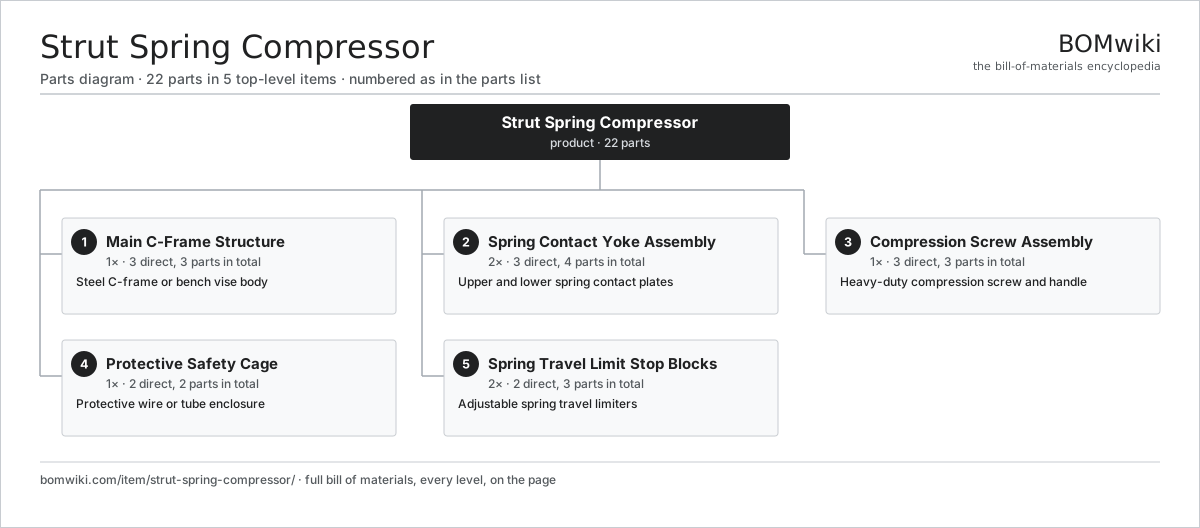
| # | Part | Qty | What it does |
|---|---|---|---|
| 1 | Main C-Frame Structure 3 parts | 1× | Steel C-frame or bench vise body |
| 2 | Spring Contact Yoke Assembly 3 parts | 2× | Upper and lower spring contact plates |
| 3 | Compression Screw Assembly 3 parts | 1× | Heavy-duty compression screw and handle |
| 4 | Protective Safety Cage 2 parts | 1× | Protective wire or tube enclosure |
| 5 | Spring Travel Limit Stop Blocks 2 parts | 2× | Adjustable spring travel limiters |
3D model
No 3D model yet. Have a CAD file of this? Add a 3D model. STL renders right on this page; STEP, FreeCAD, and OpenSCAD sources are welcome too (openly licensed, like all 3D models on BOMwiki).
Build & assembly graph
expand / collapse · shared sub-assemblies converge · links to related products · est. labourTap an assembly to expand/collapse · tap a part to open it · use “Open page” for any node · drag to pan, scroll to zoom.
Bill of materials for Strut Spring Compressor
5 top-level lines · 18 rows shown · 22 parts total · indented to 3 levels| # | Item / sub-assembly | Part no. | Qty/assy | Ext. qty | Parts | Type |
|---|---|---|---|---|---|---|
| 1 | Main C-Frame Structure 3 parts | strut-compressor-frame | 1× | 1 | 3 | assembly |
| 1.1 | C-Frame Body | strut-compressor-frame-body | 1× | 1 | · | part |
| 1.2 | Base Plate | strut-compressor-frame-base | 1× | 1 | · | part |
| 1.3 | Mounting Boss | strut-compressor-mounting-holes | 1× | 1 | · | part |
| 2 | Spring Contact Yoke Assembly 3 parts | strut-compressor-yokes | 2× | 2 | 4 | assembly |
| 2.1 | Upper Yoke | strut-compressor-yoke-upper | 1× | 2 | · | part |
| 2.2 | Lower Yoke | strut-compressor-yoke-lower | 1× | 2 | · | part |
| 2.3 | Yoke Contact Pad | strut-compressor-yoke-pad | 2× | 4 | · | part |
| 3 | Compression Screw Assembly 3 parts | strut-compressor-screw | 1× | 1 | 3 | assembly |
| 3.1 | Compression Screw Shaft | strut-compressor-screw-shaft | 1× | 1 | · | part |
| 3.2 | Compression Handle | strut-compressor-screw-handle | 1× | 1 | · | part |
| 3.3 | Driving Nut Assembly | strut-compressor-screw-nut | 1× | 1 | · | part |
| 4 | Protective Safety Cage 2 parts | strut-compressor-safety-cage | 1× | 1 | 2 | assembly |
| 4.1 | Safety Cage Mesh | strut-compressor-cage-wire | 1× | 1 | · | part |
| 4.2 | Cage Mounting Bracket | strut-compressor-cage-mount | 1× | 1 | · | part |
| 5 | Spring Travel Limit Stop Blocks 2 parts | strut-compressor-stops | 2× | 2 | 3 | assembly |
| 5.1 | Stop Block | strut-compressor-stop-block | 2× | 4 | · | part |
| 5.2 | Stop Height Adjustment | strut-compressor-stop-adjustment | 1× | 2 | · | part |
Something wrong in this list? Report a problem with this BOM.
Sourcing: possible vendors
Browse the supplier directory → Prices, MOQ, and lead times are algorithmic estimates, not quotes, and not claims about these companies. Company mappings are curated by keyword; est. price band $5–$2k. How estimates work| Vendor | HQ | Specialty | MOQ | Lead time |
|---|
976-word article