Surgical Headlight
ProductOverview
A surgical headlight is a wearable illumination system designed to provide shadowless lighting in the deep cavities and narrow operative fields that characterize modern surgery. Unlike fixed overhead operating room lights, a headlight moves with the surgeon's head, casting a cone of light down the patient's axis and through the magnifying loupes or surgical microscope that the operator wears. The system uses high-output LEDs to generate bright, shadow-free illumination without generating excessive heat that would affect tissue or burn through sterile drapes.
The Light Engine (LED Module) houses a cluster of six to ten white LEDs producing approximately 60 W equivalent brightness. Rather than mounting the heat-generating LED module directly on the surgeon's head, which would be uncomfortable and dangerous, the lights are positioned in a slightly heavier battery-powered pack worn at the waist or attached to the surgeon's belt. Light is transmitted over long distances through an Fiber Optic Light Guide Bundle, a flexible bundle of several hundred 700 µm silica fibers that deliver the light with minimal loss. The surgeon wears the light module head-mounted, weighing only a few hundred grams, positioned on the Headband & Gimbal Assembly with an ergonomic Adjustable Gimbal Arm that allows quick adjustment of the illumination angle without compromising sterility.
Light generation and transmission
The LED Array Module comprises individual 10 W white LEDs binned to ≤50 K color temperature drift. These diodes operate at 5000–6500 K, mimicking daylight, which reduces eye strain over long operative periods. Power is supplied via a Battery Pack Assembly containing 11.1 V of lithium-ion cells in series. The Power & Brightness Controller regulates LED current using a programmable MOSFET driver, allowing the surgeon to adjust brightness in ten discrete steps or to dim continuously using PWM (pulse-width modulation).
The light from all LEDs converges at an Collimating Lens, an aspheric lens that transforms the divergent point sources into a parallel collimated beam approximately 40 mm in diameter. This uniform beam enters the proximal end of the Fiber Optic Light Guide Bundle. The bundle consists of 500–800 individual step-index fibers, each 700 µm in core diameter with borosilicate glass cladding. Fibers are loosely bound by a Protective Fiber Jacket of silicone-coated polyimide that is autoclavable and flexible enough to route along the body without kinking.
At the distal end, the Fiber Termination Ring crimp-seals the fiber bundle, preventing light leakage and unraveling. The fibers then feed into an Lens Housing Collar containing the Exit Projection Lens, which recollates the divergent light exiting the fiber bundle into a controlled beam cone projected onto the operative field.
Beam control and focusing
An electrically-driven Iris Aperture Control allows the surgeon to adjust beam cone angle from 10° to 40°. A narrow 10° beam provides intense spot illumination for detail work in constrained spaces, such as during ophthalmic microsurgery. A wide 40° beam illuminates a broader field, suitable for general open surgery. The iris blades are motor-driven by the Iris Stepper Motor, controlled via a thumbwheel or foot switch, allowing adjustment without removing hands from the surgical field.
The Adjustable Gimbal Arm mounted on the Headband & Gimbal Assembly allows the surgeon to tilt and pan the light module ±25° to change the illumination angle relative to the line of sight. Ball joints provide smooth articulation, and a Position Lock Knob friction clamp locks the position once set, preventing accidental drift during use.
Power and control
The Battery Pack Assembly contains three 3.7 V 18650 lithium-ion cells connected in series, yielding 11.1 V at 2.2 Ah (24.4 Wh). Integrated battery management electronics include over-charge and over-discharge protection via a Battery Management System module with a thermal cut-off. The pack is worn in a Battery Housing that mounts at the surgeon's waist via a Wear Clip / Belt Attachment spring clip compatible with standard surgical gowns. A Umbilical Cable Assembly routes from the battery pack to the head-mounted light engine, carrying power and control lines.
The Power & Brightness Controller housed in the light engine accepts input from brightness control and iris adjustment mechanisms. A Brightness Adjustment (Thumbwheel) thumbwheel mounted on the headlight body allows real-time dimming. A LED Status Indicator LED glows green during normal operation, yellow when battery voltage drops below 9 V, and red when thermal shutdown is imminent. An optional Low-Battery Buzzer provides an audible alert if battery is critically low, prompting the surgeon to swap packs.
Thermal management and surgical practicality
Unlike incandescent or halogen headlights, LEDs produce much less radiant heat. Still, with 60 W of optical power, some thermal management is necessary. A Aluminum Heatsink Fin Array aluminum heatsink fin array affixed to the LED module dissipates heat passively through natural convection. The TIM (Thermal Interface Material) material (silicone-free gap filler) bonds the LED cluster to the heatsink, ensuring good thermal contact while remaining steam-sterilizable.
The fiber-optic delivery means no heat travels to the patient or the surgical field, a major safety advantage. The head-mounted module itself remains warm but not hot (typically <50°C at the grip), preventing discomfort or accidental burns. The fiber bundle can be sterilized via steam autoclave after wrapping in protective packaging, and single-use sterile fiber bundles are also available to ensure cross-contamination prevention in high-risk environments.
Clinical workflow
Before the surgical procedure, the surgeon dons the headlight system: the Headband & Gimbal Assembly is adjusted to fit the 50–58 cm range, and the Adjustable Gimbal Arm is positioned so the light module rests comfortably in line with the eyes. The battery pack is clipped to the waist. Once surgical loupes or a microscope is positioned, the surgeon powers on the light, adjusts brightness to a comfortable level (typically 50–70% for general surgery, higher for microsurgery), and sets the iris to the desired beam width.
During the procedure, the surgeon can continuously adjust brightness using the thumbwheel, or reset the iris dial to zoom the beam without disrupting work. The flexible fiber bundle allows the light to pivot with head motion, and the gimbal permits quick changes in illumination angle if different viewing is needed. After surgery, the fiber bundle is detached from the headlight module, coiled, and sent to sterile processing for steam autoclaving or cold sterilization; the battery pack is removed, recharged in the charging dock, and stored until the next use.
Surgical Headlight parts and their functions
7 top-level parts · 37 parts in total · full bill of materials below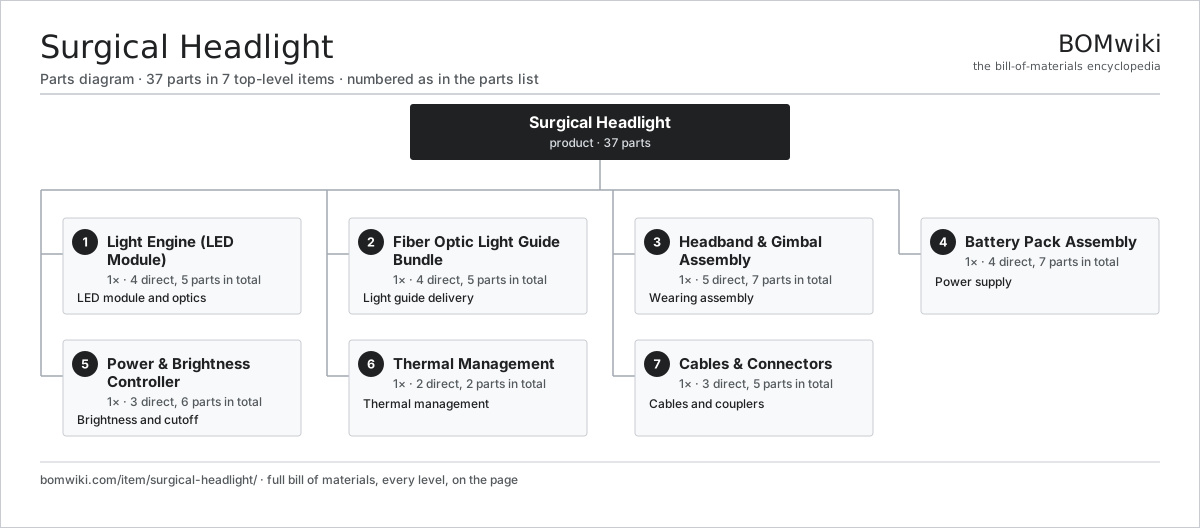
| # | Part | Qty | What it does |
|---|---|---|---|
| 1 | Light Engine (LED Module) 4 parts | 1× | LED module and optics |
| 2 | Fiber Optic Light Guide Bundle 4 parts | 1× | Light guide delivery |
| 3 | Headband & Gimbal Assembly 5 parts | 1× | Wearing assembly |
| 4 | Battery Pack Assembly 4 parts | 1× | Power supply |
| 5 | Power & Brightness Controller 3 parts | 1× | Brightness and cutoff |
| 6 | Thermal Management 2 parts | 1× | Thermal management |
| 7 | Cables & Connectors 3 parts | 1× | Cables and couplers |
3D model
No 3D model yet. Have a CAD file of this? Add a 3D model. STL renders right on this page; STEP, FreeCAD, and OpenSCAD sources are welcome too (openly licensed, like all 3D models on BOMwiki).
Build & assembly graph
expand / collapse · shared sub-assemblies converge · links to related products · est. labourTap an assembly to expand/collapse · tap a part to open it · use “Open page” for any node · drag to pan, scroll to zoom.
Bill of materials for Surgical Headlight
7 top-level lines · 47 rows shown · 37 parts total · indented to 3 levels| # | Item / sub-assembly | Part no. | Qty/assy | Ext. qty | Parts | Type |
|---|---|---|---|---|---|---|
| 1 | Light Engine (LED Module) 4 parts | surgical-headlight-light-engine | 1× | 1 | 5 | assembly |
| 1.1 | LED Array Module | surgical-headlight-led-cluster | 1× | 1 | · | part |
| 1.2 | Collimating Lens | surgical-headlight-collimating-lens | 1× | 1 | · | part |
| 1.3 | Iris Aperture Control 2 parts | surgical-headlight-iris-diaphragm | 1× | 1 | 2 | assembly |
| 1.3.1 | Iris Stepper Motor | surgical-headlight-iris-motor | 1× | 1 | · | part |
| 1.3.2 | Iris Blade Assembly | surgical-headlight-iris-mechanism | 1× | 1 | · | part |
| 1.4 | LED Heatsink Assembly | surgical-headlight-heat-sink | 1× | 1 | · | part |
| 2 | Fiber Optic Light Guide Bundle 4 parts | surgical-headlight-fiber-bundle | 1× | 1 | 5 | assembly |
| 2.1 | Fiber Bundle Core | surgical-headlight-multi-fiber-bundle | 1× | 1 | · | part |
| 2.2 | Protective Fiber Jacket | surgical-headlight-fiber-jacket | 1× | 1 | · | part |
| 2.3 | Fiber Termination Ring | surgical-headlight-fiber-termination-ring | 1× | 1 | · | part |
| 2.4 | Exit Lens Adapter 2 parts | surgical-headlight-fiber-lens-adapter | 1× | 1 | 2 | assembly |
| 2.4.1 | Exit Projection Lens | surgical-headlight-exit-lens | 1× | 1 | · | part |
| 2.4.2 | Lens Housing Collar | surgical-headlight-adapter-housing | 1× | 1 | · | part |
| 3 | Headband & Gimbal Assembly 5 parts | surgical-headlight-headband | 1× | 1 | 7 | assembly |
| 3.1 | Headband Frame | surgical-headlight-headband-frame | 1× | 1 | · | part |
| 3.2 | Comfort Padding | surgical-headlight-headband-padding | 1× | 1 | · | part |
| 3.3 | Adjustable Gimbal Arm 2 parts | surgical-headlight-gimbal-arm | 1× | 1 | 3 | assembly |
| 3.3.1 | Arm Support Rod | surgical-headlight-arm-rod | 1× | 1 | · | part |
| 3.3.2 | Ball Joint Coupler | surgical-headlight-ball-joint | 2× | 2 | · | part |
| 3.4 | Gimbal Pivot Mechanism | surgical-headlight-gimbal-joint | 1× | 1 | · | part |
| 3.5 | Position Lock Knob | surgical-headlight-position-lock | 1× | 1 | · | part |
| 4 | Battery Pack Assembly 4 parts | surgical-headlight-battery-pack | 1× | 1 | 7 | assembly |
| 4.1 | Lithium Battery Module 1 parts | surgical-headlight-battery-cells | 1× | 1 | 3 | assembly |
| 4.1.1 | Li-ion Cell, 18650 | li-cell-18650 | 3× | 3 | · | part |
| 4.2 | Battery Management System 2 parts | surgical-headlight-battery-bms | 1× | 1 | 2 | assembly |
| 4.2.1 | BMS Control Board | surgical-headlight-bms-pcb | 1× | 1 | · | part |
| 4.2.2 | Battery Fuse (30 A) | surgical-headlight-protection-fuse | 1× | 1 | · | part |
| 4.3 | Battery Housing | surgical-headlight-battery-casing | 1× | 1 | · | part |
| 4.4 | Wear Clip / Belt Attachment | surgical-headlight-wear-clip | 1× | 1 | · | part |
| 5 | Power & Brightness Controller 3 parts | surgical-headlight-power-controller | 1× | 1 | 6 | assembly |
| 5.1 | Main Controller Board 2 parts | surgical-headlight-controller-pcb | 1× | 1 | 3 | assembly |
| 5.1.1 | Microcontroller | mcu | 1× | 1 | · | part |
| 5.1.2 | Power MOSFET | mosfet | 2× | 2 | · | part |
| 5.2 | Brightness Adjustment (Thumbwheel) | surgical-headlight-brightness-control | 1× | 1 | · | part |
| 5.3 | LED Status Indicator 2 parts | surgical-headlight-status-indicator | 1× | 1 | 2 | assembly |
| 5.3.1 | RGB Status LED | surgical-headlight-status-led | 1× | 1 | · | part |
| 5.3.2 | Low-Battery Buzzer | surgical-headlight-status-buzzer | 1× | 1 | · | part |
| 6 | Thermal Management 2 parts | surgical-headlight-cooling | 1× | 1 | 2 | assembly |
| 6.1 | Aluminum Heatsink Fin Array | surgical-headlight-passive-cooler | 1× | 1 | · | part |
| 6.2 | TIM (Thermal Interface Material) | surgical-headlight-thermal-interface | 1× | 1 | · | part |
| 7 | Cables & Connectors 3 parts | surgical-headlight-interconnect | 1× | 1 | 5 | assembly |
| 7.1 | Umbilical Cable Assembly | surgical-headlight-umbilical-cable | 1× | 1 | · | part |
| 7.2 | Power Quick-Connect Coupler | surgical-headlight-power-connector | 2× | 2 | · | part |
| 7.3 | Charging Dock / Base Station 2 parts | surgical-headlight-charging-dock | 1× | 1 | 2 | assembly |
| 7.3.1 | Power Supply | power-supply | 1× | 1 | · | part |
| 7.3.2 | Charging Connector Interface | surgical-headlight-dock-connector | 1× | 1 | · | part |
Something wrong in this list? Report a problem with this BOM.
Related products
same domain, ranked by shared parts Fetal Doppler
41 parts · shares 2 with this page
Vein Finder (Near-IR Vein Locator)
65 parts · shares 2 with this page
Fetal Doppler
41 parts · shares 2 with this page
Vein Finder (Near-IR Vein Locator)
65 parts · shares 2 with this page
Sourcing: possible vendors
Browse the supplier directory → Prices, MOQ, and lead times are algorithmic estimates, not quotes, and not claims about these companies. Company mappings are curated by keyword; est. price band $500–$3M. How estimates work| Vendor | HQ | Specialty | MOQ | Lead time |
|---|---|---|---|---|
| gehealthcare.com ↗ | Chicago, US | Medical imaging & devices | 100 units | 12–20 wks |
| siemens-healthineers.com ↗ | Erlangen, DE | Medical systems | 100 units | 12–20 wks |
|
🇳🇱Philips
philips.com ↗
|
Amsterdam, NL | Health technology | 100 units | 12–20 wks |
| medtronic.com ↗ | Minneapolis, US | Medical devices | 100 units | 12–20 wks |
|
🇨🇳Mindray
mindray.com ↗
|
Shenzhen, CN | Medical devices | 100 units | 12–20 wks |
1,101-word article