Surgical Smoke Evacuator
ProductOverview
Surgical smoke, also called plume or aerosol, is produced when electrosurgery, laser, or cautery ablates tissue. The smoke contains viable cellular material, DNA fragments, and hazardous volatile compounds including benzene, toluene, and formaldehyde. Uncontrolled plume exposure is a known occupational hazard to surgical staff, with repeated inhalation linked to respiratory symptoms, immunosuppression, and theoretical malignancy risk. The surgical smoke evacuator is the standard intervention, removing plume at source via negative pressure suction and multi-stage ULPA filtration.
The device is mandatory in high-volume surgical centers in North America and increasingly adopted globally. Most modern ORs are equipped with portable evacuation carts; some institutions employ room-level central vacuum with surgeon-side suction outlets. The handheld capture pencil, integrated suction inlet around the electrosurgical tip, allows the surgeon to maintain plume control while operating.
How it Works
The surgeon activates the suction turbine via the foot pedal or console button. The AC motor spins the turbine impeller at up to 3600 rpm, creating 300–500 mmHg (40–67 kPa) negative pressure. This pressure draws plume and blood-tinged air from the surgical field through the suction tubing attached to the capture pencil.
The plume-laden air passes first through the collection trap, a 1–2 L canister downstream of the pencil. The inlet valve is a one-way check preventing backflow. Heavier particulates and fluid droplets settle in the trap; a float switch alerts the nurse when the canister reaches 80% fill, at which point the drain port allows safe disposal.
Air continues from the trap into the filter stack. The pre-filter (1 µm) removes surgical sponge fibers and gross particulates. The main ULPA H14 stage (99.995% efficiency at 0.3 µm) captures virus-sized particles and cellular debris. Finally, a carbon filter layer absorbs volatile organic compounds, benzene, toluene, formaldehyde, that would otherwise pass through as odorous gas.
The vacuum gauge on the control console displays real-time suction pressure. As the filters progressively clog with use (over days to weeks), suction pressure rises. An alarm triggers when differential pressure exceeds baseline by >100 mmHg, signaling the filter needs replacement. The variable-frequency drive allows the surgeon or anesthetist to adjust suction strength from 0% (standby) to 100% (maximum plume clearance).
Exhaust air exits the device either to the OR room or, in central systems, to the facility's main air handling unit. The motor bearing set is oil-lubricated and rated 50,000 hours of operation, typical life span for high-utilization surgical equipment.
Pencil Design
The capture pencil is the surgeon's interface. It resembles a standard electrosurgical handpiece but includes a suction inlet ring around the electrode tip. As the tip contacts tissue and plume forms, the inlet immediately draws smoke away. The pencil grip is ergonomically designed for one-handed operation; the surgeon holds the pencil in the dominant hand while the non-dominant hand manages retraction or grasps instruments, leaving both hands free, the suction is hands-off via the foot pedal.
Monopolar pencils (common in general and vascular surgery) apply RF energy through the tip to ground via patient return pad. Bipolar pencils (used in neurosurgery) complete the circuit between two tips on the same handpiece, eliminating need for a patient ground pad and reducing RF scatter. Both variants work with the same evacuator unit; the pencil tip is swappable.
Filter Life and Maintenance
ULPA filters clog gradually, first visible as rising suction pressure (alarm threshold typically set at 100 mmHg above baseline). Filter life depends on plume volume: high-utilization services (e.g., 20+ ablative cases daily) may change filters weekly; low-volume services may run 1–2 months per cartridge. The filter frame uses quick-change latches, allowing a nurse to swap a depleted cartridge in <2 minutes between cases.
The trap canister is typically disposable but can be autoclaved and reused in resource-constrained settings. The motor bearings require periodic oil lubrication (every 200 operating hours on high-use units); replacement or rebuilding is a service center task.
Clinical Outcomes
Studies show properly functioning evacuators reduce surgeon and OR staff inhalation of plume by >90% compared to unvented surgery. Organizations including OSHA, AORN (Association of periOperative Nurses), and the National Institute for Occupational Safety and Health (NIOSH) recommend plume evacuation as standard of care. Long-term surveillance of vented vs. unvented surgical staff is ongoing, but short-term respiratory outcomes are clearly superior with evacuation.
Effective plume control requires proper technique: the pencil must be held close to tissue (within 1–2 cm) for optimal capture, and the foot pedal should remain engaged only during active ablation, continuous suction is unnecessary and wastes filter life. Some surgeons prefer low-flow gentle suction during fine work and higher suction during bulk ablation, a capability enabled by the variable-speed drive.
Surgical Smoke Evacuator parts and their functions
7 top-level parts · 28 parts in total · full bill of materials below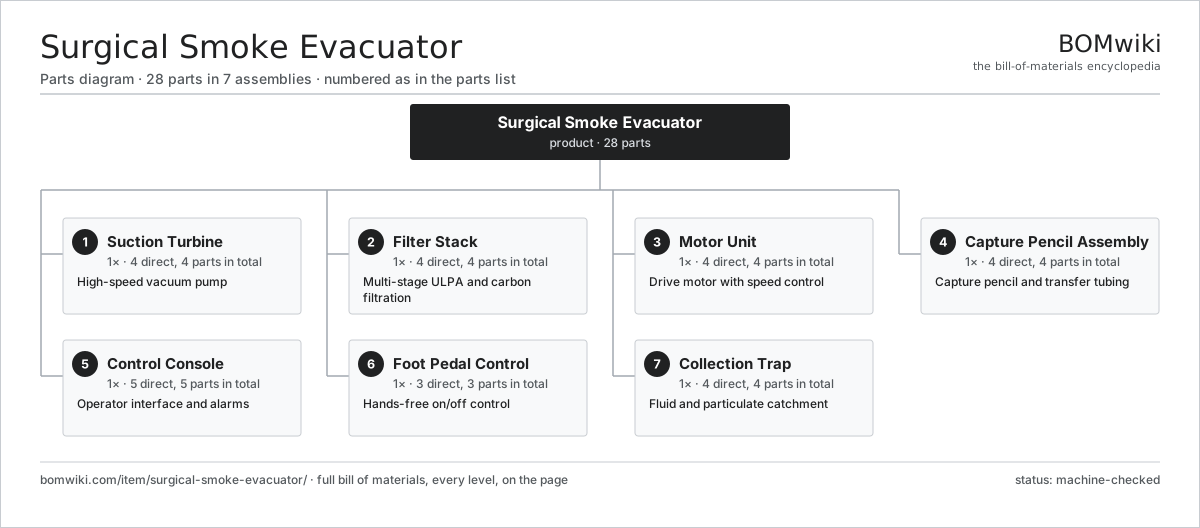
| # | Part | Qty | What it does |
|---|---|---|---|
| 1 | Suction Turbine 4 parts | 1× | High-speed vacuum pump |
| 2 | Filter Stack 4 parts | 1× | Multi-stage ULPA and carbon filtration |
| 3 | Motor Unit 4 parts | 1× | Drive motor with speed control |
| 4 | Capture Pencil Assembly 4 parts | 1× | Capture pencil and transfer tubing |
| 5 | Control Console 5 parts | 1× | Operator interface and alarms |
| 6 | Foot Pedal Control 3 parts | 1× | Hands-free on/off control |
| 7 | Collection Trap 4 parts | 1× | Fluid and particulate catchment |
3D model
No 3D model yet. Have a CAD file of this? Add a 3D model — STL renders right on this page; STEP, FreeCAD, and OpenSCAD sources are welcome too (openly licensed, like all 3D models on BOMwiki).
Build & assembly graph
expand / collapse · shared sub-assemblies converge · links to related products · est. labourTap an assembly to expand/collapse · tap a part to open it · use “Open page” for any node · drag to pan, scroll to zoom.
Bill of materials for Surgical Smoke Evacuator
7 top-level lines · 35 rows shown · 28 parts total · indented to 3 levels| # | Item / sub-assembly | Part no. | Qty/assy | Ext. qty | Parts | Type |
|---|---|---|---|---|---|---|
| 1 | Suction Turbine 4 parts | surgical-smoke-evacuator-suction-turbine | 1× | 1 | 4 | assembly |
| 1.1 | Turbine Rotor | surgical-smoke-evacuator-turbine-rotor | 1× | 1 | · | part |
| 1.2 | Turbine Housing | surgical-smoke-evacuator-turbine-housing | 1× | 1 | · | part |
| 1.3 | Bearing Set | surgical-smoke-evacuator-bearing-set | 1× | 1 | · | part |
| 1.4 | Drive Shaft | surgical-smoke-evacuator-shaft | 1× | 1 | · | part |
| 2 | Filter Stack 4 parts | surgical-smoke-evacuator-filter-stack | 1× | 1 | 4 | assembly |
| 2.1 | Pre-filter | surgical-smoke-evacuator-prefilter | 1× | 1 | · | part |
| 2.2 | ULPA Filter | surgical-smoke-evacuator-ulpa-filter | 1× | 1 | · | part |
| 2.3 | Carbon Filter | surgical-smoke-evacuator-carbon-filter | 1× | 1 | · | part |
| 2.4 | Filter Frame | surgical-smoke-evacuator-filter-frame | 1× | 1 | · | part |
| 3 | Motor Unit 4 parts | surgical-smoke-evacuator-motor-unit | 1× | 1 | 4 | assembly |
| 3.1 | AC Motor | surgical-smoke-evacuator-ac-motor | 1× | 1 | · | part |
| 3.2 | Start Capacitor | surgical-smoke-evacuator-capacitor | 1× | 1 | · | part |
| 3.3 | Speed Controller | surgical-smoke-evacuator-speed-controller | 1× | 1 | · | part |
| 3.4 | Motor Mount | surgical-smoke-evacuator-motor-mounting | 1× | 1 | · | part |
| 4 | Capture Pencil Assembly 4 parts | surgical-smoke-evacuator-tubing-pencil | 1× | 1 | 4 | assembly |
| 4.1 | Capture Pencil | surgical-smoke-evacuator-capture-pencil | 1× | 1 | · | part |
| 4.2 | Pencil Tip | surgical-smoke-evacuator-pencil-tip | 1× | 1 | · | part |
| 4.3 | Suction Tubing | surgical-smoke-evacuator-suction-tubing | 1× | 1 | · | part |
| 4.4 | Tubing Connector | surgical-smoke-evacuator-tubing-connector | 1× | 1 | · | part |
| 5 | Control Console 5 parts | surgical-smoke-evacuator-control-console | 1× | 1 | 5 | assembly |
| 5.1 | Display Panel | surgical-smoke-evacuator-display-panel | 1× | 1 | · | part |
| 5.2 | Speed Knob | surgical-smoke-evacuator-speed-knob | 1× | 1 | · | part |
| 5.3 | Power Button | surgical-smoke-evacuator-power-button | 1× | 1 | · | part |
| 5.4 | Alarm Indicator | surgical-smoke-evacuator-alarm-indicator | 1× | 1 | · | part |
| 5.5 | Relay | relay | 1× | 1 | · | part |
| 6 | Foot Pedal Control 3 parts | surgical-smoke-evacuator-footswitch | 1× | 1 | 3 | assembly |
| 6.1 | Pedal Mechanism | surgical-smoke-evacuator-pedal-mechanism | 1× | 1 | · | part |
| 6.2 | Pedal Cable | surgical-smoke-evacuator-pedal-cable | 1× | 1 | · | part |
| 6.3 | Relay | relay | 1× | 1 | · | part |
| 7 | Collection Trap 4 parts | surgical-smoke-evacuator-collection-trap | 1× | 1 | 4 | assembly |
| 7.1 | Trap Canister | surgical-smoke-evacuator-trap-canister | 1× | 1 | · | part |
| 7.2 | Inlet Valve | surgical-smoke-evacuator-inlet-valve | 1× | 1 | · | part |
| 7.3 | Drain Port | surgical-smoke-evacuator-drain-port | 1× | 1 | · | part |
| 7.4 | Float Switch | surgical-smoke-evacuator-float-switch | 1× | 1 | · | part |
Related products
same domain, ranked by shared parts Apheresis Machine
199 parts · shares 1 with this page
Autopsy Table
78 parts · shares 1 with this page
Apheresis Machine
199 parts · shares 1 with this page
Autopsy Table
78 parts · shares 1 with this page
 Blood Bank Refrigerator
79 parts · shares 1 with this page
Blood Gas Analyzer
386 parts · shares 1 with this page
Blood Bank Refrigerator
79 parts · shares 1 with this page
Blood Gas Analyzer
386 parts · shares 1 with this page
 Clinical Audiometer
608 parts · shares 1 with this page
Clinical Audiometer
608 parts · shares 1 with this page
 Cryosurgery Unit
33 parts · shares 1 with this page
Cryosurgery Unit
33 parts · shares 1 with this page
Sourcing: possible vendors
Prices, MOQ, and lead times are algorithmic estimates, not quotes, and not claims about these companies. Company mappings are curated by keyword; est. price band $500–$3M. How estimates work| Vendor | HQ | Specialty | MOQ | Lead time |
|---|---|---|---|---|
| gehealthcare.com ↗ | Chicago, US | Medical imaging & devices | 100 units | 12–20 wks |
| siemens-healthineers.com ↗ | Erlangen, DE | Medical systems | 100 units | 12–20 wks |
|
🇳🇱Philips
philips.com ↗
|
Amsterdam, NL | Health technology | 100 units | 12–20 wks |
| medtronic.com ↗ | Minneapolis, US | Medical devices | 100 units | 12–20 wks |
|
🇨🇳Mindray
mindray.com ↗
|
Shenzhen, CN | Medical devices | 100 units | 12–20 wks |
915-word article