Automatic Swing Door Operator
ProductOverview
An automatic swing door operator is a motorized device that opens (and assists in closing) hinged doors without requiring manual push force. The operator is most commonly seen at building entrances (retail stores, hospitals, offices) and is essential for accessibility: people with mobility impairments, parents with strollers, and those carrying large loads can pass through doors without needing to open them manually.
The operator opens doors via two primary control modes: automatic (motion sensor detects approach and signals the motor to push the door open) and manual (user presses an accessible push button). Many operators integrate with access control systems: a cardholder swipes a badge, the access panel sends a signal to the door operator, and the door unlocks and opens automatically.
How it works
The motor and gearbox provide the driving force. A 24 VDC brushed motor rated 200–500 W is coupled to a planetary gearbox with a 50:1 to 200:1 reduction ratio. This gearbox multiplies the motor torque by 50–200 times, allowing a relatively small motor to exert enough force to open a heavy (100+ kg) hinged door against wind resistance and mechanical friction.
The drive arm is a mechanical linkage connecting the gearbox output shaft to either the door's push hardware or the frame-mounted door actuator. As the gearbox output rotates, it pulls or pushes the drive arm, which in turn pulls the door open. The drive arm is typically 300–500 mm long; the leverage multiplies the gearbox torque further.
The controller board is the logical hub. It receives inputs from three sources:
Motion sensor: The sensor module detects approaching occupants via infrared (PIR) or microwave doppler sensing. The PIR sensor detects body heat from 1–2 meters away; the microwave sensor detects motion via doppler shift. When motion is detected, the sensor output goes high.
Push button: An accessible push button on the door frame allows manual triggering. The button is oversized (50 mm diameter) and requires minimal activation force (5–9 N) for ADA accessibility compliance.
Access control signal: If integrated with an access control system, the panel sends a low-voltage relay contact closure to the operator, commanding the door to open.
The MCU firmware implements the state machine:
- CLOSED state: Door is at full close position (0°), detected by the limit switch. Motor is de-energized. MCU continuously monitors motion sensor.
- OPENING state: Motion is detected or push button is pressed. MCU energizes the motor in forward direction. The door swings open. MCU monitors the open limit switch.
- OPEN state: Door reaches 90° (full open position), detected by limit switch. Motor is de-energized. MCU starts a hold timer (typically 3–5 seconds).
- AUTO-CLOSING state: Hold timer expires. MCU sends motor command to reverse direction, allowing the door to swing closed under its own spring pressure (powered assist optional). MCU monitors the close limit switch.
- CLOSED: Full close position reached. Motor de-energizes. MCU returns to idle monitoring.
Sensor operation and false-trigger mitigation
Motion sensors can generate false positives in busy environments: a person standing still at an entrance can trigger repeated openings if the sensor sensitivity is too high. Modern controllers include debounce logic and timer thresholds to minimize false triggers:
- Hold time: After motion is detected, the MCU waits 200–500 ms before energizing the motor, ensuring the detection is not noise.
- Retrigger lockout: After a door-open cycle completes, the MCU ignores motion sensor input for 5–10 seconds to prevent the sensor from re-triggering the door while it is closing.
- Sensitivity zones: Advanced sensors divide the detection area into concentric rings (0.5 m, 1 m, 1.5 m, 2 m). Only motion in the far rings (>1 m) triggers door opening; motion in the near ring (<0.5 m) is ignored (prevents opening when someone is standing at the door).
PIR sensors are preferred in controlled environments (offices, hospitals) where temperature is stable. Microwave sensors are used in highly variable temperature environments (storefronts with glass doors, outdoor entrances) because PIR performance degrades with wind chill and thermal reflections.
Control modes and integration
The operator supports multiple control modes:
Sensor-driven: The motion sensor continuously monitors for approaching occupants. When motion is detected, the door opens automatically. This is the standard mode for retail storefronts, cafeterias, and public bathrooms. Occupants simply approach and walk through without lifting a finger.
Manual push button: Some entrances disable the motion sensor and require manual push-button activation. This is used in secure facilities (server rooms, restricted labs) where automatic opening is not desired, or in low-traffic areas where motion-sensor power consumption is wasteful.
Card-reader activation: Integration with an access control system allows the door to open only when a valid credential is presented. The access panel sends a relay contact closure or 24 VDC pulse to the door operator, commanding immediate opening. This is used on secure doors leading into restricted areas (executive suite, development lab).
Timed door unlock: For life-safety compliance, many operators include a "timed hold" mode: the door is held in the open position for a fixed duration (e.g., 30 seconds) to allow wheelchair users or people with mobility aids to pass through at their own pace, rather than having the door close while they are still approaching.
Mechanical design and mounting
The operator is typically mounted above the door frame in a header case. The motor and gearbox are housed inside; the drive arm extends down to the door or door frame hardware. For single-leaf doors (800–1200 mm wide), the operator is centered above the hinge side of the door; the drive arm pulls the door open from the push-bar side.
The limit switches are precision-mounted and calibrated to detect exact door position. A 1–2 mm mis-calibration can cause the motor to overshoot (driving the door beyond the hinge mechanical limit, straining the drive arm) or undershoot (not fully opening the door). Annual calibration and maintenance is required.
The operator should include a manual override: a mechanical lever or handle that allows the door to be manually pushed/pulled open even if the motor or power supply fails. This is essential for life-safety egress during emergencies.
Power consumption and battery backup
A typical operator draws 200–500 W during motor activation (opening or closing the door, 3–10 seconds per cycle). In a busy entrance with traffic every 2–3 seconds, the motor runs continuously during peak hours, consuming substantial power. Energy-efficient designs use brushless DC motors (BLDC) with variable-voltage control: the motor is powered at just enough voltage to overcome door resistance, reducing power draw.
For life-safety compliance, the power supply module includes optional battery backup (24 VDC sealed lead-acid, 5–10 Ah). If mains power is lost, the backup battery maintains the door operator's ability to open the door for 2–4 hours, ensuring occupants can exit the building during a fire or power outage. The battery self-test function checks capacity quarterly.
ADA accessibility compliance
The push button must comply with ADA 508 accessibility standards:
- Button size: Minimum 50 mm diameter for easy targeting by people with low vision or fine motor control impairment.
- Activation force: Maximum 5 lbf (22 N) for initial activation, maximum 8 lbf (36 N) sustained force.
- Visual/audible feedback: An illuminated button or beep confirms activation.
- Location: Button mounted 36–48 inches (0.9–1.2 m) from the ground on both sides of the door for accessibility from both directions.
- Door opening time: Minimum 3 seconds to allow slow-moving people (elderly, mobility impaired) to pass through.
Doors with automatic motion sensors are considered "accessible" without requiring a push button, as long as the sensor operates reliably and the door opens within 3 seconds of occupant approach.
Maintenance and diagnostics
Motor brushes in brushed DC motors wear with repeated cycling; typical brush life is 500,000–1,000,000 cycles. In a busy entrance opening every 2 seconds 10 hours per day, brush life is 3–5 years. A worn brush set reduces motor torque and increases current draw; excessive sparking at the commutator indicates imminent brush failure.
Gearbox lubricant (synthetic oil) can degrade over time, especially in high-temperature environments. The gearbox should be re-oiled every 2–3 years; inadequate lubrication causes gear wear and increased noise.
The mechanical drive arm should be visually inspected for bending or cracks. Even a 5 mm lateral flex can cause the door to bind and increase motor load.
Limit switches accumulate dirt and dust and can become unreliable. A periodic contact-cleaning and adjustment is required; a stuck limit switch can prevent the door from fully opening or closing, requiring manual override.
The motion sensor requires periodic cleaning and sensitivity adjustment. Dust on the sensor lens degrades detection range; in dusty environments (construction sites, warehouse entrances), more frequent cleaning is needed.
Integration with video surveillance and entry logging
Modern door operators can integrate with video surveillance and entry logging systems:
- Motion detector camera trigger: When the motion sensor detects approach, it simultaneously triggers a nearby video camera to start recording, creating a video record of every entrance.
- Entry log: Each door-open event is logged with timestamp, type (sensor/button/access panel), and optional cardholder ID (if card-reader integrated). This provides a physical security audit trail.
- Abnormal pattern detection: The central server can detect unusual patterns: if a door opens 100+ times in one hour (abnormal traffic spike), an alert is generated.
For buildings with multiple entrances, a central security console displays real-time status of all door operators: which doors are currently open, how many people passed through each entrance per hour, and any failure alerts (motor stuck, battery low, sensor failure).
Automatic Swing Door Operator parts and their functions
8 top-level parts · 43 parts in total · full bill of materials below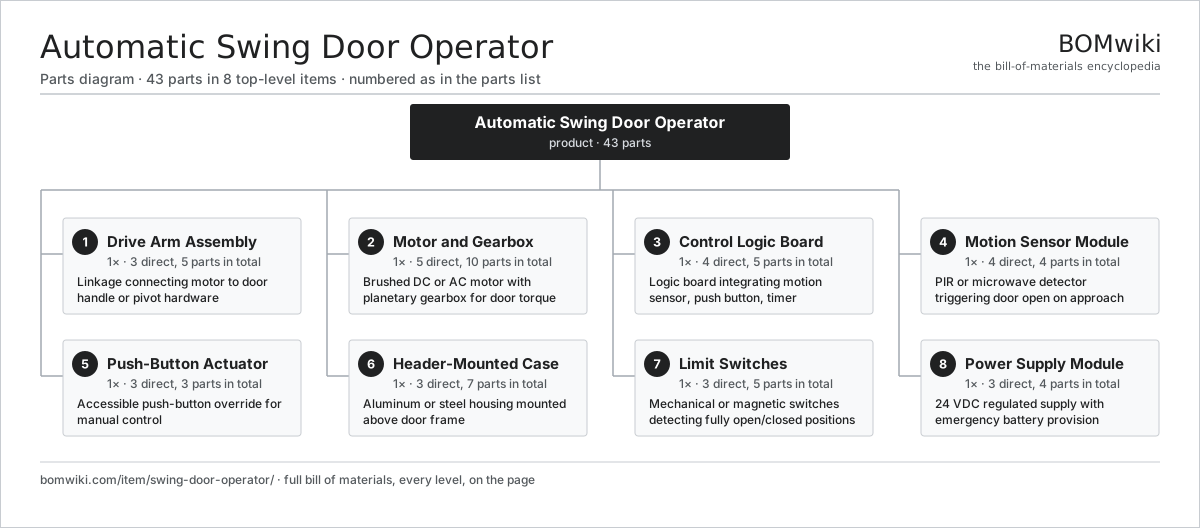
| # | Part | Qty | What it does |
|---|---|---|---|
| 1 | Drive Arm Assembly 3 parts | 1× | Linkage connecting motor to door handle or pivot hardware |
| 2 | Motor and Gearbox 5 parts | 1× | Brushed DC or AC motor with planetary gearbox for door torque |
| 3 | Control Logic Board 4 parts | 1× | Logic board integrating motion sensor, push button, timer |
| 4 | Motion Sensor Module 4 parts | 1× | PIR or microwave detector triggering door open on approach |
| 5 | Push-Button Actuator 3 parts | 1× | Accessible push-button override for manual control |
| 6 | Header-Mounted Case 3 parts | 1× | Aluminum or steel housing mounted above door frame |
| 7 | Limit Switches 3 parts | 1× | Mechanical or magnetic switches detecting fully open/closed positions |
| 8 | Power Supply Module 3 parts | 1× | 24 VDC regulated supply with emergency battery provision |
3D model
No 3D model yet. Have a CAD file of this? Add a 3D model. STL renders right on this page; STEP, FreeCAD, and OpenSCAD sources are welcome too (openly licensed, like all 3D models on BOMwiki).
Build & assembly graph
expand / collapse · shared sub-assemblies converge · links to related products · est. labourTap an assembly to expand/collapse · tap a part to open it · use “Open page” for any node · drag to pan, scroll to zoom.
Bill of materials for Automatic Swing Door Operator
8 top-level lines · 36 rows shown · 43 parts total · indented to 3 levels| # | Item / sub-assembly | Part no. | Qty/assy | Ext. qty | Parts | Type |
|---|---|---|---|---|---|---|
| 1 | Drive Arm Assembly 3 parts | swing-door-operator-drive-arm | 1× | 1 | 5 | assembly |
| 1.1 | Sheet Metal Panel | sheet-panel | 2× | 2 | · | part |
| 1.2 | Ball Bearing | ball-bearing | 2× | 2 | · | part |
| 1.3 | Fastener Set | fastener-set | 1× | 1 | · | part |
| 2 | Motor and Gearbox 5 parts | swing-door-operator-motor-gearbox | 1× | 1 | 10 | assembly |
| 2.1 | Blower Motor | blower-motor | 1× | 1 | · | part |
| 2.2 | Gearbox Housing | gearbox-housing | 1× | 1 | · | part |
| 2.3 | Helical Gear Pair | gear-pair | 4× | 4 | · | part |
| 2.4 | Oil Seal | oil-seal | 2× | 2 | · | part |
| 2.5 | Ball Bearing | ball-bearing | 2× | 2 | · | part |
| 3 | Control Logic Board 4 parts | swing-door-operator-controller | 1× | 1 | 5 | assembly |
| 3.1 | Microcontroller | mcu | 1× | 1 | · | part |
| 3.2 | Bare PCB | pcb-bare | 1× | 1 | · | part |
| 3.3 | Power MOSFET | mosfet | 2× | 2 | · | part |
| 3.4 | SMD Passive (R/C/L) | smd-passives | 1× | 1 | · | part |
| 4 | Motion Sensor Module 4 parts | swing-door-operator-motion-sensor | 1× | 1 | 4 | assembly |
| 4.1 | Hall Sensor | hall-sensor | 1× | 1 | · | part |
| 4.2 | Bare PCB | pcb-bare | 1× | 1 | · | part |
| 4.3 | Connector | connector | 1× | 1 | · | part |
| 4.4 | SMD Passive (R/C/L) | smd-passives | 1× | 1 | · | part |
| 5 | Push-Button Actuator 3 parts | swing-door-operator-push-button | 1× | 1 | 3 | assembly |
| 5.1 | Touch Digitizer | touch-digitizer | 1× | 1 | · | part |
| 5.2 | Bare PCB | pcb-bare | 1× | 1 | · | part |
| 5.3 | Connector | connector | 1× | 1 | · | part |
| 6 | Header-Mounted Case 3 parts | swing-door-operator-header-case | 1× | 1 | 7 | assembly |
| 6.1 | Sheet Metal Panel | sheet-panel | 4× | 4 | · | part |
| 6.2 | Fastener Set | fastener-set | 1× | 1 | · | part |
| 6.3 | Connector | connector | 2× | 2 | · | part |
| 7 | Limit Switches 3 parts | swing-door-operator-limit-switches | 1× | 1 | 5 | assembly |
| 7.1 | Hall Sensor | hall-sensor | 2× | 2 | · | part |
| 7.2 | Connector | connector | 1× | 1 | · | part |
| 7.3 | Coil Spring | coil-spring | 2× | 2 | · | part |
| 8 | Power Supply Module 3 parts | swing-door-operator-power-supply | 1× | 1 | 4 | assembly |
| 8.1 | Power Supply | power-supply | 1× | 1 | · | part |
| 8.2 | 12 V Battery | lv-battery | 1× | 1 | · | part |
| 8.3 | Connector | connector | 2× | 2 | · | part |
Something wrong in this list? Report a problem with this BOM.
Related products
same domain, ranked by shared parts Access Control Panel
52 parts · shares 7 with this page
Access Control Panel
52 parts · shares 7 with this page
 Intrusion Alarm Panel
40 parts · shares 7 with this page
Intrusion Alarm Panel
40 parts · shares 7 with this page
 Smart Parcel Locker
278 parts · shares 6 with this page
Smart Parcel Locker
278 parts · shares 6 with this page
 Electronic Key Cabinet
92 parts · shares 6 with this page
Electronic Key Cabinet
92 parts · shares 6 with this page
 Mantrap Interlock Portal
82 parts · shares 6 with this page
Mantrap Interlock Portal
82 parts · shares 6 with this page
 Magnetic Lock
24 parts · shares 5 with this page
Magnetic Lock
24 parts · shares 5 with this page
Sourcing: possible vendors
Browse the supplier directory → Prices, MOQ, and lead times are algorithmic estimates, not quotes, and not claims about these companies. Company mappings are curated by keyword; est. price band $50–$10k. How estimates work| Vendor | HQ | Specialty | MOQ | Lead time |
|---|---|---|---|---|
| assaabloy.com ↗ | Stockholm, SE | Locks & access | 1,000 units | 8–12 wks |
|
🇺🇸Allegion
allegion.com ↗
|
Dublin, US | Security products (Schlage) | 1,000 units | 8–12 wks |
| dormakaba.com ↗ | Rümlang, CH | Access & door systems | 1,000 units | 8–12 wks |
| honeywell.com ↗ | Charlotte, US | Building & safety tech | 1,000 units | 8–12 wks |
| hikvision.com ↗ | Hangzhou, CN | Surveillance & security | 1,000 units | 8–12 wks |
1,710-word article