Tabla Set
ProductOverview
The tabla is a pair of shallow hand drums from North Indian classical music. The Dayan is a higher-pitched treble drum (typically tuned to G3 or C4), played with the dominant hand, carrying melodic and ornamental patterns. The Bayan is a deeper bass drum (typically D2–G2), played with the other hand, providing a resonant rhythmic foundation. Played together, they create the rhythmic backbone of Indian classical concerts, producing everything from subtle tonal conversations to thunderous rolls.
The two drums are connected by a rope system that links them into a single tuning apparatus: tightening the rope raises the pitch of both drums slightly but proportionally. The interplay of hand positions, striking locations, and tuning adjustments creates dozens of distinct tone colours, each with its own name in the tabla tradition.
Dayan (treble drum)
The Dayan is a wooden barrel, a truncated cone of mango, neem, or rosewood wood, typically 12 cm in bore and about 25 cm across the top head. The wood choice affects the inherent pitch and resonance. Mango is warm and stable; neem is brighter; rosewood is more resonant but more fragile. The Dayan Shell is always open at both ends: one end is smaller (the base) and lies against the player's thigh, the other is larger (the top) and is stretched with the playing head.
The Top Head is a circle of untreated goatskin, typically 25 cm in diameter and 2–3 mm thick. It is stretched taut by a rope-and-strap lacing system and glued around its edge to a cloth reinforcement ring. At the centre of the head is the Syahi (struck spot), a hand-applied paste spot of flour, gum arabic, brick dust and rice husks. This syahi is the strike zone; it is intentionally damped and pitched. The paste stiffens the head locally, raising the pitch of the ''tha'' strike (the main tone) and giving it a metallic, ''thuk'' quality. Different syahi recipes and thicknesses produce dayan sounds from warm and woody (light syahi) to bright and penetrating (thick syahi).
The Tuning Block is a wedge of wood sitting underneath the head, positioned between the two rope attachments. By moving this block or changing the rope tension, the player adjusts the dayan pitch before and during a performance. Pitch tuning is slow (takes minutes) and usually done before playing, though skilled players can nudge it with light adjustments during a resting passage.
Bayan (bass drum)
The Bayan is dramatically different in construction. It is a kettle, a spun or welded copper or brass bowl, typically 15 cm in bore and 28 cm across the top. Unlike the dayan, the bayan is closed at the base; only the top is open and covered with the playing head. This gives it very different acoustics: the enclosed air acts as a spring, and the metal walls resonate sympathetically, producing a deep, complex tone with lots of natural sustain.
The Top Head is similar to the dayan's, untreated goat skin, but typically larger (28 cm) and thicker, stretched by a rope running around the rim and down the exterior. The Bayan Syahi is heavier and covers a larger area (10–12 cm) than the dayan's, optimized for the lower pitch and resonant sustain. The bayan's tone is fundamentally different: striking the syahi produces a deep bass drum sound; striking the outer rim produces a brighter, pitched treble tone (sometimes called ''chap''); placing a palm on the head near the edge creates ''dag'', a hand-muted tone.
The key tuning innovation on the bayan is the Finger Holes, one or more holes drilled or welded into the kettle side. By placing a finger or palm over these holes during playing, the performer changes the internal air pressure, shifting the pitch up or down. An open hole lowers the pitch; a covered hole raises it. This is the primary live tuning mechanism: as the player's hands move around the drum, they modulate pitch in real-time, creating dynamic tonal effects. Advanced players can execute pitch bends and microtonal slides on the bayan alone.
Head structure
Each Head consists of three elements: the Goatskin membrane, the Syahi Paste central paste, and the Edge Binding reinforcement. The goatskin is stretched wet and glued to a cloth ring at the rim to prevent splitting. Over time, the skin dries and tightens; very dry skins are carefully wetted again and allowed to re-dry to restore tension. In humid climates, the skin can loosen; in very dry climates, the skin may crack and require replacement every few years.
The syahi is applied by hand, usually mixed fresh by the drummer or a specialist. The recipe and consistency vary: a wetter paste yields a lower pitch and deeper tone; a thicker, drier paste yields higher pitch and brightness. Expert players can hear the exact pitch change as a wet syahi dries out during a performance.
Lacing and rope system
The Lacing connect the dayan and bayan into a single acoustically coupled system. The Bass Rope, traditionally jute or coir, now often nylon, runs around both drums in a figure-eight or double-loop pattern. This rope does two things: it physically distances the two drums so the dayan doesn't rattle against the bayan, and it couples their tuning, tightening the rope raises both pitches proportionally.
The Tuning Strap are removable leather cords (gajra) wound around the rope at various points. Wrapping a gajra tighter raises the pitch; unwrapping it lowers the pitch. A player preparing a set might wrap 2–4 gajra around the rope before performance, then fine-tune by unwrapping during play. Gajra adjustment is fast (seconds) and allows live pitch correction.
Some modern bayana use a Bayan Tuner, a foot pedal or screw mechanism that tightens the entire rope system, allowing hands-free pitch control during performance. Traditional players consider this less pure (less player control), but it is gaining acceptance in studio recording.
Tuning and maintenance
Before a performance, a tabla player spends considerable time tuning. The dayan is tuned first by adjusting the tuning block and rope tension, checking with a drone or pitch reference. The bayan is then tuned by adjusting its rope and gajra, and testing with the finger holes covered and uncovered. Because the skins swell and shrink with temperature and humidity, tuning must be checked every 15–30 minutes during a long concert, and the syahi paste may need to be rewetted or lightly retouched if it has begun to crack.
The heads eventually deteriorate: the syahi paste flakes off or dries to uselessness, or the goatskin itself cracks or develops a hole. Replacing a head is a significant undertaking, requiring soaking, stretching, gluing, and weeks of drying. Skilled tabla makers and repairers are valued specialists.
Playing technique
The player sits cross-legged, the dayan resting against the right thigh (for a right-handed player), the bayan on the left. The hands strike and dampen the heads using the fingers, palm, and heel of the hand. A single dayan strike near the syahi produces ''tha'' (mid-high pitch); a strike near the rim produces ''tak'' (high, bright). Similarly, the bayan near the syahi produces ''dhum'' (low bass); near the edge, ''kat'' or ''tang'' (high). Each strike location and hand position has a name, and the tabla repertoire consists of hundreds of stereotyped sequences, called ''bols'', which are chanted and then played rhythmically. A virtuoso can execute rapid bols at 180+ beats per minute, and a professional tabla session can last 30 minutes or more of continuous, intricate rhythmic interplay.
Tabla Set parts and their functions
6 top-level parts · 31 parts in total · full bill of materials below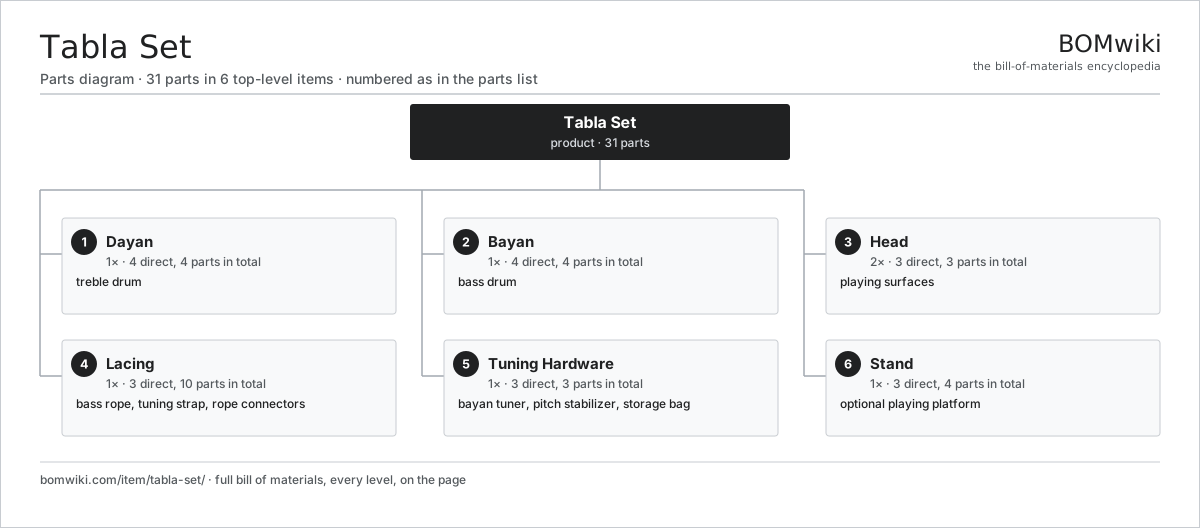
| # | Part | Qty | What it does |
|---|---|---|---|
| 1 | Dayan 4 parts | 1× | treble drum |
| 2 | Bayan 4 parts | 1× | bass drum |
| 3 | Head 3 parts | 2× | playing surfaces |
| 4 | Lacing 3 parts | 1× | Rope or leather cords running between drum shells, tensioning the heads and tuning pitch. |
| 5 | Tuning Hardware 3 parts | 1× | Mechanism for adjusting and maintaining pitch during performance. |
| 6 | Stand 3 parts | 1× | optional playing platform |
3D model
No 3D model yet. Have a CAD file of this? Add a 3D model. STL renders right on this page; STEP, FreeCAD, and OpenSCAD sources are welcome too (openly licensed, like all 3D models on BOMwiki).
Build & assembly graph
expand / collapse · shared sub-assemblies converge · links to related products · est. labourTap an assembly to expand/collapse · tap a part to open it · use “Open page” for any node · drag to pan, scroll to zoom.
Bill of materials for Tabla Set
6 top-level lines · 26 rows shown · 31 parts total · indented to 3 levels| # | Item / sub-assembly | Part no. | Qty/assy | Ext. qty | Parts | Type |
|---|---|---|---|---|---|---|
| 1 | Dayan 4 parts | tabla-dayan | 1× | 1 | 4 | assembly |
| 1.1 | Dayan Shell | tabla-dayan-shell | 1× | 1 | · | part |
| 1.2 | Top Head | tabla-dayan-top-head | 1× | 1 | · | part |
| 1.3 | Syahi (struck spot) | tabla-dayan-syahi | 1× | 1 | · | part |
| 1.4 | Tuning Block | tabla-dayan-tuning-block | 1× | 1 | · | part |
| 2 | Bayan 4 parts | tabla-bayan | 1× | 1 | 4 | assembly |
| 2.1 | Bayan Shell | tabla-bayan-shell | 1× | 1 | · | part |
| 2.2 | Top Head | tabla-bayan-top-head | 1× | 1 | · | part |
| 2.3 | Bayan Syahi | tabla-bayan-syahi | 1× | 1 | · | part |
| 2.4 | Finger Holes | tabla-bayan-finger-holes | 1× | 1 | · | part |
| 3 | Head 3 parts | tabla-heads-assembly | 2× | 2 | 3 | assembly |
| 3.1 | Goatskin | tabla-goatskin | 1× | 2 | · | part |
| 3.2 | Syahi Paste | tabla-syahi-paste | 1× | 2 | · | part |
| 3.3 | Edge Binding | tabla-edge-binding | 1× | 2 | · | part |
| 4 | Lacing 3 parts | tabla-lacing-straps | 1× | 1 | 10 | assembly |
| 4.1 | Bass Rope | tabla-bass-rope | 1× | 1 | · | part |
| 4.2 | Tuning Strap | tabla-tuning-strap | 8× | 8 | · | part |
| 4.3 | Rope Connectors | tabla-rope-connectors | 1× | 1 | · | part |
| 5 | Tuning Hardware 3 parts | tabla-tuning-hardware | 1× | 1 | 3 | assembly |
| 5.1 | Bayan Tuner | tabla-bayan-tuner | 1× | 1 | · | part |
| 5.2 | Pitch Stabilizer | tabla-pitch-stabilizer | 1× | 1 | · | part |
| 5.3 | Storage Bag | tabla-storage-bag | 1× | 1 | · | part |
| 6 | Stand 3 parts | tabla-stand | 1× | 1 | 4 | assembly |
| 6.1 | Stand Frame | tabla-stand-frame | 1× | 1 | · | part |
| 6.2 | Drum Rests | tabla-drum-rests | 2× | 2 | · | part |
| 6.3 | Stand Braces | tabla-stand-braces | 1× | 1 | · | part |
Something wrong in this list? Report a problem with this BOM.
Sourcing: possible vendors
Browse the supplier directory → Prices, MOQ, and lead times are algorithmic estimates, not quotes, and not claims about these companies. Company mappings are curated by keyword; est. price band $50–$5k. How estimates work| Vendor | HQ | Specialty | MOQ | Lead time |
|---|---|---|---|---|
| yamaha.com ↗ | Hamamatsu, JP | Audio & instruments | 200 units | 8–14 wks |
|
🇺🇸Fender
fender.com ↗
|
Los Angeles, US | Guitars & amps | 200 units | 8–14 wks |
|
🇺🇸Gibson
gibson.com ↗
|
Nashville, US | Guitars | 200 units | 8–14 wks |
|
🇯🇵Roland
roland.com ↗
|
Hamamatsu, JP | Electronic instruments | 200 units | 8–14 wks |
| steinway.com ↗ | New York, US | Pianos | 200 units | 8–14 wks |
1,289-word article